PART 2: EIGHT GUNS AGAINST ONE MOUNTAIN MAN
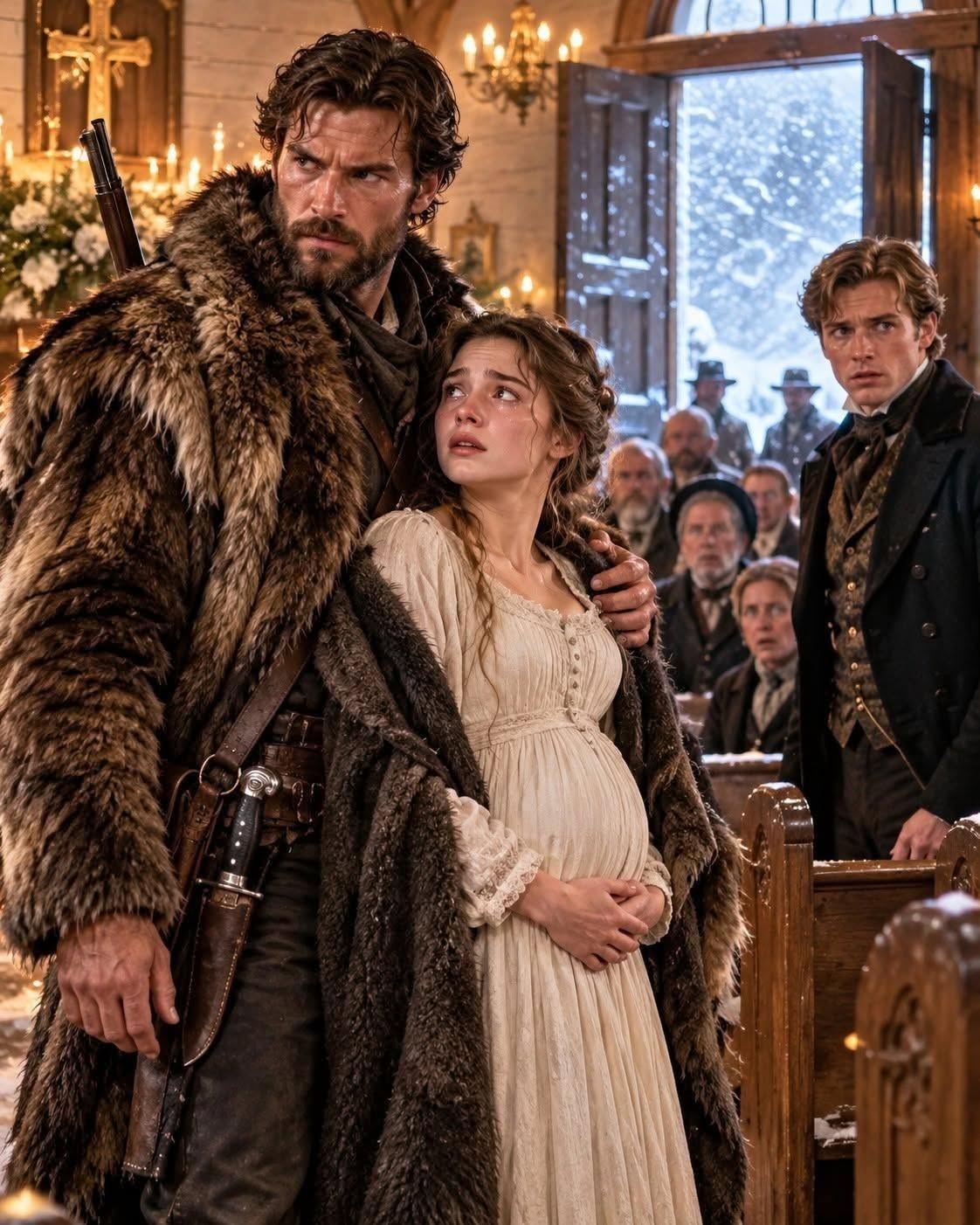
The first rider appeared through the trees just after sunrise.
Morgan Montgomery was splitting firewood when the sound of hooves reached his ears. He stopped mid-swing, the axe suspended above the log.
Eight horses.
Eight men.
And at their head, Billy Hastings, wearing a black wool coat and the smug expression of someone who had never been told no and expected to survive the experience.
Morgan lowered the axe.
Behind him, Abigail stood in the cabin doorway, one hand resting protectively over her belly.
“Is it him?” she whispered.
Morgan didn’t turn.
“Yes.”
Her face drained of color.
“He came all this way because of me.”
“No,” Morgan said quietly. “He came because he’s afraid of what you know.”
He set the axe against the chopping block and walked toward the cabin.
“Get inside. Lock the door.”
Abigail caught his sleeve.
“Morgan, there are eight of them.”
“I can count.”
“They have rifles.”
“So do I.”
“Please.” Her voice broke. “I don’t want anyone else to die because of me.”
For the first time that morning, Morgan looked directly at her.
“Abigail, look at me.”
She lifted her eyes.
“You are not the reason evil men do evil things. Do you understand?”
Her lips trembled, but she nodded.
Morgan gently freed his sleeve from her grasp.
“Now go inside.”
She obeyed, but she did not lock the door until he gave her one final look.
Then the mountain man stepped into the snow.
Billy Hastings reined in his horse twenty yards away.
“Well, well,” he called. “The beast of the mountains has come out to greet civilization.”
Morgan said nothing.
Billy’s smile widened.
“I’m here for the girl.”
“She isn’t yours to take.”
“She is a criminal. A liar. My father has authorized me to bring her back to town.”
“Your father can authorize the weather to change. Doesn’t mean the snow will listen.”
One of the riders chuckled.
Billy’s smile vanished.
“You think this is amusing?”
“No.”
Morgan’s voice was so calm that it unsettled the men more than a shout would have.
“I think you’ve ridden a long way to make a mistake.”
Billy dismounted.
“You kidnapped a pregnant girl and told an entire church that her child belonged to you. You expect us to believe you’re some kind of hero?”
“I don’t expect you to believe anything.”
“Then step aside.”
“No.”
Billy’s hand moved toward his holster.
Morgan’s rifle came up.
The other riders raised their weapons, and suddenly the quiet clearing became a place where one twitch could leave a man bleeding in the snow.
From behind the cabin window, Abigail watched with both hands pressed against her mouth.
Billy stared down the barrel of Morgan’s Winchester.
“You won’t shoot me,” he said. “My father is the mayor. He owns half the businesses in Bitter Creek. He has friends in Cheyenne and men who would hunt you to the end of the territory.”
Morgan’s expression didn’t change.
“Then I suppose you ought to be careful about giving them a reason.”
Billy’s jaw тιԍнтened.
“Bring the girl out!”
No one moved.
He turned toward the cabin and shouted, “Abigail! Come out now, and I’ll tell the judge you were confused. I’ll tell everyone the mountain man forced you to lie.”
A sound came from inside.
The door opened.
Abigail stepped onto the porch.
Morgan’s head snapped toward her.
“I told you to stay inside.”
“I know.”
Her voice shook, but she kept walking until she stood beside him.
“I can’t spend the rest of my life hiding every time he comes looking for me.”
Billy looked delighted.
“There she is. The little liar.”
Abigail flinched.
Morgan shifted half a step in front of her.
“Choose your next words carefully.”
Billy ignored him.
“Tell these men what you told the church. Tell them Morgan Montgomery is the father of your bastard child.”
Abigail’s eyes filled with tears.
Then she looked at the eight armed men.
“My child has done nothing wrong.”
Billy rolled his eyes.
“Your child is evidence of your disgrace.”
“No,” Abigail whispered. “My child is evidence that you hurt me.”
The clearing went silent.
For a moment, even the horses seemed to stop moving.
Billy’s face darkened.
“You’d better think carefully about what you’re saying.”
“I have thought about it every night since that harvest festival.”
Abigail’s hands trembled at her sides.
“You threatened me with a knife. You told me you would burn my father’s church if I spoke. You said no one would believe a poor preacher’s daughter over the mayor’s son.”
One of the riders, an older man with a gray beard, slowly lowered his rifle.
Billy noticed.
“Keep that weapon raised, Harlan.”
The older man didn’t obey.
Instead, he looked at Abigail.
“Miss, are you saying Billy Hastings attacked you?”
“Yes.”
“Did anyone witness it?”
Morgan’s jaw тιԍнтened.
“I did.”
Every face turned toward him.
Billy laughed sharply.
“Of course you did. The mountain lunatic suddenly appears with a convenient story.”
Morgan reached into his coat.
Billy’s hand flew to his gun.
“Don’t move!”
Morgan stopped.
“Easy,” he said. “If I wanted to kill you, you wouldn’t have time to give orders.”
Slowly, he withdrew a small silver cufflink and held it between two fingers.
The engraved letter H caught the morning light.
Billy’s face changed.
It was only a flicker, but everyone saw it.
The older rider stepped closer.
“Where did you get that?”
“Near the harvest tents,” Morgan answered. “The night Abigail was attacked.”
Billy shook his head.
“That proves nothing.”
“Perhaps not.”
Morgan turned the cufflink so the engraving faced the riders.
“But I also found blood on the broken fence where she tried to escape. And I heard your friend threaten to burn the church.”
Billy’s eyes darted toward the trees.
Morgan continued.
“I sent a letter to the territorial marshal three weeks ago. It included the cufflink’s description, the names of the witnesses who heard your threats, and the date of the attack.”
That was not entirely true.
Morgan had sent a letter to a lawman he trusted, but he had not yet mentioned every piece of evidence. He had kept some details back because he suspected Billy’s family had friends in the county office.
Still, the lie had the desired effect.
Billy went pale.
“You’re bluffing.”
“Maybe.”
Morgan lowered the cufflink into his palm.
“Would you like to find out?”
For several long seconds, nobody spoke.
Then Billy did something none of them expected.
He drew his revolver.
“Enough!”
Abigail gasped.
Morgan moved instantly, pushing her behind him as the first sH๏τ cracked through the clearing.
The bullet struck the cabin’s wooden wall.
The horses screamed and scattered.
A second sH๏τ followed.
Morgan fired once toward the ground in front of Billy’s horse, forcing the animal to rear and sending Billy stumbling backward into the snow.
“Put the guns down!” the gray-bearded rider shouted.
But the clearing had already dissolved into chaos.
Two riders aimed at Morgan. Another grabbed Billy’s arm. Someone shouted that a man had been hit, though the noise made it impossible to tell who.
Morgan kept his body between Abigail and the guns.
“Get behind the woodpile!” he ordered.
“I won’t leave you!”
“Abigail!”
His voice cracked like a whip.
She ran.
Morgan fired again, striking the rifle from one rider’s hands. The man cursed and dropped behind his saddle.
Then a sharp pain tore through Morgan’s left shoulder.
He staggered.
Abigail heard his grunt and turned.
Blood was spreading across his coat.
“Morgan!”
She ran back toward him just as the gray-bearded rider seized Billy by the collar.
“You fool!” the man roared. “You fired first!”
Billy struggled against him.
“He stole her! He stole my future!”
“Your future?” Abigail shouted.
Her voice was suddenly louder than the gunfire had been.
She stepped into the open, tears running down her face.
“You took my choice. You took my safety. You made me believe my own father would rather see me suffer than hear the truth.”
Billy stared at her.
“You’re nothing without my family.”
Abigail looked at Morgan, who was pressing one hand against his bleeding shoulder.
Then she looked back at Billy.
“I was someone before you hurt me. And I am still someone now.”
The words seemed to surprise even her.
Billy’s expression twisted with fury.
He lunged toward her.
Morgan caught him with his good arm and slammed him into the snow.
The two men struggled briefly before Morgan pinned Billy’s wrist against the frozen ground.
“Don’t,” Morgan warned.
Billy spat at him.
“You can’t protect her forever.”
Morgan leaned closer.
“Forever isn’t what she needs. She needs one day when she doesn’t have to be afraid of you.”
He released Billy and stepped back.
The gray-bearded rider immediately placed Billy’s hands behind his back and tied them with a leather strap.
No one raised a weapon again.
But as the men began to regroup, the sound of another horse came from the trail.
A lone rider emerged between the pines, carrying a leather satchel beneath his arm.
He wore a dark coat marked with the insignia of the territorial marshal’s office.
Morgan’s expression changed.
The rider dismounted and surveyed the blood, the scattered horses, and Billy’s bound hands.
“Which one of you is Billy Hastings?”
Billy straightened as much as his restraints allowed.
“I am. And I demand that you arrest this man. He kidnapped Abigail Preston and held her against her will.”
The marshal regarded him for a long moment.
Then he opened his satchel.
“Interesting.”
He withdrew a folded document.
“Because I have a sworn statement from a witness who says you threatened Miss Preston with a knife. I have a report from a physician who examined her injuries. And I have a letter from someone inside the Hastings household.”
Billy stopped struggling.
The marshal unfolded the final page.
“This letter claims that the mayor paid a local constable to destroy the original complaint filed after the harvest festival.”
The gray-bearded rider swore under his breath.
Billy’s face went white.
“That’s a lie.”
“Perhaps,” the marshal replied. “You’ll have the opportunity to explain it before a judge.”
He motioned for the other men to help him.
Then he turned to Abigail.
“Miss Preston, I need you to come to Bitter Creek and give a formal statement. You’ll have protection. No one will be permitted to force you into the same room as the accused.”
Abigail looked at Morgan.
He was still standing, but his face had grown pale from blood loss.
She stepped toward him.
“Will you come with me?”
Morgan looked at the cabin, then at the mountains beyond it.
For years, he had lived as though the world ended at the edge of his land. He had learned to trust trees, weather, and the silence of snow more than he trusted people.
But Abigail was looking at him as though his answer mattered.
“Yes,” he said.
Her shoulders sagged with relief.
The marshal began leading Billy toward the trail.
Just before he mounted, Billy twisted around.
“You think this ends with me?” he shouted. “My father will bury you both!”
The marshal тιԍнтened his grip on Billy’s arm.
“Then I suggest he start preparing his own defense.”
Billy was taken down the mountain under guard.
For the first time in months, Abigail watched him disappear without feeling that she had to follow his orders.
But the danger was not over.
Not yet.
Three days later
The journey back to Bitter Creek was slow.
Morgan’s shoulder had been cleaned and bandaged by a traveling physician who met them halfway down the trail. Abigail refused to leave his side, even when he insisted the wound was little more than a scratch.
“You were sH๏τ because of me,” she said one evening as they rested at a small way station.
Morgan stared at the fire.
“I was sH๏τ because a man chose to pull a trigger.”
“But if you hadn’t taken me in—”
“Then you would have been alone.”
He looked at her.
“And I don’t regret that choice.”
Abigail lowered her eyes, fighting tears.
“Why did you do it? At the church, I mean. You could have stayed out of it. Everyone in town fears you. You had nothing to gain by taking my side.”
For a long time, Morgan said nothing.
Then he reached into his coat and pulled out a small, faded pH๏τograph.
It showed a young woman standing beside a wooden cabin, her hair blowing across her face as she laughed at whoever had taken the picture.
Abigail studied it.
“Who is she?”
“My sister, Clara.”
Morgan’s voice grew distant.
“She was seventeen when a man from a wealthy family hurt her. He told everyone she had tempted him. His father paid the right people, and the truth disappeared.”
He rubbed his thumb over the pH๏τograph’s worn edge.
“Clara left town before winter. I found her the following spring.”
Abigail’s breath caught.
“Was she—?”
“She survived.”
Morgan swallowed.
“But she never believed she deserved a better life. Not after what they called her.”
He put the pH๏τograph away.
“When I saw you standing in that church, surrounded by people who had already decided you were guilty, I saw my sister.”
Abigail reached for his hand.
“I am sorry.”
“Don’t be sorry for something you didn’t do.”
She held his rough, scarred fingers between hers.
For the first time since the harvest festival, Abigail allowed herself to cry without apologizing for it.
Morgan did not tell her to stop.
He simply stayed beside her until the fire burned low.
The truth in the courthouse
When they returned to Bitter Creek, the town was waiting.
Some people stared at Abigail with pity. Others looked away in shame. A few whispered that she had brought trouble upon everyone.
But this time, Abigail did not lower her head.
The territorial marshal escorted her into the courthouse, where Billy sat beside his lawyer. His father, Mayor Hastings, stood behind them, dressed in an immaculate black suit.
Reverend Preston sat on the opposite side of the room.
He looked older than Abigail remembered.
When their eyes met, he rose halfway from his chair.
“Abigail—”
She turned away.
The judge entered, and the hearing began.
Billy’s lawyer argued that Abigail was an unstable young woman who had been manipulated by a dangerous recluse. He called Morgan a violent hermit and suggested that the pregnancy had been used to invent a scandal against the Hastings family.
For a while, Abigail could barely breathe.
Then the marshal called the first witness.
The gray-bearded rider stepped forward.
“My name is Harlan Price,” he said. “I rode with Billy Hastings to Morgan Montgomery’s cabin. We were told we were rescuing a prisoner.”
He looked toward Billy.
“Instead, I watched Mr. Hastings draw his revolver and fire before anyone attacked him.”
The lawyer rose.
“Mr. Price, are you claiming that the mayor’s son deliberately attempted to murder someone?”
“I am saying what I saw.”
The judge ordered him to continue.
Then came the physician’s report. The description of Abigail’s injuries. The testimony of a woman who had heard Billy threatening her behind the harvest tents.
Finally, the marshal placed the silver cufflink on the evidence table.
Mayor Hastings stood abruptly.
“That item proves nothing!”
The judge looked at him.
“Sit down, sir.”
The mayor remained standing.
“You cannot allow a mountain savage and a disgraced girl to destroy my son’s name!”
The judge’s expression hardened.
“Another interruption, and I will have you removed.”
The mayor sat.
Abigail was called to testify.
Her legs felt weak as she approached the witness stand. She placed one hand over her stomach and raised the other to take the oath.
When the lawyer asked what had happened behind the harvest tents, she closed her eyes for a moment.
Then she began.
She described the knife. The threats. The way Billy had blocked her path and told her that no one would believe her.
She did not embellish.
She did not scream.
She told the truth, one painful detail at a time.
When she finished, the courtroom was silent.
The lawyer approached her.
“Miss Preston, you admit you never named Billy Hastings in the church.”
“Yes.”
“And you allowed everyone to believe you had committed a sin.”
Abigail looked directly at him.
“I was afraid.”
“Afraid of what?”
She glanced toward Billy.
“Of the man who threatened to kill me if I spoke.”
The lawyer paused.
Then he asked, “And you expect this court to believe you now?”
Abigail’s voice steadied.
“I expect this court to examine the evidence. Whether you believe me or not doesn’t change what happened.”
The judge leaned forward.
For the first time that morning, Abigail felt the room shift—not because people pitied her, but because they were finally listening.
The hearing continued into the afternoon.
By the end of it, Billy Hastings was ordered held pending a full criminal trial. The marshal also requested an investigation into the alleged destruction of Abigail’s original complaint and the possible involvement of the mayor.
The judge made it clear that the final verdict would depend on the evidence presented at trial.
It was not a complete victory.
But it was the first time Billy had been forced to answer for his actions.
As Abigail stepped outside, Morgan waited at the bottom of the courthouse steps.
She stopped in front of him.
“It’s not over,” she whispered.
“No,” he said. “But now the truth has a place to stand.”
Across the street, Reverend Preston approached them.
His face was pale, and his hands shook beneath his coat.
“Abigail, please. I need to speak with you.”
Morgan moved slightly, but Abigail touched his arm.
“I can hear him.”
Her father stopped several feet away.
“I was wrong,” he said.
The words sounded strange coming from a man who had spent his life telling others what was right and wrong.
“I thought I was protecting the church. I thought if I condemned you publicly, the scandal would end.”
Abigail stared at him.
“You protected the church’s reputation.”
He lowered his head.
“Yes.”
“And you left your daughter alone.”
His eyes filled with tears.
“Yes.”
For a moment, Abigail wanted to run into his arms as she had when she was a little girl.
She wanted him to tell her that everything would be all right, that she had done nothing wrong, that he would stand between her and anyone who tried to hurt her.
But that was not what happened.
Instead, she said, “I don’t know if I can forgive you.”
Her father nodded slowly.
“I understand.”
“I need time.”
“You shall have it.”
He stepped back.
Abigail watched him walk away, feeling both lighter and sadder than she had expected.
Morgan offered his arm.
She took it.
A new beginning
Spring arrived late in Bitter Creek.
Snow melted from the rooftops, streams broke free from the ice, and the mountain trails turned muddy beneath the hooves of pᴀssing horses.
Abigail stayed in town long enough to give her formal statement and arrange for the birth of her child. Morgan rented a small house near the edge of Bitter Creek so she would have access to the physician.
He never told her she had to come live with him in the mountains.
He never called her a burden.
And he never again claimed that her child was his.
One evening, as the sun dipped behind the distant peaks, Abigail sat on the porch of the little house with a blanket across her lap.
Morgan was repairing a broken chair when she spoke.
“You know, you never answered my question.”
He looked up.
“Which one?”
“Why did you tell the whole church that my child was yours?”
He set down the hammer.
“Because I knew what would happen if I didn’t.”
“You could have said you were protecting me.”
“They wouldn’t have listened.”
Abigail smiled faintly.
“So you lied.”
“I did.”
“Quite convincingly.”
“Had practice.”
She laughed—a small, startled sound that seemed to surprise them both.
Then her expression grew serious.
“Would you have stayed if I hadn’t been pregnant?”
Morgan considered the question.
“I don’t know.”
She looked down.
He continued before she could misunderstand.
“I might never have come into town that morning. I might never have learned what kind of trouble you were in. But once I knew, I couldn’t pretend I didn’t.”
Abigail rested a hand over her belly.
“I’m frightened about being a mother.”
“Most people are frightened of things that matter.”
“What if I make mistakes?”
“You will.”
She stared at him.
Morgan’s mouth twitched.
“So will I. The trick is to keep showing up.”
She laughed again, this time more freely.
A few weeks later, on a quiet morning in April, Abigail gave birth to a healthy baby girl.
Morgan waited outside the room while the physician worked. He paced the narrow hallway so relentlessly that the doctor finally opened the door and told him to sit down before he wore a hole through the floor.
When he was finally allowed inside, Abigail lay exhausted against the pillows, holding a tiny bundle wrapped in white cloth.
“She’s beautiful,” Morgan whispered.
Abigail smiled.
“She needs a name.”
Morgan stood beside the bed, careful not to crowd her.
“What have you chosen?”
Abigail looked at the little girl.
“Clara.”
Morgan became very still.
“You don’t have to—”
“I know.”
She met his eyes.
“I want her to grow up knowing that what happened to her mother was never something to be ashamed of. And I want her to know that there are people who will stand beside her when the world turns cruel.”
Morgan bowed his head.
For a moment, he could not speak.
Then he reached out and gently touched the baby’s tiny hand.
Her fingers curled around one of his.
Outside, the mountains stood beneath a clear blue sky.
The world had not become kind overnight. Billy’s trial still lay ahead, and the mayor’s influence would not disappear simply because the truth had begun to emerge. Abigail had wounds that would take years to heal, and forgiveness would not come simply because her father had finally admitted his failure.
But she was no longer alone.
And the child everyone had called a disgrace had become the beginning of something the town had never expected: a family built not on blood or reputation, but on courage, honesty, and the simple decision to stand beside someone when it mattered most.
Years later, when people in Bitter Creek told the story of the morning the church doors burst open, they remembered Morgan Montgomery’s towering figure in the snow.
They remembered the rifles, the threats, and the silver cufflink that helped expose a powerful family’s secrets.
But Abigail remembered something else.
She remembered a frightened nineteen-year-old girl sitting beneath the church windows, convinced that the whole world had already judged her.
And she remembered the moment a man stepped forward and made it clear that she still deserved to be heard.
Because Morgan Montgomery had never truly claimed ownership of Abigail or her child.
He had claimed responsibility for protecting them when no one else would.
And that, Abigail came to understand, was the difference between a man who wanted to control her life and a man who was willing to help her reclaim it.