**Alexander’s Story – A Brave Little Boy Living with Apert Syndrome**
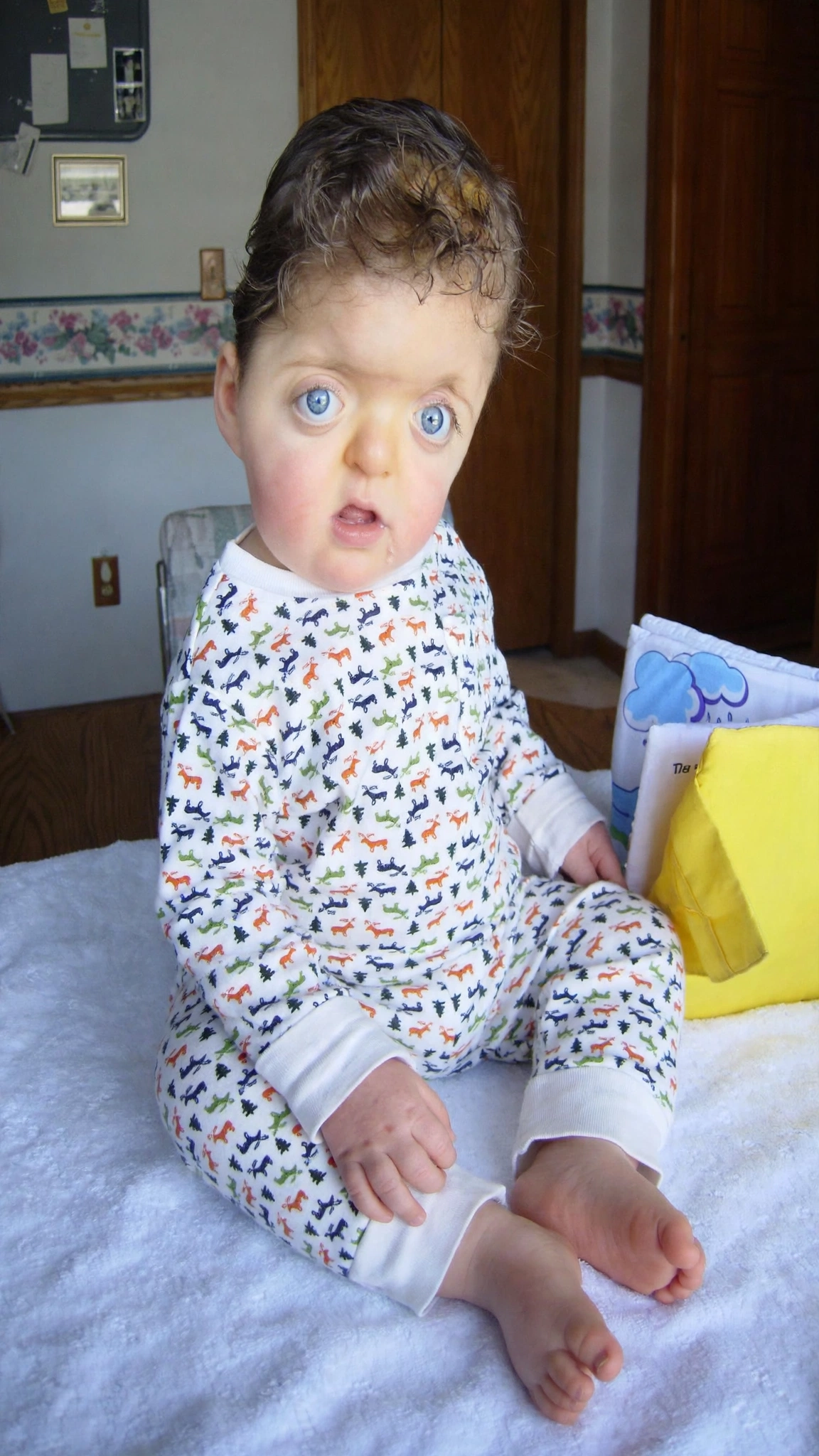
From the moment he was born, little Alexander faced a series of complex medical challenges that would make his childhood very different from that of many other children. His skull and facial bones had developed abnormally before birth, resulting in significant differences in the shape of his head, forehead, eyes, and middle portion of his face.
👶 Alexander was born with a condition in which the sutures connecting the bones of his skull fused too early. Normally, these sutures remain flexible during infancy, allowing the skull to expand as the brain grows. However, when they close prematurely, the skull cannot develop in the usual way. This condition is known as **craniosynostosis**.
As a result, Alexander’s head developed an unusual shape. His forehead appeared unusually high and prominent, while the overall proportions of his skull were noticeably different. The early fusion of the skull bones also meant that doctors needed to pay close attention to the growth of his head and the possibility of increased pressure inside the skull.
😢 His facial differences were also particularly pronounced. The middle portion of his face had not developed sufficiently, affecting the cheekbones, nasal area, and upper jaw. His upper jaw was underdeveloped, making his facial profile look significantly different from that of other children his age.
👁️ Another challenging feature was the unusual development of his eye sockets. Because these bony structures were relatively shallow, Alexander’s eyes appeared to protrude forward. This condition can place the eyes at greater risk of exposure, dryness, irritation, and damage to the cornea.
Protecting his eyesight is therefore extremely important. Alexander needs regular examinations by ophthalmologists to monitor his eye movements, vision, corneal health, and any signs of increased pressure or other complications. Even small changes in eye function may require careful medical attention.
🖐️ But Alexander’s challenges do not end with his head and facial development.
He was also born with abnormalities affecting his hands and feet. Several of his fingers and toes are fused together, a condition medically known as **syndactyly**. Instead of developing as completely separate digits, some of the fingers and toes are joined by skin and, in certain cases, underlying bone.
This feature is commonly ᴀssociated with Apert syndrome, a rare genetic condition characterized by premature fusion of the skull bones and distinctive abnormalities of the hands and feet.
For a young child, these differences can create additional difficulties in everyday activities. The development of the hands is especially important for grasping objects, holding toys, feeding himself, and eventually learning to perform tasks independently.
🩺 Because Apert syndrome can affect several parts of the body, Alexander requires comprehensive and long-term medical care. His treatment cannot focus on just one physical difference. Instead, doctors must carefully evaluate his overall development and determine which medical interventions are most appropriate at each stage of childhood.
A multidisciplinary team may include craniofacial surgeons, neurosurgeons, ophthalmologists, ear, nose and throat specialists, geneticists, and rehabilitation professionals.
One of the most important priorities is monitoring the growth of his skull and ensuring that his brain has sufficient room to develop. Depending on the severity of the craniosynostosis, some children with Apert syndrome may require cranial surgery to reshape the skull and reduce the risk of complications ᴀssociated with increased intracranial pressure.
Doctors must also monitor his breathing. Underdevelopment of the middle facial region can sometimes narrow the upper airway, potentially leading to breathing difficulties, sleep-disordered breathing, or obstructive sleep apnea.
His upper jaw and dental development also require attention. As he grows, specialists may need to ᴀssess his bite, chewing ability, and the alignment of his teeth. Some children with similar conditions benefit from orthodontic treatment or additional reconstructive procedures at different stages of development.
❤️ For Alexander’s family, every hospital appointment represents another step in a long and sometimes exhausting journey. They must face uncertainty, medical decisions, and the possibility that their little boy may need several procedures as he grows older.
Yet, behind every examination and treatment plan is the same simple wish: to give Alexander the opportunity to live a healthier, more comfortable, and more independent life.
His parents hope that advances in specialized medical care will help protect his vision, support the development of his skull, improve his breathing, and give him greater use of his hands and feet.
🌈 Although Alexander was born with a rare condition that affects his appearance and physical development, he is so much more than his diagnosis. He is a child who deserves to play, learn, make friends, discover new things, and experience the happiness of growing up surrounded by people who accept him.
His journey may involve challenges that many people cannot imagine, but he should never have to face them without love, compᴀssion, and support.
🙏 May Alexander receive the best possible treatment, find strength through every stage of his journey, and enjoy a future filled with happiness and opportunities. Sending love, courage, and heartfelt wishes for good health to Alexander and every child around the world living with a rare congenital condition. ❤️