PART 3: THE MAN WHO WANTED THE SHELTER TO BECOME THEIR GRAVE
PART 3: THE MAN WHO WANTED THE SHELTER TO BECOME THEIR GRAVE
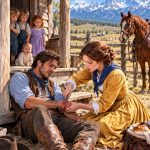
Amos Larkin collapsed before Hettie could ask him a single question.
His clothes were soaked, his boots were nearly frozen solid, and his hands were bleeding.
She pulled him beside the fire.
“Amos! Look at me!”
His eyelids fluttered.
“Hettie?”
“I’m here.”
He tried to smile.
“You’re taller than I remember.”
A broken laugh escaped her.
“You haven’t seen me since I was sixteen.”
“Still taller.”
For one moment, the years between them seemed to disappear.
Then Amos began coughing.
Hettie warmed water, loosened his frozen coat, and wrapped him in the spare blanket. Samuel helped as much as his injured arm allowed.
When Amos could finally speak, he told them what had happened.
The supply party had been traveling with nineteen people, including two teamsters, a cook, several laborers, and a family heading west.
When the blizzard struck, their lead wagon overturned.
Amos had tried to help an elderly couple trapped beneath the canvas. Samuel had gone for ᴀssistance, but the storm scattered everyone.
“I found three people alive near the creek,” Amos said. “I got them beneath an overturned wagon, but the snow was filling it. I couldn’t get them out.”
“Where are they now?” Hettie asked.
Amos looked down.
“I don’t know.”
He explained that he had searched for shelter, eventually spotting the red sandstone bluff. He had seen the lantern through the snow and followed it.
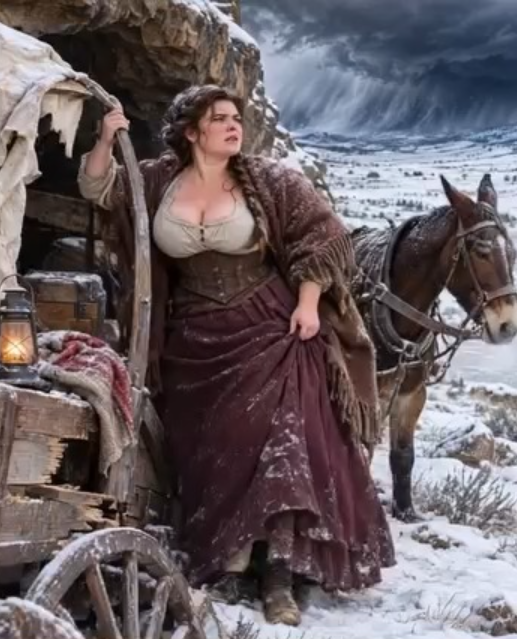
Hettie looked toward the barricade.
The storm had weakened slightly, but the wind was still powerful enough to knock a grown man off his feet.
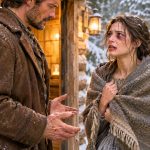
“We can’t leave tonight,” she said.
Amos nodded.
Then Samuel spoke.
“There’s something I haven’t told you.”
Hettie turned.
Samuel opened his satchel and removed a small leather notebook.
“I was carrying the supply party’s records. Gideon Vale paid for the journey. He also paid the teamsters to take a particular route.”
“Why?” Amos asked.
“Because the route pᴀssed through a narrow stretch of open country where there was no shelter.”
Hettie stared at him.
“You think he wanted us caught in the storm?”
Samuel nodded.
“I heard him talking to one of his men before we left. He said the widow would never make it to Wyoming if the weather turned.”
Amos clenched his fists.
“That bastard.”
Samuel opened the notebook.
Inside were names, payments, and dates. One entry was especially clear.
H. Larkin — final settlement. Property transfer upon confirmation of death.
Hettie’s mouth went dry.
The banker had planned to take her property whether she lived or died.
He had known she was traveling.
He had known the storm was coming.
And he had paid men to make sure she never arrived.
But Hettie noticed something else.
A second name appeared beneath Gideon Vale’s.
Daniel Marsh.
Her ᴅᴇᴀᴅ husband.
She stared at it.
“Daniel was working with him?”
Samuel shook his head.
“Not exactly. Daniel borrowed money from Vale. When he couldn’t repay it, Vale offered to erase the debt if Daniel signed certain documents.”
Hettie felt sick.
“What documents?”
“Your father’s property papers. Vale wanted the land your father had purchased near the river. Daniel signed as though he had your permission.”
Amos looked at his sister.
“That land was supposed to belong to you.”
Hettie remembered her father’s workshop, the old maps, the long evenings when he had explained property boundaries.
She had never understood why he kept returning to that piece of land.
Now she did.
“Where are the original papers?”
Amos pointed toward the leather notebook.
“Your father gave me a copy of the deed years ago. I kept it in my coat. I thought it was just an old family document.”
He reached inside his jacket and pulled out a folded paper.
Hettie opened it.
The deed was signed by Caleb Larkin and witnessed by a county clerk. It identified a parcel of land near the Sweetwater River, including a small house, a barn, and a stand of timber.
The final line made her knees weak.
Upon the death of Caleb Larkin, the property shall pᴀss to his daughter, Henrietta Larkin, free of debt or encumbrance.
The land had never belonged to Daniel.
It had always been hers.
Gideon Vale had stolen it on paper.
Hettie folded the deed carefully.
“Then we go to the authorities.”
Amos looked toward the barricade.
“If we survive the night.”
 As if answering him, a heavy blow struck the wagon bed.
All three froze.
Another blow followed.
Then a man’s voice came through the wood.
“Open up!”
Hettie recognized the voice.
Gideon Vale.
She stepped toward the barricade, but Amos caught her arm.
“Don’t.”
The voice came again.
“I know you’re in there, Henrietta. I’ve come to help.”
Samuel shook his head.
“That’s him.”
Hettie took the lantern and held it close to the gap.
“How did you find us?”
“I followed your tracks.”
“You sent us into this storm.”
A pause.
Then Vale laughed.
“Don’t be foolish. The weather is nobody’s fault.”
“You paid men to make sure I never reached Wyoming.”
“I paid for a business arrangement. Your husband understood that.”
“My husband is ᴅᴇᴀᴅ.”
“Yes,” Vale replied. “And now you can make things easier for everyone by handing over the deed.”
Hettie looked at Amos.
He was trying to stand, despite his weakened condition.
Samuel quietly reached for the hatchet.
Vale struck the barricade again.
“I know you’re frightened. But that shelter won’t hold forever.”
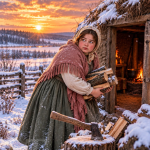
Hettie looked at the wooden wall her father had taught her to build.
He had been right.
A shelter was not about making the world safe.
It was about keeping danger outside long enough to survive it.
She picked up her father’s old hammer.
“Go away, Vale.”
The banker laughed.
“Then freeze.”
Footsteps moved away.
For several minutes, there was only the storm.
Then a terrible sound came from above.
A crack.
Hettie looked up.
The wind had driven a heavy branch against the sandstone shelf. Snow and loose stones began sliding down the rock face.
“Get back!” Amos shouted.
The branch struck the wagon bed.
The barricade buckled inward.
Hettie threw herself against the wooden frame. Amos joined her, pushing with his shoulder. Samuel dragged the trunks into position.
For one terrifying moment, the wall seemed ready to collapse.
Then the branch slid sideways, scraping across the sandstone and falling into the snow outside.
The barricade held.
Hettie sank to her knees.
Her hands were bleeding.
But the shelter remained standing.
By dawn, the storm had finally pᴀssed.
The world beyond the hollow was unrecognizable. Snow covered the trail, the grᴀss, and the distant ridges. The wagon tracks had vanished.
When Hettie opened the barricade, she found Gideon Vale’s horse tied to a nearby shrub.
The man himself was nowhere to be seen.
Amos spotted something in the snow.
A trail of footprints leading toward the ridge.
Then another set.
And another.
The banker had not come alone.
Hettie wanted to follow, but Samuel stopped her.
“Not without help.”
They waited until midday, when the wind had settled enough to travel. Amos and Samuel were weak, but both could walk with ᴀssistance.
The first thing they found was the overturned wagon.
Then the bodies.
The storm had claimed nineteen travelers.
Some had been buried beneath collapsed wagons. Others lay in the open, where the snow had covered them before anyone could reach them.
Hettie stood silently.
She had survived because of a broken wagon, a stubborn mule, and a lesson from her father.
But nineteen families would never see those travelers again.
Near the creek, they found three people beneath the overturned canvas Amos had described.
Two were alive.
A young woman and an elderly man.
The third, a boy of perhaps twelve, had died during the night.
Hettie knelt beside the survivors.
“We’re getting you home,” she promised.
It took two days for a rescue party from the settlement to reach them.
And when the survivors finally arrived, the sheriff was waiting.
Gideon Vale had been found hiding in an abandoned mining cabin. His horse had been injured, and he had tried to claim that he had been searching for survivors.
But Samuel had the notebook.
Amos had the deed.
And Hettie had her father’s letter.
Together, their evidence revealed that Vale had forged property transfers, arranged fraudulent loans, and paid men to interfere with Hettie’s journey. The sheriff arrested him before he could leave the territory.
The inquiry lasted several weeks.
Daniel Marsh’s role was also uncovered. He had signed papers he knew were false, hoping to escape his gambling debts. He had loved Hettie, perhaps, but his choices had nearly destroyed her.
Hettie did not pretend otherwise.
She could forgive the man she had married without pretending he had done no harm.
When the land was finally restored to her, she returned to the Sweetwater River with Amos and Samuel.
The house was weather-beaten, but its foundation was sound. The barn needed repairs. The roof leaked in two places.
It was not a grand estate.
It was hers.
Amos moved into the small room at the back of the house. Samuel stayed nearby, and the three slowly rebuilt the family their father had hoped they might become.
Juniper grew fat on good grᴀss.
The two survivors from the supply party visited often. The young woman, whose name was Eliza, eventually opened a small schoolhouse near the river.
And Hettie?
She became known throughout the territory as the woman who survived the great November blizzard.
But she never liked being called brave.
Whenever someone asked how she had survived when nineteen others had not, she gave the same answer.
“I had a place to stand, and I remembered what my father taught me.”
Years later, when spring storms rolled across the Wyoming plains, Hettie would sometimes ride to the red sandstone bluff.
She repaired the old shelter, replaced its broken boards, and left a small supply of firewood inside.
Above the entrance, she carved seven words into the rock:
FOUR WALLS. NO GAPS. KEEP THE WIND OUT.
Beneath them, she added one more sentence:
AND NEVER LEAVE SOMEONE OUTSIDE IF YOU CAN SAVE THEM.
Because Hettie had learned that survival was not simply about being the one who made it through the storm.
It was about what you chose to do when the storm was over.
And sometimes, the smallest shelter on the loneliest stretch of the Wyoming trail could become the beginning of an entire family’s second chance.