PART 2 – THE WOMAN HE THOUGHT WAS WORTHLESS
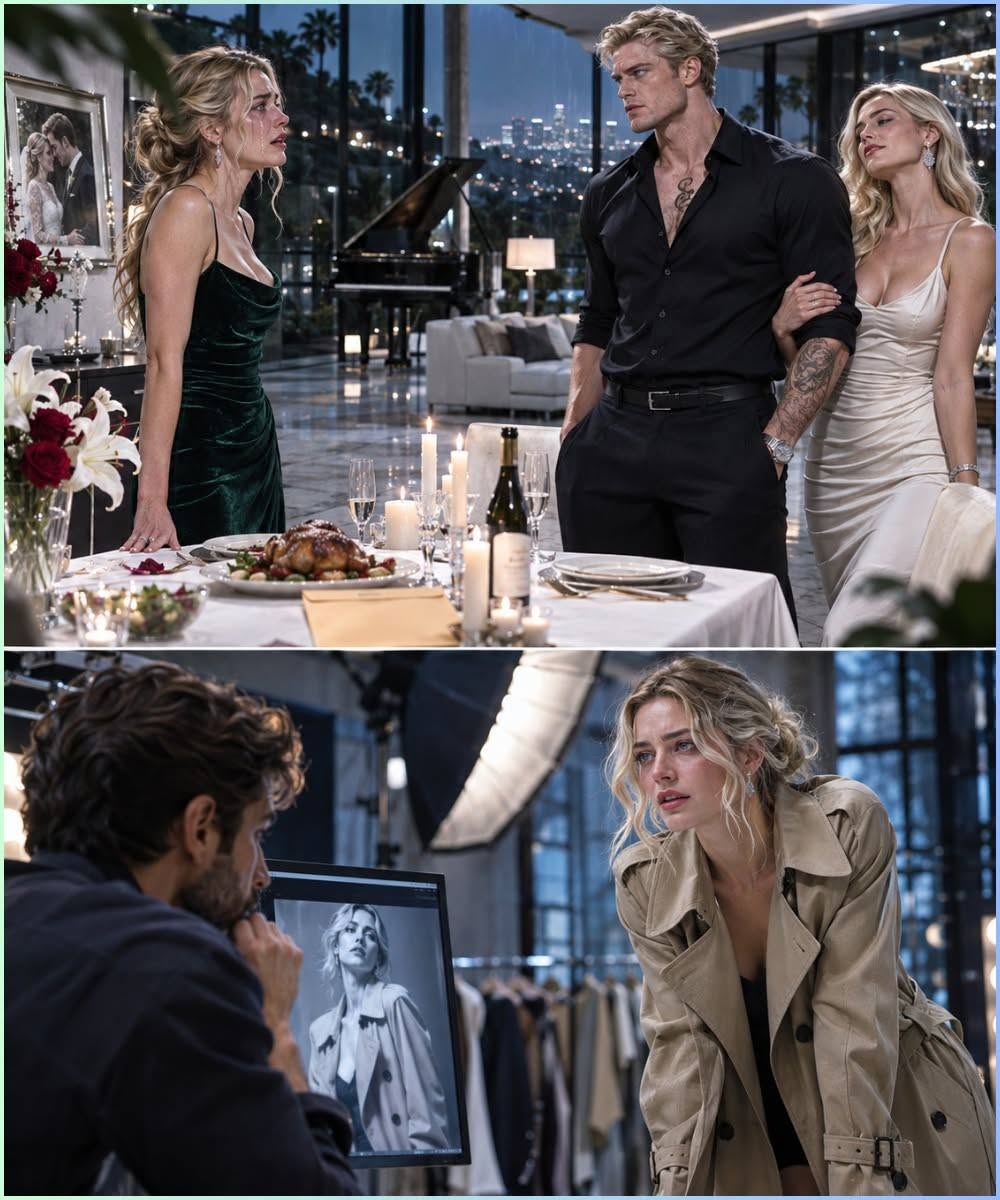
I nodded.
“And you have no recent retail experience?”
“No. But I have experience with luxury clients, styling, presentation, and managing demanding schedules.”
She glanced at my résumé.
“That sounds more like personal ᴀssistance than fashion.”
I forced a smile.
“I understand.”
She returned the paper.
“We’ll keep your information on file.”
I walked out knowing exactly what that meant.
By the end of the month, I had received eleven rejections.
My savings were shrinking. The apartment rent was due in six days, and the divorce proceedings had barely begun.
One evening, while searching through my old belongings, I found the black portfolio I’d carried out of Preston’s house.
I hadn’t opened it in years.
Inside were pH๏τographs from my modeling days, magazine tear sheets, campaign contracts, and a few handwritten notes from pH๏τographers I’d worked with.
On top was a pH๏τograph from my final professional shoot.
I was twenty-seven, standing in a white studio, wearing a simple black dress. My hair was pulled back, my expression confident, and my eyes looked like they belonged to someone who believed the world was full of possibilities.
I barely recognized that woman.
Behind the pH๏τograph was an old business card.
MARCUS REED – CREATIVE DIRECTOR, REED IMAGE GROUP.
Marcus had been one of the first pH๏τographers to believe in me. He had encouraged me to pursue international campaigns and once told me I had a rare ability to make ordinary clothes look extraordinary.
I hadn’t spoken to him in almost eleven years.
I stared at his number for several minutes.
Then I called.
He answered after the fourth ring.
“Hello?”
“Marcus? It’s Tessa.”
There was a pause.
Then a surprised laugh.
“Tessa Morgan? Is that really you?”
“Yes.”
“Where on earth have you been?”
I looked around my little apartment.
“That’s a long story.”
“Well, I hope it’s a good one.”
“It isn’t.”
His voice softened.
“Then tell me what you need.”
I swallowed.
“I need work.”
He didn’t ask why. He didn’t ask what had happened to my marriage.
He simply said, “Come to my studio tomorrow at ten.”
Marcus’s studio was in a converted warehouse in downtown Los Angeles.
The walls were covered with campaign pH๏τographs, fashion editorials, and large prints from shoots around the world.
When I walked in, he looked at me for a long moment.
“You’ve changed your hair.”
I smiled faintly.
“Ten years will do that.”
“Not as much as you think.”
He handed me a coffee and listened while I explained the divorce, the years away from modeling, and the financial uncertainty I was facing.
When I finished, he leaned back.
“Do you remember what I told you after your last campaign?”
“That I had a good eye for composition?”
“No. I told you that you understood people. You could walk into a room and recognize what made someone feel confident.”
I shrugged.
“I was younger.”
“You’re still the same person. You just spent ten years making someone else’s life look beautiful.”
His words stung because they were true.
Marcus opened a folder.
“I’m building a new creative division. We work with fashion brands, luxury H๏τels, and independent designers. I need someone who understands styling, client relationships, and campaign development.”
I looked at him.
“You want me to model?”
“I want you to help me run the division.”
I blinked.
“I haven’t worked in this industry for years.”
“Then you’ll learn again.”
He slid a contract across the table.
It was a six-month position as a creative consultant, with a salary that was modest but enough to cover my rent and expenses.
I stared at it.
“Why are you offering this to me?”
“Because I’ve seen your work. And because I know talent doesn’t disappear just because someone stops using it.”
I signed.
For the first time in ten years, I was making a decision that belonged entirely to me.
The following weeks were exhausting.
I learned new software, reviewed campaign proposals, met clients, and spent long hours studying trends that had changed dramatically since my modeling career.
Some younger employees treated me like an outsider.
One ᴀssistant whispered that I was “the boss’s nostalgic charity project.”
I heard her.
I didn’t respond.
Instead, I worked.
I reorganized the styling department, created a new client presentation process, and suggested a campaign featuring women over thirty-five who were rarely represented in luxury advertising.
Marcus loved the idea.
Within two months, three brands agreed to participate.
The first campaign featured women from different professions and backgrounds, pH๏τographed in elegant everyday settings.
The message was simple:
Confidence doesn’t expire.
The campaign gained attention online.
A major fashion publication requested an interview with Marcus and the creative team.
For the first time in years, I saw my name printed beneath a professional pH๏τograph.
Tessa Morgan – Creative Consultant.
I bought a copy of the magazine and placed it on my kitchen table.
Then I sat down and cried.
Not because I missed Preston.
Because I had missed myself.
Meanwhile, Preston’s life was becoming less perfect than his social media suggested.
Sloane had moved into the Hollywood Hills house almost immediately after I left.
She posted pH๏τographs of the pool, the marble kitchen, and the bedroom I had once decorated.
She captioned one picture:
New chapter. New energy.
I didn’t follow her account.
But mutual acquaintances kept sending me updates.
At first, Preston seemed happy.
He took Sloane to business dinners and introduced her to investors as his partner.
But the problems began when she started asking questions.
She wanted a new car.
Then a larger allowance.
Then access to his company accounts so she could help manage his public image.
Preston refused.
Sloane wasn’t accustomed to hearing no.
Their arguments became increasingly public.
And then came the financial issue.
During the early years of Preston’s company, I had helped him organize expenses, negotiate vendor contracts, and prepare documents for several important investments.
I had also kept copies of certain business records because he frequently lost paperwork.
Those records were not secret.
They were simply part of the household files I had maintained for years.
When Denise reviewed my financial documents for the divorce, she discovered something important.
Preston’s original settlement proposal claimed that I had made no meaningful contribution to his business.
But several emails, calendars, and signed documents showed otherwise.
I had helped coordinate the negotiations for two major H๏τel acquisitions. I had managed the household expenses while Preston reinvested company earnings. I had even used money from my own savings to cover payroll during a temporary cash-flow crisis.
Denise looked up from the documents.
“Did you know these could matter?”
“I didn’t think about them that way.”
“Well, you should.”
She placed a folder on her desk.
“Your husband is presenting his success as though you were never part of the story. These records tell a different story.”
I stared at the papers.
For years, I had believed that because my name wasn’t on the company doors, my work didn’t count.
I was beginning to understand how wrong that was.
Three months after I left, Preston contacted me.
His message was short.
Preston: We need to discuss the divorce. My attorney says you’re challenging the settlement.
I didn’t respond immediately.
A second message arrived.
Preston: I thought we could handle this privately.
Then:
Preston: You know I don’t want a public fight.
I finally replied.
Me: I don’t want a fight either. I want a fair settlement. Please communicate with Denise.
He called immediately.
I let it go to voicemail.
His message sounded irritated.
“Tessa, this is getting ridiculous. You know how much pressure the company is under. Don’t turn this into something it doesn’t need to be.”
I listened twice.
Then I deleted it.
A week later, Denise informed me that Preston’s legal team had agreed to a financial review.
The review revealed that my contributions had been significantly understated.
The settlement negotiations changed.
Preston was no longer speaking to me as though he were doing me a favor.
He was speaking through lawyers.
And that was exactly how it needed to be.
Then, one Thursday afternoon, I received an invitation.
A major H๏τel group was hosting a charity fashion event at one of Preston’s properties.
Marcus’s agency had been selected to produce the visual campaign.
The event would feature designers, investors, celebrities, and representatives from several luxury brands.
I read the invitation twice.
The venue was the same H๏τel where Preston and I had celebrated our tenth anniversary the year before.
Marcus noticed my expression.
“Something wrong?”
I handed him the invitation.
He looked at the address.
“Ah.”
“You know?”
“I know who owns the property.”
“I don’t want special treatment.”
“You’re not getting any. You’re leading the creative presentation. The client approved your work.”
I looked at the invitation again.
“Will Preston be there?”
“Almost certainly.”
I considered declining.
Then I remembered the woman in the green velvet dress standing beside the untouched anniversary dinner.
I remembered the suitcase outside the house.
And I remembered Preston’s voice.
Nobody forced you to become useless.
I placed the invitation on my desk.
“I’ll go.”
The event took place on a Friday evening.
I wore a tailored black evening gown, simple diamond earrings, and my mother’s silver necklace.
My hair was styled in soft waves.
I didn’t look like the woman who had stood beneath the broken streetlight three months earlier.
But I hadn’t become someone else.
I had simply stopped hiding.
When I entered the ballroom, several guests recognized me from the campaign.
A fashion editor approached.
“Tessa! Congratulations. The new collection presentation was beautiful.”
“Thank you. I’m glad you enjoyed it.”
Marcus joined us, introducing me to two investors.
Then I saw Preston.
He stood near the stage wearing a black tuxedo.
Sloane was beside him in a sparkling silver dress.
She was laughing at something a guest had said.
Then her eyes landed on me.
Her smile disappeared.
She leaned toward Preston and whispered.
He turned.
For a moment, he looked genuinely stunned.
“Tessa?”
I offered a polite smile.
“Good evening, Preston.”
He stared at me as though he were trying to reconcile the woman in front of him with the person he had ordered out of his house.
“You look…”
He stopped.
“Different,” Sloane finished.
I looked at her.
“Good evening, Sloane.”
She glanced at Marcus.
“You’re working with Reed Image Group?”
“I’m leading the creative division.”
Her eyebrows rose.
Preston looked confused.
“You work there?”
“I do.”
He glanced at Marcus, then back at me.
“That’s… good.”
“Thank you.”
There was an awkward silence.
Then Preston said, “We should talk sometime.”
I held his gaze.
“About the divorce? Denise can arrange that.”
His jaw тιԍнтened.
“I meant personally.”
“I don’t think there’s anything personal left to discuss.”
Before he could answer, the event coordinator approached.
“Ms. Morgan, they’re ready for your presentation.”
I excused myself.
As I walked toward the stage, I could feel Preston watching me.
But for the first time, his attention no longer mattered.
The presentation went better than expected.
The campaign images appeared on the enormous screens, followed by the stories of the women who had participated.
I spoke about confidence, reinvention, and the importance of recognizing value beyond age or appearance.
When I finished, the ballroom applauded.
A senior executive from one of the sponsoring brands approached me.
“Ms. Morgan, we’d like to discuss a larger campaign. Would you be available next week?”
“Absolutely.”
Marcus smiled proudly.
Then I noticed Preston standing behind him.
He waited until the conversation ended.
“Tessa, can we talk now?”
I nodded toward a quiet hallway.
We walked away from the crowd.
For several seconds, he said nothing.
Then he spoke.
“I didn’t expect to see you here.”
“I gathered that.”
“You’ve done well.”
“Thank you.”
He looked down.
“I’ve been thinking about what I said that night.”
I waited.
“I was angry. I was under pressure. I said things I shouldn’t have.”
“You called me useless.”
He swallowed.
“Yes.”
“You said you needed someone you could be proud to stand beside.”
“I was wrong.”
I looked at him.
“Which part?”
He seemed surprised.
“All of it.”
“No, Preston. You weren’t wrong about wanting a different life. You were wrong about believing that my life had no value because it didn’t look like yours.”
He lowered his eyes.
“I know.”
I shook my head gently.
“I don’t think you do. Not yet.”
He took a breath.
“Sloane and I aren’t doing well.”
I almost smiled.
“That’s unfortunate.”
“She isn’t who I thought she was.”
“Neither was I, apparently.”
He looked up sharply.
“What does that mean?”
“It means you thought I was someone who would stay quiet while you erased ten years of her life.”
He had no answer.
Then he asked the question I hadn’t expected.
“Do you ever miss us?”
I thought about the apartment in Pasadena.
The cold mornings.
The cheap coffee.
The two of us laughing over a broken washing machine.
I remembered loving him before money and status had changed the way he saw the world.
“Sometimes I miss who we were,” I said. “But I don’t miss who we became.”
He nodded slowly.
“I wish I could go back.”
“I don’t.”
He looked at me for a long moment.
Then the coordinator called my name from the ballroom.
I turned to leave.
“Tessa.”
I stopped.
“I’m sorry.”
This time, I believed he meant it.
But an apology was not a key.
And my life was no longer a house he could simply walk back into.
“Goodbye, Preston.”
I returned to the ballroom.
And I didn’t look back.
PART 3 – THE WOMAN WHO FOUND HERSELF AGAIN
The divorce was finalized four months later.
Denise negotiated a settlement that recognized my contributions during the marriage and protected my financial interests.
I didn’t receive everything I had once imagined.
But I received enough to begin again without fear.
Preston kept his company.
I kept my dignity.
Sloane eventually moved out of the Hollywood Hills house after their relationship ended. I heard about it through mutual acquaintances, but by then the news barely registered.
I was busy.
The campaign that had begun as a small project became one of the agency’s most successful divisions. Marcus offered me a permanent position as creative director.
I accepted.
My first major project was a campaign for a luxury fashion house featuring women who had returned to their careers after years away.
One was a former dancer.
Another was a mother who had spent fifteen years raising children.
A third had left the corporate world to care for an aging parent.
Their stories were different, but they shared one thing.
Each had been told, in one way or another, that her best years were behind her.
I wanted the campaign to challenge that idea.
The final pH๏τographs were displayed in a gallery in Beverly Hills.
On opening night, the room was filled with designers, journalists, and guests.
I stood beside the largest pH๏τograph, looking at the women who had trusted me with their stories.
Marcus walked up with two glᴀsses of champagne.
“Look at what you’ve built.”
I smiled.
“We built it.”
“Don’t do that.”
“What?”
“Give away credit when you don’t need to.”
I laughed.
He handed me a glᴀss.
“To the woman who came back.”
I looked around the gallery.
Then I raised my glᴀss.
“To the woman who never really left.”
A year after the divorce, I moved into a small but beautiful apartment overlooking the city.
It wasn’t a mansion.
There was no marble entrance or enormous swimming pool.
But every room reflected my choices.
The books on the shelves were mine.
The pH๏τographs were mine.
The kitchen was filled with things I liked, not things selected to impress investors.
And in the bedroom, beside my mother’s silver necklace, I kept the old pH๏τograph from my final modeling campaign.
Sometimes I looked at it and remembered the woman I had been.
I no longer felt ashamed of the years I had spent supporting Preston.
I had loved him.
I had believed in him.
I had made sacrifices because I thought we were building something together.
Those choices did not make me foolish.
They made me human.
The mistake would have been allowing his opinion to define the rest of my life.
One afternoon, I received an unexpected email.
It was from Preston.
He wrote that his company had recently completed another H๏τel project. He said he had thought about our early years and regretted how he had treated me.
He also said he hoped I was happy.
I read it once.
Then I closed the message.
I didn’t need to answer.
Not every ending requires another conversation.
That evening, I attended a small dinner with Marcus and several colleagues.
Someone asked how I had found the courage to start over at thirty-seven.
I thought about the question.
“I didn’t feel courageous,” I said. “I was frightened. I had no idea what would happen next. But eventually I realized that staying somewhere I was constantly made to feel worthless was more frightening than leaving.”
The table grew quiet.
I smiled.
“And I learned that starting over doesn’t mean you’ve failed. Sometimes it means you’ve finally stopped abandoning yourself.”
Marcus lifted his glᴀss.
“To that.”
Everyone raised theirs.
Later that night, I returned home and stood by the window.
Los Angeles glittered beneath the dark sky.
I remembered the rain falling on the night I left Preston’s house.
I remembered the broken streetlight.
The suitcase.
The untouched anniversary dinner.
And the woman who had wondered how ten years of her life could fit inside something she could carry with one hand.
Now I understood.
Those ten years had never been inside the suitcase.
They were inside me.
The skills I had learned.
The strength I had developed.
The love I had given.
The courage I had discovered when there was nobody left to rescue me.
Preston had called me useless because he could no longer see my value.
But his inability to recognize it had never made it disappear.
I turned off the light and walked into my bedroom.
For the first time in years, I was going to sleep in a home where I didn’t have to prove I deserved to belong.
And that was worth more than anything I had left behind.
THE END