PART 2: THE WIDOW, HER SIX SONS, AND THE SECRET INSIDE THE WAGON
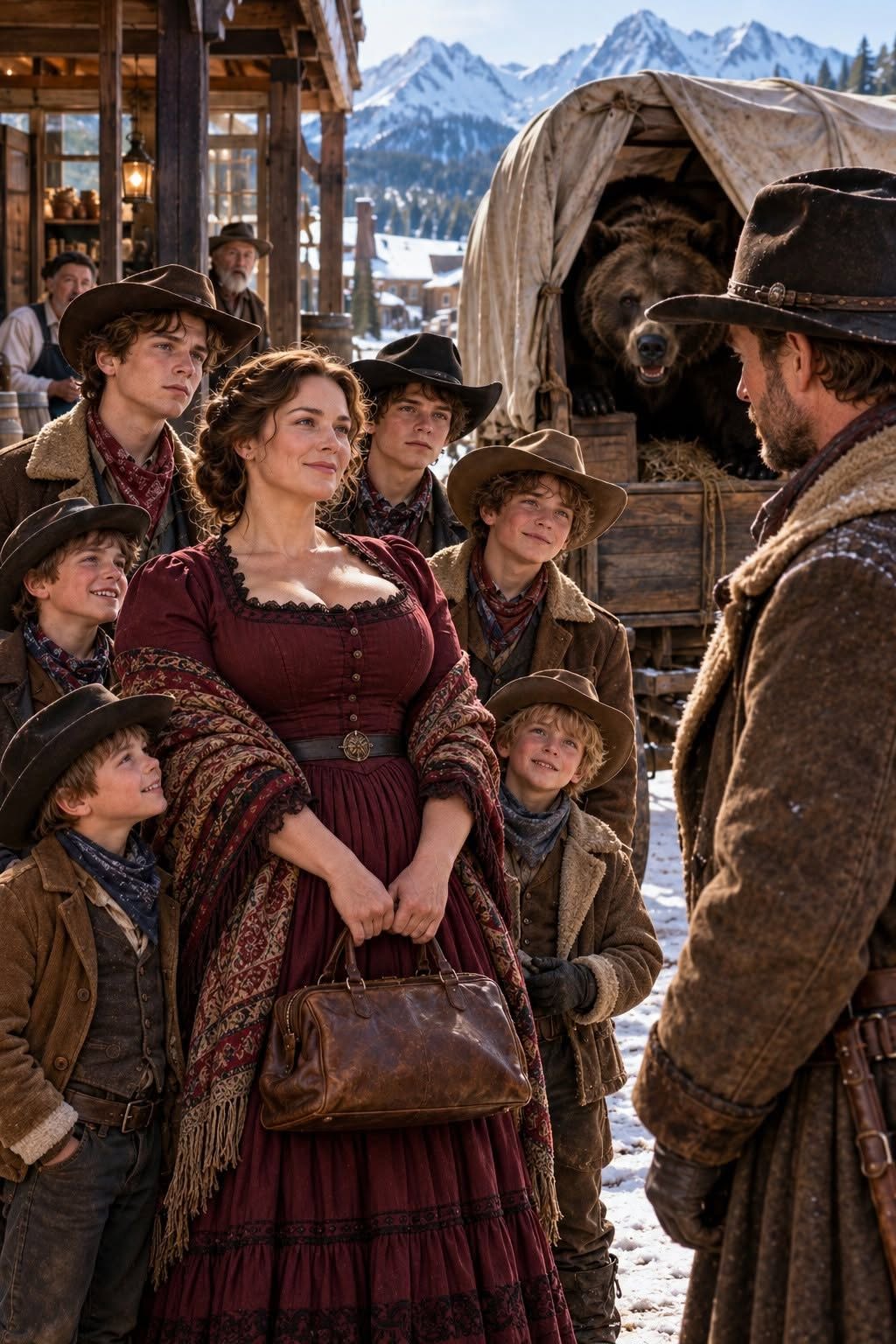
Low. Deep. Powerful enough to make the wooden boards beneath the wagon tremble.
Harlan froze beside the hitching post.
For one long second, he stared at the canvas covering the wagon as something shifted beneath it. Then he turned slowly toward Clara Bennett.
“Ma’am,” he said, his voice suddenly hard, “I want you to tell me exactly what your boys have brought onto my property.”
Clara closed her eyes.
“Boys,” she called, without raising her voice, “I am going to give you one chance to tell the truth before I start asking questions you won’t enjoy answering.”
Six faces appeared around the wagon.
The oldest, a seventeen-year-old with broad shoulders and his late father’s serious eyes, looked toward his mother.
“We found it three days ago, Ma.”
“That was not my question, Nathan.”
Nathan swallowed.
Behind him, the other five boys suddenly found the ground, the wagon wheels, and their own boots fascinating.
Harlan stepped closer.
“Found what?”
A tremendous thump came from inside the wagon.
His horse jerked against the reins, snorting in alarm.
Harlan instinctively moved between the animal and the wagon.
“Get those boys away from there,” he ordered. “Whatever is inside, it stays contained until I know what I’m dealing with.”
Clara nodded immediately.
“Everyone, step back. Slowly. Nobody touches that canvas.”
For the first time since arriving in Red Fork, all six Bennett boys obeyed their mother without argument.
That alone made Harlan look at her differently.
Then the canvas bulged outward.
A dark shape struck the wooden slats beneath it, followed by another growl.
Harlan’s face changed.
“Lord Almighty,” he whispered. “Is that a bear?”
The youngest Bennett boy, little Daniel, peeked around his mother’s skirt.
“Just a little one.”
“A little one?” Harlan repeated incredulously. “You brought a bear to my ranch and called it little?”
“He’s not as big as a grown bear,” Daniel explained.
“Daniel,” Clara said sharply.
The boy disappeared behind her skirt.
Nathan stepped forward.
“Sir, we didn’t steal it or trap it. We found it caught in an old iron trap near the creek. Its leg was bleeding, and it was making a terrible noise. We couldn’t just leave it there.”
“You couldn’t leave it?” Harlan stared at him. “Son, that’s a wild animal. A wounded bear can tear a man apart before he has time to blink.”
“I know.”
“Then why in heaven’s name is it in your wagon?”
Nathan’s jaw тιԍнтened.
“Because if we’d left it, it would’ve died.”
For a moment, neither man spoke.
Harlan recognized that expression. He had seen it on his own eldest son, Jesse, whenever the boy believed he was right and the entire world was standing in his way.
It was the expression of a boy who had already made up his mind and would rather face punishment than admit he had acted out of fear.
Clara placed a hand on Nathan’s shoulder.
“We should have told you before we came here,” she admitted. “That was my mistake. I thought we could get the animal safely to an experienced trapper near the northern trail. I didn’t expect to meet you in town, and I certainly didn’t expect my boys to make such an entrance.”
“An entrance?” Harlan said. “Mrs. Bennett, I’ve had nine housekeepers leave my ranch in less than a year. One of them nearly fainted because your future housemates put a ᴅᴇᴀᴅ snake in her bed. I came into town looking for a woman who could cook supper and keep five boys from destroying my house. I did not come looking for a woman who travels with a bear.”
“I can cook,” Clara replied calmly. “And I can keep boys in line.”
Harlan glanced toward his wagon.
The canvas shifted again.
“Can you keep that in line?”
“No,” Clara said honestly. “And neither can you. That’s why we’re taking it to someone who knows what to do with it.”
For the first time, Harlan almost smiled.
Almost.
Then a voice rang out from behind him.
“Pa! Is that a bear?”
Jesse, Emmett, Luke, Sam, and Toby had appeared at the edge of the mercantile’s yard.
They had followed their father into town, supposedly because they needed to collect a sack of flour. In truth, they had been curious about the woman who had volunteered to live under the same roof as them.
Now they stood staring at the wagon as though Christmas had arrived early.
Emmett was the first to grin.
“Well, this is the best housekeeper we’ve ever had.”
Clara turned her head.
“Is that so?”
“She’s brought us a bear,” Emmett said. “Mrs. Higgins only brought a broom.”
“Emmett,” Harlan warned.
But the boy was already circling the wagon.
“Do you think it eats snakes? Because Toby still has—”
“EMMETT!”
Every adult in the yard shouted at once.
Toby went crimson.
“I don’t have the snake anymore!”
“Where is it?” Harlan demanded.
Toby looked at the Bennett boys.
One of them, a lanky fourteen-year-old named Caleb, slowly began to grin.
“Oh, no,” Clara murmured. “What have you done?”
Caleb raised both hands.
“We haven’t done anything yet.”
That was precisely the sort of answer that made a mother worry.
Harlan pointed at the five boys.
“All of you, stand over there. Nobody approaches that wagon. Nobody lifts the canvas. Nobody pokes anything with a stick. And if I catch one of you trying to feed that animal, you will spend the next month mucking out every stall on this ranch.”
The boys exchanged glances.
Jesse folded his arms.
“What if it gets loose?”
“Then you run in the opposite direction and pray you’re faster than it is.”
That earned a nervous laugh from the Bennett boys.
Clara did not laugh.
“That’s enough. Nathan, help your brothers get the horses ready. We’ll take the wagon to the northern trail as soon as Mr. Harlan can arrange someone experienced to handle the animal.”
Nathan nodded.
Then Jesse stepped in front of him.
“You think you can order everybody around just because you’re the oldest?”
Nathan looked down at him.
“No. I think my mother can.”
Jesse’s expression hardened.
“Your mother isn’t our mother.”
The words landed harder than Jesse intended.
Behind him, Sam stopped smiling. Toby stared at the ground.
Harlan’s jaw тιԍнтened.
“Jesse, apologize.”
“Why?” Jesse snapped. “It’s true.”
Clara looked at the boy for a long moment.
She could see the anger in his face, but beneath it lay something older and more painful. It was the kind of anger that came from being afraid that if you let anyone else take charge, the whole world might fall apart.
She had seen it in Nathan after his father died.
She had seen it in herself.
“Your father is right,” she said gently. “I am not your mother, Jesse. And I won’t pretend to be.”
Jesse looked surprised.
“But that doesn’t mean I have to let you be cruel to someone who hasn’t done anything to you.”
“I wasn’t being cruel.”
“Then you can choose better words next time.”
For a moment, Jesse seemed ready to argue.
Instead, he turned away.
Harlan watched Clara carefully. Nine women had tried to manage his sons by shouting, threatening, pleading, or giving up. Clara had done none of those things.
She had simply spoken to Jesse as though he were a boy capable of making a better choice.
And somehow, that seemed to trouble him more than any punishment.
By late afternoon, the bear had been transferred safely into a reinforced transport cage under the supervision of an experienced local trapper, Mr. Whitcomb, who had agreed to take it away and tend to its injured leg before arranging its return to suitable wilderness.
The Bennett boys had insisted on helping with the preparations, but Clara had made them stand well back whenever Mr. Whitcomb worked near the cage.
“You can be brave without being foolish,” she told them.
Nathan nodded solemnly.
Caleb muttered, “That’s what Pa used to say.”
The words slipped out before he could stop them.
Clara’s hands paused on the strap she was тιԍнтening.
Harlan heard it.
“Your father?” he asked quietly.
“Two winters ago,” Clara replied. “A fever took him. It was quick, but it left us with a great deal to learn about living without him.”
Her eyes remained on the strap.
“Nathan learned to mend fences. Caleb learned to repair wheels. The others learned to help wherever they could. They are good boys, Mr. Harlan. But sometimes they think being brave means they must solve every problem themselves.”
Harlan looked toward his own sons, who were now arguing over whether the bear had been larger than their father’s biggest steer.
“I know something about boys who believe that.”
Clara met his gaze.
“Do you?”
The question was quiet, but it struck deeper than he expected.
He glanced away.
“My wife died last year.”
Clara’s expression softened.
“I’m sorry.”
“So am I.”
It was the first honest thing he had said about Mary to a stranger in months.
For a moment, the two widowed parents stood beside the wagon, surrounded by the sounds of horses, children, and a town going about its ordinary business.
Then Clara broke the silence.
“If you still need a housekeeper, I’ll accept the position. I won’t promise your boys will like me. I won’t promise they’ll like mine. But I will promise that every child under my roof will be fed, clothed, taught to work, and treated fairly.”
Harlan studied her.
“And if they refuse to listen?”
“Then there will be consequences.”
“What sort of consequences?”
Clara smiled faintly.
“The kind that don’t require me to shout.”
Behind them, Emmett whispered to Luke, “I think she’s scarier than Pa.”
“I heard that,” Clara called without turning around.
Both boys went silent.
Harlan rubbed a hand over his beard.
For the first time in a year, he felt something unfamiliar stir inside him.
Hope.
It was a dangerous thing to feel when you had already lost so much.
“All right, Mrs. Bennett,” he said. “You and your boys can come to the ranch.”
The six Bennett boys exchanged triumphant looks.
“However,” Harlan continued, raising one finger, “there will be rules. No animals brought onto my property without permission. No dangerous tricks. No fighting. And nobody touches a weapon without an adult present.”
“Agreed,” Clara said.
“And your boys will work.”
“They already do.”
“And my boys will work harder.”
“Then perhaps they’ll learn from one another.”
Harlan looked at her for another moment.
“Perhaps.”
He had no idea how much trouble that single word would bring.
The journey to the ranch took nearly two hours.
By the time the wagons reached the valley, the sun had begun sinking behind the Montana mountains, painting the fields gold and the distant peaks purple.
Harlan rode ahead, expecting the Bennett boys to complain about the distance, the cold, or the rough road.
Instead, Nathan rode beside his mother, keeping pace with the wagon. Caleb checked the wheel whenever the road grew rocky. The younger boys took turns watching the horses.
Harlan noticed everything.
He also noticed Jesse watching them.
His eldest son sat stiffly on his horse, his eyes following Nathan as he helped one of his younger brothers тιԍнтen a loose strap.
When they reached the ranch, Clara climbed down from the wagon and surveyed the sprawling house, the barns, the corrals, and the long stretch of pasture beyond.
“It’s beautiful,” she said.
“It’s a working ranch,” Harlan replied. “Beautiful doesn’t keep the cattle fed.”
“Neither does a man working himself to exhaustion.”
He turned toward her.
“What did you say?”
Clara lifted a brow.
“I said the cattle need feeding.”
“That’s not what you said.”
“No,” she admitted. “It wasn’t.”
Harlan stared at her.
Then, to his own surprise, he laughed.
It was a short, rusty sound, as though he had forgotten how to make it.
The boys turned toward him.
Even Jesse looked startled.
Their father had not laughed like that since before Mary died.
The moment pᴀssed quickly, but Clara noticed the way every boy watched Harlan afterward, as though they were trying to determine whether the sound had truly come from him.
She said nothing.
Some things needed time.
Inside the house, the situation deteriorated almost immediately.
The kitchen was a disaster.
Dirty plates stood in stacks beside the sink. A pan had been left on the stove until its contents had hardened into something black and unrecognizable. Boots lay beneath the table, and a broken chair had been propped against the wall as if someone expected it to repair itself.
Clara surveyed the room in silence.
Harlan shifted uncomfortably.
“I told the boys to clean up.”
“When?”
“This morning.”
“And did they?”
“No.”
“Then tomorrow, we’ll try something different.”
Emmett grinned.
“What’s that?”
Clara removed her gloves.
“Tomorrow, you will all learn what happens when six boys who know how to work meet five boys who believe work is optional.”
Caleb laughed.
Luke immediately took offense.
“We work!”
“Of course you do,” Caleb replied. “You work very hard at making messes.”
Luke lunged toward him.
Nathan caught Caleb by the collar before the two boys could collide.
“Don’t start.”
Jesse stepped forward.
“Let him go.”
Nathan turned slowly.
“Excuse me?”
“You heard me.”
Clara clapped her hands once.
The sound was sharp enough to silence the room.
“Everybody stop.”
Eleven boys stood staring at her.
“Now, I understand that some of you have spent years believing that the only way to survive in a house full of brothers is to be louder, meaner, or quicker with your fists than everyone else.”
Jesse’s face darkened.
“But that will not happen in my kitchen,” Clara continued. “Not while I’m responsible for feeding you.”
“Your kitchen?” Jesse challenged.
“Our kitchen,” she corrected. “Unless you’d rather cook your own supper.”
Nobody answered.
“Good. Then we understand each other.”
She pointed toward the sink.
“Sam, Luke, and Toby, wash those dishes. Nathan and Caleb, bring in the wood. Emmett and the other boys, clear the table and sweep the floor. Jesse, you will help me prepare supper.”
Jesse stared at her.
“Why me?”
“Because you’re the oldest, and the others watch what you do.”
“I don’t cook.”
“Then tonight you’ll learn.”
“I don’t take orders from strangers.”
Clara met his gaze without flinching.
“Then consider this your first lesson in living with people who aren’t impressed by your stubbornness.”
For one long second, the room seemed to hold its breath.
Harlan stepped forward.
“Jesse, do as she says.”
Jesse’s eyes flashed with hurt.
“Fine.”
He turned toward the kitchen counter so quickly that he knocked a wooden spoon to the floor.
Clara watched him bend to retrieve it.
She recognized that movement, too.
A boy pretending that anger was easier than sadness.
Supper was served an hour later.
There was beef stew, fresh bread, potatoes, and a pan of biscuits so golden that even Harlan paused when he smelled them.
The boys crowded around the table.
For the first few minutes, the only sounds were spoons against bowls and the occasional request for more bread.
Then Sam, who had been watching the Bennett boys with open curiosity, finally asked the question everyone had been wondering about.
“Do you really have six brothers?”
Caleb grinned.
“Count us.”
“I did,” Sam replied. “Twice.”
“Then you should know the answer.”
“Are all your brothers as annoying as you?”
“Worse.”
Daniel laughed so hard that milk came out of his nose.
Toby giggled.
For a moment, the table filled with the sound of children laughing together.
Then Jesse spoke.
“Does your mother make you work every day?”
Nathan swallowed a mouthful of stew.
“Most days.”
“Even when you don’t want to?”
“Especially then.”
“Why?”
Nathan looked toward Clara.
“Because she says work gives us something useful to do when our hearts are full of things we don’t know how to talk about.”
The room fell quiet.
Jesse’s spoon stopped halfway to his mouth.
Harlan lowered his eyes.
Mary had once said something similar.
She had told him that boys who lost someone needed more than chores and discipline. They needed someone who would sit beside them long enough for the hurt to come out.
He had promised her he would do that.
Then he had buried himself in the ranch and left his sons to grieve alone.
“Does it work?” Jesse asked quietly.
Nathan considered the question.
“Not every time.”
“Then what’s the point?”
“Because some days, it does.”
Jesse looked down at his bowl.
For the first time that evening, he had no answer.
Clara quietly pᴀssed him the bread.
He took it without looking at her.
It was not an apology.
But it was a beginning.
The next morning, the trouble began before sunrise.
Clara was already in the kitchen when a tremendous crash shook the house.
A second later, Emmett came running through the doorway.
“Mrs. Bennett! You have to come!”
Clara set down the knife she was using.
“What happened?”
“It’s Jesse!”
She was moving before Emmett finished speaking.
Outside, she found Jesse standing beside the barn with his shirt torn at the shoulder and a split lip. Nathan stood several feet away, his fists clenched. The other boys had gathered around them, some frightened, others eager to see how the fight would end.
Harlan came running from the corral.
“What happened here?”
“Nothing,” Jesse snapped.
Nathan wiped a streak of blood from his cheek.
“He said my father was a fool for bringing us here.”
Jesse’s face reddened.
“I said your father was a fool for bringing a bear to our ranch!”
“You called him a ᴅᴇᴀᴅbeat who couldn’t keep his own family safe!”
“I didn’t mean—”
“You said it!”
Nathan stepped forward again.
Harlan caught Jesse by the arm.
“That’s enough!”
Jesse tried to pull free.
“Let go of me!”
“No.”
“Pa, you don’t understand!”
“Then explain it!”
Jesse’s voice broke.
“Because you brought them here! Six strangers! Six boys who think they’re better than us! And now they’re going to take over the house, and the kitchen, and everything else!”
The words spilled out of him in a rush.
“And you’ll be glad when they do, because then you won’t have to worry about us anymore!”
Silence swept across the yard.
Harlan went pale.
“Jesse…”
But his son was no longer looking at him.
He was staring at the ground, breathing hard, his hands shaking.
Clara approached slowly.
“Jesse, look at me.”
“Leave me alone.”
“I will, if that’s what you truly want. But first, I need you to hear something.”
He shook his head.
“You don’t know anything about us.”
“No,” she agreed. “I don’t know everything about you. But I know what it looks like when a boy is frightened that the people he loves might leave him.”
Jesse’s eyes filled with furious tears.
“I’m not frightened!”
“Then why are you shouting?”
He opened his mouth.
Nothing came out.
Clara glanced at Nathan.
“Go inside with your brothers. Give Jesse a little space.”
Nathan hesitated.
“He hit me.”
“And he will answer for that. But you don’t have to stand here and fight him to prove that your father mattered.”
Nathan’s jaw тιԍнтened.
After a moment, he nodded and walked away.
One by one, the other boys followed him.
Soon, only Jesse, Harlan, and Clara remained beside the barn.
Jesse wiped his eyes angrily.
“I don’t need you feeling sorry for me.”
“I’m not sorry for you,” Clara said. “I’m concerned about you. There’s a difference.”
He stared at her.
“Your mother is gone,” she continued gently. “And nothing I say will bring her back. Nothing your father says will make that loss disappear. But you cannot punish every person who comes into your life because you’re afraid they’ll leave, too.”
Jesse’s face crumpled.
“I didn’t ask them to come here.”
“No. You didn’t.”
“I don’t want another mother.”
Clara’s heart ached.
“Then you won’t get one from me. I’m not here to replace Mary.”
Jesse looked up sharply.
“You knew her name?”
“Your father told me.”
For a long moment, Jesse stood very still.
Then he whispered, “She used to make biscuits like yours.”
Clara’s throat тιԍнтened.
“Then perhaps she was a very good cook.”
“She was the best.”
“I believe you.”
Jesse looked toward the house.
“She used to sing while she cooked. I can’t remember the words anymore.”
His voice was barely audible.
“I try, but I can’t.”
Clara stepped closer, careful not to touch him without permission.
“Sometimes we forget the words,” she said. “But we remember how the song made us feel. That part can stay with us.”
Jesse’s tears finally fell.
He turned away, ashamed of them.
Harlan stood several feet behind them, unable to speak.
He had spent a year trying to make his sons strong enough to survive their mother’s absence.
Clara had understood, in less than a day, that they had never needed to be stronger.
They had needed permission to hurt.
And Harlan, who had built his life around protecting his family, suddenly realized how badly he had failed to protect their hearts.
He stepped forward.
“Jesse.”
The boy stiffened.
His father swallowed hard.
“Your mother would never have wanted you to carry this alone.”
Jesse turned.
“Then why did you?”
The question struck Harlan like a blow.
For once, he did not defend himself.
“Because I didn’t know how to live without her,” he admitted. “And I thought if I kept working, I wouldn’t have to think about it.”
His voice shook.
“But I left you boys to do the same thing. I’m sorry.”
Jesse stared at him.
Then, slowly, he crossed the space between them and buried his face against his father’s chest.
Harlan wrapped both arms around his son.
For the first time in a year, he held him like a grieving child rather than a young man expected to keep the household standing.
Clara quietly stepped away.
She knew some moments belonged only to a family.
But as she turned toward the house, she heard Jesse whisper something that made her stop.
“Pa?”
“Yes, son?”
“Can we keep them here?”
Harlan looked over Jesse’s shoulder.
Through the open barn door, he could see Nathan helping Sam repair a broken latch. Caleb was showing Emmett how to тιԍнтen a wagon wheel, while the younger boys argued over who had the better horse.
Clara stood on the porch, watching them all with a mixture of exhaustion and quiet affection.
Harlan took a slow breath.
“If they want to stay,” he said, “then we’ll make room.”
Jesse nodded against his father’s chest.
And for the first time since Mary died, the ranch felt less like a place where five boys were trying to survive their grief and more like a home that might one day become whole again.
Neither Harlan nor Clara knew that the real test was still waiting for them.
Because later that afternoon, when Clara went to fetch the flour from the wagon, she discovered something missing.
The reinforced transport cage was empty.
The bear was gone.
And beside the wagon, in the soft earth beneath the kitchen window, were a set of enormous paw prints leading straight toward the barn.
Clara’s blood ran cold.
“Harlan!” she shouted.
Across the yard, Harlan turned.
“What is it?”
She pointed toward the tracks.
He followed her gaze.
Then he saw the barn door swinging slowly in the wind.
Inside, something growled.
And from somewhere among the stalls, little Toby began to scream.
To be continued…