PART 2: THE MOUNTAIN MAN GAVE HER A BED, NOT A WEDDING NIGHT — BUT THE SECRET OF HIS FIVE CHILDREN CHANGED EVERYTHING
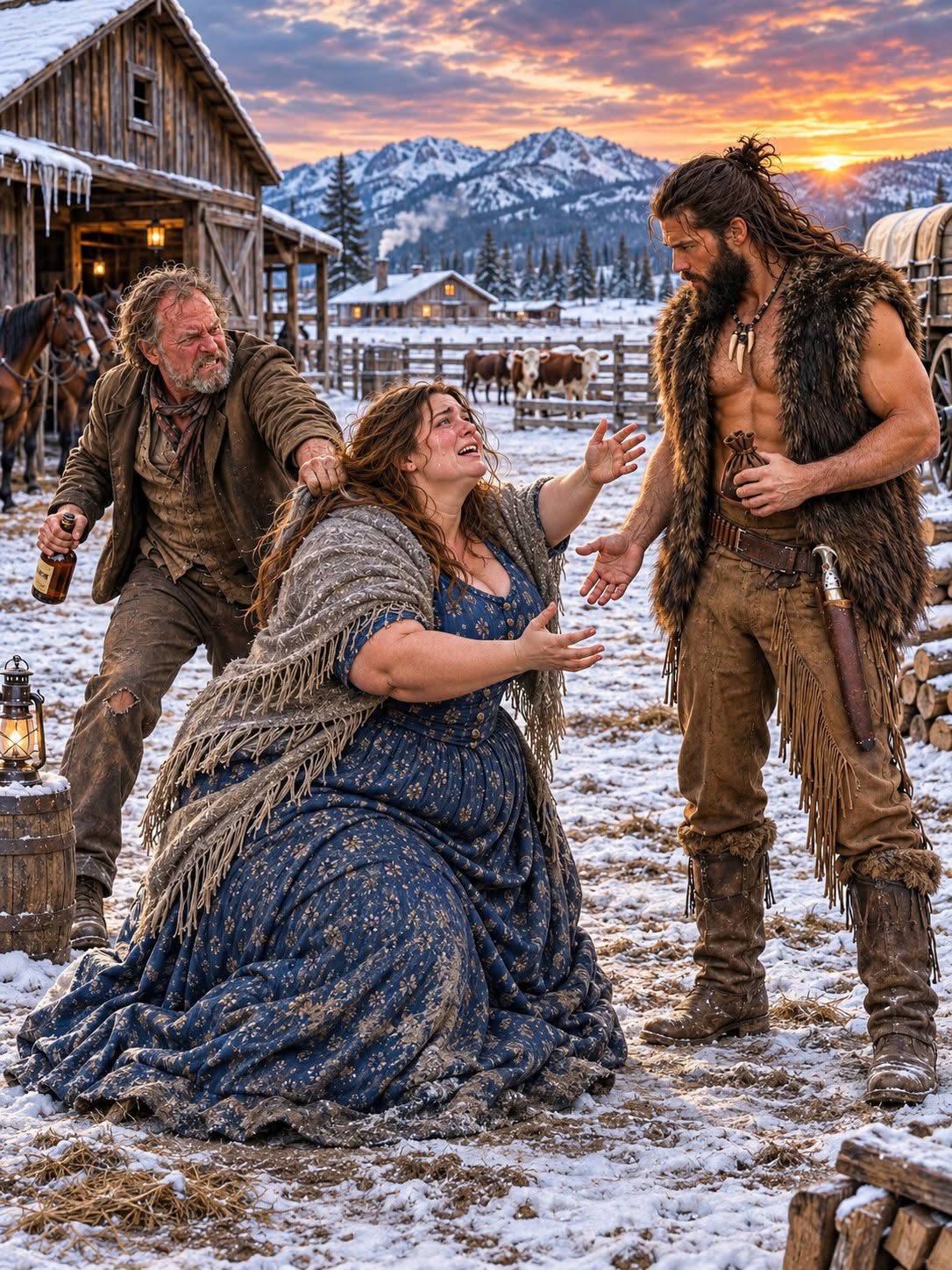
HER FAMILY SOLD HER AT 19 TO A MOUNTAIN MAN WITH FIVE KIDS — THAT FIRST NIGHT, HE REFUSED TO TOUCH HER AND TOLD HER SHE WAS SAFE, BUT JUST BEFORE LEAVING THE ROOM, HE WHISPERED, “THERE’S SOMETHING ABOUT THESE CHILDREN YOU NEED TO KNOW…”
PART 2: THE MOUNTAIN MAN GAVE HER A BED, NOT A WEDDING NIGHT — BUT THE SECRET OF HIS FIVE CHILDREN CHANGED EVERYTHING
Judson stopped directly in front of Norah.
She could hear his breathing.
She could smell the cold air clinging to his bear-hide coat.
Her fingers remained frozen against the ʙuттons of her dress.
Then he reached out.
Norah flinched so violently that her shoulder struck the table.
Judson’s hand stopped in midair.
For several seconds, he looked at the bruise on her collarbone.
Then he slowly lowered his hand.
“Who did that?”
Norah stared at the floor.
“It doesn’t matter.”
“Was it your father?”
She said nothing.
Judson’s jaw тιԍнтened.
He walked to the fireplace, took a thick wool blanket from a wooden chest, and placed it on the table.
“Put your dress back together.”
Norah blinked.
“What?”
“You heard me.”
He pulled a small iron key from his pocket and placed it beside the blanket.
“There’s a room behind the kitchen. It has a proper bed, a lock on the inside, and a window that faces the eastern ridge. You’ll sleep there.”
She looked at him as though he had spoken another language.
“And you?”
“I’ll sleep in the loft.”
“But we’re married.”
Judson turned.
“Your father made a bargain. I paid his debt. That doesn’t mean you owe me your body.”
Norah’s lips parted.
She had prepared herself for cruelty.
She had prepared herself for pain.
She had not prepared herself for a man who would look at her frightened face and step away.
Judson picked up the fallen spoon.
“One more thing. Nobody enters your room without your permission. Not even me.”
He started toward the door.
Then he stopped.
“There is something about these children you need to know.”
Norah’s stomach тιԍнтened.
“What?”
Judson glanced toward the ceiling.
“None of them are mine.”
She stared.
He continued.
“They belonged to men who worked with me at the northern silver mine. Five families. Five fathers who never came home.”
He took a breath.
“Three winters ago, a tunnel collapsed. I was the only one who made it out alive.”
Norah slowly lowered herself into a chair.
“Those children?”
“I promised their mothers I’d keep them together.”
His voice became rougher.
“Some of them were too young to remember their fathers. Some remember every detail. But all of them remember the day I brought them here.”
He paused.
“They don’t hate you because you’re a stranger, Norah. They hate you because they believe every woman who comes into this house will eventually leave.”
Norah looked toward the loft.
“How many have left?”
Judson didn’t answer immediately.
“Two.”
“Why?”
“Because they couldn’t bear the children.”
He rubbed a hand over his beard.
“The oldest one, Toby, has chased away every hired woman I’ve brought here. He thinks if he makes this house miserable enough, nobody will get close enough to hurt him.”
Norah looked down at her hands.
She knew something about making herself difficult to love.
She knew what it meant to be abandoned before anyone had the chance to leave.
“Then perhaps,” she whispered, “he and I have something in common.”
For the first time that evening, Judson’s expression softened.
He nodded toward the small room.
“Get some sleep.”
That night, Norah lay beneath three heavy quilts.
The room was tiny, but it was clean.
A little iron stove glowed in the corner. Someone had placed a glᴀss of water on the bedside table, along with a candle and a small plate containing two pieces of bread.
There was also a folded note.
The handwriting was large and uneven.
“You are safe here. Nobody will hurt you. — J.W.”
Norah read it until her eyes blurred.
She had not realized how desperately she needed those words.
For the first time in nineteen years, she locked a door from the inside and knew that the person outside would respect it.
She slept.
Not peacefully, not at first.
Her dreams were filled with her father’s voice and the sound of boots crossing a wooden floor.
But when she woke, the door was still locked.
And nobody had entered.
 The next morning, she discovered that the mountain cabin was even more chaotic in daylight.
Caleb had poured molᴀsses into his boots.
Abner was trying to repair a broken chair with a hammer.
Minnie was brushing Ruthie’s hair with a fork.
Toby sat by the window, sharpening a pocketknife.
Judson stood over the stove, looking at a pot of oatmeal as though it were a dangerous animal.
“Breakfast,” he announced.
Toby glanced at the pot.
“Looks like glue.”
“Then eat it before it dries,” Judson replied.
Norah almost smiled.
She stepped into the kitchen wearing the wool dress Judson had left outside her door.
Toby looked at her.
“You’re still here?”
“Apparently.”
“How long?”
Norah considered the question.
“Until breakfast, at least.”
Caleb giggled.
Toby did not.
Judson placed a bowl in front of her.
“Sit.”
Norah noticed the children had already eaten, but Ruthie’s bowl was nearly untouched.
The little girl was sitting on Minnie’s lap, staring at the oatmeal.
“Is she sick?” Norah asked.
Minnie shrugged.
“She doesn’t like food.”
Norah studied the child’s pale face.
“How long has she been eating like this?”
“Since Mama died.”
Norah’s heart тιԍнтened.
She took a little warm milk, mixed it into the oatmeal, and mashed a small piece of dried apple into the bowl.
Then she sat beside Ruthie.
“Would you like to try something?”
The toddler shook her head.
Norah did not force her.
Instead, she took a spoonful herself.
“Well, that’s disappointing. I was hoping this would be the best breakfast in the mountains.”
Ruthie watched her.
Norah took another spoonful and pretended to be surprised.
“Oh. Wait. I think it needs a little more apple.”
She offered the spoon again.
This time, Ruthie opened her mouth.
Minnie stared.
“She hasn’t eaten a whole bowl in three days.”
Norah smiled gently.
“Then we’ll celebrate this one spoonful.”
Across the table, Judson watched without saying anything.
Later that morning, Norah discovered why the children were so difficult.
Nobody had shown them how to live together after losing the people who once held their little world together.
Toby had taken on the role of a father without being old enough to understand what that meant.
Abner had learned to stay invisible.
Minnie had become Ruthie’s mother.
Caleb had learned that making people laugh was easier than admitting he was frightened.
And Ruthie had stopped eating because she still believed her real mother might come back and feed her.
Norah understood something then.
She had not been brought to this mountain merely to cook and clean.
These children were surviving.
But they were not living.
By afternoon, she had washed the dishes, cleaned the table, and started repairing the children’s torn clothing.
She found a small wooden horse beneath the bed.
One of its legs had broken.
She sat on the floor and began wrapping the damaged part with a strip of cloth.
Caleb crawled closer.
“Can you fix it?”
“I can try.”
“Nobody can fix it.”
“Then we’ll have to surprise it.”
The little boy giggled.
It was the first genuine laughter Norah had heard in the cabin.
Toby appeared in the doorway.
“Don’t get too comfortable.”
Norah looked up.
“Wasn’t planning to.”
“Father says you’re staying.”
“Then perhaps you should ask him why.”
“Because he feels sorry for you.”
Norah’s hands stopped.
Toby’s eyes were hard.
“He brought two women here before. They both left. You’ll leave too.”
Norah looked at the broken wooden horse.
“Perhaps.”
Toby seemed surprised.
She continued.
“But I won’t leave because you tell me to.”
His face reddened.
“You don’t know anything about us.”
“You’re right.”
“Then stop acting like you do.”
Norah put down the horse.
“I know what it’s like to be afraid that someone will hurt you. I know what it’s like to wish someone would stay. And I know what it’s like to pretend you don’t care because caring makes it hurt more.”
Toby stared at her.
For one brief moment, he looked like a frightened little boy rather than an angry fourteen-year-old.
Then he turned and walked away.
That evening, Judson returned from checking his traps.
He found Norah asleep beside the hearth, with Caleb’s wooden horse resting in her lap.
Minnie had fallen asleep against her shoulder.
Ruthie was curled up beside her.
Judson stood in the doorway for a long time.
Then Toby appeared behind him.
“She won’t stay,” the boy whispered.
Judson looked down at him.
“Maybe not.”
“Then why let her in?”
The mountain man was silent.
Finally, he answered.
“Because nobody should have to earn the right to be treated kindly.”
Toby looked away.
That night, after the children were asleep, Judson knocked softly on Norah’s door.
She opened it only a few inches.
He held out a small leather pouch.
“What’s this?”
“Your father’s gambling note.”
Norah’s face went pale.
“Why do you have it?”
“Because there’s something I didn’t tell you.”
He waited until she opened the door wider.
“Your father didn’t just owe money at the saloon. He owed money to a man who had been asking about you for months.”
Norah felt the room tilt.
“What man?”
Judson’s eyes darkened.
“Silas Crowe. He runs the mining camp east of here.”
Norah recognized the name.
She had heard her father mention it.
He had spoken of a man who paid well for young women willing to work in his boardinghouse.
“Your father intended to send you there when he couldn’t pay his debt,” Judson said. “I found out before he could.”
Norah gripped the doorframe.
“Then you bought me?”
“I bought the debt. Not you.”
He reached into the pouch and produced another folded document.
A signed release.
Her father’s signature.
And beneath it, a legal declaration establishing that Norah was free to leave the marriage whenever she wished.
She looked up at him.
“Why didn’t you tell me?”
“Because I wanted you to see it before you had to believe me.”
He placed the document in her hands.
Then he hesitated.
“There’s one more thing.”
Norah’s heart began pounding.
Judson glanced toward the loft.
“Toby knows something about Silas Crowe. Something he has never told me.”
From above them came a sudden crash.
A child’s frightened cry followed.
And then Toby shouted words that made Judson’s face turn white.
“HE’S THE MAN WHO KILLED MY FATHER!”