PART 3 — THE PROMISE HE MADE BESIDE THE YELLOW DRESS
PART 3 — THE PROMISE HE MADE BESIDE THE YELLOW DRESS
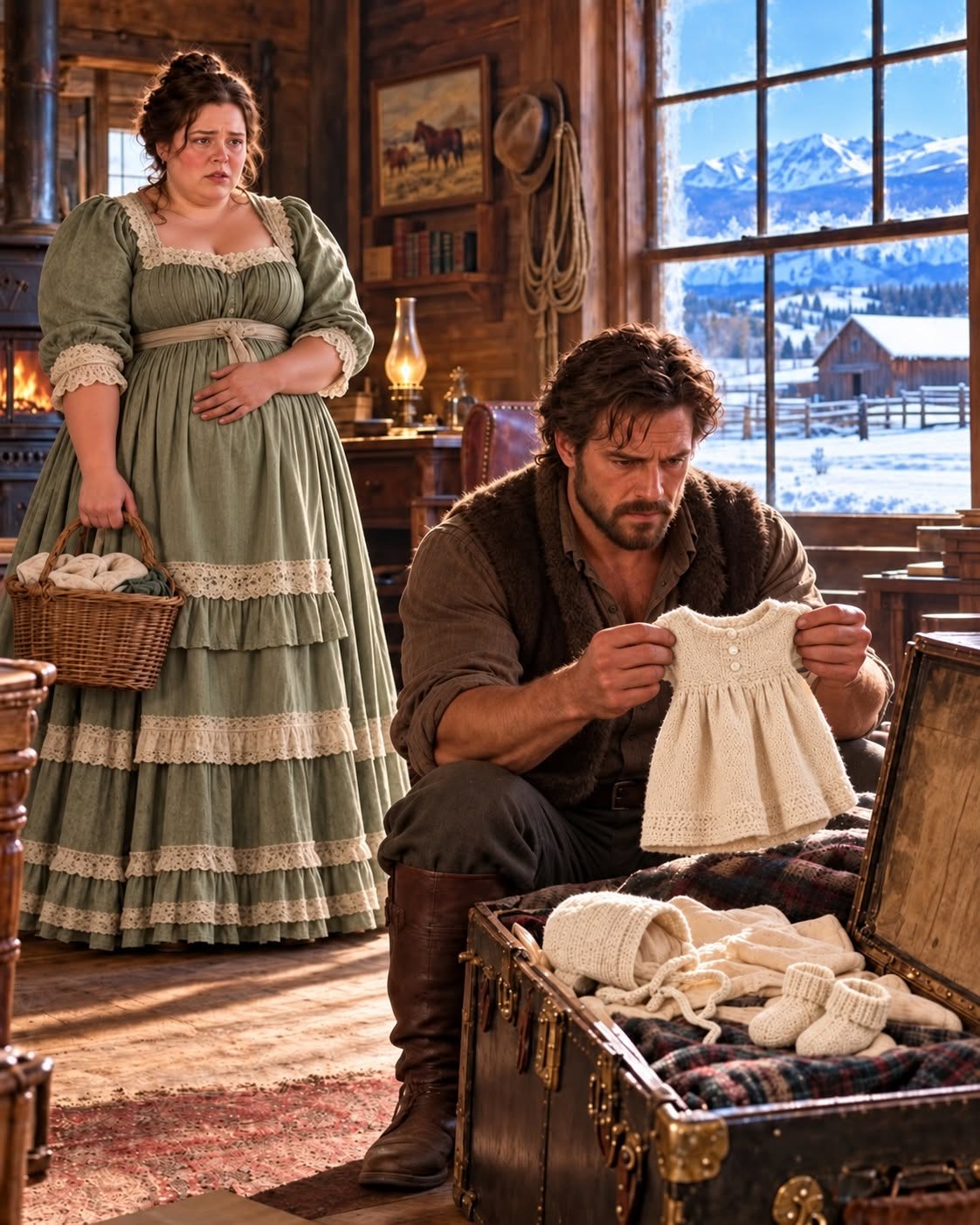
Jackson stood motionless, holding the tiny yellow dress between his hands.
For a long moment, he said nothing.
Then he looked at Eliza.
“Tell me,” he whispered. “Whose baby clothes are these?”
Eliza’s eyes filled with tears. She had rehearsed this moment a hundred times, but none of those rehearsals had prepared her for the pain in his voice.
“Mine,” she answered softly. “And yours.”
Jackson lowered the dress.
“Mine?”
She nodded, placing one trembling hand over her belly.
“I’m going to have your child, Jackson.”
The cattle baron stared at her as though the entire world had suddenly changed. His eyes moved from the little dress to her face, then down to the hand resting against her stomach.
“How long have you known?”
“Several weeks.”
“And you were going to leave?”
Eliza looked away.
“I thought it was the kindest thing I could do.”
“The kindest thing?”
His voice cracked, but he quickly lowered it.
“You were going to disappear with my child, and you thought that was kindness?”
“I wasn’t trying to punish you.”
“Then why didn’t you tell me?”
Eliza took a shaky breath.
“Because I saw the bank notices. I heard you talking about selling the northern acreage. I knew the ranch was struggling, and I couldn’t bear the thought of you believing I had become pregnant to keep your money or your name.”
Jackson looked genuinely wounded.
“You believed I would think that of you?”
“I didn’t know what you would think. That’s what frightened me.”
He placed the yellow dress carefully on the desk.
“Eliza, look at me.”
She raised her eyes.
“I have spent years building this ranch,” he said. “I’ve bought cattle, sold land, survived droughts, and buried more dreams than I care to count. But none of those things ever made this house feel like a home.”
He paused.
“Then you arrived.”
Eliza’s tears slipped down her cheeks.
“I didn’t want you to feel trapped.”
Jackson shook his head.
“You don’t understand. I’ve been trapped in this empty house for years. And now you’re telling me the one thing I never dared hope for is about to happen, and you were planning to leave before I could even know?”
“I was afraid.”
 “So was I,” he admitted. “I’m still afraid. But not of having a child. I’m afraid you thought you had to face all of this without me.”
He reached toward her, then stopped.
“May I?”
Eliza nodded.
Jackson gently placed his hand over hers.
For the first time, he felt the small movement beneath her palm.
His expression changed.
“Was that…?”
“The baby,” she whispered.
He didn’t speak for several seconds.
Then the enormous cattle baron, a man who had faced blizzards, cattle stampedes, and business failures without shedding a tear, sat down beside his desk and covered his face.
Eliza knelt beside him.
“Jackson?”
He looked up, his eyes shining.
“I wish I’d known sooner.”
“So do I.”
He glanced at the yellow clothes.
“Is it a girl?”
“I don’t know.”
“Then why yellow?”
“Because I wanted the baby to have something bright waiting in this world.”
Jackson picked up the tiny bonnet.
“Then we’ll give this child more than something bright.”
He looked at her.
“We’ll give our baby a home.”
But Eliza’s relief was interrupted by the sound of a horse approaching the house.
A moment later, one of the ranch hands knocked urgently.
“Mr. Thorne! The bank representative is here. He says he’s brought the final papers.”
Jackson stood.
He looked at the yellow dress, then at Eliza.
“Stay here. I’ll handle it.”
But Eliza caught his sleeve.
“No, Jackson. You told me this house was different when I was in it. Let me stand beside you now.”
He studied her face, then nodded.
Together, they walked toward the front room.
The bank representative stood near the fireplace, holding a leather folder. He was a thin, neatly dressed man named Mr. Whitcomb, whose expression suggested he had already decided how the conversation would end.
“Mr. Thorne,” he began, “I’m afraid the bank can wait no longer.”
Jackson took the papers.
Eliza watched his face as he read them.
Then he looked up.
“You intend to foreclose?”
“Unless the outstanding balance is settled by the end of the month.”
Jackson glanced toward the windows, where the winter fields stretched beyond the ranch buildings.
“How much time?”
“Thirty days.”
The room fell silent.
Then Eliza noticed a second document tucked beneath the bank papers.
It bore the name of the railroad company.
“Mr. Whitcomb,” she asked carefully, “is that the original easement agreement?”
The representative looked surprised.
“Yes. Why?”
Jackson turned toward her.
Eliza stepped closer to the desk.
“Because you said the bank needed it, didn’t you?”
Jackson nodded slowly.
She pointed to a line near the bottom.
“Look at the date.”
Jackson examined it.
Then his eyes widened.
The document had been signed by his father nearly twenty years earlier. It granted the railroad a narrow pᴀssage across the northern acreage, but it also contained a clause requiring the company to pay the ranch a substantial annual fee.
A fee that had never appeared in Jackson’s accounts.
“Where have these payments gone?” he asked.
Mr. Whitcomb shifted uneasily.
“That’s a matter for the railroad’s accounting department.”
Jackson’s voice hardened.
“No. It’s a matter for this room.”
And for the first time that morning, Eliza saw something other than fear in his expression.
She saw hope.
But neither of them yet knew how much that forgotten agreement would change their future.
PART 3 — THE SECRET HER MOTHER LEFT BEHIND
“Bring me the deed—or I’ll tell Miss Hart what her mother did to your family.”
The voice outside the study was calm, almost pleasant.
That frightened Eliza more than an angry shout would have.
Jackson folded the letter and slipped it inside his coat.
“Tell Mr. Whitcomb he can wait in the front room,” he instructed the foreman. “And don’t let anyone touch that trunk.”
When the foreman left, Eliza turned toward him.
“What did my mother do?”
Jackson looked at the old envelope.
“I don’t know yet. But we’re going to find out.”
He led her into the front room, where Silas Whitcomb stood beside the fireplace. The railroad representative was a neatly dressed man with silver spectacles and a polished walking stick. His smile disappeared when he noticed the document in Jackson’s hand.
“So,” Silas said, “you found it.”
Jackson didn’t offer him a seat.
“You seem remarkably certain of what’s inside my house.”
“I’ve been following this matter for years.”
“Then you know the northern acreage was placed in a trust.”
Silas glanced at Eliza.
“An arrangement made by people who are no longer alive. It has no practical value now.”
“That’s not what the document says,” Eliza replied.
Silas gave her a thin smile.
“Miss Hart, I understand this must be confusing. Your mother was involved in a complicated business agreement. She was not an innocent party.”
Eliza straightened.
“My mother worked hard, raised me alone, and never took what belonged to someone else.”
“Is that what she told you?”
Jackson stepped forward.
“Choose your next words carefully.”
Silas ignored him.
“Your mother was supposed to sign the northern property over to the railroad. Instead, she concealed the original agreement and disappeared with the records.”
“Why?” Eliza asked.
“Because she wanted money.”
“That’s a lie.”
Silas opened his leather folder and produced another paper.
“This is a copy of the original transfer agreement. It bears Margaret Hart’s signature.”
Eliza examined it.
The handwriting looked familiar, but something about the document troubled her.
“My mother always signed her name with her middle initial,” she said.
Silas frowned.
“What?”
“Margaret E. Hart. She never left out the E.”
Jackson took the paper.
“And the date is wrong,” he added. “My father was already ᴅᴇᴀᴅ when this agreement supposedly took effect.”
Silas’s smile vanished.
For the first time, he looked less like a confident businessman and more like a man who had been caught unprepared.
Jackson placed the forged document beside the original letter.
“You’ve brought a false agreement into my house and demanded land you don’t own.”
“I represent the railroad.”
“Then you can explain this to the county judge.”
Silas closed his folder.
“You don’t understand what you’re risking, Thorne. Your bank debt remains. Even if the land belongs to Miss Hart, the railroad has other claims.”
Eliza looked at Jackson.
“Other claims?”
Silas seized the opportunity.
“Your mother borrowed money from the company. She used the northern acreage as security. When she died, the debt pᴀssed to her heir.”
Eliza felt the room grow cold.
“How much?”
Silas named a sum that made her gasp.
Jackson’s jaw тιԍнтened.
“That’s impossible. The original trust agreement forbids the land from being used as collateral.”
Silas smiled again.
“Unless the heir agrees to release it.”
He turned toward Eliza and laid a pen on the table.
“Sign this, and the matter ends. The railroad will ᴀssume the old debt. You’ll receive enough money to begin a comfortable life somewhere far from here.”
Eliza stared at the paper.
For a moment, she thought of the little yellow dress, the baby she carried, and the future she had imagined beyond the mountains.
Then she looked at Jackson.
He wasn’t watching the document.
He was watching her.
He would not tell her what to do. He would not use his position or his wealth to decide her future.
And that made her decision easier.
“No,” she said.
Silas blinked.
“Excuse me?”
“I said no. I won’t sign away something I don’t understand.”
His expression hardened.
“Then you may lose everything.”
Eliza lifted her chin.
“I’ve spent most of my life with almost nothing. You cannot frighten me with the threat of taking away a fortune I never had.”
Jackson’s expression softened with pride.
Silas gathered his papers.
“This isn’t finished.”
“No,” Jackson replied. “It isn’t.”
The railroad man left, but his warning remained in the room.
For several minutes, neither Eliza nor Jackson spoke.
Then Jackson unfolded the old letter again.
There was another page hidden behind the first, stuck to the envelope by age. He carefully separated it.
At the top was a sentence written in Jonathan Thorne’s familiar handwriting.
Margaret, if anything happens to me, my son must know the truth.
Beneath it was a confession.
Twenty years earlier, Jonathan Thorne had discovered that the railroad company was secretly claiming private ranchland through altered survey records. Margaret Hart, who worked as a bookkeeper for the company, had found the original maps proving the fraud.
She had brought them to Jonathan.
Together, they had arranged for the northern acreage to be placed in a trust for Margaret’s daughter, protecting it from the railroad’s claims. Jonathan had promised to keep the original deed safe until Eliza came of age.
But before the agreement could be completed, several documents disappeared.
Margaret was dismissed, accused of stealing company funds, and forced to leave the territory. Jonathan died before he could correct the public record.
His son, Jackson, inherited the ranch without knowing that part of the northern land had never belonged to the Thorne family.
Eliza read the final paragraph twice.
“My mother wasn’t trying to steal anything,” she whispered.
“No,” Jackson said. “She was trying to protect you.”
He turned the page.
There was a location written in the margin: an old survey office near the abandoned railroad station.
And beneath it, a final note:
The original deed is not in the trunk. It is where Margaret left the truth for her daughter.
Eliza looked up.
“Then we have to find it.”
Jackson glanced at her belly.
“Not in this weather. And not while you’re unwell.”
“I can help.”
“You already have.”
He placed his hand gently over hers.
“Tomorrow, I’ll send for the county clerk. We’ll have the papers examined properly. Then we’ll go to the survey office together, if the road is safe.”
That evening, Jackson did something Eliza had never expected.
He brought the yellow baby clothes from his study and placed them in a small wooden cradle that had belonged to his mother.
“I found this in the attic,” he said. “It needs a little repairing, but I thought the baby might like it.”
Eliza touched the smooth wooden rail.
“Jackson…”
“I don’t know whether we’ll have a son or a daughter. I don’t know how much money the ranch will have next spring. But I know I want to be here when our child arrives.”
She looked at him through tearful eyes.
“And if the land doesn’t save the ranch?”
“Then we’ll find another way.”
He paused.
“I didn’t ask you to stay because of the deed, Eliza. I asked because I love you.”
She had waited so long to hear those words that, for a moment, she could not answer.
Then she reached for his hand.
“I love you too.”
But their happiness was interrupted the following morning by a visitor neither had expected.
An elderly woman stood on the porch, leaning on a wooden cane. Her gray hair was tucked beneath a wool hat, and she carried a small leather case.
When Jackson opened the door, she looked past him.
“Is Margaret Hart’s daughter here?”
Eliza appeared behind him.
“I’m Eliza.”
The old woman studied her face, and her eyes filled.
“Oh, child,” she whispered. “You have your mother’s eyes.”
She opened the leather case and removed a folded pH๏τograph.
It showed Margaret Hart standing beside a young man in front of the old survey office.
The man was Jonathan Thorne.
On the back, Margaret had written:
For Eliza, when she is old enough to know why we had to wait.
The old woman introduced herself as Ruth Bell, the former clerk of the railroad survey office.
“I kept a promise to your mother,” she explained. “She told me that if anyone ever came looking for the deed, I was to make certain it reached you—not the railroad.”
Ruth opened her case.
Inside lay a small iron key.
“Your mother left something else,” she said. “And I believe you’re finally ready to see it.”
She looked toward Jackson.
“Both of you should come. Because the truth about the northern land is only half the story.”