PART 3: THE SILENT RANCHER’S VOICE — AND THE SECRET THAT BROUGHT A TOWN TO ITS KNEES
NO FOOD, NO SHOES, AND NO FAMILY LEFT TO PROTECT HER — A SILENT RANCHER SAVED HER, BUT WHAT HAPPENED NEXT SHOCKED THE ENTIRE TOWN
PART 3: THE SILENT RANCHER’S VOICE — AND THE SECRET THAT BROUGHT A TOWN TO ITS KNEES
The lantern outside the window stopped moving.
Abselum was already reaching for his coat.
Anora clutched Caleb’s letter against her chest.
“Who is it?”
He didn’t answer.
He took the rifle from above the fireplace and stepped onto the porch.
A man sat on a tired chestnut horse at the edge of the yard.
He was perhaps fifty, with a gray beard and a face that looked as though it had spent too many winters fighting the weather.
“Evening, Kerr,” the stranger called.
Abselum lowered the rifle slightly.
The man removed his hat.
“My name is Thomas Bell. I was the county clerk before the new administration took over.”
Anora stepped outside.
“Mr. Bell?”
He looked at her and nodded.
“Mrs. Lisk. I’ve been looking for you.”
Her fingers тιԍнтened around the letter.
“Why?”
“Because your husband came to see me two days before he died. He left something in my care. Something that could put a very dangerous man behind bars.”
Abselum motioned for him to come inside.
They gathered around the kitchen table.
Ike poured coffee while Thomas removed a leather folder from beneath his coat.
“Caleb discovered that his brother had been selling timber from the western section of the Lisk property,” Thomas explained. “He was also forging signatures on land agreements. When Caleb confronted him, Lyman threatened him.”
Anora felt sick.
“You’re saying Lyman caused the accident?”
Thomas hesitated.
“I’m saying Caleb believed his brother was planning to stop him from speaking. He asked me to keep a record of everything.”
He opened the folder.
Inside were copies of land transfers, bank receipts, and two signed statements from men who had worked for Lyman.
One statement described a conversation in which Lyman had offered money to a hired hand to loosen the brake ᴀssembly on Caleb’s wagon.
Anora covered her mouth.
“No.”
Thomas looked at her sadly.
“I’m afraid so.”
The kitchen seemed to tilt.
She remembered Caleb leaving that morning.
He had kissed her forehead, promised to be home before supper, and laughed when she told him to take his heavier coat.
He had never come home.
For months, she had mourned him as a victim of an unfortunate accident.
Now she understood that someone had deliberately taken him away.
Abselum stood so abruptly that his chair fell backward.
His face was pale with fury.
He reached for the slate, but his hands shook too badly to write.
Anora stood and took his hand.
“Please. Don’t let him make you lose yourself.”
Abselum looked at her.
For a moment, the anger in his eyes softened.
Then he turned to Thomas and wrote:
“Where is the man who signed the statement?”
Thomas answered quietly.
“His name is Owen Pike. He disappeared three days after Caleb’s funeral.”
A long silence followed.
Then Ike spoke.
“Disappeared or was made to disappear?”
Nobody answered.
The next morning, the ranch became a place of preparation.
Thomas rode to Cutbank to contact the sheriff.
Ike sent one of the hired hands to bring two neighboring ranchers.
Abselum checked every gate and made certain the horses were saddled.
Anora remained at the kitchen table, reading Caleb’s letters.
She found one that had been folded inside the lining of his old Bible.
It was addressed to Abselum Kerr.
She stared at the name.
Why would Caleb have written to him?
The letter was brief.
“Mr. Kerr,
You may not remember me, but I remember the kindness you showed my wife at the store last winter. She told me how you helped a little girl retrieve her dropped basket when nobody else would stop.
I have heard people speak unkindly of you because you do not talk much.
I know better.
A man’s worth is not measured by the number of words he can speak.
If anything happens to me, please look after Anora if she needs help.
I know you will understand what it means to protect someone without expecting anything in return.
Caleb Lisk.”
Anora read the letter until the words blurred.
When Abselum returned, she held it out.
He read it slowly.
Then he sat down.
His eyes remained on the page for a long time.
Finally, he reached for the slate.
“I should have done more.”
Anora shook her head.
“You did more than anyone.”
He looked at her.
She moved closer.
“You found me when I had nothing. You gave me your mother’s boots. You let me stay when I had nowhere else to go. You never once made me feel like I owed you something.”
His hand trembled as he wrote again.
“I wanted to say welcome home. I couldn’t.”
 Anora’s eyes filled.
“Then let me say it for you.”
She placed her palm against his cheek.
“Home.”
He closed his eyes.
For the first time, he leaned into someone’s touch instead of pulling away from it.
But their quiet moment did not last.
By noon, Lyman arrived with the sheriff.
And he had brought half the town with him.
Dorcas sat in a wagon behind her husband, her expression triumphant.
“I told you,” she whispered loudly enough for everyone to hear. “That woman has brought shame upon the family.”
Lyman climbed down.
“Take her into custody. She’s stolen property and is living unlawfully on another man’s land.”
The sheriff, a tired-looking man named Harlan, held up one hand.
“Let’s settle this without shouting.”
Thomas Bell stepped forward.
“I have evidence of forged deeds and an attempt to murder Caleb Lisk.”
The crowd went silent.
Lyman laughed too loudly.
“That old fool has been dismissed from the county office. His word means nothing.”
Thomas opened his folder.
“Then perhaps these will mean something.”
He handed the documents to the sheriff.
Lyman’s face changed.
The sheriff read the first statement.
Then the second.
Then he looked at Lyman.
“Where is Owen Pike?”
“I don’t know any Owen Pike.”
A voice came from behind the crowd.
“I do.”
A thin man stepped out from behind a wagon.
His coat was worn, his face gaunt, and one arm hung stiffly at his side.
Anora recognized the fear in his eyes.
It was the same fear she had seen in herself the morning she left the Lisk farm.
“I’m Owen Pike,” he said.
Lyman took a step backward.
Owen told the sheriff everything.
He had been offered money to sabotage Caleb’s wagon. He had refused at first, but Lyman threatened his family. On the morning of the accident, Owen had been sent to inspect the wagon.
He had loosened the brake.
But he had not expected Caleb to be the one driving it.
Afterward, Lyman paid him to disappear.
“I’ve lived with that guilt every day,” Owen said. “I came back because Caleb’s wife deserved to know the truth.”
The sheriff turned toward Lyman.
“You’re under arrest.”
Dorcas began screaming.
Lyman tried to run.
Abselum moved faster.
He caught the man’s coat and held him until the sheriff’s deputies reached them.
Lyman struggled.
“Get your hands off me!”
Abselum did not strike him.
He simply held on.
The same quiet man who had once been mocked for his silence now stood before an entire town, refusing to let evil walk away.
As the sheriff led Lyman toward the wagon, Dorcas turned toward Anora.
“Please. You know I was only doing what my husband told me.”
Anora looked at her for a long moment.
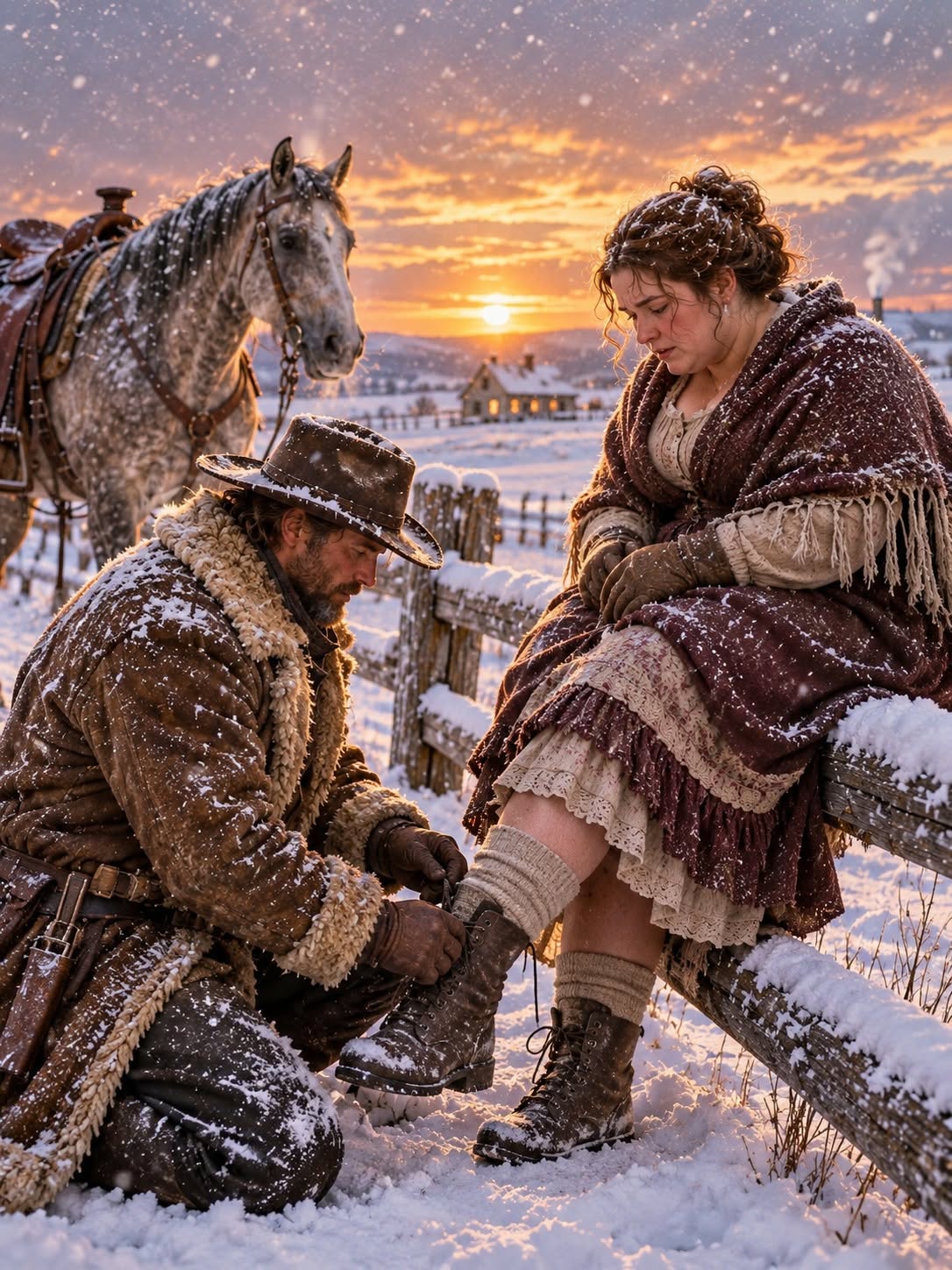
She remembered the boots.
The cold road.
The moment she had sat down in the snow, believing nobody would ever come.
“I know exactly what you did,” she said.
And then she turned away.
Three months later, the original deed was restored.
The Lisk farm legally belonged to Anora, just as Caleb had intended.
But she made a decision that surprised everyone.
She sold it.
Not because she wanted to forget Caleb, but because she no longer wanted to live in a place where every corner carried the memory of betrayal.
She used the money to buy a small piece of land adjoining Abselum’s ranch.
There, she built a modest house with a wide porch, a bright kitchen, and a garden that would bloom in spring.
Ike declared that the kitchen was too small.
Anora told him he was welcome to complain after he finished eating.
He complained every day.
And every day, he returned for another plate.
One evening, as the first spring rain tapped against the windows, Abselum stood beside the fireplace holding a small wooden box.
He placed it in Anora’s hands.
Inside lay a simple gold ring.
Beside it was a folded piece of paper.
She opened it.
“I have spent most of my life believing that silence was the only safe place for me. Then you came into my house and made it feel like a home again. I cannot promise you a perfect life. But I can promise you that you will never have to walk through another winter alone. Will you stay with me, Anora?”
She looked up.
Abselum was watching her, his eyes full of a fear she had never seen there before.
He was afraid she might say no.
Anora stepped toward him.
“You know something, Abselum?”
He shook his head.
“You once carried me three miles through a snowstorm without saying a word.”
A small smile touched his mouth.
“Now I think it’s my turn to carry something.”
She took his hand and placed the ring on her finger.
“I choose you. Not because I need somewhere to go. Because you’re the place I want to stay.”
Abselum’s lips parted.
He tried to speak.
His throat тιԍнтened.
For one terrible second, she thought he would retreat into silence again.
But he didn’t.
“Anora,” he whispered.
The word came out rough and broken, but it came.
She began to cry.
He tried again.
“I… love… you.”
Anora wrapped her arms around him.
And the man who had once been taught that his voice was something to be ashamed of finally understood that the right person would never ask him to be someone else.
They married in May beneath the old cottonwood tree.
Ike stood beside Abselum as his witness, pretending the tears in his eyes were caused by the wind.
Thomas Bell attended.
Owen Pike came too, carrying a small wooden rocking horse he had made for the couple’s future children.
And when the preacher asked whether Abselum Kerr took Anora Lisk to be his wife, Abselum did not reach for his slate.
He looked directly at her.
“Yes,” he said.
The entire gathering heard him.
And nobody laughed.
Years later, people in Cutbank would still tell the story of the widow who was thrown into the snow without shoes, the silent rancher who stopped his horse, and the family that believed they could destroy a woman simply because she had no one left to protect her.
But the part people remembered most was not the arrest, the inheritance, or the wedding.
It was what Abselum Kerr had written on the slate the morning Anora first thanked him.
“Nobody else should have had to.”
Because sometimes the greatest act of love is not rescuing someone from the cold.
It is making sure they never have to wonder again whether they deserve a place beside the fire.