THE WOMAN BENEATH THE DYING COTTONWOOD
An 1887 Montana Western Romance — A Story in Three Parts
PART 1: “PLEASE… LET ME DIE.”
“Please… let me die.”
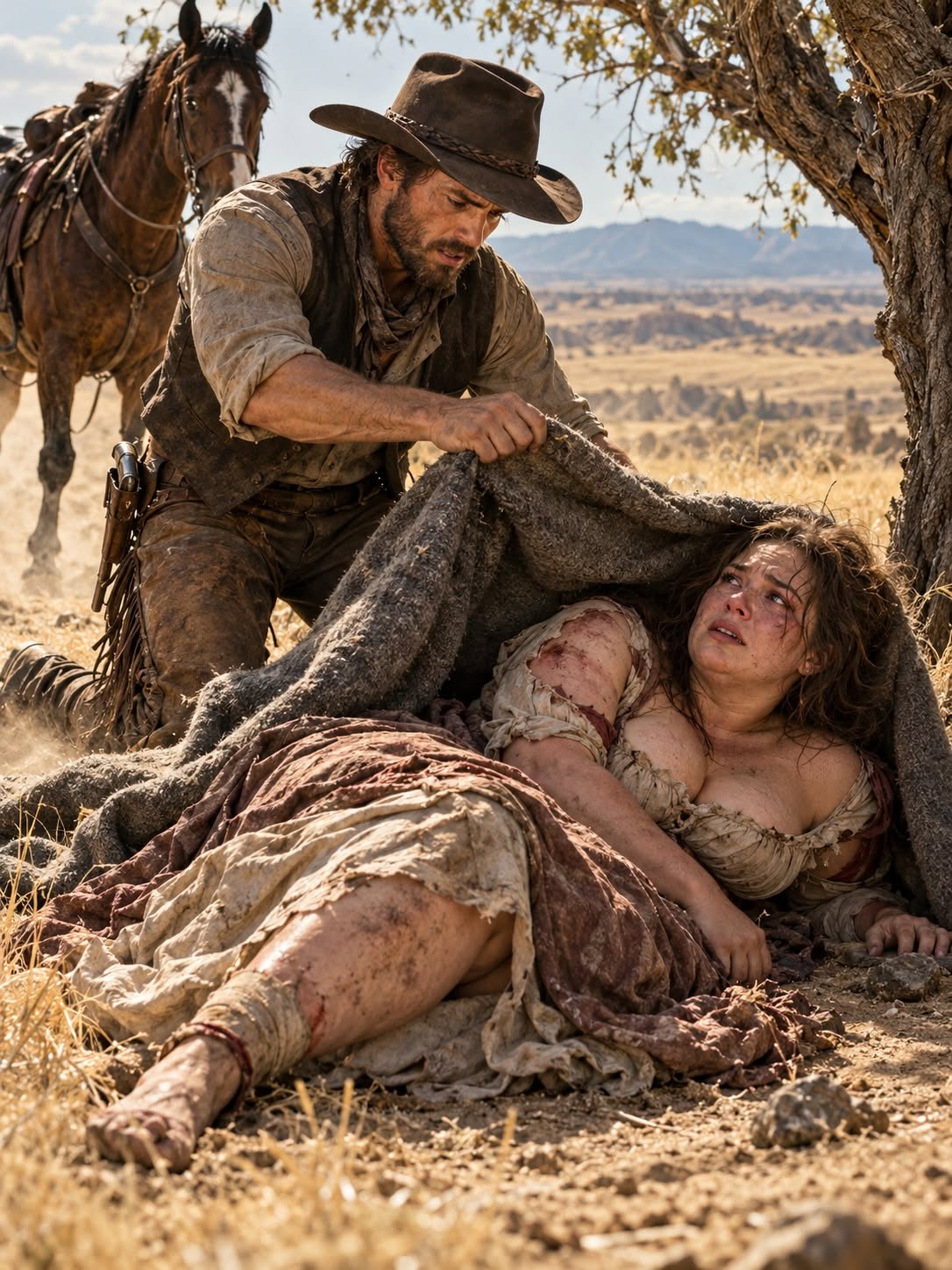
Caleb Dawson heard the whisper just as he was riding past a dying cottonwood tree on a lonely stretch of Montana wilderness in the summer of 1887.
He stopped his horse.
Beneath the tree lay a woman in a torn blue dress, her face bruised, her lips cracked from thirst. One ankle had swollen so badly that she could barely move.
Caleb dismounted and knelt beside her.
“Ma’am, can you hear me?”
The woman opened her eyes. Fear flashed across her face.
“No,” she whispered, trying to crawl away. “Please. Don’t take me back.”
“Take you where?”
She shook her head, tears slipping down her dusty cheeks.
“I’m Maggie Whitmore. And if you have any kindness left in you, leave me here.”
Caleb stared at her. He had buried his wife, Eleanor, three years earlier. Since then, he had learned to live with an empty house, cold suppers, and nights so quiet that even the wind seemed cruel.
But he could not leave another human being to die.
“You’re coming with me,” he said gently.
“I’m too much trouble.”
“Then I suppose I’ll have trouble for a while.”
Before she could protest, he lifted her carefully into his arms and carried her to his horse.
By sunset, Maggie was lying in a clean bed at Caleb’s ranch. He washed her wounds, wrapped her swollen ankle, and placed a bowl of broth beside her.
She stared at the food as though she had forgotten what kindness looked like.
“When was the last time you ate?” Caleb asked.
“I don’t remember.”
He said nothing more. He simply waited until she picked up the spoon.
That evening, Maggie ate slowly, watching him with suspicion.
“Why are you helping me?”
“Because you needed help.”
“You don’t even know who I am.”
“Does that change anything?”
She lowered her eyes.
For years, a man named Silas Greer had controlled her life. He operated a boardinghouse near Helena, promising respectable employment to desperate women. Once they arrived, he invented debts for their rooms, clothing, and meals. When they tried to leave, his hired men threatened them, beat them, and dragged them back.
Maggie had worked as a bookkeeper before Greer discovered she could read and write better than most men in his establishment. He forced her to maintain his accounts, recording payments from people who visited after dark.
Then she discovered what those accounts really contained.
Greer wasn’t merely exploiting helpless women. He was paying officials, a sheriff, and several wealthy businessmen to keep his operation hidden. Some women had been transferred to other towns under false names. Others had disappeared entirely.
Maggie had copied several pages of the original ledger.
When Greer discovered the missing records, he accused her of theft. His men dragged her outside town, beat her, and abandoned her beneath the cottonwood, believing the heat would finish what they had started.
But Maggie had hidden the copied pages inside the lining of her dress.
“I thought I was going to die,” she whispered.
Caleb’s jaw тιԍнтened.
“Who did this to you?”
“Silas Greer. And if he learns I’m alive, he’ll come here.”
“Let him come.”
She looked at him in disbelief.
“You don’t understand. He has friends everywhere. Men who wear fine coats and sit in respectable offices. Men who can make a person disappear without anyone asking questions.”
Caleb leaned forward.
“Three years ago, I buried my wife. Since then, I’ve spent every day pretending there’s nothing left in this world worth fighting for.”
He paused.
“Maybe I was wrong.”
For the first time, Maggie looked at him without fear.
Later that night, Caleb sat on the porch with his rifle across his knees. The moon hung above the dark mountains, and the horses shifted nervously in their stalls.
Then he noticed something beyond the fence.
A rider.
The stranger sat motionless among the trees, watching the ranch house.
When Caleb raised his rifle, the rider turned and disappeared into the darkness.
A moment later, Caleb heard a sound behind him.
Maggie stood in the doorway, pale and trembling.
“Was it him?” she asked.
Caleb looked toward the trees.
“I don’t know.”
Maggie gripped the doorframe.
“But I know one thing.”
“What?”
“Silas Greer never sends a man to watch a house unless he’s planning to burn it down.”
And somewhere beyond the ranch, a second rider was already heading toward town.
He carried a message bearing Greer’s signature.
Find Maggie Whitmore. Recover the ledger. Leave no witnesses.
PART 2: THE SECRET INSIDE HER DRESS
The following morning, Caleb rode to the nearest settlement for medicine and supplies, leaving Maggie with a loaded revolver and strict instructions not to open the door for anyone.
Before he left, she caught his sleeve.
“If they come, don’t try to be a hero.”
Caleb gave her a faint smile.
“I’m a rancher, Maggie. Heroes usually have better horses.”
She almost smiled back.
It was the first time in years that she had felt something other than fear.
But when Caleb returned that afternoon, he found the front door open and the kitchen overturned.
“Maggie!”
He rushed inside, rifle raised.
She emerged from the pantry holding a revolver with both hands.
“It’s me,” she cried.
Caleb lowered his weapon.
“What happened?”
“Two men came asking about a missing horse. One tried to push past me. I fired into the ceiling.”
She glanced upward at the bullet hole.
“They left.”
Caleb looked at the shattered dishes, then at Maggie’s trembling hands.
“You did well.”
“They’ll come back.”
“Then we’ll be ready.”
That evening, Maggie finally showed him the papers concealed inside her dress. They contained names, dates, payments, and coded entries linking Greer to the county sheriff and a prominent businessman named Nathaniel Voss.
One entry was marked with a black cross.
Maggie refused to explain it at first.
“That’s the name of a woman who tried to escape before me,” she finally said. “Her name was Clara. She knew too much. Greer told everyone she had run away.”
“What happened to her?”
“I don’t know. But I heard him tell Voss that she would never speak again.”
Caleb studied the pages.
“If these records are genuine, we can take them to the federal authorities.”
“Greer will know before we reach them. The sheriff controls the roads, and Voss owns half the businesses in Helena.”
“Then we won’t tell the sheriff.”
Maggie looked at him.
“You’d risk everything for a woman you found lying in the dirt?”
Caleb was silent for a moment.
“When Eleanor was dying, she asked me to promise I wouldn’t let grief turn me into a man who only cared about himself. I tried to keep that promise. But after she was gone, I stopped trying.”
He folded the papers carefully.
“I’m not making that mistake again.”
Maggie’s eyes filled with tears.
For a long moment, neither spoke.
Then she reached for his hand.
“I’m afraid,” she confessed.
“So am I.”
“You don’t look afraid.”
“That’s because I’m very good at looking foolishly confident.”
A quiet laugh escaped her. It surprised them both.
For a few precious hours, the ranch felt like a home again.
Then the horses began to scream.
Caleb rushed outside.
Flames were climbing the wall of his barn.
Three masked riders galloped away from the property as Caleb grabbed buckets and shouted for Maggie to help him save the animals. Together, they managed to open the stalls and lead the frightened horses into the pasture before the roof collapsed.
When the fire finally died, Caleb stood amid the smoking ruins.
His hay stores were gone. Two valuable saddles had been stolen. His winter feed lay beneath a blanket of ash.
Maggie stared at the destruction.
“I’m sorry,” she whispered. “This is all because of me.”
Caleb turned toward her.
“No. This is because of the men who did it.”
“But your ranch—”
“Can be rebuilt.”
“And if they kill you?”
He stepped closer.
“Then they’ll have to work harder than they did tonight.”
Maggie wanted to believe him. Yet she knew Greer would never stop while the ledger remained hidden.
The next morning, Caleb found a folded note nailed to his front door.
It contained only one sentence.
Bring us the papers by sundown, or the woman dies first.
Beneath the message was a small silver locket.
Maggie recognized it immediately.
It had belonged to Clara.
Her face drained of color.
“They have her,” she whispered.
“Who?”
“Clara. She’s alive.”
She sank into a chair, struggling to breathe.
“I thought she was ᴅᴇᴀᴅ. But Greer kept her hidden because she knew where the original ledger was buried.”
Caleb crouched beside her.
“Where?”
Maggie looked at the papers in his hands.
“Beneath the floor of Greer’s old office. The pages I stole are only copies. The original contains the names of every man who paid him.”
“Then we’ll get it.”
“No,” Maggie said sharply. “You don’t understand. If we go there, we’ll be walking straight into a trap.”
Caleb rose and checked his rifle.
“Probably.”
She grabbed his arm.
“Caleb, please. I can’t watch another person suffer because of me.”
He looked down at her hand resting against his sleeve.
“You didn’t bring this trouble to my door, Maggie. Those men did.”
For the first time, he placed his hand over hers.
“And I’m not leaving you to face them alone.”
That night, they rode toward Helena under a moonless sky.
Neither noticed the rider following them from a distant ridge.
By midnight, the man had reached Greer’s boardinghouse.
Silas Greer stood behind his desk, reading the report.
The rancher was coming.
Maggie was coming.
And the ledger would soon be within his reach.
Greer smiled.
“Excellent,” he said.
Then he opened a drawer and removed a second document.
It was a deed to Caleb Dawson’s ranch, signed in a hand that looked remarkably like Caleb’s own.
Greer had already arranged to claim the property as payment for a debt Caleb had never owed.
If the plan succeeded, Caleb would lose everything.
And if it failed, neither he nor Maggie would leave Helena alive.
PART 3: THE NIGHT THE TRUTH CAME OUT
Caleb and Maggie reached Helena shortly before dawn.
Instead of approaching the boardinghouse directly, Caleb left his horse behind a livery stable and led Maggie through a narrow alley to the back of the building.
“Stay close,” he whispered.
They found a cellar entrance secured by an old iron lock. Caleb forced it open, and they descended into the darkness.
From upstairs came the sound of men’s voices.
Then Maggie heard something that made her blood run cold.
A woman crying.
“Clara,” she whispered.
They followed the sound to a small room beneath the boardinghouse. Inside, a woman sat chained to a wooden chair, her face pale and bruised.
When she saw Maggie, she began to weep.
“You came back.”
Maggie hurried to her side.
“I thought you were ᴅᴇᴀᴅ.”
“Greer wanted me to tell him where you hid the papers. I refused.”
Caleb broke the chain securing Clara’s wrist and helped her stand.
“Can you walk?”
“With help.”
Maggie reached into her pocket and showed her the copied pages.
“We have enough to expose him.”
Clara shook her head.
“Not without the original ledger. Voss has been moving the money through a bank in Helena. The original contains the account numbers, the names of the officials, and proof that the sheriff received payments every month.”
“Where is it?” Caleb asked.
Clara pointed toward the ceiling.
“Greer’s office. Beneath the floorboards.”
They climbed the stairs.
The office door stood open.
Inside, Silas Greer waited behind his desk, flanked by four armed men. Nathaniel Voss stood beside the window, wearing an expensive black coat.
Greer smiled when Maggie entered.
“There she is. The little thief who thought she could destroy me.”
Maggie trembled, but she did not step back.
“You destroyed yourself.”
Greer’s expression hardened.
“You have no idea how many important men depend on my discretion.”
“Then perhaps they’ll be interested in seeing your accounts.”
Caleb moved toward the desk, but two men raised their rifles.
“Careful, rancher,” Greer warned. “You’re a long way from your little patch of land.”
Caleb stopped.
Greer turned to Maggie.
“Give me the papers, and I’ll let you leave. The rancher, however, will answer for the damage he’s caused.”
“You burned his barn,” Maggie replied. “You threatened his life. You imprisoned women and stole their freedom.”
Greer laughed.
“And who will believe you? A disgraced bookkeeper? A rancher with a ruined property? A woman who can’t even keep her own story straight?”
Maggie’s face went pale.
For one terrible moment, she was back beneath the cottonwood tree, hearing the same words that had convinced her she was worthless.
Then she remembered Caleb’s voice.
You’re a person, Maggie. That’s enough.
She straightened.
“My name is Maggie Whitmore. I kept your books. I recorded your payments. And I remember every name you tried to erase.”
She pulled the copied pages from her pocket.
“Your accounts are here. The original ledger is beneath your floor. And Clara is alive to tell the world what you did.”
Greer lunged toward her.
Caleb struck the desk with his rifle, sending a stack of papers flying. In the confusion, Maggie seized a brᴀss lamp and smashed it against the window.
The glᴀss shattered.
Outside, a whistle sounded.
Greer’s men turned toward the noise.
Through the broken window came the voices of federal marshals.
Caleb had arranged for a trusted telegraph operator to send a message before their arrival, forwarding the names and account details to federal authorities in Helena. The operator had alerted a marshal who had been investigating suspicious payments for months.
The marshals rushed through the front entrance.
“Drop your weapons!”
One of Greer’s men surrendered immediately. Another attempted to flee through the back door but was caught in the alley.
Greer drew a pistol and seized Maggie by the arm.
“Stay back!”
Caleb raised his rifle.
For a heartbeat, nobody moved.
Then Maggie drove her heel into Greer’s injured foot and twisted free.
The pistol fired.
Caleb staggered backward, clutching his shoulder.
“Caleb!”
Maggie dropped beside him as the marshals seized Greer and Voss.
Blood seeped through Caleb’s shirt, but he remained conscious.
“It’s only a scratch,” he muttered.
Maggie stared at him in disbelief.
“You’ve been sH๏τ!”
“I noticed.”
Despite everything, she let out a broken laugh that quickly became a sob.
“You foolish, stubborn man.”
“That’s what I’ve been told.”
The original ledger was recovered beneath the office floorboards. Its contents confirmed the copied pages, revealing payments to the sheriff, Nathaniel Voss, and several other men who had helped Greer maintain his operation.
Within weeks, the boardinghouse was closed. Greer and his accomplices faced criminal charges, while the authorities began searching for the women who had disappeared under his control.
Clara testified against Greer. Maggie gave her statement and helped identify the victims listed in the ledger.
For the first time, the women he had threatened were no longer alone.
Caleb’s shoulder healed slowly.
His ranch did not recover so quickly. The barn had to be rebuilt, his savings were nearly exhausted, and the coming winter promised to be difficult.
But something had changed.
Maggie stayed.
She helped repair the house, kept the ranch accounts, and planted wildflowers beside the porch. She no longer flinched whenever a horse approached or lowered her eyes when someone spoke to her.
One evening, as the autumn sun painted the mountains gold, Caleb found her standing beside the fence.
“Thinking about leaving?” he asked.
Maggie turned.
“Sometimes I think about the woman I was before Greer. I wonder whether she’ll ever come back.”
Caleb stood beside her.
“Maybe she doesn’t have to come back.”
“What do you mean?”
“Maybe you get to become someone new.”
Maggie looked at the rebuilt barn, the grazing horses, and the little patch of flowers she had planted beside the house.
“And what if I don’t know how?”
“Then we’ll figure it out.”
She studied his face.
“Why did you really save me, Caleb?”
He was quiet for a long time.
“Because when Eleanor died, I thought my life had ended with hers. I worked, ate, slept, and waited for the days to pᴀss. Then I found you beneath that tree, asking me to leave you to die.”
He took her hand.
“And I realized I couldn’t bear the thought of walking away.”
Tears filled Maggie’s eyes.
“I was afraid you would regret helping me.”
“I regret plenty of things, Maggie. Saving you isn’t one of them.”
She leaned against him, resting her head on his shoulder.
For the first time since Eleanor’s death, Caleb felt the silence around his ranch become something peaceful rather than cruel.
Months pᴀssed.
Winter came and covered Montana in snow, but the ranch house remained warm. Maggie learned to ride again, and Caleb discovered that he could laugh without feeling guilty for having survived his grief.
On Christmas Eve, he placed a small wooden box on the table between them.
Maggie stared at it.
“What is this?”
“Something I’ve been meaning to ask you.”
Inside lay a simple gold ring.
Caleb took a breath.
“I won’t promise you a perfect life. This ranch will always need work, the winters will always be cold, and I’ll probably say the wrong thing more often than I should.”
Maggie smiled through her tears.
“But I can promise you a home where no one will ever tell you that your life isn’t worth saving.”
He held out his hand.
“Maggie Whitmore, will you stay here with me—not because you owe me anything, but because you want to?”
She looked at the ring, then at the man who had carried her from the wilderness when she had no strength left to save herself.
“Yes,” she whispered. “But only if you promise to let me help rebuild the barn properly this time.”
Caleb laughed.
“I was afraid you’d say something unreasonable.”
She slipped the ring onto her finger.
Outside, snow drifted across the fields, covering the scars left by fire and time. Beyond the fence stood the old cottonwood tree, its branches bare against the winter sky.
It had not died after all.
A few stubborn green leaves had appeared in the spring, and by autumn, new shoots had begun to grow along its trunk.
Maggie often thought about that tree.
She had once believed it was the perfect place to surrender, a lonely patch of earth where the world could finally forget her.
Instead, it had become the place where her life began again.
And Caleb, who had once believed his heart was buried beside his wife, discovered that love was not a promise to forget the past.
It was the courage to build something new after the past had nearly destroyed you.
Because the woman he rescued had not come to his ranch to ruin his life. She had come carrying the truth that would set them both free.
And sometimes, the people who believe they have nothing left to give are the very people who teach us how to live again.