PART 3 — THE MOUNTAIN MAN’S LAST PROMISE
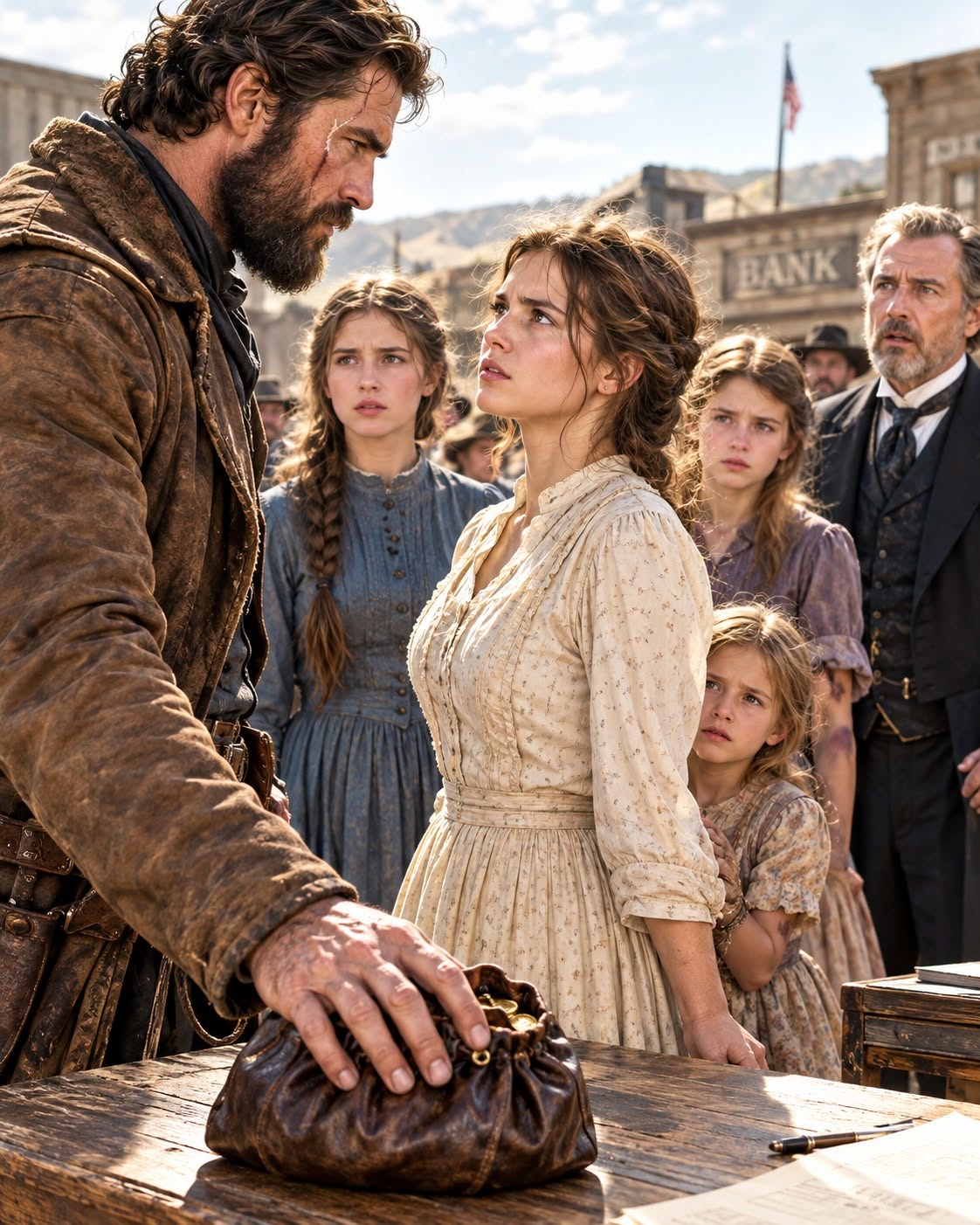
FOUR ORPHANED SISTERS WERE PUT UP FOR AUCTION — BUT THE SCARRED MOUNTAIN MAN WHO PAID THEIR DEBT HAD A REASON NO ONE EXPECTED
PART 3 — THE MOUNTAIN MAN’S LAST PROMISE
The cabin on Black Elk Ridge was larger than Nora expected.
It stood beside a clear mountain stream, surrounded by pine trees and a wide stretch of meadow.
There was a stone fireplace, a long wooden table, two bedrooms, and a small loft.
A barn stood behind the house.
And beside the porch grew four young apple trees.
Josie ran toward them.
“Are these yours?”
Gideon climbed down from the wagon.
“They are now yours to look after.”
Josie looked delighted.
“All four?”
“One for each sister.”
Maeve crossed her arms.
“What if we kill them?”
“Then we’ll plant four more.”
Clara smiled.
Nora watched him carefully.
He had not asked them to cook, clean, or work.
He had simply opened his door.
That evening, Gideon prepared a large pot of beef stew. The meal was simple, but there was enough for everyone.
Josie fell asleep at the table.
Clara carried her to the bedroom.
Maeve sat near the fire, staring at the flames.
Nora remained at the table.
“Why do you live alone?” she finally asked.
Gideon stopped washing a plate.
“Because I got used to it.”
“That’s not an answer.”
He gave a faint smile.
“You ask questions like your father.”
Nora waited.
Gideon dried his hands.
“I had a wife once. Her name was Eleanor. We lost our little boy during his first winter. Eleanor never recovered from the grief. She died the following spring.”
He looked toward the dark window.
“After that, I couldn’t bear the sound of an empty house. So I moved farther into the mountains, where there was nothing to remind me of what I’d lost.”
Nora’s expression softened.
“I’m sorry.”
“Me too.”
He glanced toward the bedroom.
“That’s why I didn’t hesitate when I heard what the bank was doing to you.”
Nora looked down.
“You saw four girls about to lose their home.”
“I saw four children who deserved better than I got.”
The next morning, Gideon took Nora to inspect the old Hayes property.
It lay about six miles from his cabin, near a creek and a grove of cottonwood trees.
The house was weather-beaten, but the roof was still sound. The barn needed repairs, and the fence had fallen in several places.
Nora stood on the porch.
She remembered her father sitting there, carving little wooden animals for Josie.
“He wanted us to live here,” she whispered.
Gideon nodded.
“He told me he planned to move your family west once the business was secure.”
Nora turned toward him.
“Then why did he leave the property unfinished?”
“Because he got sick before he could finish.”
She walked into the house.
A thin layer of dust covered the furniture.
On the kitchen shelf sat a chipped blue cup.
Her mother’s cup.
Nora picked it up with trembling hands.
For several moments, she could not speak.
Gideon stood quietly behind her.
Then she noticed something carved into the underside of the table.
Four little names.
Nora.
Clara.
Maeve.
Josie.
And beneath them, two more words.
Always together.
Nora pressed her hand against the carving.
Her father had known exactly what he was building.
A home for his daughters.
Not a fortune.
Not a business empire.
A place where they could grow up without fear of being separated.
That afternoon, Gideon brought a carpenter to examine the house.
But before they could begin repairs, a rider appeared on the road.
It was the sheriff.
“Rust! I need to speak with you.”
Gideon stepped onto the porch.
“What is it?”
The sheriff handed him a folded document.
“Farrow has filed a claim against the Hayes property.”
Nora came outside.
“On what grounds?”
The sheriff looked uncomfortable.
“He says the timber business was transferred to him before Thomas died. According to this paper, Gideon Rust signed as a witness.”
Nora looked at Gideon.
He read the document.
His expression turned cold.
“This is forged.”
The sheriff nodded.
“That’s what I thought. But Farrow has a witness who claims he saw you sign it.”
“Who?”
The sheriff hesitated.
“Silas Bell.”
Nora felt betrayed.
“Silas gave us the ledger. He told the truth.”
“Perhaps he did,” the sheriff replied. “But Farrow has offered him money, and now he’s changed his statement.”
Gideon folded the document.
“Then I’ll speak to him.”
“No,” Nora said.
Both men turned.
She stepped forward.
“Silas is frightened. If you threaten him, he’ll only become more afraid.”
Gideon studied her.
“What do you suggest?”
“Find out what Farrow is holding over him.”
The sheriff gave her a surprised look.
“You’re sharp, Miss Hayes.”
Nora’s expression hardened.
“I’ve had to be.”
The following morning, Nora returned to Red Creek with Clara.
Gideon objected at first, but Nora insisted.
“I’m twenty years old. I’m not going to spend the rest of my life hiding in a cabin because men with money think they can frighten me.”
Gideon finally agreed.
They found Silas Bell behind the old livery stable.
He looked exhausted.
Nora approached slowly.
“Silas.”
He turned.
“I don’t have anything to say.”
“You told us the truth once. Why change your story?”
He glanced around nervously.
“Farrow knows where my daughter lives.”
 Nora’s face softened.
“He’s threatening her?”
Silas nodded.
“He says he’ll have her husband arrested for theft unless I testify that Gideon signed the transfer.”
Clara stepped forward.
“That’s wicked.”
Silas wiped his forehead.
“I have no choice.”
Nora looked directly at him.
“You do. You can keep helping him hurt people, or you can tell the truth and let the sheriff protect your family.”
Silas shook his head.
“You don’t understand what Farrow can do.”
Nora reached into her coat and pulled out her father’s letter.
“My father trusted Gideon when everyone else thought he was nothing. He trusted him because Gideon did the right thing even when it cost him.”
She held the letter out.
“He paid our debt when he could have walked away. He gave us a home when he had every reason to keep living alone.”
Her voice trembled, but she continued.
“How many more families must lose everything before you decide your daughter deserves a better world?”
Silas stared at her.
Then his shoulders collapsed.
“I’ll testify.”
The hearing took place three days later.
The courthouse was packed.
Farrow sat beside his attorney, looking confident.
Gideon stood at the opposite table with Nora and the sheriff.
Silas was called first.
He described the original timber loan, the payment made by Thomas Hayes, and the instructions he had received to alter the bank’s records.
Then he revealed that Farrow had threatened his family.
Farrow’s attorney objected repeatedly.
But the sheriff produced the original ledger and the copy Silas had kept.
Finally, Nora was called.
She stood before the judge with her father’s letter in one hand.
“Miss Hayes,” the judge began, “do you understand why you’re here?”
“Yes, Your Honor.”
“Tell us what you know.”
Nora described the auction, the banker’s claims, and the moment Gideon paid the debt.
Then she placed her father’s letter on the table.
“He wrote that this land was meant to be our home. He never gave it to Mr. Farrow. He never authorized anyone to sell it.”
Farrow stood abruptly.
“That letter is meaningless!”
The judge raised his hand.
“Sit down, Mr. Farrow.”
Nora continued.
“My sisters and I lost our parents. We lost our home. We were brought into the town square and offered to strangers like livestock.”
Her voice shook.
“But we were never a debt. We were never property. We are four human beings who deserve the chance to build our own lives.”
The courtroom fell silent.
She turned toward Gideon.
“This man paid the money because he believed our father’s promise mattered. He didn’t ask us to belong to him. He helped us become free.”
The judge looked at Gideon.
“Mr. Rust, is that true?”
Gideon stood.
“Yes, sir.”
“Why did you pay the debt?”
Gideon looked at Nora, Clara, Maeve, and Josie.
“Because their father once saved my life. And because I couldn’t let the last thing he built for his daughters be taken by a dishonest man.”
The judge examined the evidence for several minutes.
Then he delivered his ruling.
The bank’s claim was dismissed.
The Hayes property was restored to the sisters.
Farrow’s fraudulent accounts were referred for criminal investigation.
And the attempted auction was declared unlawful.
Outside the courthouse, people crowded around the four sisters.
Some offered apologies.
Others congratulated them.
Maeve looked at Nora.
“Does this mean we’re rich?”
Nora laughed through her tears.
“No.”
Maeve sighed.
“Then what was all that excitement for?”
Clara laughed.
Gideon looked down at Josie, who was holding his enormous hand.
“It means you’re free, little one.”
Josie smiled.
“Good. Because I want an apple tree.”
Summer arrived on Black Elk Ridge.
The old Hayes house was repaired, the barn was rebuilt, and the four apple trees beside Gideon’s cabin began producing their first leaves.
Clara started a small school for younger children in the valley.
Maeve helped Gideon manage the livestock, although she insisted that she was better at handling horses than he was.
Josie followed him everywhere, asking questions about bears, mountains, and why his beard was so large.
Nora took responsibility for the family’s finances and began rebuilding the timber business her father had started.
Gideon helped her negotiate contracts, but he never treated her like someone who needed to be rescued.
Instead, he listened.
He trusted her judgment.
And slowly, the enormous mountain man who had once avoided every human being began to find himself surrounded by laughter.
One evening, Nora found him sitting on the porch, holding an old pH๏τograph.
It was the picture of him and her father.
“You miss him,” she said.
“Every day.”
Nora sat beside him.
“So do I.”
For a while, they watched the sunset.
Then Gideon spoke.
“Your father once told me something before he left for the west.”
Nora turned.
“He said that a man’s life wasn’t measured by how much land he owned or how much money he carried. It was measured by how many people could sleep safely because he was alive.”
He looked toward the house.
“I didn’t understand him then.”
“And now?”
Gideon smiled faintly.
“Now I have four reasons to understand.”
Nora’s eyes filled.
“You gave us our lives back.”
He shook his head.
“No. Your father gave you a future. I only helped keep it from being stolen.”
She leaned her shoulder against his arm.
“You gave us somewhere to begin again.”
Gideon looked at her.
For the first time, his scarred face held no trace of loneliness.
That autumn, the sisters held a small gathering at the Hayes ranch.
Neighbors came with food, music, and gifts.
A new sign hung above the front gate:
HAYES FAMILY RANCH — ALWAYS TOGETHER.
Josie ran through the yard carrying four small apples.
Maeve chased her.
Clara stood near the kitchen, laughing with the women from the valley.
Nora watched them from the porch.
Gideon approached with two cups of coffee.
“Looks like you’ve built yourself quite a home.”
Nora smiled.
“We built it together.”
He nodded.
Then she reached into her pocket and handed him a small envelope.
Inside was a letter written by all four sisters.
Dear Gideon,
You paid a debt that was never ours to carry.
You gave us a home without asking us to give up our freedom.
You protected our family when the world had decided we were worth less than a wagon and a few horses.
We cannot repay you with gold.
But if you ever find yourself wondering whether you belong somewhere, remember this: you have a place at our table, a chair beside our fire, and four people who will always be grateful that you came down from the mountain.
With love,
Nora, Clara, Maeve, and Josie.
Gideon read the letter twice.
Then he folded it carefully and slipped it into his coat.
His eyes were wet.
“Your father would be proud.”
Nora smiled.
“I think he already knew you’d do something wonderful.”
Gideon looked toward the four sisters.
The man who had once believed his life ended with the death of his wife and child now stood surrounded by a family he had never expected to find.
He had entered Red Creek with a pouch of gold.
He had left with something worth far more.
A reason to wake up.
A place to belong.
And four sisters who would never again have to wonder whether the world had room for them.
The town had watched four orphaned girls being offered to the highest bidder.
But the scarred mountain man had seen something entirely different.
He had seen four lives worth protecting.
And when he placed his gold on that auction table, he wasn’t buying a family.
He was making sure no one could ever sell one again.