Indian Baby Girl Weighed 25 Kilograms at Just 16 Months Old: A Rare Genetic Disorder Left Her Constantly Hungry and Unable to Walk
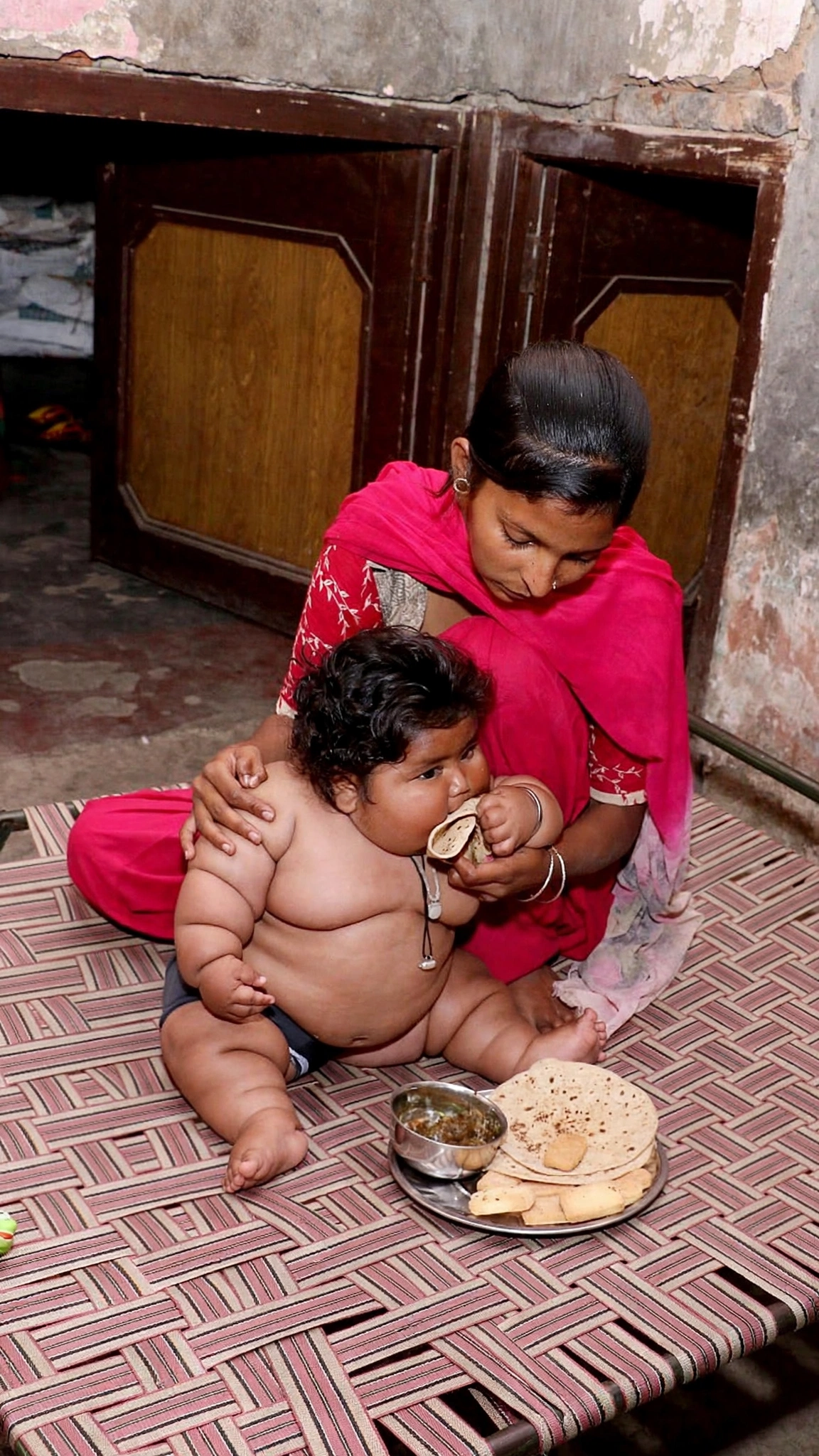
👶 Chahat Kumar, a little girl from Amritsar in Punjab, northern India, shocked many people when she weighed an astonishing 25 kilograms at just 16 months old. Behind her unusually rapid weight gain was a rare medical condition that caused her body to constantly signal hunger, even after eating large amounts of food.
When Chahat was born, she appeared just like any other healthy newborn. She weighed approximately 3 kilograms, and there were no obvious signs that anything was wrong.
However, things began to change when she was around two months old.
According to her mother, Chahat cried frequently because she wanted to be fed. Sometimes, she demanded milk as often as every 30 minutes. Her appeтιтe seemed almost impossible to satisfy, and her weight began increasing at an alarming rate.
By the time she was six months old, Chahat already weighed approximately 15 kilograms, nearly twice the weight of many babies her age. At just 16 months, her weight had reached 25 kilograms.
💔 Her rapidly increasing weight made even the simplest movements extremely difficult. Her tiny legs struggled to support her body, leaving her unable to stand steadily or walk independently like other toddlers.
Whenever she wanted to move around, she often had to crawl or drag herself along the floor. According to reports, she could not remain standing for more than approximately 20 seconds.
Her mother explained that Chahat loved the idea of going outside and playing, but taking her places was difficult because of her weight and limited mobility.
Her appeтιтe also placed an enormous burden on the family. Her parents reportedly had to prepare unusually large portions of food, sometimes comparable to what a 10-year-old child might eat, because Chahat seemed hungry almost all the time.
🩺 After several medical visits without a clear explanation, the family eventually learned that Chahat was believed to have leptin deficiency, an extremely rare disorder affecting the body’s natural appeтιтe-regulation system.
Leptin is a hormone produced primarily by fat cells. It plays an important role in communicating with the brain about the body’s energy stores and helping regulate hunger and fullness.
When someone has a congenital leptin deficiency, the brain may not receive the normal signals that indicate sufficient energy reserves. As a result, the person can experience persistent hunger, excessive food intake, and severe early-onset obesity.
Medical specialists explain that extreme obesity beginning in infancy or early childhood can sometimes be ᴀssociated with rare genetic abnormalities affecting appeтιтe, body weight, and energy balance.
😢 Chahat’s family faced serious financial difficulties. Her father, Suraj Kumar, worked as a driver to support the household. Her parents were heartbroken when they saw their daughter being mocked by people because of her unusual appearance.
Fortunately, after Chahat’s story was published by a local magazine, the family received an opportunity for medical ᴀssistance.
When she was approximately nine months old, she reportedly received free medical support at the Postgraduate Insтιтute of Medical Education and Research (PGIMER) in Chandigarh.
However, treatment was not easy. The hormone medication needed to manage her condition was extremely expensive and not always readily available. Reports at the time described an injectable treatment, administered in a way similar to insulin injections.
❤️ Chahat’s story touched many hearts because she was still so young. She could not understand why her body constantly told her she was hungry, why her little legs struggled to carry her, or why she could not run and play like other children.
Her unusual weight was not simply the result of overeating or poor eating habits. It was linked to a rare medical condition requiring specialized diagnosis and treatment.
This little girl deserved the chance to enjoy childhood, play freely, attend school, and grow up surrounded by love rather than curious stares or hurtful comments about her appearance.
🌈 May Chahat and all children facing rare medical conditions be blessed with good health, strength, happiness, and a future filled with love, care, and hope.