PART 3: THE SHERIFF’S BETRAYAL — AND THE WOMAN WHO FORCED A LONELY MOUNTAIN MAN TO FIGHT FOR LOVE
PART 3: THE SHERIFF’S BETRAYAL — AND THE WOMAN WHO FORCED A LONELY MOUNTAIN MAN TO FIGHT FOR LOVE
Cyrus didn’t open the door.
He raised his rifle and stepped away from the window.
“Dalton, take three steps backward.”
Silence.
Then came a chuckle.
“Still suspicious of everyone, Creed?”
“Especially men who knock after midnight.”
The sheriff sighed.
“Fine. I suppose you want proof.”
A folded badge slid beneath the door.
Cyrus glanced down.
The silver star was real.
But the name engraved across its center was not.
The badge belonged to Sheriff Dalton, yet the number was different from the one Cyrus remembered seeing in Orofino.
“That’s not your badge,” Cyrus called.
A gunsH๏τ shattered the window.
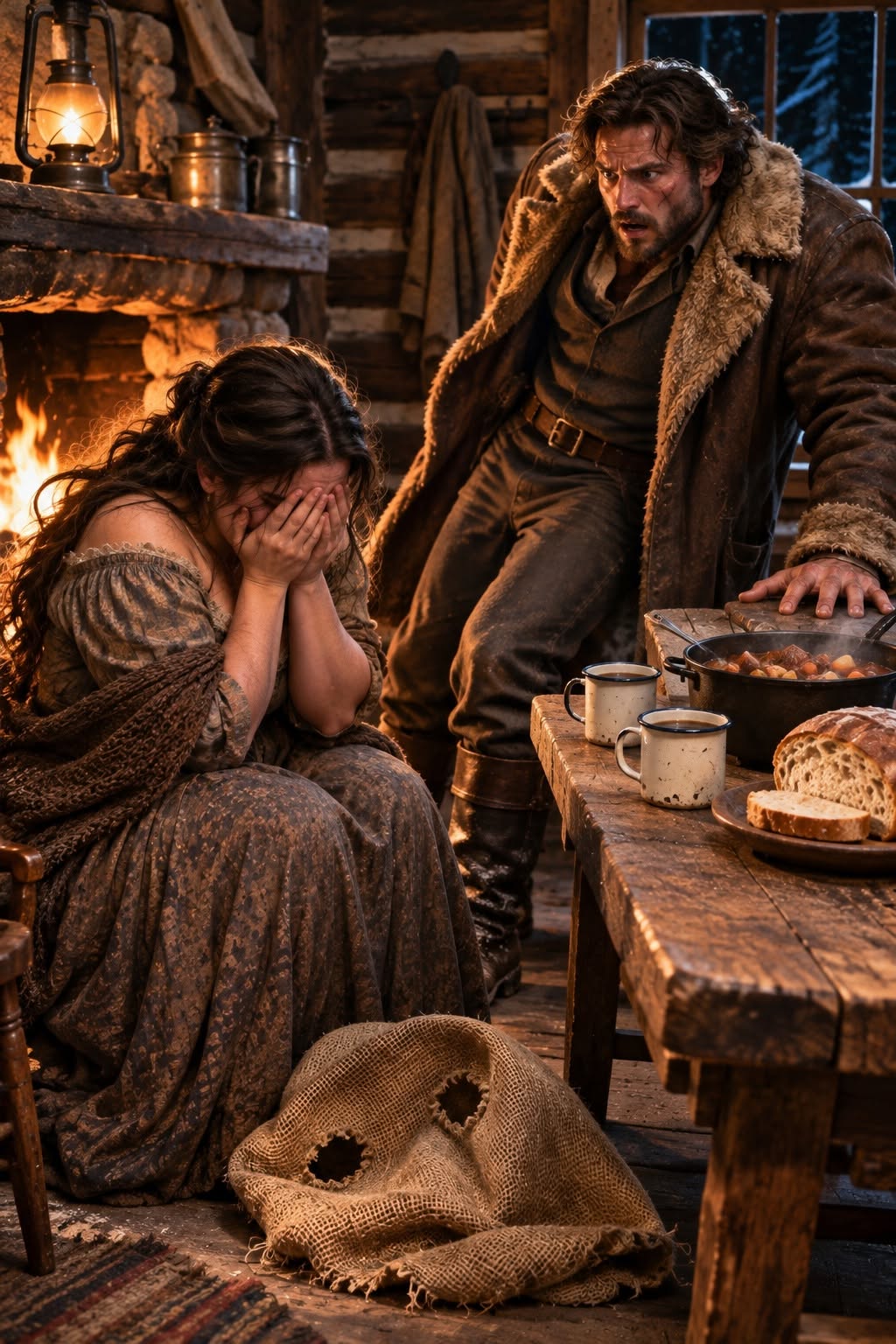
Cyrus grabbed Josephine and threw them both behind the heavy table.
Another bullet struck the fireplace.
“They’re not here to arrest us,” Josephine whispered.
“No.”
Cyrus loaded his rifle.
“They’re here to make sure we never reach morning.”
He pointed toward the back room.
“There’s a cellar beneath the floorboards. Get inside.”
Josephine shook her head.
“I’m not leaving you.”
“That’s an order.”
“I’m not your prisoner, Cyrus.”
He stared at her.
 Even now, with armed men outside, she refused to let someone else decide what she should do.
For the first time, he understood just how much courage had survived beneath all that humiliation.
“Then stay behind me.”
The back door exploded inward.
Two men rushed into the cabin.
Cyrus fired once.
The first man fell against the doorframe. The second ducked behind the woodpile.
Josephine crawled toward the fireplace, where Cyrus kept a small hunting knife.
She heard boots moving overhead.
Then a third man appeared at the window.
He aimed directly at Cyrus.
Josephine grabbed the iron kettle from the stove and hurled it.
The boiling water struck the man’s arm.
His revolver dropped.
Cyrus turned and knocked him unconscious with the ʙuтт of his rifle.
For several minutes, the cabin became a battlefield.
Then silence returned.
Outside, horses thundered away through the snow.
Cyrus checked the injured men and found a letter inside one man’s coat.
The handwriting belonged to Jeremiah Higgins.
It contained a single instruction:
Bring the girl alive. Kill Creed.
Josephine read it over his shoulder.
Her face crumpled.
“I brought this to your door.”
Cyrus turned toward her.
“No.”
“They wanted you ᴅᴇᴀᴅ because of me.”
“They wanted me ᴅᴇᴀᴅ seven years ago. You simply brought the reason back into my life.”
He placed a hand on her shoulder.
“And I’m not letting them finish what they started.”
The next morning, Cyrus and Josephine traveled to Orofino.
They took the captured men directly to the federal marshal, along with the medallion, the pH๏τograph, and the letter.
At first, the marshal was skeptical.
Then Josephine produced the last piece of evidence.
A small handwritten note hidden inside the lining of her valise.
Her father had written it shortly before his death.
It contained the location of the missing Blackridge ledger.
A buried iron box beneath the abandoned mill outside town.
That afternoon, a team of federal officers searched the property.
They found the box exactly where Samuel Whitcomb had described.
Inside were account books, forged deeds, letters, and a list of payments made to officials throughout Idaho.
Among the names was Jeremiah Higgins.
And beneath his name was the signature of Sheriff Dalton.
The real sheriff was found ᴅᴇᴀᴅ in a storage building outside town.
The man who had come to Cyrus’s cabin had been an impostor.
The discovery sent shockwaves through Orofino.
Several land speculators were arrested. Two judges resigned before warrants could be served. The Blackridge Company lost its influence almost overnight.
But the greatest revelation came three days later.
The federal marshal summoned Cyrus and Josephine to his office.
He placed a document on the desk.
“Miss Whitcomb, according to these records, your father transferred ownership of his remaining property into your name before he died.”
Josephine looked confused.
“What property?”
“Three thousand acres along the Clearwater River. Including the timber rights and the old mill.”
She stared at the paper.
Her father hadn’t left her penniless.
He had left her a future.
A future that men had tried to steal by convincing the world she was too ugly, too helpless, and too worthless to defend herself.
Josephine began to cry.
This time, they were not tears of shame.
They were tears of relief.
Cyrus stood beside her, silent.
When they returned to the mountain cabin, the first spring thaw had begun.
Snow melted from the roof.
The creek ran beneath the ice.
And for the first time in years, Cyrus felt that the mountains were no longer trying to bury him alive.
One evening, he found Josephine standing beside the fireplace, holding the burlap sack.
“I want to burn this.”
Cyrus looked at it.
“Then burn it.”
She threw it into the flames.
The coarse fabric curled and blackened.
“I spent so long believing I was something terrible,” she whispered. “I started to believe that perhaps everyone was right.”
Cyrus stepped closer.
“Look at me.”
She did.
“You know what I saw when I first removed that sack?”
Josephine lowered her eyes.
“I saw a woman who had been hurt by people who needed her to believe she was worthless.”
He gently lifted her chin.
“And I saw something else.”
“What?”
“Someone who had survived them.”
Her eyes filled again.
Cyrus touched the scar running along his jaw.
“Do you know why I lived alone for so long?”
She shook her head.
“I thought this face made me unworthy of being loved. Every time someone looked at me, I ᴀssumed they saw a monster.”
Josephine reached up and traced the edge of his scar with her fingertips.
“I don’t see a monster.”
Cyrus closed his eyes.
For seven years, nobody had touched that scar without flinching.
And now this woman, who had been taught to hate her own reflection, was looking at him as though there was nothing about him she needed to fear.
“I don’t want you to stay because you owe me fifty dollars,” he whispered.
She smiled faintly.
“I don’t owe you anything.”
“I know.”
“I don’t want to stay because I have nowhere else to go.”
“I know that, too.”
She stepped closer.
“Then perhaps I’ll stay because I like the coffee, the mountains, and the terribly stubborn man who lives here.”
Cyrus laughed.
It was a rough, unfamiliar sound.
But it was real.
“That’s a mighty poor reason.”
“Then I’ll find a better one.”
He took her hands.
“Josephine Whitcomb, would you consider building a life with me?”
She looked toward the fire.
Then back at him.
“Only if you promise never to hide from me.”
“I promise.”
“And no more pretending you don’t need anyone.”
He nodded.
“That may be the hardest promise you’ve asked me to make.”
She smiled.
“Then it’s the one that matters most.”
Six months later, Cyrus and Josephine married beneath a great pine tree overlooking the Clearwater Valley.
The ceremony was small.
The federal marshal attended. So did several families whose land had been restored through Josephine’s father’s evidence.
Josephine wore a simple ivory dress.
No burlap.
No veil hiding her face.
And when Cyrus took her hand, he looked at her as though he had found something more valuable than every acre of land in Idaho.
After the wedding, they returned to the cabin.
Josephine planted flowers beside the porch.
Cyrus repaired the roof, built a larger kitchen, and finally purchased a proper dining table.
One evening, as the sun disappeared behind the mountains, Josephine found him standing by the window.
“What are you thinking about?” she asked.
He turned.
“That the first night you came here, I thought someone had brought trouble to my doorstep.”
She laughed.
“And now?”
“Now I think someone brought me the life I had given up hoping for.”
Josephine walked into his arms.
The old burlap sack had been burned.
The men who had hunted her were gone.
And the mountain man who had once believed his scars made him unworthy of love finally understood that a person’s face was never the measure of their heart.
Because the woman the entire town had called hideous was the woman who uncovered the ugliest men in Idaho — and taught a lonely mountain cowboy that even the most broken hearts could find their way home.