Brody The Baby Born With an Extremely Rare and Severe Cleft Lip and Palate
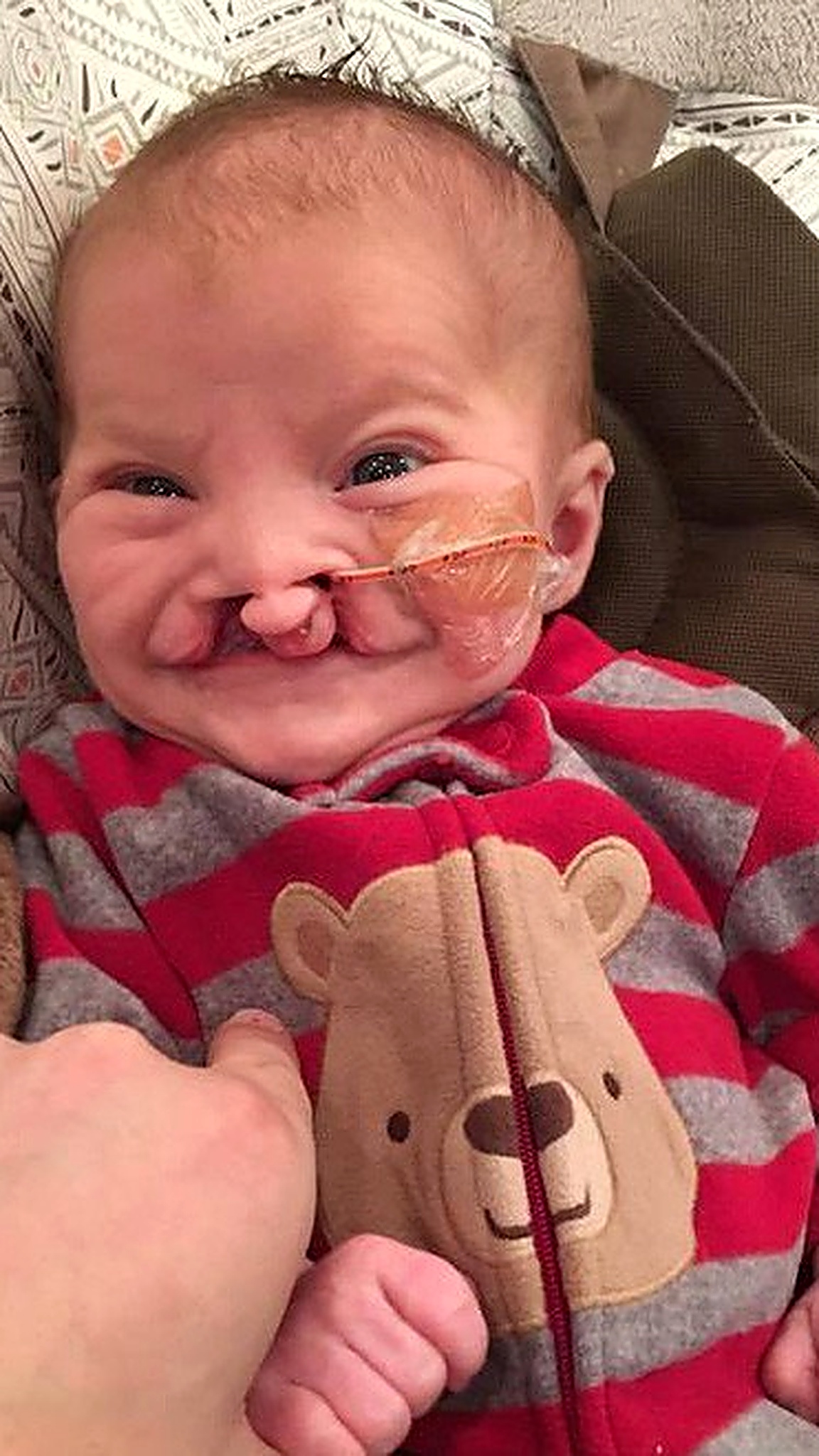
When little Brody was born, his family was faced with an unexpected and heartbreaking discovery. Their newborn son had an extremely severe facial birth defect that affected the development of his upper lip, nose, and roof of his mouth.
Unlike the more common forms of cleft lip, which may appear as a relatively small opening on one side of the upper lip, Brody’s abnormality was much more extensive.
The opening extended from his upper lip toward his nostril, creating a large separation in the middle of his face. He also suffered from a severe cleft palate, meaning that the roof of his mouth had failed to develop completely.
According to the information provided about his case, doctors reportedly said that only around nine similar cases had been identified worldwide.
For Brody and his family, this diagnosis marked the beginning of a challenging medical journey involving specialized treatment and potentially multiple reconstructive operations.
What Is a Cleft Lip and Cleft Palate?
Cleft lip and cleft palate are congenital abnormalities that develop during the early stages of pregnancy.
During normal fetal development, the tissues that form the upper lip and the roof of the mouth gradually grow and join together.
When this process does not happen completely, an opening remains in the affected structures.
A cleft lip occurs when the tissues forming the upper lip fail to fuse properly. The opening may appear on one side or both sides of the lip.
In more extensive cases, the cleft can extend upward toward the nostril, affecting the shape of the nose and the surrounding facial tissues.
A cleft palate occurs when the structures forming the roof of the mouth do not join completely, leaving an opening between the oral and nasal cavities.
Some children are born with both conditions, creating a more complex abnormality that affects several parts of the face.
Why Was Brody’s Condition So Unusual?
The most striking aspect of Brody’s condition was the extensive separation affecting his upper lip and the area around his nose.
In less severe cases, a cleft may involve only a small portion of the upper lip.
However, in Brody’s case, the opening reportedly extended much farther, reaching toward his nostril and involving deeper facial structures.
Severe facial clefts can sometimes affect the underlying muscles, cartilage, and bones that support the upper lip and nose.
Depending on the exact anatomical pattern, specialists may classify extensive facial clefts using the Tessier classification system, which describes different types of craniofacial clefts.
However, the precise classification of Brody’s condition cannot be established from the description alone.
The reported estimate of only nine similar cases worldwide also requires confirmation from the original medical records or the doctors involved.
How Can a Severe Cleft Affect a Newborn?
A severe cleft lip and palate can create several medical difficulties from the first days of life.
One of the most immediate challenges is feeding.
Babies normally create suction with their lips and mouths to breastfeed or drink from a bottle. When the upper lip and palate are severely affected, creating and maintaining this suction can become extremely difficult.
Because the mouth and nasal cavity are connected through the opening in the palate, milk may also escape through the baby’s nose during feeding.
This can make feeding sessions longer and more exhausting, increasing the risk of inadequate nutrition if appropriate support is not provided.
Specialized feeding bottles, positioning techniques, and nutritional monitoring may be necessary.
As the child grows, additional challenges may emerge.
Possible Long-Term Complications
Children with severe cleft lip and palate may experience several complications involving speech, hearing, dental development, and facial growth.
Speech difficulties
The palate plays an essential role in producing many speech sounds. When it does not close properly, air can escape through the nose during speech.
This may result in hypernasal speech, difficulty pronouncing certain sounds, and delayed speech development.
Dental abnormalities
A cleft extending toward the upper jaw may affect the development and alignment of the teeth.
Some children may have missing, unusually positioned, or malformed teeth near the affected area.
Orthodontic treatment and specialized dental care may be necessary as they grow.
Hearing problems
Children with cleft palate have an increased risk of middle-ear problems because the muscles responsible for opening the Eustachian tubes may not function normally.
This can lead to fluid accumulation behind the eardrum, recurrent ear infections, and temporary hearing difficulties.
Regular hearing examinations are therefore important.
Facial development
In more extensive clefts, the development of the upper jaw, nose, and surrounding facial structures may also be affected.
Some children require additional procedures to improve facial symmetry and function.
Can Severe Cleft Lip and Palate Be Reconstructed?
Although a severe cleft can dramatically change a baby’s facial appearance, modern reconstructive surgery offers important treatment possibilities.
The treatment process usually requires a multidisciplinary medical team.
The first priority is ensuring that the baby can feed safely and receive adequate nutrition.
When the child is medically ready, surgeons may perform cleft lip repair to reconstruct the upper lip and restore the natural relationship between the lip and nose.
A separate procedure, known as palatoplasty, is used to close the opening in the roof of the mouth.
The timing of these operations depends on the child’s overall health, the severity of the defect, and the treatment plan established by specialists.
Some children with particularly complex facial abnormalities require additional surgeries during childhood.
Speech therapy, dental treatment, hearing monitoring, and orthodontic care may also form part of their long-term treatment.
A Long Journey Filled With Hope
For Brody’s family, learning that their newborn son had such an unusual and severe facial abnormality must have been an overwhelming experience.
Instead of focusing only on the excitement of bringing home a new baby, they had to consider feeding difficulties, surgical treatment, and the possibility of years of medical follow-up.
His condition may make his early childhood more complicated than that of other children, but it does not determine his worth or the future he deserves.
With appropriate treatment, many children born with cleft lip and palate can develop improved facial function, clearer speech, and better oral health.
Brody’s story highlights the importance of specialized medical care and continued support for families raising children with rare congenital abnormalities.
Behind the severe facial defect is a little boy who deserves the same opportunities as every other child: to eat comfortably, speak confidently, smile freely, attend school, and grow up surrounded by love.
A birth defect may change the way a child looks, but it should never change how much that child deserves to be loved.