A Baby Girl Born Without an Anus or a Left Kidney: Her Fight Against Multiple Congenital Conditions
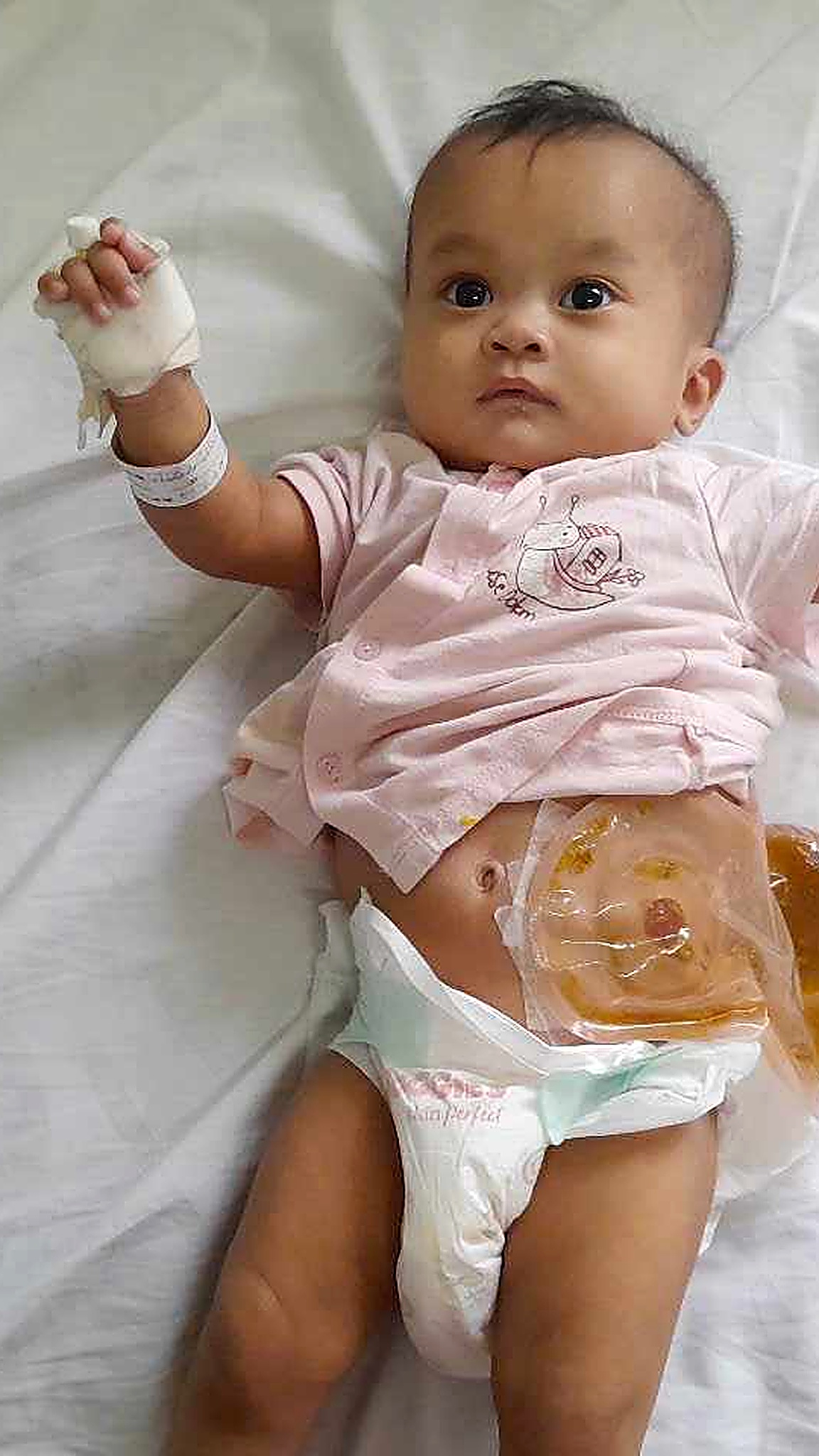
“When my daughter was born, she had no anus and no left kidney. She only had a right kidney, but it was affected by hydronephrosis.”
For one mother, these words describe the heartbreaking reality she faced when welcoming her newborn daughter into the world.
Every parent hopes that their child will be born healthy. They imagine holding their baby for the first time, hearing her cry, and bringing her home to begin a new life together. But for this family, the joy of childbirth was quickly overshadowed by the discovery of several serious congenital abnormalities.
The baby girl had been born with multiple conditions affecting two important parts of her body: her digestive system and her urinary system.
Her medical challenges began with an abnormality that prevented her from having a normal anal opening. Doctors also discovered that her left kidney had never developed. Even more concerning was the fact that her only remaining kidney, the right one, was affected by a condition called hydronephrosis.
Born Without a Normal Anal Opening
One of the first major abnormalities identified in the baby was the absence of a normal anal opening.
This condition is medically known as imperforate anus, also called an anorectal malformation. It is a congenital defect that develops before birth, when the lower part of the digestive tract does not form properly.
In a typical newborn, the rectum connects to an opening at the end of the digestive tract, allowing stool to pᴀss out of the body.
However, in babies with imperforate anus, this opening may be completely absent, incorrectly positioned, or connected to another structure through an abnormal pᴀssage known as a fistula.
The severity of the condition varies from one child to another. In some cases, the rectum ends in a closed pouch rather than reaching the surface of the body. In others, an abnormal connection may form between the rectum and the urinary or reproductive system.
Without a normal pᴀssage for stool, the baby cannot eliminate waste in the usual way. If the condition is not treated, intestinal contents can accumulate and cause serious complications.
Doctors must carefully examine the anatomy of the digestive tract to determine the exact type of malformation and the most appropriate treatment.
Depending on the baby’s condition, surgery may be necessary to create a functional anal opening. Some infants require a temporary colostomy, allowing stool to exit through an opening in the abdominal wall while the digestive system is being treated.
For this little girl, the absence of a normal anal opening represented one of the first major challenges she would have to face.
A Missing Left Kidney
The second major discovery was that the baby girl had been born without a left kidney.
This condition is known as unilateral renal agenesis. It occurs when one kidney fails to develop during pregnancy.
The kidneys play an essential role in the human body. They filter waste products from the blood, regulate fluid and electrolyte balance, help control blood pressure, and contribute to the production of hormones involved in red blood cell formation.
Most people are born with two kidneys. However, some babies develop with only one because the other kidney never forms.
Children with a single healthy kidney can often grow and live normal lives. The remaining kidney may gradually enlarge and compensate for some of the work normally performed by two kidneys.
Nevertheless, these children need regular medical examinations to monitor kidney function, blood pressure, and urine protein levels.
In this baby’s case, the situation was more complicated because her only existing kidney was not entirely healthy.
Hydronephrosis Affecting Her Only Remaining Kidney
Although the baby had a right kidney, her mother explained that it was affected by hydronephrosis.
Hydronephrosis is a medical condition in which urine accumulates inside the kidney, causing the kidney’s collecting system to become enlarged.
Normally, urine flows from the kidneys through narrow tubes called ureters and eventually reaches the bladder, where it is stored before leaving the body.
When this drainage process is disrupted, urine can build up inside the kidney.
There are several possible causes, including a blockage in the urinary tract, an abnormal narrowing where the kidney connects to the ureter, or vesicoureteral reflux, a condition in which urine flows backward toward the kidneys.
The severity of hydronephrosis can vary considerably. Some cases are mild and improve with time, while others require medical intervention to prevent damage to the kidney.
For a child with two kidneys, hydronephrosis affecting one kidney is already a condition that requires careful evaluation.
For this baby girl, however, the concern was even greater because her right kidney was her only kidney.
Doctors would need to determine how well it was functioning, whether urine was draining normally, and whether there was any obstruction or other abnormality threatening its health.
Depending on the underlying cause and severity, treatment may involve regular ultrasound examinations, additional urinary tract imaging, antibiotics when indicated, or surgery to restore proper urine drainage.
Protecting the function of her remaining kidney would be one of the most important priorities in her medical care.
The Challenges of Having Multiple Congenital Abnormalities
The combination of an anorectal malformation and a congenital kidney abnormality raises important medical concerns.
These two systems develop during early pregnancy, and certain congenital conditions can affect both the digestive and urinary tracts.
Children born with anorectal malformations may have additional abnormalities involving the kidneys, urinary tract, spine, heart, or reproductive organs.
For this reason, doctors often recommend a comprehensive evaluation to identify any ᴀssociated conditions.
One group of abnormalities doctors may consider is VACTERL ᴀssociation, which involves a combination of vertebral, anorectal, cardiac, tracheoesophageal, renal, and limb abnormalities.
However, the presence of an anorectal malformation and a kidney abnormality alone does not establish this diagnosis. Further examinations are necessary to determine whether the child has this or another underlying condition.
The baby’s medical team may include pediatric surgeons, pediatric nephrologists, urologists, and other specialists working together to develop an appropriate treatment plan.
A Mother’s Love in the Face of Uncertainty
For the mother, discovering that her daughter had been born without an anus and without a left kidney was devastating.
The situation became even more frightening when she learned that the baby’s only remaining kidney was affected by hydronephrosis.
Instead of spending the first days of motherhood simply enjoying her newborn, she had to confront difficult medical information, possible operations, and concerns about her daughter’s future.
Every examination and every medical update could bring new questions.
Would her daughter be able to pᴀss stool normally after treatment? Would her remaining kidney continue to function properly? Would she need additional surgeries as she grew older?
These were questions that no mother would ever want to face.
Yet her daughter was more than her medical conditions. She was a little girl who deserved care, protection, and the opportunity to experience childhood.
Her journey would require close medical supervision and potentially multiple treatments, but the goal would remain the same: to give her the best possible chance at a healthy future.
Her story reminds us that some children enter the world facing challenges that most people cannot imagine. It also highlights the importance of early diagnosis, specialized medical care, and continued support for families raising children with complex congenital conditions.