The Teardrop Pattern That Conquered the World—and the Scottish Town That Gave It a Name
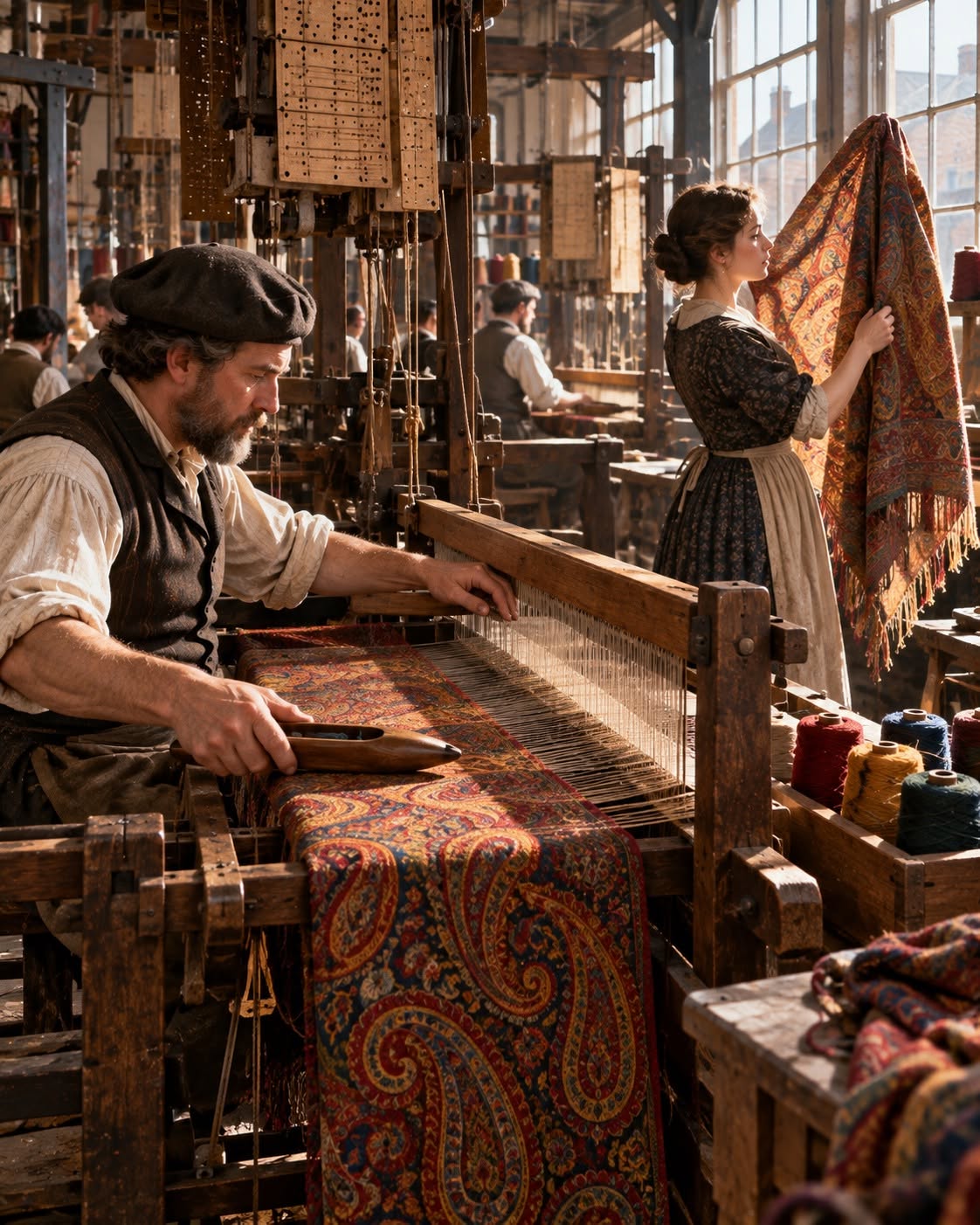
Today, the design is known as Paisley, named after a small Scottish town that helped turn an ancient artistic tradition into a worldwide fashion phenomenon.
But the story began far from Scotland.
Long before the name Paisley became famous, artisans in Persia and India were creating intricate motifs known as boteh or buta. Resembling curved teardrops, leaves, or tiny flowering shoots, these designs appeared on beautiful textiles prized for their colour and craftsmanship.
Among the most celebrated were the woollen shawls woven in Kashmir. Their delicate patterns and exceptional quality made them treasured possessions, symbols of elegance that eventually caught the attention of British officers and merchants returning from India in the late 18th century.
Soon, fashionable women across Britain wanted these exotic shawls. Unfortunately, genuine Kashmiri pieces were so expensive that only the wealthiest could afford them.
British textile makers saw an opportunity.
In Scotland, the town of Paisley already possessed a thriving weaving industry. Its skilled workers began producing their own versions of the fashionable shawls, experimenting with colours, intricate arrangements, and increasingly elaborate teardrop motifs.
The work demanded patience and extraordinary skill. Every pattern had to be carefully planned, every colour placed with precision. As weaving technology improved, particularly with the development of Jacquard looms, manufacturers could reproduce complex designs more efficiently.
Paisley’s weavers seized the moment.
During the early and middle 19th century, their shawls became increasingly popular. They offered the beauty of the coveted Kashmir designs at prices that made them accessible to a much wider public. The town’s workshops grew busy, and its reputation spread far beyond Scotland.
Before long, people began ᴀssociating the distinctive teardrop pattern with Paisley itself. A design rooted in Persian and Indian artistic traditions had acquired a Scottish name recognised around the world.
Yet the town’s legacy was never limited to its textiles. Paisley’s weavers were hardworking people with strong independent opinions, an interest in education, and a lively tradition of political and cultural debate. Their creativity helped shape not only the fabrics they produced but also the idenтιтy of the community in which they lived.
Then, as fashion inevitably changed, the demand for traditional Paisley shawls began to decline. By the later 19th century, the industry faced serious difficulties. Workshops that had once buzzed with activity could no longer rely on the popularity that had made their products famous.
But the pattern survived.
It appeared on scarves, neckties, dresses, upholstery, and countless other fabrics. Designers continued returning to its graceful curves, adapting the old motif to new fashions and new generations.
Today, Paisley remains a distinctive part of Scotland’s textile heritage. The town, whose residents are affectionately known as “Buddies,” continues to celebrate the craftsmanship and ingenuity that helped give the world one of its most recognisable patterns.
And perhaps that is what makes the story so remarkable.
A simple teardrop shape travelled from the artistic traditions of Persia and India to the weaving workshops of Scotland, crossing oceans and generations along the way. It changed names, inspired new creations, and survived the rise and fall of the industry that made it famous.
So, the next time you discover a Paisley-patterned scarf in an old drawer or see the familiar curling shapes on a treasured family shawl, take a closer look.
You may be holding more than a beautiful piece of fabric. You may be holding a small piece of history—a reminder of distant cultures, hardworking artisans, and a Scottish town whose name became woven into the story of fashion itself.
Do you have an old Paisley-patterned scarf or shawl in your family? Perhaps it belonged to a grandmother or another loved one. Who wore it first, and what stories might its delicate patterns still hold?