Ah Neath: A Mother’s Desperate Fight to Find Medical Help for Her Baby Born With a Severe Skull Abnormality
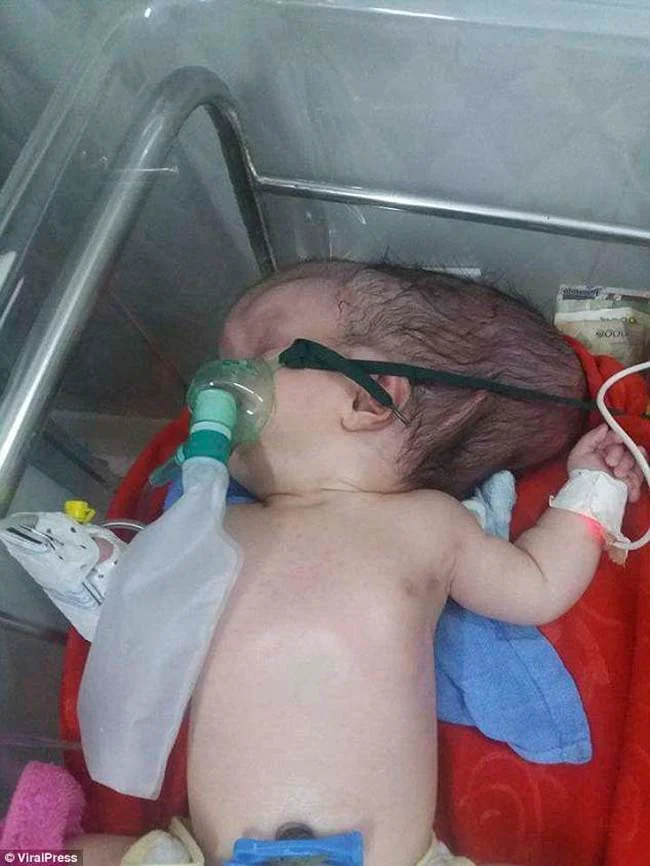
From the moment little Ah Neath was born, her mother realized that something was seriously wrong with her daughter’s head.
Instead of experiencing the happiness she had imagined throughout her pregnancy, she suddenly found herself facing fear, uncertainty, and an overwhelming number of questions.
Her newborn daughter had an unusual skull shape that immediately attracted attention and raised concerns about a possible congenital abnormality.
The most striking feature was the unusual contour of her head. One area appeared deeply sunken inward, forming a depression that resembled a volcanic crater. At the back of her head, a large swelling protruded outward, creating a dramatic difference in the overall shape of her skull.
The combination of the deep indentation and the prominent bulging area made her head appear severely irregular compared with that of a typical newborn.
For her mother, the sight was heartbreaking. She could not understand why her daughter had been born with such a condition or what it might mean for the child’s future.
A Mother’s Fear After Discovering Her Baby’s Condition
According to the family’s account, Ah Neath’s mother spent many days crying as she tried to understand the seriousness of her daughter’s condition.
She worried about whether the abnormality would affect the baby’s brain, whether she would be able to develop normally, and whether medical treatment could offer any hope of improvement.
Specialists at a medical center in Southeast Asia reportedly raised concerns about a possible structural abnormality involving the skull and underlying brain tissue.
The unusual depression and large swelling required further examination to determine whether there was a defect in the skull bones and whether brain tissue or surrounding membranes were involved.
Although Ah Neath’s arms and legs appeared to move normally, this observation alone could not establish the condition of her central nervous system.
A baby may retain certain spontaneous movements and reflexes even when a serious structural abnormality is present.
Understanding Possible Congenital Skull and Brain Abnormalities
One condition that doctors may consider when a newborn has an unusual skull defect accompanied by a prominent swelling is encephalocele.
Encephalocele is a rare congenital neural tube defect in which part of the brain tissue and the membranes covering the brain protrude through an abnormal opening in the skull.
This condition develops during early pregnancy when the structures responsible for forming the skull and central nervous system do not develop normally.
Depending on the location and size of the defect, the protruding mᴀss may appear at the back of the head, near the top of the skull, or in other regions.
The swelling may contain different structures, including:
- Meninges, the protective membranes surrounding the brain.
- Cerebrospinal fluid, the fluid that surrounds and protects the brain and spinal cord.
- Brain tissue, depending on the size and location of the defect.
The severity of encephalocele varies considerably. Some cases involve relatively limited abnormalities, while others may be ᴀssociated with significant neurological complications.
However, an unusual skull shape or a large swelling does not automatically confirm encephalocele. Other congenital abnormalities can produce similar external appearances.
Why Specialized Medical Examinations Are Necessary
For a baby like Ah Neath, determining the exact nature of the skull abnormality is essential before doctors can recommend treatment.
A detailed clinical examination would help specialists ᴀssess the location, size, and characteristics of the abnormality.
Imaging examinations are particularly important.
Magnetic Resonance Imaging (MRI) can provide detailed information about the brain, surrounding membranes, and any tissue extending through an abnormal opening in the skull.
Computed Tomography (CT) can help doctors examine the skull bones and identify structural defects that may not be fully understood through physical examination alone.
Doctors may also recommend neurological ᴀssessments to evaluate muscle tone, reflexes, spontaneous movement, and other signs of nervous system function.
Depending on the findings, the baby may need evaluation by pediatric neurosurgeons, neurologists, and other specialists.
Potential Treatment and Medical Challenges
Treatment depends entirely on the confirmed diagnosis, the size and location of the abnormality, and whether important neurological structures are involved.
If encephalocele is diagnosed, some babies may be candidates for surgery to repair the skull defect and reposition or protect the affected tissues.
However, surgery is not suitable for every case, and the potential benefits and risks must be evaluated individually.
Other congenital skull abnormalities may require completely different treatment approaches.
Long-term follow-up may also be necessary to monitor neurological development, vision, movement, feeding, and other important functions.
For families, the uncertainty surrounding these examinations and treatment decisions can be emotionally and financially exhausting.
A Mother’s Desperate Appeal for Donations
As Ah Neath’s medical concerns became increasingly difficult to manage, her mother began appealing to the public for financial ᴀssistance.
She hoped that donations would help cover specialized examinations, hospital expenses, and any treatment that doctors might recommend.
Her appeal came from a place of desperation and love.
She was not asking for financial support for herself. She was trying to find a way to give her daughter access to medical care and a possible opportunity for a better future.
Every medical examination represented another chance to understand the condition. Every contribution offered the possibility of obtaining the support her daughter needed.
The family faced a future filled with unanswered questions, but her mother continued searching for help rather than giving up.
The Story of a Mother Who Refused to Lose Hope
Ah Neath’s unusual skull shape raised serious medical concerns, but her story is also about the emotional strength of a mother confronting an unexpected and frightening reality.
She had imagined holding a healthy newborn daughter and watching her grow through the ordinary stages of childhood.
Instead, she found herself searching for medical answers, worrying about complicated treatment, and asking strangers for help.
Her daughter’s condition remained a source of uncertainty, and a confirmed diagnosis was essential to understanding what could be done.
Yet one thing was clear: Ah Neath was a baby who deserved medical attention, dignity, protection, and love.
Behind the unusual shape of her head was a little girl whose mother wanted nothing more than to give her a chance to grow up.
Her story reminds us that compᴀssionate care and family support matter deeply, especially when a child is born facing extraordinary medical challenges.