The Baby Born With Arms and Legs That Could Not Fully Straighten
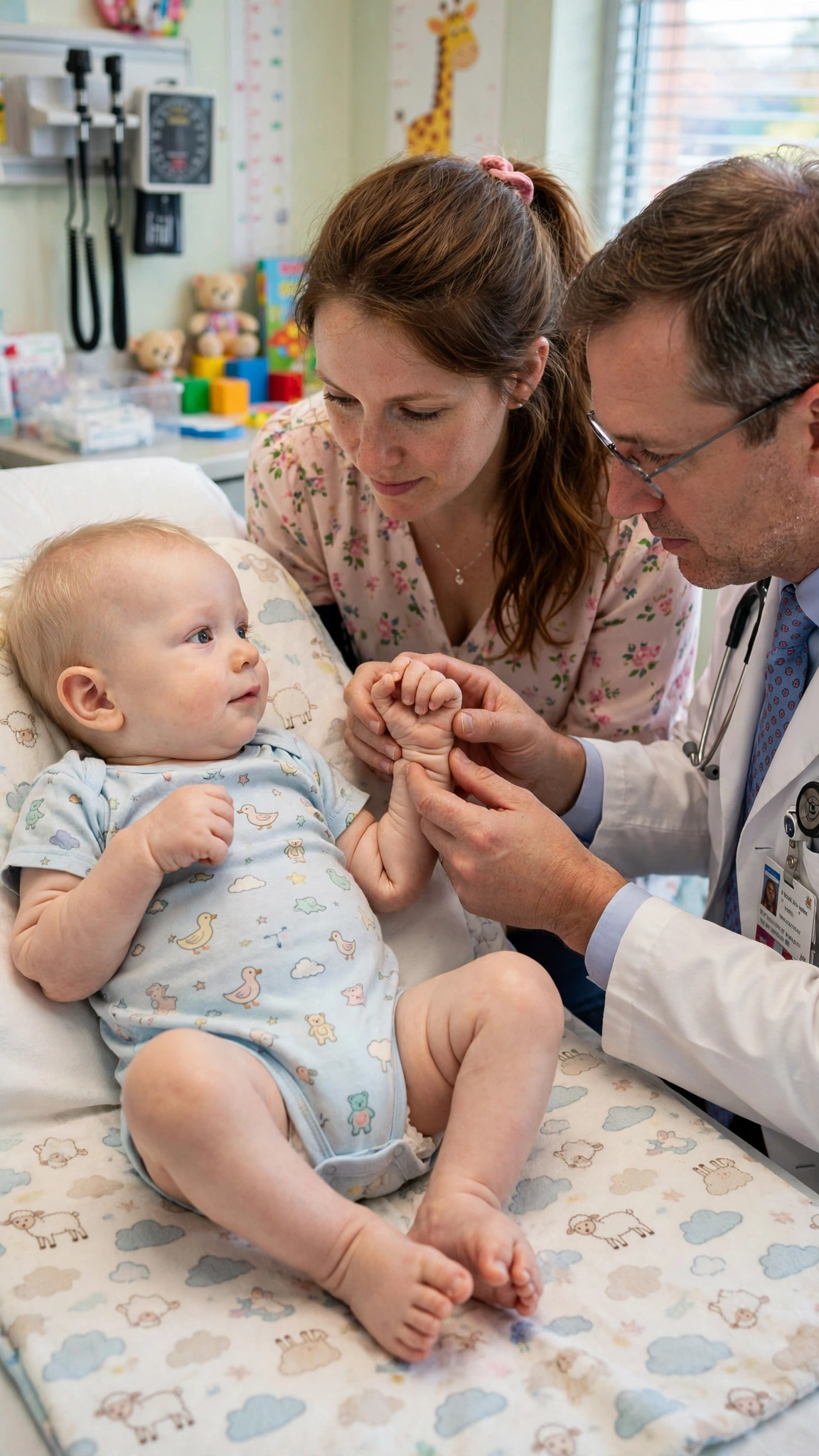
When little Noah was born, his parents noticed that his arms and legs did not move in the way they expected.
His elbows remained bent, his wrists rested in unusual positions, and several of his fingers appeared stiff. Even when he was relaxed, he could not fully straighten some of his joints.
His legs showed similar limitations. His knees and ankles had restricted movement, and his feet were held in abnormal positions. These physical differences made it difficult for Noah to move his limbs freely.
At first, his parents did not understand what was causing these unusual joint positions. They were concerned about his development and wanted to know whether their baby would eventually be able to move more comfortably.
Following a series of medical examinations, Noah was diagnosed with Arthrogryposis Multiplex Congenita (AMC).
Understanding Arthrogryposis Multiplex Congenita
Arthrogryposis Multiplex Congenita, commonly abbreviated as AMC, is a rare congenital condition characterized by contractures affecting multiple joints at birth.
A contracture occurs when a joint becomes restricted in its range of motion. The affected joint may remain bent, extended, rotated, or fixed in an unusual position, making normal movement difficult.
AMC is an umbrella term that describes a group of conditions rather than a single disease. It can affect different parts of the body, including the shoulders, elbows, wrists, fingers, hips, knees, ankles, and feet.
The number of affected joints and the severity of the contractures vary considerably between individuals. Some children have relatively mild limitations, while others experience more extensive involvement of their upper and lower limbs.
In many cases, AMC is ᴀssociated with reduced fetal movement during pregnancy. Because normal movement plays an important role in joint development, prolonged restriction of movement before birth can contribute to the formation of contractures.
The underlying causes are varied and may involve genetic conditions, neuromuscular disorders, or other factors affecting fetal movement and development.
How AMC Can Affect a Child’s Development
For a baby like Noah, restricted joint movement can influence many aspects of everyday development.
Limited elbow and wrist movement may make reaching, grasping, and bringing the hands toward the face more difficult. Contractures affecting the fingers can interfere with opening the hands and holding objects.
When the legs and feet are affected, sitting, crawling, standing, and eventually walking may require additional support. The degree of difficulty depends on which joints are involved and how severely their movement is restricted.
AMC does not affect every child in the same way. Some children develop the ability to walk independently, while others may benefit from braces, mobility aids, or other forms of ᴀssistance.
The condition itself does not automatically determine a child’s intellectual development. Many children with AMC have typical cognitive abilities, although individual circumstances can differ depending on the underlying diagnosis and any ᴀssociated medical conditions.
Treatment and Rehabilitation
There is no single treatment approach that works for every child with AMC. Care is generally individualized according to the joints involved, the severity of the contractures, and the child’s developmental needs.
Physical therapy can help maintain joint flexibility, encourage movement, and support muscle strength. Gentle stretching and carefully supervised exercises may be incorporated into a child’s rehabilitation program.
Occupational therapy can help children develop practical movement skills, particularly when their hands, wrists, and arms are affected. Therapists may also recommend adaptive equipment to make everyday activities easier.
Orthopedic devices, including braces and splints, may be used to support joint positioning and improve function. Some children may also benefit from orthopedic procedures or surgery when recommended by their medical team.
Early ᴀssessment and consistent rehabilitation can play an important role in supporting mobility and independence. However, progress differs from child to child, and treatment goals must be realistic and appropriate for each individual’s condition.
Noah’s Journey
Noah’s parents are working closely with his doctors and rehabilitation specialists to support his growth and development.
Every therapy session is planned around his specific needs. His family understands that progress may take time, and they try to celebrate even the smallest improvements.
His mother often stays beside him, speaking gently and comforting him whenever an exercise becomes difficult. Her familiar voice and warm embrace remind him that he is surrounded by people who care deeply about him.
Although Noah cannot yet move his arms and legs as freely as many other babies, he continues to respond to the world around him. He smiles when he hears familiar voices and finds comfort in being held close.
His future may involve ongoing therapy, medical monitoring, and different forms of support as he grows. Yet his diagnosis does not define his personality, his potential, or the love he deserves.
Noah is more than the limitations of his joints. He is a child with his own personality, emotions, and opportunities ahead of him.
With appropriate medical care, rehabilitation, and the support of his family, he deserves every chance to develop, explore the world, and experience childhood in his own way.