The Little Boy Who Couldn’t Run Like Other Children
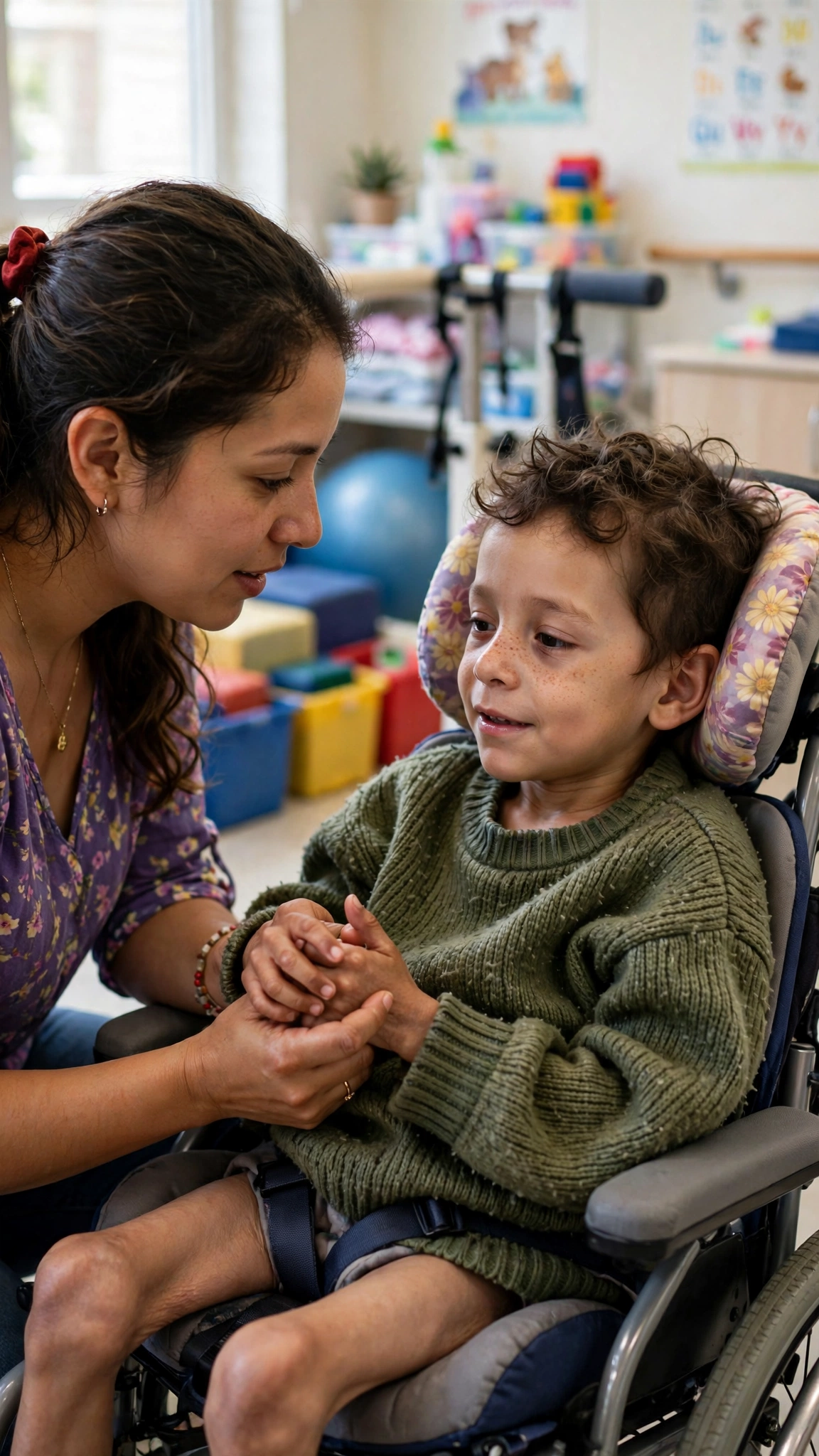
At just four years old, Mateo was already experiencing a childhood very different from that of many other children his age.
While other little boys were running through playgrounds, jumping over small obstacles, chasing balls, and learning to ride bicycles, Mateo faced physical challenges that made even the simplest movements difficult.
He was living with severe cerebral palsy, a neurological condition that affects movement, muscle control, posture, and coordination.
For Mateo, everyday activities required additional ᴀssistance, patience, and specialized support.
His little arms were often stiff, and controlling his movements was not always easy. Sitting comfortably required proper positioning and supportive equipment. Even reaching for a favorite toy could become a difficult task.
He could not run across the playground after a ball.
He could not climb the stairs to a slide or join other children in their outdoor games.
Sometimes, even holding a small toy required someone to gently help position his hand.
For a four-year-old boy who naturally wanted to explore everything around him, these limitations could make everyday experiences especially challenging.
But Mateo’s life was not defined only by the things he could not do.
There was something about him that his mother, Sofia, treasured more than anything else.
His eyes.
Whenever Sofia entered the room, Mateo often followed her with his gaze. Even when his body could not respond the way he wanted, his eyes seemed to search for the familiar face that made him feel safe.
His mother had learned to recognize those little moments.
Every morning, she would approach his wheelchair, kneel beside him, and greet him with a warm smile.
She often brought his favorite colorful toys and placed them where he could see them.
“Good morning, my little superhero.”
Sometimes, Mateo responded with a tiny smile.
For Sofia, that smile could brighten even the most difficult day.
She did not need expensive toys or extraordinary surprises to make her son happy. She simply wanted to see him comfortable, engaged, and enjoying the little experiences of childhood.
But caring for Mateo required more than love alone.
Every week, she took him to physical therapy, where specialists worked with him on movement, positioning, flexibility, and the physical skills appropriate for his individual needs.
The sessions were not always easy.
Some exercises required patience and repeated attempts. Mateo sometimes became tired or frustrated, especially when his body could not respond as quickly as he wanted.
Sofia stayed beside him, encouraging him through each activity.
She celebrated every attempt, even when the progress seemed almost invisible.
There were also difficult moments when Sofia returned home feeling emotionally exhausted.
Sometimes, after watching her little boy struggle through another therapy session, she would quietly cry.
She wished she could take away every physical difficulty he experienced. She wished he could run freely, play without limitations, and enjoy the same carefree childhood as other children.
But she also knew that Mateo needed her strength, encouragement, and unwavering support.
So every morning, she reminded herself to keep moving forward, one day at a time.
Then came a special moment during one of his therapy sessions.
Mateo was sitting in a supportive position while a colorful toy was placed in front of him.
His therapist encouraged him to reach toward it.
At first, he simply looked at the toy.
His little fingers remained still for a moment.
Then, slowly and carefully, he began moving his hand toward it.
It was not a large movement. It was not an independent grasp or a dramatic breakthrough.
But it was an effort.
And Sofia noticed every bit of it.
Her face immediately brightened. She began clapping her hands, leaned closer, and gently kissed her son’s forehead.
“That’s my brave boy!”
Mateo turned his eyes toward his mother.
Then a small smile appeared on his face.
For Sofia, that moment was worth more than words could describe.
She knew that cerebral palsy was a lifelong condition and that Mateo’s developmental journey might look different from what she had once imagined.
She also understood that progress would not always be measured by walking, running, or reaching traditional childhood milestones.
Sometimes, progress could mean improving his ability to control a small movement, communicating through his expressions, participating in an activity, or finding a more comfortable way to interact with his surroundings.
Every child with cerebral palsy has different abilities and needs, and Mateo’s journey would always be his own.
His mother did not expect him to follow another child’s timeline.
She wanted him to have opportunities to learn, experience happiness, develop his abilities, and enjoy the world in whatever ways were possible for him.
She wanted him to know that he was never a disappointment, that his efforts mattered, and that he was loved without conditions.
Mateo might not be able to run after a ball like other children.
He might need ᴀssistance with activities that others can do independently.
But he still has a favorite toy, a mother whose voice he recognizes, and a smile that can make an ordinary day feel extraordinary.
His world may look different, but it is still filled with opportunities for connection, discovery, and happiness.
And Sofia has made one promise to herself: she will continue standing beside her son, celebrating every achievement, encouraging every attempt, and loving him through every stage of his journey.
Because sometimes, the greatest victories are not the ones that everyone can see.
Sometimes, they are found in a tiny movement of the fingers, a gentle turn of the eyes, or a small smile shared between a mother and her child.
Not every victory looks big. Sometimes, the smallest movement carries the greatest meaning.