PART 2 — THE PERFORMANCE THAT TURNED THEIR WEDDING INTO A NIGHTMARE
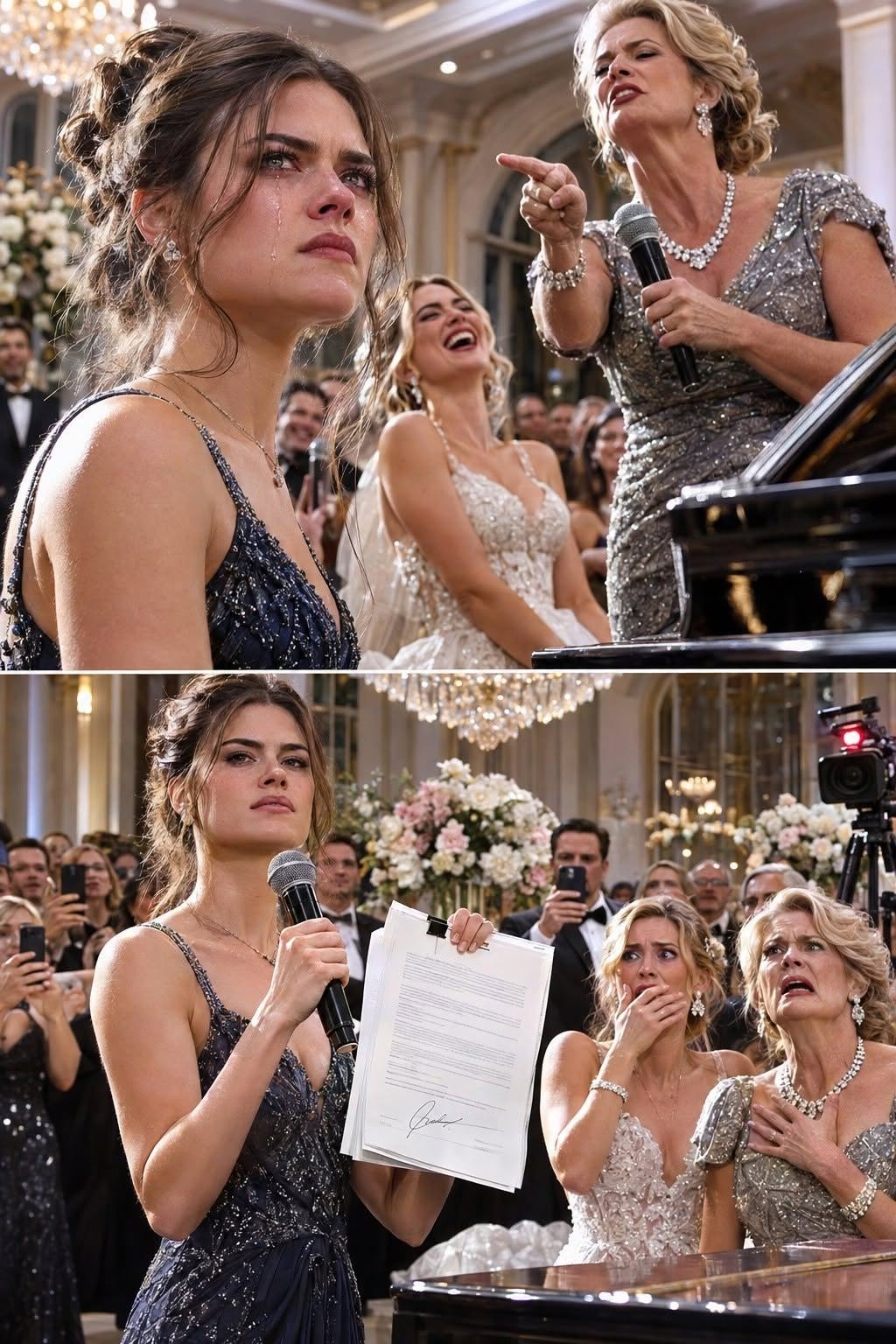
She stood beside the stage, holding her champagne glᴀss, looking pleased with herself.
“Everyone, please give Clara a little encouragement,” she announced into the microphone. “She hasn’t performed in public for years. Let’s hope she remembers how.”
More laughter.
Vanessa lifted her champagne flute toward me.
“Don’t worry, Clara. Nobody expects perfection. Just keep it simple.”
Her new husband, Ethan, stood beside her. He smiled awkwardly, clearly unaware of the history behind those words.
I didn’t respond.
I simply adjusted the piano bench, placed my hands over the keys, and looked at the sheet music.
There was no sheet music.
I didn’t need it.
The first note floated through the ballroom.
Then another.
Within seconds, the melody began to unfold.
It was gentle, haunting, and strangely familiar. The opening notes of a composition my father and I had started together seven years earlier.
But I had transformed it.
The fragile melody grew into something breathtaking. My left hand carried the deep, emotional harmony while my right hand moved effortlessly across the keys.
The ballroom gradually fell silent.
A waiter stopped halfway through pouring champagne.
Two women near the dance floor turned toward the piano.
Even the wedding pH๏τographer lowered his camera.
I closed my eyes.
For a moment, I wasn’t in that ballroom.
I was twenty-four again, sitting beside my father in our old living room.
His hands were trembling.
“Clara, don’t rush the ending,” he had told me. “Let the music breathe.”
I had remembered those words every day since he died.
And now, I was finally giving our song the ending it deserved.
The final movement rose dramatically, filling the enormous ballroom with a powerful orchestral arrangement I had originally composed for a film project.
When I struck the final chord, the sound seemed to hang in the air.
Silence.
One second.
Two seconds.
Then someone stood up.
It was an older gentleman sitting at the front table.
He began applauding.
Another guest followed.
Then another.
Within moments, nearly two hundred people were on their feet.
The applause was deafening.
I slowly lifted my hands from the keys.
My mother was no longer smiling.
Vanessa’s champagne glᴀss remained frozen halfway to her lips.
“What… was that?” Ethan whispered.
Before I could answer, the older gentleman approached the piano.
I recognized him immediately.
Richard Hale.
The chairman of the luxury H๏τel group that had commissioned the commercial featuring my father’s melody.
He looked at me with genuine astonishment.
“Young lady, where did you learn to play like that?”
“New York,” I answered quietly.
“Are you professionally trained?”
“Yes.”
“Who composed that piece?”
I looked down at the piano.
“My father started it. I completed it.”
Richard’s expression changed.
“Your father?”
I nodded.
“Thomas Bennett.”
He went completely still.
Then he turned toward Vanessa.
“Isn’t that the name attached to the original composition in the licensing dispute?”
Vanessa’s face went pale.
My mother immediately stepped between us.
“Mr. Hale, I think there’s been some confusion. Clara is emotional tonight. This is a family matter.”
Richard ignored her.
He looked directly at Vanessa.
“Your company submitted a composition called The Morning We Keep for our H๏τel campaign. You identified yourself as the original composer and exclusive rights holder.”
Vanessa forced a laugh.
“Yes. That’s correct.”
Richard slowly shook his head.
“Interesting.”
He pulled out his phone.
“Because the piece this young woman just performed is exactly the melody our legal department has been investigating.”
A wave of whispers spread through the ballroom.
Vanessa turned toward me.
“What did you do?”
I met her eyes.
“Nothing you didn’t do yourself.”
My mother grabbed the microphone.
“Please, everyone, let’s not turn a beautiful wedding into some kind of public argument. Clara has always been jealous of her sister. She has a habit of making everything about herself.”
I stood up.
For seven years, I had allowed those words to silence me.
Not tonight.
“Mom, I didn’t come here to compete with Vanessa.”
“Then why are you doing this?” she snapped.
“Because she sold something that never belonged to her.”
Vanessa’s expression hardened.
“That’s a lie!”
I reached into my handbag and removed a black document folder.
My attorney had prepared everything before I arrived.
I handed it to Richard.
“These are copies of my father’s original handwritten manuscript, his estate documents, and the publishing records establishing my ownership of the completed composition.”
Richard opened the folder.
His eyes moved slowly across the pages.
Then he stopped.
“Wait a moment.”
He examined one document more closely.
“Your father transferred the composition rights to you through his estate?”
“Yes.”
“And you never authorized Vanessa’s company to license the music?”
“Never.”
Richard turned another page.
Then he found the document we had been waiting for.
The disputed release.
It carried my name.
My signature.
My supposed authorization.
Richard stared at it.
“Is this your signature?”
“No.”
Vanessa immediately interrupted.
“Clara signed it. I have the paperwork!”
I looked at her.
“Then explain why the document claims I signed it in New York on a day when I was performing in Vienna.”
Her mouth opened.
Nothing came out.
I continued.
“My attorney has the original campaign submission, the email correspondence, the metadata, and the concert records proving I was in Europe. We also have an independent handwriting analysis showing that the signature on this release does not match my genuine signature.”
Richard closed the folder.
His expression was no longer friendly.
“Vanessa, this is serious.”
She looked desperately at her mother.
“Mom, tell him!”
My mother stepped forward.
“There’s a perfectly reasonable explanation. We all knew Thomas wanted his music to stay in the family.”
Richard’s voice became colder.
“That doesn’t give anyone the right to forge another person’s authorization.”
The ballroom fell silent again.
Then Richard made a phone call.
“Get legal on the line. Tell them to suspend the campaign immediately. Preserve every version of the licensing documents and all correspondence submitted by Bennett Events.”
Vanessa’s face crumpled.
“Please don’t do this. That campaign is worth millions!”
Richard looked at her.
“Then you should have been more careful about whose work you were selling.”
Ethan slowly stepped away from his bride.
“Vanessa, you told me you wrote that song.”
She turned toward him.
“I can explain.”
“You said your father taught you music. You said that composition was your greatest achievement.”
“Please, Ethan.”
He glanced at the document in Richard’s hands.
“Why does it have Clara’s name on it?”
Vanessa began crying.
My mother immediately intervened.
“Enough! This is a wedding, not a courtroom!”
I looked at her.
“You were the one who put me on that stage, Mom.”
She froze.
“You called me background music. You told two hundred people I was a failed investment. You wanted everyone to laugh at me.”
I paused.
“Well, now they’ve heard the music.”
Nobody laughed.
Nobody even whispered.
Then Richard turned toward me.
“Miss Bennett, there’s something you should know. Our company has been looking for the original composer since this dispute began. We were impressed by the melody, but the ownership documentation raised serious concerns.”
He looked at the folder again.
“If your legal representatives confirm these records, we would be interested in negotiating directly with you for the composition.”
I nodded.
“Thank you. My attorney can handle that.”
At that moment, a woman sitting near the front of the ballroom suddenly stood up.
She was wearing a navy-blue evening gown and holding a small program booklet.
“Excuse me,” she said. “Did you say your name was Clara Bennett?”
I turned.
“Yes.”
She smiled.
“I’m Evelyn Brooks, executive director of Sterling Film Music Publishing.”
I recognized her immediately.
She had overseen my exclusive publishing agreement two years earlier.
She walked toward the piano.
“Clara, I didn’t realize you were attending this wedding. Your latest orchestral work was just selected for consideration in an upcoming international film project.”
A few guests gasped.
My mother stared at her.
Evelyn continued.
“And I believe your Manhattan recital last month was completely sold out, wasn’t it?”
I smiled politely.
“Yes.”
Evelyn turned toward the guests.
“Then perhaps everyone should know that Clara is not an amateur pianist. She’s an established concert performer and composer. We’ve been working with her for two years.”
My mother’s champagne glᴀss slipped slightly in her hand.
Vanessa looked at me as though she were seeing a stranger.
The same sister she had called a failure.
The same woman she had forced to sit beside the service doors.
The same woman she had expected to entertain her guests for free.
Now the people she desperately wanted to impress were asking for my music.
But I wasn’t finished.
I reached into my handbag one final time and removed a small, worn pH๏τograph.
It showed my father sitting beside me at his old upright piano.
I placed it on the grand piano.
“This is why I came tonight,” I said.
My voice trembled, but I continued.
“That melody was the last piece of music my father and I worked on together. When I heard it in Vanessa’s commercial, I didn’t recognize it because she had improved it. I recognized it because I had spent seven years trying to finish it without him.”
I looked at Vanessa.
“You didn’t just take a composition. You took a memory.”
She began sobbing.
My mother whispered, “Clara, please.”
I turned toward her.
“You wanted me to play background music tonight. But Dad taught me that music doesn’t need to be loud to matter. It just needs to be honest.”
I closed the document folder.
“My attorney will contact your company. From now on, the music and the legal issues will be handled properly.”
Richard nodded.
“That’s the right decision.”
I stepped away from the piano.
The guests parted to let me pᴀss.
But just as I reached the ballroom doors, I heard Vanessa call my name.
“Clara!”
I stopped.
She was standing beneath the chandelier, her wedding dress glittering beneath the lights.
Her mascara had begun to run.
“Did you really become that successful?”
I looked at her.
“Yes.”
“Why didn’t you tell us?”
I gave her a sad smile.
“I tried. You just never wanted to listen.”
Then I walked out.
Behind me, the wedding continued, but the laughter had disappeared.
And for the first time in seven years, I no longer felt like the family’s failed investment.
I felt like my father’s daughter.
But as I stepped into the cool night air, my phone vibrated.
It was a message from my attorney.
Clara, we’ve just received another document from Vanessa’s company. It appears your mother may have been involved in submitting the disputed licensing authorization. There’s something else in the file that you need to see.
I stopped walking.
I opened the attachment.
And when I saw the date on the document, my heart sank.
It had been signed just two weeks after my father’s funeral.
My mother hadn’t simply stood by while Vanessa took our song.
She might have helped them do it.
And suddenly, I understood that the biggest betrayal of the evening hadn’t come from my sister.
It had come from the person who was supposed to protect me.
TO BE CONTINUED IN PART 3…