PART 3 — WHEN THE WHOLE VALLEY CAME KNOCKING
PART 3 — WHEN THE WHOLE VALLEY CAME KNOCKING
By sunrise, Willow Creek had disappeared.
There were no fences.
No wagon tracks.
No familiar rooftops.
Only a vast white landscape stretching from the river to the mountains.
The storm had buried the lower road, snapped trees across the trails, and collapsed the roof of Samuel Price’s storage shed.
At the Thornton cabin, one side of the roof had given way beneath the weight of the snow.
The chimney had cracked.
The front door was buried almost to its top.
And the woodpile was nowhere to be seen.
Maggie didn’t know any of this yet.
She was busy making breakfast.
Billy had eaten a little porridge and was resting beneath the blankets. His coughing had eased, though Maggie still watched him carefully.
Emma sat beside her doll, telling it a story about a princess who lived inside a mountain.
“Does the princess have a father?” Maggie asked.
“Yes,” Emma replied. “He’s away, but he’ll find the mountain.”
Maggie looked down at the spoon in her hand.
“That sounds like a good story.”
“It’s not a story,” Emma said seriously. “Papa knows where we are.”
Maggie swallowed.
“Perhaps he does, sweetheart.”
A sudden thump echoed through the cave.
Maggie turned.
Another thump followed.
Then came a voice.
“Mrs. Thornton!”
She hurried toward the entrance.
Marcus appeared through the snow, his beard covered in ice.
Behind him stood Samuel Price and two other men.
They looked exhausted.
Samuel was carrying a little girl wrapped in a blanket.
“Please tell me you have room,” he said.
Maggie stared at him.
“What happened?”
“Our house is gone,” Samuel replied. “The roof came down in the night. We managed to get everyone out, but the children are freezing.”
Maggie stepped aside immediately.
“Bring them in.”
The men entered, stamping snow from their boots.
Samuel’s wife, Ruth, followed with two boys. Their faces were pale, and their clothes were soaked.
Maggie helped them settle on the dry platform.
She gave Ruth a blanket and warmed some broth.
“Where is everyone else?” she asked.
Marcus shook his head.
“Trapped in the settlement. Several homes have lost their roofs. The road is completely blocked.”
“How many people?”
“More than twenty.”
Maggie looked around the cave.
It had seemed enormous when it was empty.
Now it was filling quickly.
“We can’t fit everyone in here,” she said.
Marcus nodded.
“No. But the old quarry shelter might still be accessible. I checked it last autumn. It’s farther north, though.”
Samuel shook his head.
“Nobody can reach it in this weather.”
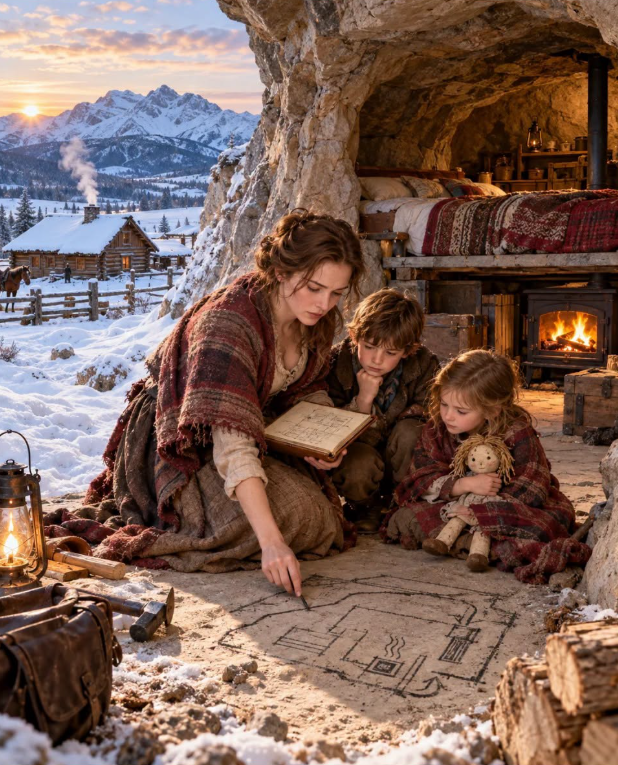
Maggie looked at the map in Robert’s notebook.
Then she remembered something.
Robert had marked another limestone opening farther up the ridge.
A smaller chamber, connected to the main cave by a narrow pᴀssage.
She had never explored it.
“There’s another chamber,” she said.
Marcus looked at her.
“Where?”
“Robert marked it here.”
She showed him the drawing.
He studied it carefully.
“That could be the old upper pᴀssage.”
“Can it hold people?”
“I don’t know. We’d have to inspect it first.”
Maggie looked at the children gathered around her.
“We need somewhere else for the families.”
Marcus nodded.
“I’ll go with you.”
They waited until the worst of the wind eased before setting out.
Maggie insisted on bringing Robert’s notebook.
The pᴀssage was narrower than the main chamber, and Marcus checked the stone carefully before allowing anyone farther inside.
Beyond it was a second space.
Smaller, but dry.
There were no signs of recent flooding, and the ceiling appeared stable. Marcus examined it thoroughly before agreeing that it could be used as a temporary shelter.
There was enough room for several families to sit and rest.
But the chamber was cold, and it had no suitable heating arrangement.
“We can use it for storage and as a place to get out of the wind,” Marcus said. “Nobody sleeps here until we’ve made sure it’s safe.”
Maggie nodded.
They returned to the main chamber.
 By noon, the first group of neighbors arrived.
Then another.
And another.
The cave became a shelter for the valley.
People who had laughed at Maggie’s project now stood beside her, accepting bowls of broth and blankets.
Edgar Miller arrived shortly before sunset.
He was soaked, limping, and carrying a bundle of wet clothes.
For several seconds, he stood in the entrance without speaking.
Then he looked around.
“Mrs. Thornton.”
Maggie turned from the stove.
“Mr. Miller.”
His eyes moved to the sleeping children, the carefully arranged supplies, and the stone walls.
“I owe you an apology.”
Maggie didn’t answer immediately.
Edgar removed his hat.
“I called this place a grave. I told people you were foolish. I was wrong.”
She handed him a cup of warm broth.
“You’re cold. Sit down.”
He accepted it.
“I don’t deserve your kindness.”
“Perhaps not,” Maggie said. “But your family may need it.”
Edgar lowered his eyes.
Then he said something that made Maggie stop.
“My wife and daughter are still at the mill. The roof hasn’t collapsed, but the river is rising. If the snow keeps melting into the lower ground, the building could flood.”
Marcus looked up.
“The mill is too close to the creek.”
“Can you reach them?” Maggie asked.
Edgar shook his head.
“Not alone.”
Marcus studied the weather beyond the entrance.
“We’ll have to wait for a safe break in the storm.”
Edgar nodded, but his face showed his fear.
That night, the wind returned.
The cave remained steady, and the families stayed together.
Maggie moved from one child to another, checking blankets and offering warm drinks. She hardly slept.
Near midnight, Billy woke.
“Ma?”
She hurried to his side.
“What is it?”
“There’s a man outside.”
Maggie froze.
“Where?”
Billy pointed toward the entrance.
At first she heard only the wind.
Then came a faint voice.
“Help!”
Marcus was awake immediately.
He took his lantern and went to the entrance with two other men.
Maggie followed, carrying a blanket.
A figure appeared in the snow.
It was a young ranch hand named Peter, barely twenty years old. He was dragging himself toward the cave, with one arm wrapped around his chest.
Marcus and Samuel pulled him inside.
“Where did you come from?” Marcus demanded.
Peter struggled to speak.
“The mill.”
Edgar jumped to his feet.
“My wife? My daughter?”
Peter shook his head.
“They’re alive. But the water’s coming up fast. Your daughter sent me.”
Edgar grabbed his shoulders.
“Where are they?”
“On the upper floor. The lower room is already flooded.”
Edgar looked toward the entrance.
“I’m going.”
Marcus blocked him.
“You won’t reach them in this storm.”
“That’s my family!”
“And if you go out there without help, we’ll have three people to rescue instead of two.”
Maggie stepped forward.
“How far is the mill?”
Peter described the route.
Maggie studied Robert’s map.
There was an old ridge trail that ran above the creek, avoiding the lowest ground.
“Could we reach it from here?” she asked.
Marcus examined the map.
“Possibly. But not tonight.”
Edgar looked desperate.
Maggie placed a hand on his arm.
“Your daughter managed to send Peter for help. That means she knows people are coming. We won’t abandon them.”
Edgar stared at her.
Then he sank onto a wooden bench.
For the first time since the storm began, the man who had mocked her cave began to cry.
At dawn, the wind finally weakened.
Marcus organized a rescue party.
Maggie wanted to go, but he refused.
“Someone needs to stay here and look after the families.”
She knew he was right.
So she remained with the children and the injured while the men followed the ridge trail.
The hours pᴀssed painfully slowly.
Emma slept beside Ruth’s little girl.
Billy helped Maggie distribute blankets.
Then, shortly before noon, a shout came from the entrance.
“They’re back!”
Maggie hurried forward.
Edgar was among the returning men.
Behind him walked his wife and daughter.
Both were exhausted, but safe.
Edgar’s daughter ran straight into her father’s arms.
Maggie turned away to give them privacy.
Then she heard Edgar’s voice.
“Mrs. Thornton?”
She looked back.
He stood before her, his wife beside him.
“I don’t know how to thank you.”
“You don’t have to.”
“Yes, I do.”
He glanced toward the stone walls.
“I thought you were building a foolish hole in the ground. I never considered that you were building something the rest of us might need.”
Maggie looked around at the families.
The children.
The blankets.
The people who had found shelter because she refused to surrender.
“I didn’t build it for the valley,” she said quietly. “I built it for Billy and Emma.”
Edgar nodded.
“That makes it even more remarkable.”
The blizzard lasted another four days.
When it finally pᴀssed, Willow Creek looked like a place no one had ever lived.
Several cabins had been damaged beyond repair. The mill needed extensive work. Fences were buried, barns had collapsed, and the road was blocked by fallen trees.
But the people had survived.
And the cave had become the one place in the valley where families could gather safely while the settlement recovered.
When the roads reopened, the town council called another meeting.
This time, no one laughed when Maggie entered.
Councilman Wallace stood before the crowd.
“Mrs. Thornton, we owe you a great deal.”
Maggie looked around.
“I didn’t do this alone. Marcus helped make the shelter safe. Samuel brought supplies. Ruth cared for the children. Everyone contributed.”
Marcus smiled.
But Edgar Miller stood.
“That’s true. But none of us would have had a place to gather if Maggie hadn’t started when everyone told her not to.”
The room fell silent.
Then Edgar placed a small leather pouch on the table.
Inside were coins collected from the families who had taken shelter.
“For the repairs,” he said. “And for whatever else you need.”
Maggie looked at the money.
It was more than she had expected.
But what mattered most was what happened next.
The schoolteacher stepped forward with a small wooden sign.
It had been carved by one of the ranch hands.
THORNTON MOUNTAIN SHELTER
Below the words was a smaller inscription:
Built by one mother who refused to give up.
Maggie’s eyes filled.
She thought of Robert.
Of the notebook beneath the floorboard.
Of the first night she had measured the temperature and realized her children could not survive another winter in the cabin.
And she thought of Billy, who was now sitting beside Emma, laughing as she made their little rag doll dance.
That evening, after everyone had gone, Maggie walked to the back wall.
She placed Robert’s notebook on the wooden shelf.
Beside it, she set his old coat.
Emma came up behind her.
“Ma?”
“Yes, sweetheart?”
“Do you think Papa would like our mountain room?”
Maggie knelt and kissed her forehead.
“I think he would be very proud.”
Emma looked around.
“Will we stay here forever?”
Maggie considered the question.
“No, darling. We’ll repair our house. We’ll make it warm again. But we’ll always keep this place ready.”
“Why?”
Maggie looked toward the entrance.
“Because sometimes the things people laugh at are the very things that save them.”
And outside, beyond the snow-covered ridge, the first clear stars appeared over Willow Creek.
The valley had learned a lesson it would never forget.
A widow with two children had built a shelter when everyone else told her she was wasting her strength.
She had not built it to prove anyone wrong.
She had built it because two small voices needed a mother who refused to give up.
But as Maggie returned to the cabin the following morning, she found something strange beneath the broken floorboards.
A second notebook.
One she had never seen before.
It was wrapped in oilcloth and marked with Robert’s initials.
And on the first page, in her husband’s handwriting, were six words that made her heart stop:
Maggie, if you found the cave, read this.
She opened it.
The next line revealed that Robert had not discovered the cave by accident.
He had been preparing for something far more serious than an ordinary winter.
And he had left one final warning about the mountain above their home.