PART 2: THE PROPOSAL HE WAS AFRAID TO MAKE
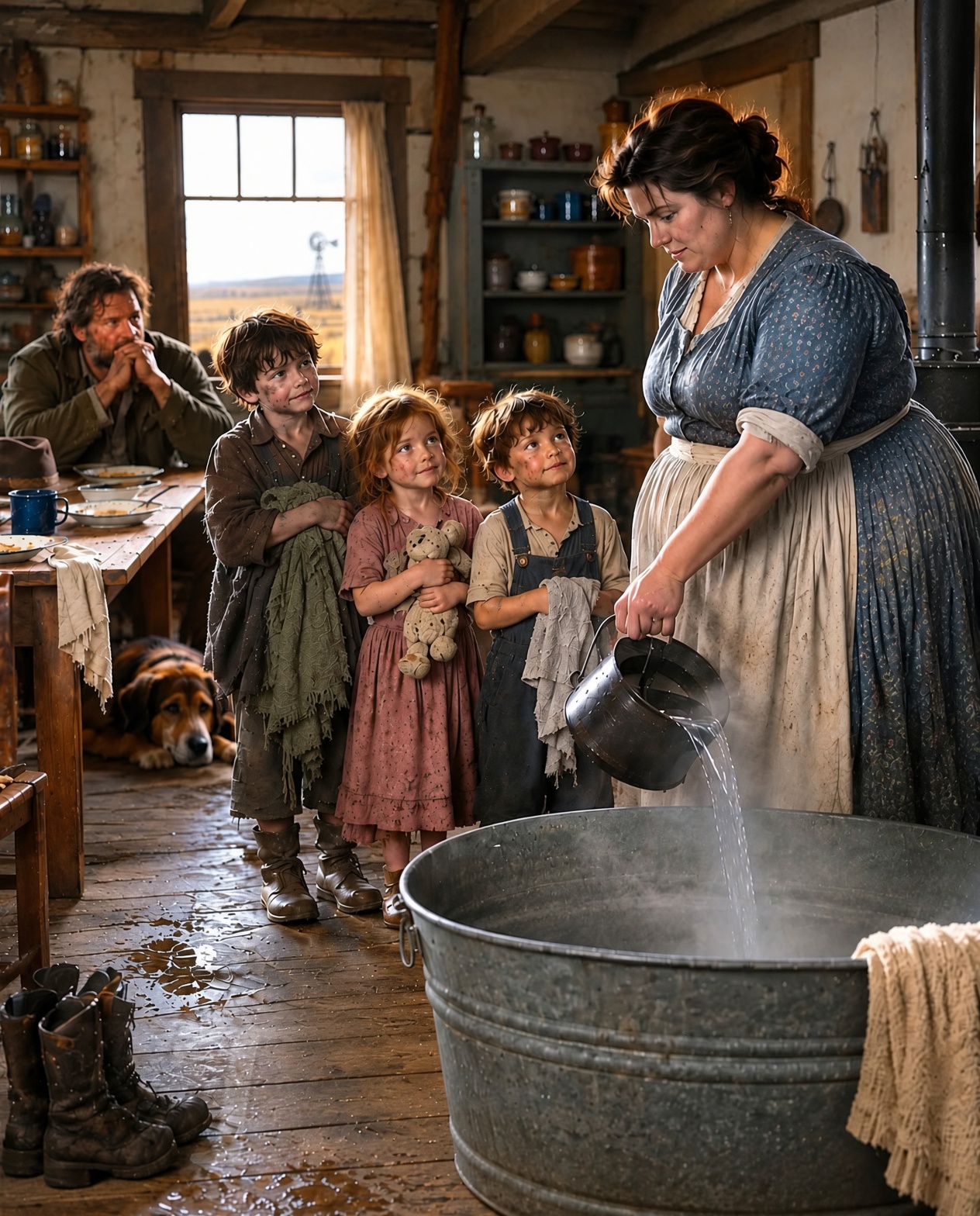
SHE WATCHED FROM HER FENCE FOR FOUR MONTHS — THEN A WIDOW WALKED INTO HIS KITCHEN WITH A WASHTUB, AND EVERYTHING CHANGED
PART 2: THE PROPOSAL HE WAS AFRAID TO MAKE
Ben Toiver had faced blizzards, broken fences, failing crops, and the unbearable silence of a house without his wife.
But asking Norah Quinn to marry him frightened him more than all of them combined.
He stood outside Reverend Hollis’s home that morning, his hat turning slowly between his hands.
“I want you to marry us this Sunday,” he repeated.
The reverend studied him carefully.
“Ben, marriage is not something you arrange like a shipment of cattle. Does Mrs. Quinn know how you feel?”
“No.”
“Then perhaps you ought to speak to her before asking me to prepare a ceremony.”
Ben lowered his eyes.
“I know. But if I wait too long, I’ll convince myself she deserves someone better.”
Reverend Hollis sighed.
“Then don’t ask her because you’re afraid of being alone. Ask her because you understand what she has brought into your life.”
Ben nodded.
For the first time in months, he knew exactly what he needed to do.
But when he reached Norah’s farm that afternoon, he discovered that courage was easier to find in a reverend’s doorway than in front of the woman who had changed his life.
Norah was hanging freshly washed sheets when she noticed him approaching.
“Good afternoon, Ben. Is something wrong with the children?”
“No. They’re fine.”
“Has the roof started leaking again?”
“No.”
“Then why do you look as though you’ve come to deliver terrible news?”
Ben almost smiled.
“Could we talk?”
Norah placed the last sheet over the line.
“Of course.”
They walked toward the fence separating their farms. It was the same fence where Norah had watched his children suffer for four long months.
Ben looked across the fields.
“Do you remember the first morning you came into my house?”
“I remember the washtub. I remember the smell. And I remember wondering whether your kitchen had ever seen a broom.”
He laughed.
It was a genuine laugh, and the sound surprised them both.
“I remember you ordering Sam to fetch water,” he said. “I thought you were the most stubborn woman I’d ever met.”
“That’s because you hadn’t met enough women.”
Ben shook his head.
“Norah, I owe you more than I could ever repay.”
She immediately looked uncomfortable.
“Please don’t make it sound like a debt. I helped because the children needed help.”
“I know. That’s what makes it different.”
He paused.
Then he faced her.
“I don’t want you coming to my house because you feel responsible for us anymore.”
Norah’s expression changed.
“Ben…”
“I want you there because you want to be. I want to wake up knowing you’re nearby. I want to hear you arguing with Sam about his schoolwork and laughing with Ruth in the garden. I want Ned to have someone who can teach him things I never learned how to teach.”
He took a breath.
“And I want you beside me when the children are asleep and the house is quiet.”
Norah looked down at her hands.
Ben reached into his coat and removed a small velvet box.
“I know I cannot replace Mary. I would never ask you to take her place. She was their mother, and she will always be part of this family.”
He opened the box.
Inside was a simple gold ring.
“Norah Quinn, would you consider becoming my wife?”
For a long moment, she didn’t answer.
Then she whispered, “Have you thought about what people will say?”
Ben frowned.
“People have already said plenty.”
“They’ll say I entered your home to become mistress of it.”
“Then they’ll be wrong.”
“They’ll say I wanted your farm.”
“Then I’ll tell them the farm isn’t worth half as much as the woman standing in front of me.”
Norah’s eyes filled with tears.
“Ben, I am not Mary.”
“I know.”
“I cannot be her.”
“I don’t want you to be.”
He stepped closer, but stopped before touching her.
“I want to build something new with you. Something that doesn’t erase what came before.”
Norah looked toward his farm.
She could see Ruth running across the yard, Sam carrying a bucket, and little Ned chasing a chicken with more enthusiasm than success.
For four months, she had watched those children disappear behind their father’s grief.
Now she could hear them laughing.
And she realized she had begun to love the sound of their happiness almost as much as she loved the quiet moments she spent with Ben.
“Yes,” she whispered.
Ben stared at her.
“Yes?”
Norah nodded.
“Yes, Ben. I will marry you.”
He closed his eyes for a moment.
Then he placed the ring in her hand.
Neither of them noticed Ruth watching from the kitchen window.
The little girl disappeared inside and returned moments later, dragging Sam behind her.
“Are you getting married?” Ruth shouted.
Norah laughed through her tears.
“If your father has his way.”
Sam looked at Ben.
“Does that mean she’s staying?”
Ben put one hand on his son’s shoulder.
“If she wants to.”
Sam studied Norah for a moment.
Then he nodded.
“Good. She makes better biscuits than Papa.”
“That’s hardly a difficult achievement,” Norah replied.
The children burst into laughter.
And for the first time in a very long while, Ben’s farm sounded like a home.
The wedding was planned for Sunday.
Norah wanted something simple. A clean dress, a few flowers, and the children standing beside them.
Ben agreed.
But on Saturday morning, trouble arrived in the form of a black carriage.
A woman stepped down wearing a dark green traveling dress and a hat decorated with feathers. Her name was Eunice Barrow, and she had spent months telling anyone willing to listen that Norah Quinn was interfering in a grieving man’s household.
She marched straight to the Toiver porch.
“Ben, I need a word with you.”
Ben was repairing a broken chair.
“What is it, Eunice?”
She looked toward the open kitchen window, where Norah was helping Ruth prepare bread.
“Is it true you’re marrying that woman tomorrow?”
Ben set down his hammer.
“Her name is Norah.”
“Everyone knows her name.”
“Then use it.”
Eunice’s lips тιԍнтened.
“I’m only thinking of your children. They’ve already lost their mother. Is it wise to bring another woman into their lives so quickly?”
Ben stared at her.
“Quickly?”
He looked toward the kitchen.
“For four months, those children woke up without breakfast, went to school in dirty clothes, and fell asleep wondering whether their father would ever speak to them again. Norah came into this house and helped them feel safe.”
“I’m not questioning her kindness.”
“You’ve been questioning it for weeks.”
Eunice lowered her voice.
“People are beginning to wonder whether she has been planning this all along.”
Ben stood.
“Then people should find something useful to do.”
Eunice looked offended.
“You may regret speaking to me that way.”
“Perhaps. But I would regret staying silent much more.”
She turned sharply and climbed back into her carriage.
But she wasn’t finished.
By evening, the entire town seemed to know that Ben Toiver intended to marry the widow next door.
And not everyone was pleased.
That night, Norah found a small wooden box outside her door.
Inside lay a bundle of old letters tied with faded blue ribbon.
There was no name on the envelope.
Only four words written across the front:
YOU SHOULD KNOW THE TRUTH.
Norah carried the box inside.
The letters were addressed to Ben.
They were all written by Mary.
Most were ordinary notes about the children, the farm, and the little things that made up their life together.
But the final letter was different.
It was dated three days before Mary’s death.
Norah hesitated before unfolding it.
My dearest Ben,
If I do not recover, I need you to promise me something. Do not let grief turn this house into a place where our children are afraid to laugh.
And when someone kind comes into your life, do not turn her away because you believe loving again means forgetting me.
You have always been a good father, even when you doubt yourself.
Let the children be happy. Let yourself be happy.
That is all I have ever wanted.
Norah read the letter twice.
Then she noticed a second sheet tucked behind it.
This one was not written by Mary.
It was a note from someone named Walter Finch, the local banker.
Mrs. Toiver,
Your husband’s outstanding loan is not what he believes it to be. I have tried to explain this to him, but he refuses to discuss his accounts.
Someone has been collecting payments on his behalf without properly crediting them.
I believe he is being cheated.
Norah’s heart began beating faster.
She knew Ben had been struggling financially.
She had ᴀssumed the farm’s decline was simply the result of months of neglect.
But this suggested something much worse.
At the bottom of the note was one final sentence.
If Ben discovers who has been taking the money, he may lose more than his land.
Norah heard footsteps outside.
She quickly gathered the letters.
Ben appeared in the doorway.
“Norah? Is everything all right?”
She looked at him.
“Ben, we need to talk about your farm.”
His expression changed.
“What about it?”
She held out the banker’s note.
“Someone has been taking your money.”
Ben read the message.
Then his face went pale.
Because the signature at the bottom was familiar.
It belonged to the man who had handled every business transaction on the Toiver farm since Mary’s death.
And that man was coming to their wedding the following morning.