PART 3: THE SECRET HIDDEN BENEATH THE BURNED CABIN
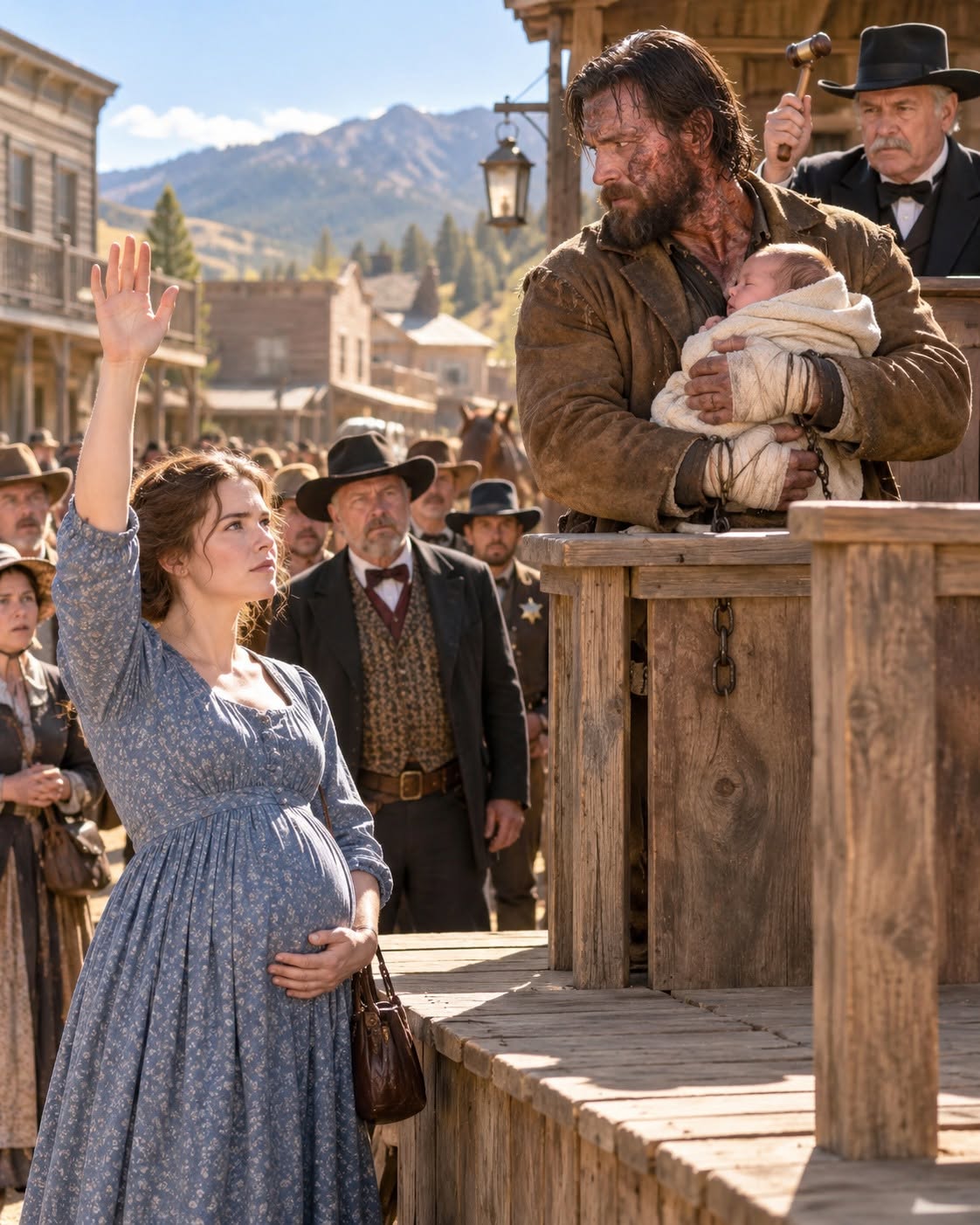
PART 3: THE SECRET HIDDEN BENEATH THE BURNED CABIN
The knock came just after sunrise.
Three hard strikes against the front door.
Ruth was already awake, standing beside the kitchen stove with one hand resting on her stomach. She had slept poorly. Every unfamiliar sound had seemed louder than usual, and twice during the night she had gone to check that Grace was still resting peacefully in her cradle.
Elias had barely slept at all.
When Ruth opened the door, she found Horace Bell standing on the porch.
Behind him stood two men in dark coats.
“Good morning, Mrs. Callahan,” Bell said pleasantly.
Ruth did not return the greeting.
“What do you want?”
“To correct a misunderstanding.”
“I don’t remember misunderstanding anything.”
Bell smiled.
“I understand you purchased Boone’s labor contract yesterday.”
“I did.”
“Then you should understand that the contract includes certain obligations.”
He unfolded a paper.
“Boone owes the Bell Ridge Silver Company for damages to company property, unpaid advances, and the destruction of a storage building.”
Ruth frowned.
“Magistrate Pike told me the contract covered his debts.”
“It covers the debts recorded with the court. This is a separate claim.”
“Convenient.”
Bell’s smile disappeared.
“I would advise you not to make accusations you cannot support.”
From inside the house came the sound of a chair moving.
Elias appeared in the doorway.
His face was pale, and his bandaged hands rested carefully against his sides.
“Leave her out of this, Bell.”
“I’m afraid that is impossible. Your new employer has inherited your problems.”
“She’s not my employer,” Elias replied. “She bought a contract. Nothing more.”
Ruth glanced at him.
It was the first time he had spoken with such certainty since arriving.
Bell raised the document.
“According to this agreement, you owe the company another two hundred and forty dollars. Until it is settled, the company retains the right to claim your remaining property.”
“I have no property,” Elias said.
“Then you should have no objection to signing a statement confirming that fact.”
Bell produced another sheet.
Ruth stepped between them.
“He isn’t signing anything.”
Bell looked at her swollen belly.
“You should concern yourself with your own circumstances, Mrs. Callahan. Winter is coming. You have no husband, no savings, and a child on the way. Do you truly intend to support another man’s debts?”
Ruth felt the insult land.
But she refused to let him see it.
“I intend to decide what happens under my own roof.”
Bell folded the paper.
“Then I suggest you examine the consequences of that decision.”
He turned toward Elias.
“You have until Friday to settle the claim. After that, I’ll ask the magistrate to review the contract.”
The two men followed him down the steps.
Ruth watched them disappear along the road.
Then she closed the door.
Elias stood beside the table, staring at the document Bell had left behind.
“What did you do for him?” Ruth asked.
Elias remained silent.
“Elias?”
 “I worked at his mine.”
“Doing what?”
“Surveying. Timber work. Repairs. Whatever needed doing.”
“Then why does he say you owe him money?”
“Because Bell has a talent for turning a man’s wages into debts.”
Elias sat down slowly.
He explained that the company had once hired him to inspect an old mining tunnel. He had discovered that the roof supports were unstable and warned Bell that the workers should be removed until the pᴀssage could be reinforced.
Bell had refused.
He wanted the silver hauled out before the end of the season.
Elias had argued with him.
Two days later, the tunnel partially collapsed.
Fortunately, the workers had been moved to another section before the worst of it happened.
But Bell blamed Elias for the delay and charged him for damaged equipment, replacement timber, and lost production.
“I told him the tunnel was dangerous,” Elias said. “He told the magistrate I had caused the damage.”
“Did anyone witness your warning?”
“Three men. One left Montana. Another disappeared from the company payroll. The third is afraid of Bell.”
Ruth looked at the paper.
“And your cabin?”
Elias’s expression changed.
“That fire wasn’t an accident.”
The words settled heavily between them.
He explained that the cabin had stood on land adjoining the mining company’s northern boundary. It was a modest place, built by his father, and Elias had refused several offers to sell it.
The land itself was not particularly valuable.
But beneath the mountain ran an old water channel.
Bell wanted it.
Without access to that channel, the company’s newest operation would have to shut down during the dry season.
“Did you tell the magistrate?” Ruth asked.
“I tried. Pike said I had no proof.”
“And the papers you went back for?”
Elias looked toward the window.
“I found something in my father’s desk. A survey map. It showed the original water rights.”
“Do you still have it?”
“No.”
“Was it destroyed in the fire?”
Elias shook his head.
“I don’t know. I never found it.”
Ruth sat opposite him.
“Then we find out.”
He stared at her.
“You have already given me everything you owned.”
“Not everything.”
“Mrs. Callahan—”
“Ruth.”
He stopped.
She continued more quietly.
“I have a roof, a stove, a few acres, and a stubborn mule. I’m not going to pretend those things make me wealthy. But I am not going to let Horace Bell frighten me into surrendering my home.”
Elias looked toward the spare room.
Grace had begun to stir.
“I won’t bring trouble to your child.”
Ruth answered without hesitation.
“Then help me keep trouble away from both of them.”
By noon, Ruth had discovered something unexpected.
Elias could not yet lift heavy objects, but he knew how to study a building.
He examined the barn, the damaged porch, and the uneven roof. He pointed out which boards needed replacing and where the foundation was beginning to settle.
He even found a way to redirect rainwater away from the house using an old drainage ditch.
“You’ve been looking at my property for an hour,” Ruth said.
“It’s a good piece of land.”
“It leaks.”
“Most roofs do when people stop repairing them.”
“Mine has been trying to become a pond for three months.”
Elias gave a quiet chuckle.
It was the first time Ruth had heard him laugh.
She found herself smiling, too.
Then Grace began crying.
Elias immediately turned toward the house.
Ruth noticed the movement.
“You don’t have to rush every time she makes a sound.”
“I know.”
But he was already heading inside.
Ruth watched him go.
There was something extraordinary about the way he cared for that child. His hands were injured, his future uncertain, and the world had treated him as though he were worthless.
Yet he never once treated Grace as anything less than precious.
It made Ruth think of Thomas.
Her husband had been a quiet man, but he had always believed that a home was built by the people who refused to abandon one another.
Perhaps, she thought, that was still true.
That afternoon, Elias asked Ruth for a shovel.
“Why?”
“I need to check something.”
“You can barely carry a bucket.”
“I won’t be digging for long.”
Ruth studied him.
“Tell me what you’re looking for.”
He hesitated before answering.
“When the cabin burned, I noticed something strange. The fire had started near the rear wall, but the ground outside was disturbed near the old root cellar.”
“What was in the cellar?”
“Nothing valuable. Potatoes, jars, tools.”
“Then why would anyone go there?”
Elias looked at her.
“Because the entrance to the old survey chamber was beneath it.”
Ruth slowly put down the cup she was holding.
“You had a hidden chamber?”
“My father built it. He used it to keep maps and documents dry.”
“And you never told the magistrate?”
“I didn’t know whether the chamber had survived.”
Ruth glanced toward the mountains.
“Then that’s where we should look.”
Elias shook his head.
“It’s too dangerous for you to come.”
“I’m pregnant, not made of glᴀss.”
“I didn’t mean—”
“I know what you meant. But if Bell is trying to take something from us, I would rather know what it is.”
Elias looked as though he wanted to argue.
Then Grace cried again from the bedroom.
He turned toward her.
Ruth sighed.
“Go look after your daughter. I’ll find the shovel.”
They reached the burned cabin shortly before sunset.
The place stood in a clearing beneath a ridge of dark pines.
Only part of the stone chimney remained standing. Charred beams lay scattered across the ground, and the old fence had collapsed.
Elias stopped at the edge of the clearing.
For a moment, he seemed unable to move.
“This was my father’s home,” he said.
Ruth did not offer empty comfort.
She simply stood beside him.
After a while, Elias pointed toward a low stone wall.
“The cellar was there.”
They found the entrance partly covered by fallen boards and ash. Ruth stayed back while Elias examined the area, then helped him clear loose debris without forcing him to strain his injured hands.
Beneath a broken plank, they discovered an iron ring.
Elias pulled gently.
A wooden panel shifted.
Underneath was a narrow storage space lined with stone.
Inside lay a small metal box.
Elias stared at it.
“My father’s lockbox.”
He reached down and lifted it carefully.
The lid was scorched, but the lock remained intact.
Ruth noticed a folded piece of paper caught beneath one corner.
“There’s something here.”
Elias took it.
The paper had been protected from the worst of the fire.
He unfolded it.
At the top was a date from 1864.
Below it was a handwritten statement signed by his father, Jonathan Boone.
Elias read silently.
Then his expression changed.
“What does it say?” Ruth asked.
He handed her the paper.
It described an agreement between Jonathan Boone and the original owners of the Bell Ridge property.
The document granted the Boone family permanent rights to the spring and underground water channel running beneath their land.
But there was something else.
A second paragraph stated that the rights could not be sold, transferred, or claimed by a mining company without the written agreement of the Boone family.
Ruth read the final lines twice.
“Elias, this could prove Bell has no right to the water.”
He nodded slowly.
“That’s why he wanted the cabin.”
“Then we take this to the magistrate.”
Elias looked down at the lockbox.
“There may be more.”
He opened it.
Inside were old survey notes, a leather-bound journal, and a smaller envelope bearing his father’s handwriting.
The envelope was addressed:
To Elias, when the company comes asking for what is not theirs.
Elias’s face went pale.
He opened it.
His father’s letter began with a warning about Horace Bell’s company.
But the final paragraph made Elias stop breathing for a moment.
Jonathan Boone had written that the water rights were only one part of the agreement.
The original deed included a second claim—a strip of land running along the mountain ridge, directly above the richest silver deposit in Bell Ridge.
And according to the deed, that land belonged to the Boone family.
Not the mining company.
Not Horace Bell.
Elias.
Ruth looked toward the distant mountains.
For the first time, she understood why Bell had been so determined to control the auction.
He had not merely wanted Elias’s labor.
He had wanted to keep him powerless long enough to take something far more valuable.
They returned to the homestead after dark.
Grace was asleep when they arrived.
Ruth placed the documents on the kitchen table and lit another lamp.
“We need to speak to someone who can verify these papers,” she said.
Elias nodded.
“There’s one man in town who can.”
“Who?”
“Samuel Whitcomb. He was the county surveyor before Pike took office. My father trusted him.”
“Then we’ll find him tomorrow.”
Elias looked at the documents.
“If these are genuine, Bell could lose the mine.”
“Then perhaps he should have thought of that before trying to take your daughter.”
Elias looked at Ruth.
“You risked your last eighty-five dollars for a stranger.”
“I know.”
“And now you may lose your homestead because of me.”
Ruth shook her head.
“I may lose it because a greedy man believes he can frighten people into giving him what he wants. That’s not the same thing.”
For a long moment, Elias said nothing.
Then he reached into his coat and removed a small object.
It was a silver locket, blackened around the edges.
“My wife wore this,” he said. “I found it near the cabin after the fire.”
He placed it beside the documents.
“I thought everything she left me was gone.”
Ruth looked at the locket.
“Would you like me to keep it somewhere safe?”
Elias nodded.
She carefully wrapped it in a clean cloth and placed it in the wooden drawer where Thomas’s old watch was kept.
Two lives.
Two losses.
Two small reminders that love did not disappear simply because someone was gone.
Then came a knock.
Not the sharp, impatient knock Bell had made that morning.
This one was hesitant.
Ruth opened the door.
An elderly man stood outside, his coat dusty from the road. He held a lantern in one hand and a folded newspaper in the other.
“Are you Mrs. Callahan?”
“Yes.”
“My name is Samuel Whitcomb. I used to survey the northern Montana claims.”
Elias appeared behind her.
“Samuel?”
The old man’s eyes widened.
“Good heavens, Elias. I heard about the fire. I thought you were ᴅᴇᴀᴅ.”
Elias stepped onto the porch.
“I’m alive.”
Whitcomb looked at the papers on the kitchen table.
Then his expression became grave.
“Where did you find those?”
“Beneath my father’s cabin.”
The old surveyor removed his hat.
“I was afraid this day would come.”
Ruth felt a chill.
“What do you mean?”
Whitcomb glanced toward the road, then lowered his voice.
“Your father’s original deed is genuine. I helped record it myself. But there is another copy, and Horace Bell has been searching for it for nearly fifteen years.”
“Why?” Elias asked.
The old man looked directly at him.
“Because the copy in your father’s possession is not the only document that proves the Boone family owns that mountain.”
He unfolded the newspaper.
A small notice had been marked in pencil.
FORMER SURVEYOR FOUND ᴅᴇᴀᴅ NEAR BELL RIDGE ROAD.
Ruth’s hand moved instinctively to her stomach.
Whitcomb continued, barely above a whisper.
“The man who kept the second copy was my brother.”
Then he looked at Elias.
“And yesterday, someone broke into my house looking for it.”