PART 6 — THE TRUTH THAT SET THEM FREE
PART 6 — THE TRUTH THAT SET THEM FREE
For several seconds, I couldn’t speak.
I stared at the signature.
It looked like Arthur’s, but something about it was wrong. The final letter was too sharp. The spacing was uneven. Arthur had always written his name with a small curl beneath the last letter.
This signature had none.
“Are you certain?” I asked.
Samuel opened another folder.
“I’ve compared it with several documents your husband signed while alive. His bakery lease, his supplier contracts, and his tax records. The differences are significant.”
“Then how did Hiram get away with it?”
“Because he expected you to be frightened, grieving, and too poor to challenge him.”
The words hurt because they were true.
Samuel explained that Arthur had borrowed money for his medical care, but the amount was far smaller than the debt Hiram claimed. Several payments had also been recorded in the bakery’s account book.
I remembered the little ledger Arthur kept beneath the counter.
I had left it behind when we fled Bozeman.
“Can that book help prove it?”
“Very much,” Samuel replied. “If we can recover it.”
Gideon immediately offered to ride with us to Bozeman.
I hesitated.
“Hiram will be waiting.”
“Then he can wait,” Gideon answered. “We’re not going there to ask permission.”
The next morning, Samuel, Gideon, and I traveled toward town. Mrs. Bell stayed with Toby and Clara, promising to keep them safe until we returned.
Bozeman looked smaller than I remembered.
The bakery stood on the same corner, but the windows were dark. A new sign hung above the door, announcing that the property belonged to Fletcher Mercantile.
My chest тιԍнтened.
I had spent years kneading dough in that kitchen. Arthur had taught Toby to count coins at the counter. Clara had taken her first steps beside the flour barrel.
Now strangers occupied the place where our family had been happy.
Samuel approached the office next door and presented his credentials. After a tense exchange, the clerk agreed to retrieve the public mortgage records.
What we found was worse than I expected.
The original loan had been issued for a modest amount. Arthur had paid most of it before his death. But Hiram had later submitted a second agreement, claiming that Arthur had borrowed additional money and pledged the bakery as security.
The second agreement carried a witness signature.
Samuel examined it carefully.
“Do you recognize this name?”
I looked down.
“Elias Mercer. He supplied flour to our bakery.”
Samuel nodded.
“Then we need to speak with him.”
We found Elias at a feed store on the edge of town. At first, he refused to discuss anything involving Hiram. He looked frightened and kept glancing toward the street.
 But when I told him Arthur was ᴅᴇᴀᴅ and my children had been threatened with separation, his expression changed.
“I never witnessed that agreement,” he said quietly.
Samuel leaned forward.
“Are you willing to state that under oath?”
Elias hesitated.
Then he nodded.
“Hiram brought me a paper months ago and told me to sign a receipt for a flour delivery. I didn’t know my name would appear on a loan agreement.”
My hands clenched.
“Why didn’t you tell someone?”
“Because he threatened to ruin my business.”
Samuel wrote down his statement.
We had the first witness.
But Hiram was not finished.
That afternoon, he appeared outside the clerk’s office with two men.
“You’re making a serious mistake, Mrs. Miller,” he said.
I stood beside Samuel.
“No. I’m correcting one.”
“You have no money for a legal fight.”
“Perhaps not. But I have the truth.”
He laughed.
“Truth doesn’t pay lawyers.”
Samuel stepped forward.
“Forgery and fraudulent debt collection may interest the county prosecutor. I suggest you choose your next words carefully.”
Hiram’s smile vanished.
“You think you’re going to frighten me with legal papers?”
“No,” Samuel replied. “I think the evidence will speak for itself.”
Hiram turned toward Gideon.
“This is your doing. You should have stayed out of it.”
Gideon stepped closer.
“I stayed out of it once. It cost Margaret her home and her future. I won’t make that mistake again.”
Hiram stared at him, then walked away.
Two weeks later, the matter reached the county courthouse.
I wore my only decent dress, the blue one Arthur had bought me for our last wedding anniversary. Toby and Clara sat with Mrs. Bell in the back row.
Gideon stood beside me.
Samuel presented the original trust document, the disputed mortgage, Arthur’s genuine signatures, and Elias Mercer’s sworn statement.
Then he produced one final piece of evidence.
A letter from Hiram to his clerk, instructing him to prepare a second debt agreement using Arthur’s signature from an older document.
The letter had been found among the business records after the clerk, fearing prosecution, agreed to cooperate.
The courtroom fell silent as the judge read it.
Hiram’s lawyer tried to argue that the letter had been misunderstood. But the evidence was clear.
The judge ruled that the disputed debt was invalid pending further investigation. He ordered the bakery property returned to the estate and placed a temporary restriction on any transfer of Margaret’s land trust.
Then came the ruling I had waited for.
The court recognized me as the rightful beneficiary of my mother’s property.
I was not rich. The land would require legal work, taxes, and repairs before it could provide any income.
But it was mine.
And Hiram Fletcher could no longer use it to threaten my children.
When the hearing ended, I walked outside and found Toby waiting on the courthouse steps.
“Mother, did we win?”
I knelt and brushed his hair from his forehead.
“Yes, sweetheart. We won.”
Clara threw her arms around me.
“Does that mean we can go home?”
I looked at the courthouse, then at Gideon.
For the first time, I understood that home wasn’t necessarily the building where we had once lived.
It was the place where my children could sleep without fear.
It was the people who stood beside us when the world tried to push us aside.
“We’re going to make a new home,” I told her.
And we did.
I chose not to return to Bozeman permanently. The bakery was eventually restored to my ownership, but I leased it to a trustworthy couple while Samuel helped me manage the land trust.
With the first income from the property, I bought a small piece of land near Bitterroot Ridge.
Gideon helped build a little house there, with two bedrooms, a warm kitchen, and a wide porch overlooking the valley.
He never asked me to marry him.
He never demanded that I owe him anything for his help.
Instead, he showed up every morning with lumber, tools, or something useful he had made for the children.
One afternoon, I found him repairing the kitchen table.
“You know,” I said, “you could simply ask me to have supper with you.”
He looked up, surprised.
“I thought you had enough of my cooking.”
I laughed.
“Not a chance.”
For the first time, he smiled without sadness.
Months pᴀssed.
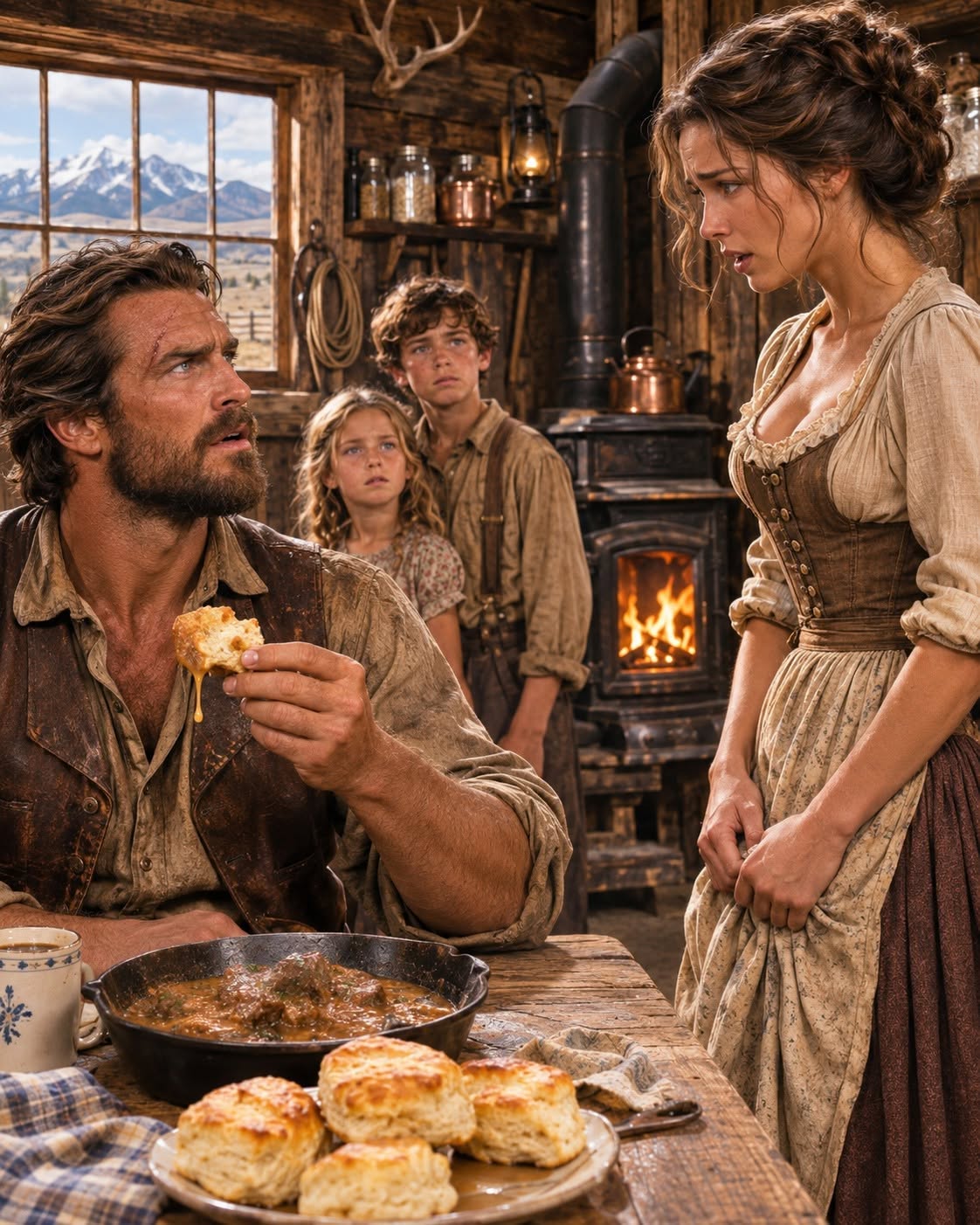
Toby grew stronger and learned to ride the ranch horses. Clara planted flowers beside the porch and insisted that every visitor receive a biscuit before leaving.
And I began selling bread, pies, and biscuits from my own kitchen.
I called it Margaret’s Table, in honor of the woman whose recipe had brought the truth back into my life.
One evening, Gideon stood beside me as the sun disappeared behind the mountains.
“I’ve spent twenty years thinking I lost Margaret because I wasn’t brave enough to keep her,” he said.
I looked at him.
“You can’t change what happened.”
“No. But I can choose what happens next.”
He reached into his pocket and placed a small silver ring on the table.
“I won’t ask you to forget your past, Etta. And I won’t ask you to become someone else. I only want to know whether you’d like to build the rest of your life beside me.”
I looked through the kitchen window.
Toby was helping Clara arrange biscuits on a plate. Their laughter filled the little house.
Then I looked back at Gideon.
“Yes,” I said. “But on one condition.”
He raised an eyebrow.
“What condition?”
“You let me keep the kitchen.”
A genuine laugh escaped him.
“Woman, after that first meal, I wouldn’t dare argue.”
We married quietly the following spring, with Toby and Clara standing beside us and Mrs. Bell bringing a basket of fresh flowers.
There was no grand celebration, no expensive dress, and no wealthy guests.
There was only a warm kitchen, a long table, and enough food for everyone.
Years later, people in Bitterroot Ridge still talked about the widow who arrived with two hungry children and sixty minutes to prove she could cook.
But the story they remembered wasn’t about the biscuits.
It was about a woman who refused to surrender her children, a mountain man who finally found the courage to face his past, and a family that discovered the truth could be stronger than fear.
And whenever someone asked Gideon why he never let anyone else make biscuits in his kitchen, he would glance toward me and say:
“Because the first ones she made didn’t just feed me.
They brought my family home.”