PART 3 — THE WOMAN WHO REFUSED TO LET THE TOWN FREEZE
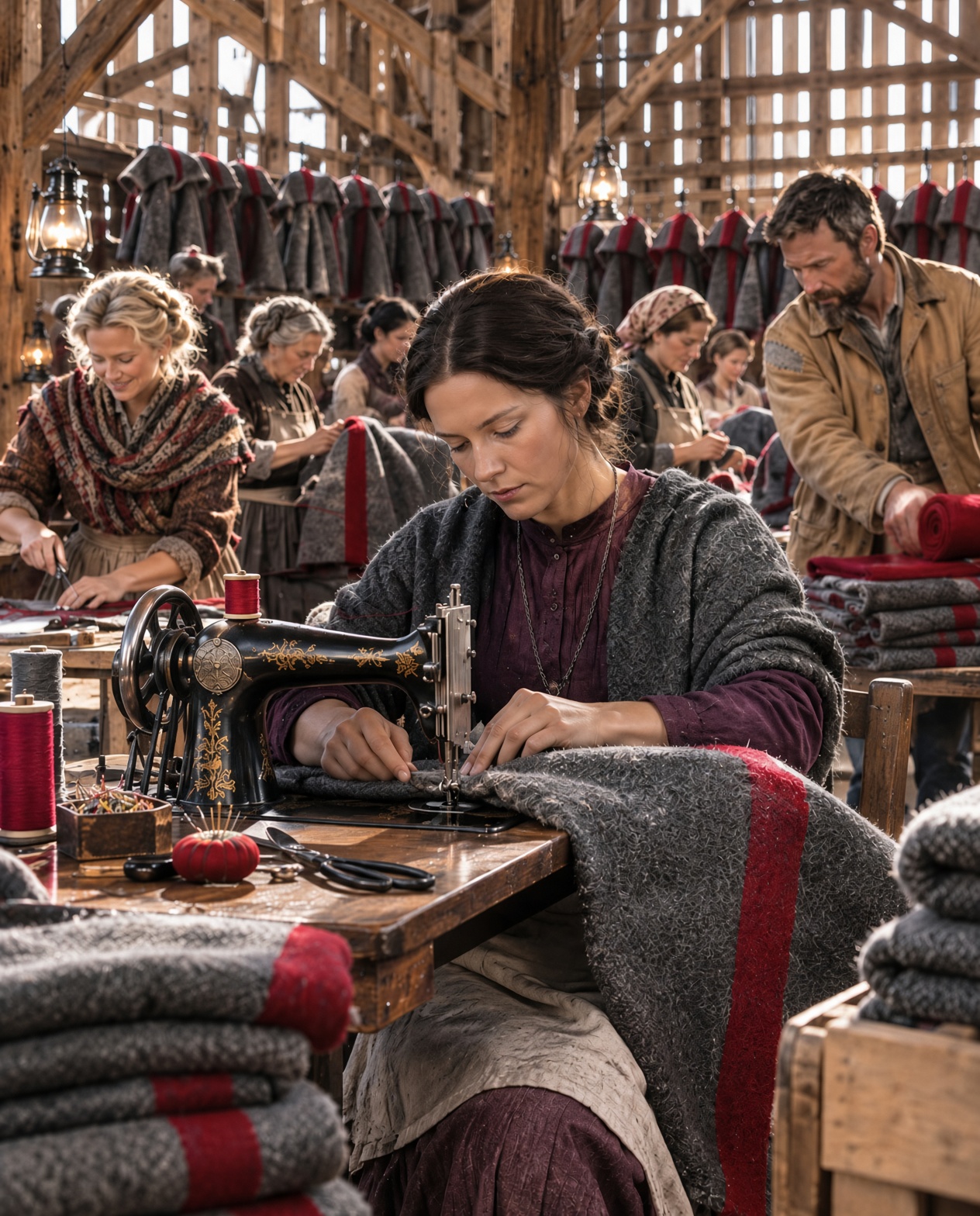
PART 3 — THE WOMAN WHO REFUSED TO LET THE TOWN FREEZE
Nobody moved for several seconds.
Mrs. Bell stood beside the schoolhouse door, her hands trembling.
“Jonas is missing?”
Miss Foster nodded.
“He went outside to bring in a basket of wood. I called for him, but the wind was so loud I couldn’t hear an answer.”
Mrs. Bell covered her mouth.
“Why didn’t you tell me?”
“I thought he had returned with the others. I didn’t realize he was gone until we counted the children.”
Halvor stepped forward.
“How long ago?”
“Almost an hour.”
The blacksmith looked toward the window.
“We can’t go back out there blindly. The storm is beginning to settle, but the drifts are still deep.”
Mrs. Bell looked at him.
“That’s my grandson.”
Nobody answered.
Then Odessa stood.
“His coat has a red stripe, doesn’t it?”
Miss Foster nodded.
“Yes.”
“Then we have a chance.”
She turned toward the door.
“Where did he last go?”
“Behind the schoolhouse, toward the woodpile.”
Odessa looked at Halvor.
“Can you take the lantern?”
He nodded.
“Stay behind me.”
The blacksmith tied another length of rope around his waist. Ezra Pell secured the other end, and Halvor took the lantern.
Odessa insisted on coming.
Mrs. Bell followed.
The group stepped outside.
The wind had weakened enough to reveal the shapes of nearby buildings, but the snow was still falling heavily. Drifts reached the men’s waists in places.
They moved slowly toward the woodpile.
“Jonas!” Mrs. Bell called.
No answer.
“Jonas!”
Halvor raised the lantern.
The light moved over the snow.
There were no footprints left to follow.
Then Odessa saw something.
A small red shape near the corner of the building.
She hurried toward it.
“Wait!” Halvor shouted.
She stopped.
The red shape moved.
It was a sleeve.
A child’s sleeve.
Halvor rushed forward and began digging.
Within moments, they uncovered Jonas, curled beside the woodpile beneath a drift of snow.
He was conscious, but barely.
Mrs. Bell dropped to her knees.
“Jonas! Oh, sweetheart!”
The boy opened his eyes.
“Grandma?”
“I’m here.”
Odessa helped remove the snow from his coat.
The red stripe was almost completely buried, but a small section remained visible.
Halvor lifted the boy carefully.
“Let’s get him inside.”
Jonas was carried back to the schoolhouse, where Miss Foster wrapped him in blankets and placed him near the stove.
The teacher examined him and ᴀssured everyone that he was breathing steadily.
Mrs. Bell held his hand.
Then she looked at Odessa.
“You saved him.”
Odessa shook her head.
“The red stripe helped us find him.”
“You designed that stripe.”
“I only wanted people to be visible in the snow.”
Mrs. Bell’s eyes filled.
“Sometimes the smallest thing becomes the biggest blessing.”
Odessa looked down.
She had never thought of herself as someone capable of saving lives.
She was a seamstress.
A woman who knew how to measure fabric, repair torn sleeves, and make a coat fit properly.
But that night, her work had done something she had never imagined.
It had helped bring people home.
By dawn, the worst of the storm had pᴀssed.
The rescue party returned to Plum Bluff with all twenty-three children alive.
The schoolhouse teacher was exhausted, but unharmed.
Colm was taken to the Ingram ranch, where Mrs. Bell and Odessa cared for him beside the fireplace.
Peter and Jonas were reunited with their families.
And every household in the district began telling the same story.
The story of the woman with the giant sewing machine.
The woman who had arrived in October with a wooden crate so large that the stationmaster had nearly refused to unload it.
The woman whose coats had kept twenty-three children warm.
The woman whose red stripes had helped rescue a boy buried beneath the snow.
By noon, people were arriving at the ranch.
Dagny Lindquist came first.
She carried a basket of fresh bread and hugged Odessa so тιԍнтly that Odessa nearly dropped it.
“I don’t know how to thank you,” Dagny said.
“You don’t have to.”
“Yes, I do.”
Dagny stepped back.
“My Peter is alive because of you.”
“He’s alive because many people went looking for him.”
“But you made the coat.”
Odessa smiled.
“Then perhaps you can help me make the next one.”
Dagny laughed through her tears.
“Gladly.”
Others arrived throughout the afternoon.
The blacksmith brought a repaired iron stove part.
Ezra Pell brought flour, sugar, and two bolts of thick flannel.
A farmer offered a dozen chickens.
Another man offered to repair the workshop roof.
Even people who had previously considered Odessa’s sewing business a foolish luxury now wanted to help.
But the most surprising visitor was the mayor.
He arrived carrying a folded document.
“Mrs. Ingram,” he said, “the town council met this morning.”
Odessa wiped her hands on her apron.
“What about?”
“The schoolhouse. And the winter supply shortage.”
He opened the document.
“We’ve decided to establish a permanent sewing and winter clothing cooperative here in Plum Bluff. We want you to direct it.”
Odessa stared.
“Me?”
“You have already shown us what this community can accomplish when people work together.”
He continued.
“The town will provide the materials. The women will be paid for their work. The finished clothing will be distributed to families who cannot afford winter supplies.”
Odessa read the paper.
It included a modest salary, a building for the workshop, and an agreement allowing her to retain ownership of her sewing machine.
She looked up.
“Why are you offering this to me?”
The mayor smiled.
“Because we have spent years waiting for someone else to save us. You showed us that we could help one another.”
Odessa was unable to answer.
For years, she had worked for wealthy families who barely remembered her name.
Now an entire town was asking her to lead something.
Something that would last beyond one winter.
She looked toward Halvor.
He was standing beside the fireplace, watching her.
And he nodded.
“Take it,” he said.
Odessa hesitated.
“What about the ranch?”
“The ranch will still be here.”
“But the work—”
“We’ll manage.”
He paused.
“And this time, you won’t have to ask permission to do what you know is right.”
She looked at him for a long moment.
Then she signed the document.
Three weeks later, the workshop opened in an empty building beside the mercantile.
The sign above the door read:
PLUM BLUFF WINTER CLOTHING COOPERATIVE
Inside, twelve sewing machines stood in neat rows.
Odessa’s Singer occupied the place of honor near the front window.
The women worked together every day.
Some cut wool.
Some prepared linings.
Others repaired old clothing and turned worn blankets into warm garments.
The children from the schoolhouse often visited after lessons. They carried ʙuттons, sorted thread, and delivered finished coats to families around town.
Colm, once strong enough to walk again, became one of Odessa’s most enthusiastic helpers.
He even learned to operate a sewing machine.
His first attempt produced a crooked seam that made everyone laugh.
“It’s not supposed to look like a river,” Odessa told him.
“Then perhaps the river should learn to sew straighter.”
Even Halvor laughed.
It was a sound that had become increasingly common in the Ingram household.
One evening, after the workshop had closed, Halvor found Odessa sitting beside her Singer machine.
She was repairing a small blue coat.
He leaned against the door.
“Still working?”
“Just finishing this.”
“It’s nearly dark.”
“I know.”
He walked over and placed a cup of tea beside her.
Then he looked at the machine.
“I owe this thing an apology.”
Odessa smiled.
“What did it do?”
“Arrived at my ranch without permission.”
She laughed.
Halvor pulled out a chair.
“When I first saw that crate at the station, I thought it was the most ridiculous thing I’d ever encountered.”
“And now?”
“Now I think it may be the finest thing that ever came through Plum Bluff.”
Odessa lowered her sewing.
“Even finer than the new stove?”
“Considerably.”
She smiled.
For a moment, they sat in comfortable silence.
Then Halvor reached into his coat and removed a small velvet box.
Odessa looked at it.
“What is that?”
“Something I should have given you earlier.”
He opened it.
Inside was a simple gold wedding ring.
Her eyes widened.
“Halvor…”
“I know we were married at the courthouse because it was convenient. I know we barely knew each other when we signed those papers.”
He took a breath.
“But I don’t want you to spend the rest of your life wondering whether I married you because I needed someone to run a household.”
He looked directly into her eyes.
“I want you to know I would choose you even if there were no ranch, no workshop, no cattle, and no sewing machine.”
Odessa’s eyes filled.
“Halvor, you don’t have to—”
“I want to.”
He held out the ring.
“Would you let me court my own wife properly?”
She laughed softly.
“You’re asking permission to court a woman you’re already married to?”
“Seems reasonable to me.”
She extended her hand.
He slipped the ring onto her finger.
Then he leaned forward and kissed her forehead.
It was a small gesture.
But to Odessa, it meant more than all the grand promises she had ever heard.
She had arrived in Nebraska expecting a difficult marriage and a lonely winter.
Instead, she had found a man who was learning to share his life, a town that had become her family, and a purpose bigger than anything she had imagined.
But the story of the red-striped coats did not end with the winter of 1888.
By the following autumn, the cooperative had produced more than six hundred coats, dozens of blankets, and hundreds of repaired garments.
The women began receiving orders from neighboring towns.
The mayor arranged for a larger building.
Ezra Pell supplied the fabric.
And Halvor expanded the ranch enough to provide steady work for several local families.
Then, one morning, a letter arrived from Omaha.
It was addressed to Odessa Brandt Ingram.
The envelope bore the seal of a large charitable organization.
She opened it at the kitchen table while Halvor poured coffee.
The letter explained that news of the Plum Bluff rescue had reached newspapers across the state.
A reporter had written about the twenty-three children, the blizzard, and the woman whose red-striped coats had helped save them.
The organization wanted to purchase five hundred winter coats for children in remote settlements.
They also wanted Odessa to travel to Omaha and speak about her cooperative.
Halvor read the letter twice.
“Five hundred?”
Odessa nodded.
“That’s what it says.”
He looked at her.
“Can we make that many?”
She glanced toward the sewing machine.
Then toward the window, where several women were already walking up the path carrying baskets of fabric.
“Yes,” she said.
“We can.”
Halvor smiled.
“Then I suppose we’d better get started.”
But there was one final surprise.
At the bottom of the letter, the organization had included a small newspaper clipping.
The headline read:
THE SEAMSTRESS WHO SAVED PLUM BLUFF — AND THE HUSBAND WHO ALMOST SENT HER AWAY.
Odessa laughed.
Halvor groaned.
“I shall never hear the end of that.”
“No,” she said, folding the clipping carefully. “I don’t believe you will.”
She placed it beside the sewing machine.
Then she began working on the first coat for the new order.
Outside, the Nebraska wind moved through the grᴀss.
Winter would come again.
But this time, the people of Plum Bluff would not face it unprepared.
And every time a child pulled on a gray wool coat with a bright red stripe down the back, they would remember the woman who arrived with a wooden crate—and changed an entire town.
Because Halvor Ingram had thought he was bringing home a wife.
He had no idea he was bringing home the person who would teach a whole community how to save itself.