PART 2 — THE LEDGER, THE LUMBERJACKS, AND THE SECRET HIDDEN IN THE SUPPLY SHED
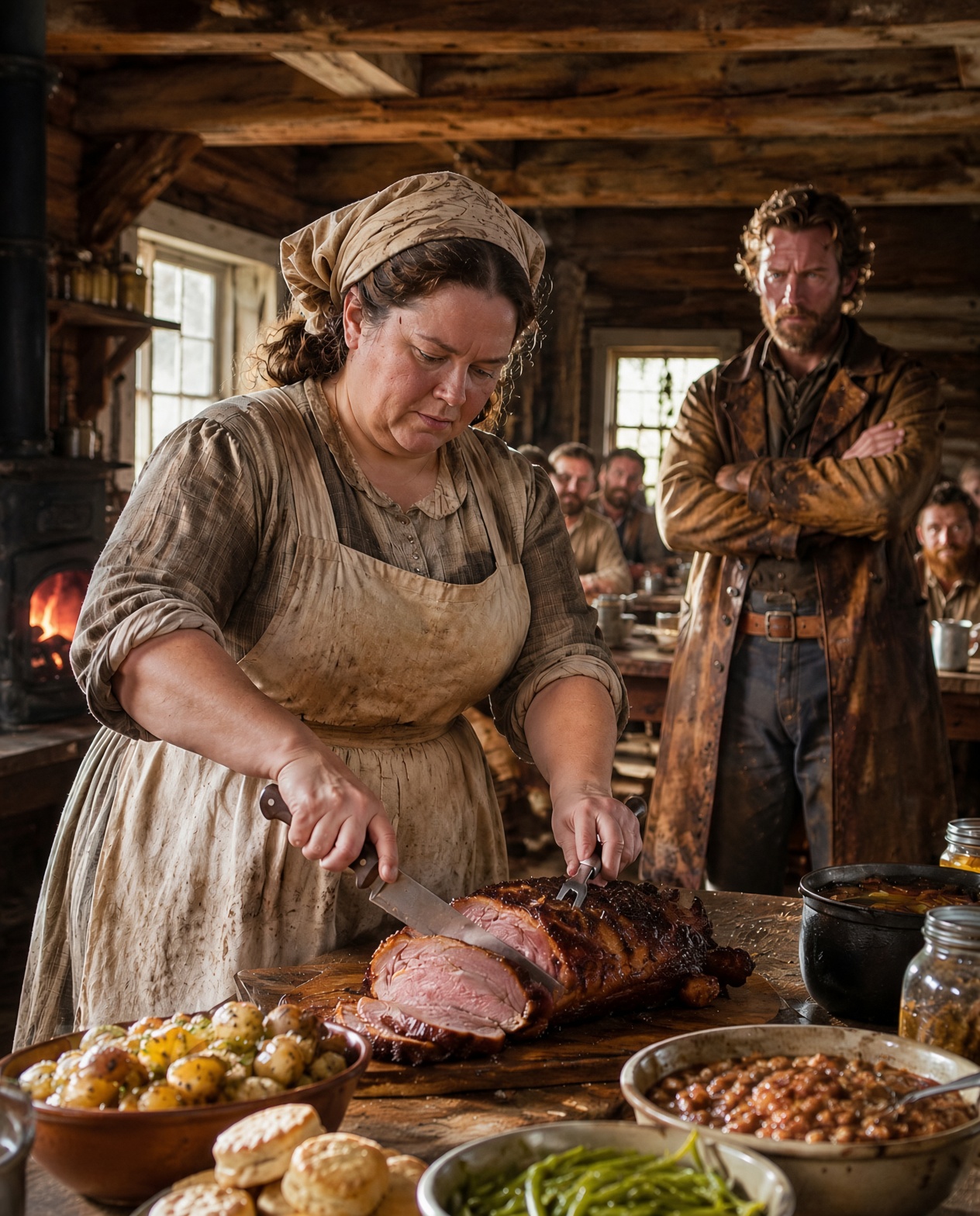
PART 2 — THE LEDGER, THE LUMBERJACKS, AND THE SECRET HIDDEN IN THE SUPPLY SHED
Reed MacKay pushed the ledger across the table.
“Something’s wrong with these numbers,” he said. “I’ve checked them three times, and I still can’t find it.”
Audra wiped her hands on her apron and pulled the book closer.
The lamp cast a yellow circle over the pages. Outside, November wind rattled the cook shack windows, while the distant sounds of the bunkhouse slowly faded.
“What exactly concerns you?” she asked.
“The flour. The salt pork. The lamp oil. Everything costs more than it should, but we’re somehow running out faster than the records say we ought to.”
Audra studied the columns.
She wasn’t a bookkeeper by profession, but three years in a railway boarding house had taught her something important: a kitchen could not survive on guesswork.
She turned several pages.
“Who handles the supply orders?”
“Mostly me. Sometimes Boyd collects deliveries when I’m out in the timber.”
“And who checks what actually arrives?”
Reed hesitated.
“Whoever happens to be here.”
Audra tapped the ledger.
“Then you’ve found your problem.”
Reed leaned forward.
“Explain.”
She placed two fingers beside an entry.
“You ordered twelve sacks of flour on October seventeenth. The invoice says twelve were delivered. But your kitchen inventory shows only eight sacks were put into storage.”
“Perhaps the previous cook used the rest.”
“Not according to the meal records. There weren’t enough men here to use four sacks in that period.”
She turned another page.
“The same thing happened with salt pork. You paid for six barrels, but only four were recorded when the shipment was unloaded.”
Reed’s expression hardened.
“Are you suggesting someone is stealing supplies?”
“I’m suggesting you are paying for things that never reach your camp.”
He stared at the pages.
For several seconds, neither spoke.
Then Reed closed the ledger.
“Can you help me straighten this out?”
Audra looked at him.
“I can. But I need authority to check every delivery, every invoice, and every item in the storage shed.”
“You’ll have it.”
“And I want the men to understand that this isn’t about accusing anyone. It’s about making sure the camp gets what it pays for.”
Reed nodded.
“Agreed.”
Audra stood.
“Then I suggest we begin tomorrow morning. And now, Mr. MacKay, you should go to bed.”
He raised an eyebrow.
“Are you ordering me around?”
“Only until breakfast.”
For the first time in weeks, Reed laughed.
The next morning, Audra began her investigation.
She counted flour sacks, measured the remaining barrels of salt pork, checked the coffee supply, and wrote down the exact number of potatoes stored in the cellar.
She also created something the camp had never possessed before: a proper inventory book.
Every delivery would be weighed, counted, and signed for by two people.
Every ingredient taken from storage would be recorded.
At first, the men found the new system amusing.
“Next she’ll be counting the beans one by one,” Saul joked.
Audra didn’t look up.
“Don’t tempt me, Saul. I’ve got a pencil and plenty of patience.”
The table erupted in laughter.
Even Boyd smiled, though he quickly hid it behind his coffee cup.
By the fourth day, the difference was already noticeable.
Nothing disappeared without explanation. Meals were more consistent, emergency orders became unnecessary, and Reed discovered that he had been spending nearly a quarter more on provisions than the camp required.
But Audra noticed something else.
The deliveries were always short when they came from the same supplier.
A merchant named Silas Crowe operated a supply warehouse in Merritt. He had held the camp’s contract for almost two years.
Every invoice bore his signature.
And every questionable delivery had pᴀssed through his hands.
Audra showed Reed the records.
He studied them carefully.
“Silas has supplied this camp since before I took over.”
“That doesn’t make the numbers correct.”
Reed nodded.
“I’ll speak to him.”
“Bring the original invoices. And don’t accuse him until we know what happened.”
Reed looked impressed.
“You’ve got a better head for business than you let on.”
Audra returned to her inventory book.
“I’ve spent years making sure sixty hungry men didn’t go to bed with empty stomachs. You learn to count when your flour has to last until payday.”
Meanwhile, something unexpected was happening in the bunkhouse.
The men were beginning to organize their lives around Audra’s cooking.
Saul started waking earlier because he wanted to help her prepare breakfast.
Jasper began collecting wild berries whenever he found them during supply runs, carefully bringing them back in a little cloth sack.
August and Birch, who rarely spoke to anyone, repaired the cook shack’s loose window frame without being asked.
One evening, Audra found a new wooden shelf beside the stove.
It had been sanded smooth and fitted neatly against the wall.
A small piece of paper rested on top.
There was no signature.
But she knew who had built it.
She ran her fingers along the smooth wood, then quietly placed a jar of fresh biscuits on the bunkhouse table that night.
The men discovered them after supper.
Saul took one bite.
“She’s trying to spoil us.”
“Too late,” Jasper replied. “I’m already spoiled.”
The laughter that followed was louder than anything Audra had heard at Blackwater since her arrival.
But the camp’s growing happiness did not go unnoticed.
At the end of November, a rival logging contractor named Malcolm Rusk rode into Blackwater.
He owned a larger operation farther north and had been trying to recruit Reed’s experienced lumberjacks for months.
He offered higher wages, shorter shifts, and a signing bonus.
The men listened politely.
Then Saul asked the question nobody expected.
“Who’s cooking?”
Malcolm frowned.
“What?”
“At your camp. Who’s cooking for the crew?”
“We’ve got a cook.”
“Can she bake bread?”
Malcolm looked irritated.
“What’s that got to do with wages?”
Saul exchanged a glance with Jasper.
“Everything.”
The men began laughing.
Malcolm left believing he had simply encountered an unusually stubborn crew.
But Reed understood the situation.
For the first time, his workers weren’t comparing jobs based on wages alone.
They were comparing the lives they had at Blackwater with what they might find somewhere else.
And Audra, who had spent most of her life believing she was easily overlooked, was becoming the heart of a place she had only come to cook for.
Two days later, Reed traveled to Merritt to confront Silas Crowe.
Audra remained at camp, preparing a large pot of beef stew and a fresh batch of bread.
The afternoon was nearly over when Jasper rushed into the cook shack.
“Miss Whitfield!”
She looked up.
“What happened?”
“There’s a wagon coming up the road. Two men with it.”
She wiped her hands.
“Is it the supply wagon?”
“I don’t think so.”
A few minutes later, the wagon stopped outside the storage shed.
One of the men climbed down.
He was unfamiliar, wearing a dark wool coat and carrying a leather folder.
“Which one of you is responsible for the camp provisions?” he asked.
Audra stepped forward.
“I am.”
The man looked surprised.
“You’re the cook?”
“I’m also the person who keeps the inventory.”
He glanced toward his companion.
Then he smiled without warmth.
“Well, that’s convenient. We have a problem with your records.”
He opened the leather folder and removed a document.
According to the paper, Blackwater owed Silas Crowe nearly three hundred dollars in unpaid supply charges.
Audra examined it.
The figures were familiar.
But the dates were wrong.
Several deliveries had been listed twice.
And the signature at the bottom was Reed’s.
She looked up.
“Mr. MacKay never signed this.”
The man’s smile disappeared.
“Are you calling the document false?”
“I’m saying the signature doesn’t match the other ones in your own folder.”
The second man stepped closer.
“Perhaps you should leave the business matters to the owner.”
Audra remained perfectly still.
“Perhaps you should leave the original records with me.”
The men exchanged an uneasy glance.
Then the first man snatched the document back.
“We’ll return when Mr. MacKay is here.”
They climbed onto the wagon and left.
Jasper watched them disappear.
“That didn’t look friendly.”
“No,” Audra answered. “It didn’t.”
She returned to the ledger, but something troubled her.
If Silas Crowe had been overcharging the camp, why was he suddenly demanding money?
And why had he sent men to collect it while Reed was away?
That evening, Reed returned.
He listened carefully as Audra described the visit.
Then he placed a folded letter on the table.
“Silas claims the same thing. He says I’ve been underpaying him for months.”
Audra read the letter.
There it was again: a list of charges that didn’t match the deliveries.
She looked at Reed.
“Someone is trying to make you pay twice.”
Reed nodded grimly.
“I suspected as much.”
He reached into his coat and removed another paper.
It was a notice from the bank.
The bank had received a claim that Blackwater Logging owed Silas Crowe a substantial outstanding balance. Until the dispute was resolved, the bank was threatening to reconsider the camp’s credit arrangement.
Reed lowered his voice.
“If they freeze our credit, I won’t be able to buy fuel, equipment, or winter supplies.”
Audra studied the notice.
“Then we need proof.”
“We have the inventory.”
“Not enough. We need the delivery receipts, the original invoices, and someone who witnessed the unloading.”
Reed looked toward the bunkhouse.
“Boyd handled several of those deliveries.”
Audra nodded.
“Then we should ask him.”
But when they called Boyd into the office, the big lumberjack refused to meet their eyes.
“I don’t know anything about missing supplies,” he muttered.
Audra watched him carefully.
“Nobody said you did.”
Boyd shifted his weight.
Then he spoke in a voice barely above a whisper.
“There’s something I should have told you.”
Reed frowned.
“What?”
 Boyd looked toward the door.
“Silas Crowe offered me money to sign a receipt saying the missing supplies had arrived.”
The room went silent.
Reed stared at him.
“You signed it?”
Boyd nodded.
“Once. He said it was only a bookkeeping adjustment. I didn’t think it would turn into this.”
Audra felt her stomach тιԍнтen.
“Why didn’t you tell us?”
Boyd looked ashamed.
“Because I was afraid of losing my job.”
Reed stood.
“You’re not the only one who has something to lose here, Boyd.”
But Audra raised a hand.
“Wait.”
She looked at the older lumberjack.
“Do you still have the money?”
Boyd nodded.
“And the receipt?”
He reached into his coat and pulled out a folded piece of paper.
Audra examined it.
The signature was there.
But so was something else.
A second name, written faintly beneath the first.
Malcolm Rusk.
The rival logging contractor.
Audra looked up slowly.
“Mr. MacKay, I don’t think Silas Crowe is working alone.”
And outside, beyond the cook shack, a horse was approaching at a full gallop.