Part 2: The Stranger by Her Fireplace
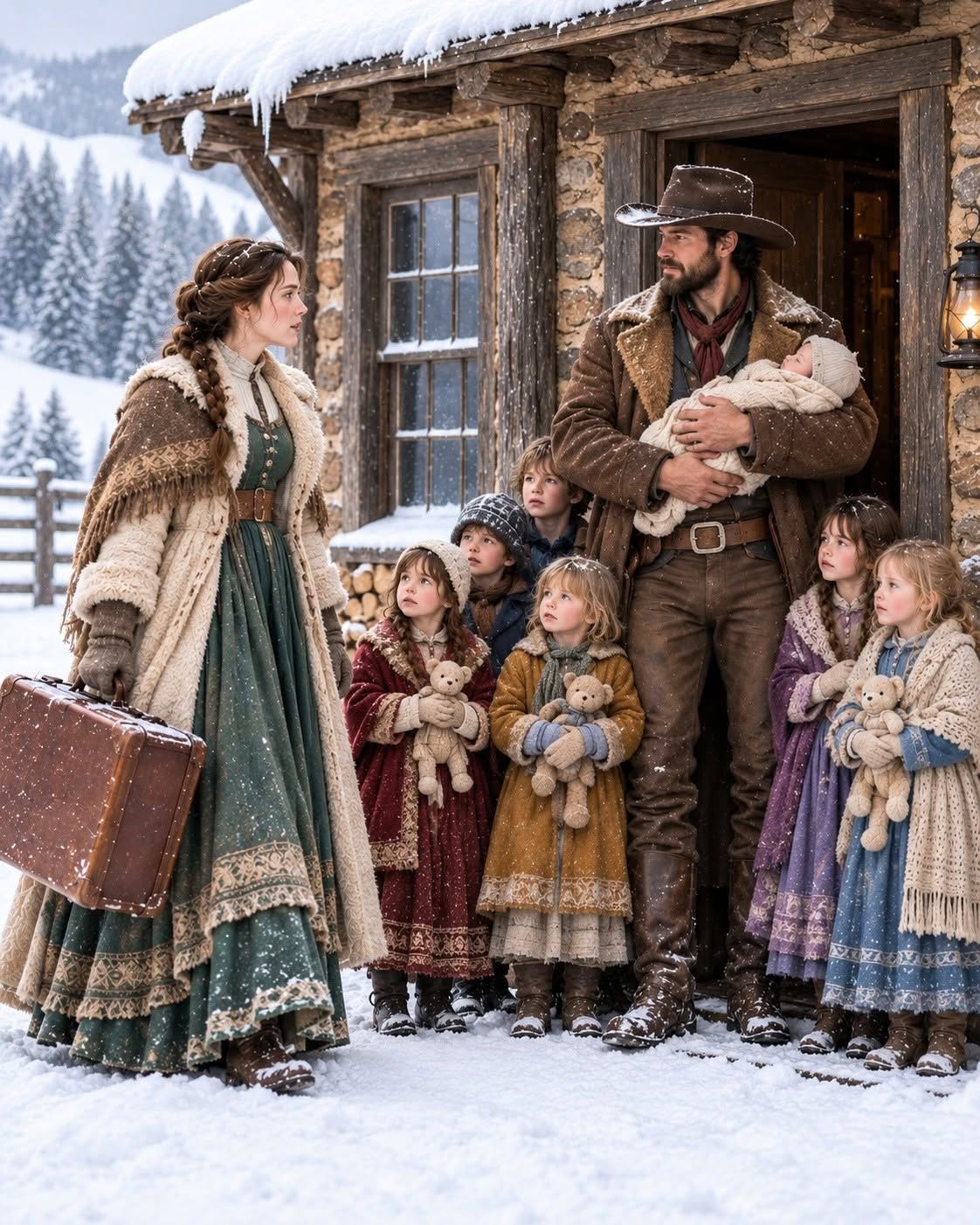
SHE CAME HOME TO A STRANGER AND HIS FIVE CHILDREN—HE WHISPERED, “WE’LL LEAVE IF YOU WANT”
Part 2: The Stranger by Her Fireplace
There was a man standing at her dry sink.
He was tall, broad through the shoulders, and dressed in a shirt that had been mended at both elbows. His beard was several days old, his hair dark with streaks of gray at the temples. One hand held a wooden spoon. The other rested on the edge of the sink.
He turned at the sound of the door.
The spoon slipped from his fingers and struck the floor.
For one suspended second, neither of them moved.
Then Martha raised the Winchester.
“Don’t.”
The word came out low and hard.
The man lifted both hands.
Behind him, five children sat around her kitchen table.
The oldest girl couldn’t have been more than twelve. She had a little boy pressed against her side and two younger children huddled together beneath a blanket. The smallest, a toddler with pale curls, was sitting on a cushion near the fireplace, clutching a rag doll with one missing arm.
Every child stared at Martha.
Nobody screamed.
That frightened her more than screaming would have.
Children who were accustomed to safety cried when a stranger burst through the door with a rifle.
These children looked as though they had learned to make themselves invisible whenever trouble arrived.
“Put the spoon down,” Martha ordered.
The man glanced at the spoon lying near his boot.
“It’s already down.”
“Then keep your hands where I can see them.”
He obeyed.
Martha’s gaze swept the room. Her mother’s old blue crockery sat on the table. Thomas’s coat hung beside the fireplace. A pair of men’s boots stood near the door, drying on a piece of newspaper she recognized from the previous summer.
Her newspaper.
Her boots were gone from the corner where she’d left them.
Someone had been sleeping in her bed.
The realization struck harder than she’d expected.
“Who are you?” she demanded.
“Daniel Mercer.”
“What are you doing in my house?”
Daniel glanced at the children.
For the first time, Martha noticed how thin he looked beneath his shirt. There was a fresh bandage wrapped around his left hand, and his right cheek bore the yellowing mark of a bruise.
“We were given permission to stay here.”
“By whom?”
“Thomas Cordell.”
Martha’s finger тιԍнтened against the rifle.
“My husband is ᴅᴇᴀᴅ.”
Daniel’s expression changed.
Not dramatically. Not the way a guilty man might react when caught in a lie.
His face simply lost what little color it had.
“Then nobody told you.”
“Told me what?”
He lowered his hands a fraction, then immediately raised them again when Martha shifted the barrel.
“Your husband gave us shelter before he died. He said we could stay until the roads cleared and I could find work.”
Martha stared at him.
“Thomas died on October third.”
Daniel swallowed.
“I know.”
“And you stayed anyway?”
“Yes, ma’am.”
“Four months I’ve been gone. Four months, and I come home to find a strange man and five children eating out of my kitchen.”
The little boy beside the oldest girl began to cry silently.
Daniel moved instinctively toward him.
“It’s all right, Samuel.”
“Don’t move!” Martha snapped.
Daniel stopped.
The boy buried his face in his sister’s sleeve.
Martha’s stomach тιԍнтened.
She knew what fear looked like. She’d seen it in cattle trapped in a blizzard, in a horse cornered by a rattlesnake, in Thomas the first time he’d come home after a winter storm and found their barn burning.
She’d also seen it in her mother’s eyes during those final weeks in Cheyenne.
This was the same fear.
The kind that came when a person had no idea whether the next moment would bring help or hurt.
But fear alone didn’t explain why these children were in her house.
“Start talking,” Martha said. “And don’t leave anything out.”
Daniel nodded slowly.
“My wife died last spring. Fever took her in three days. I had work on a freight line outside Laramie, but the company shut down after a wagon accident. I tried finding another job. Then winter came early.”
He glanced at the children.
“These are my children. Rebecca, Samuel, Joseph, Anna, and little Ruth.”
The oldest girl lifted her chin when he said her name.
Rebecca.
Twelve, perhaps. Too thin. Her dress had been let out with a different-colored strip of cloth at the waist. She was holding herself rigidly, as though she believed that if she sat straight enough, nobody would notice she was frightened.
Daniel continued.
“I was bringing them east to my wife’s sister. We never made it. The wagon axle broke near your creek, and the horses couldn’t manage the snow. Your husband found us.”
Martha’s rifle dipped by an inch.
“When?”
“October second.”
The day before Thomas died.
Daniel saw the recognition on her face.
“He brought us here. Fed the children. Gave me blankets and showed me where the wood was stacked. He said he’d speak to Ned about finding me work at the ranch.”
Martha’s mouth went dry.
“Thomas never wrote me a word about you.”
Daniel’s eyes lowered.
“He told me he was going to write. But the next morning, he went out to the north pasture.”
He paused.
“By the time Ned brought him back, there wasn’t anything anyone could do.”
The room seemed to grow smaller.
Martha could almost see Thomas standing in that very kitchen, rubbing his hands together near the fire, insisting there was always room for one more person if a person was willing to make room.
That had been her husband’s way.
It had also been the source of more than one argument between them.
Thomas believed a man’s worth was measured by what he gave when giving hurt.
Martha believed generosity was easy to promise when someone else had to pay for it.
And now Thomas was ᴅᴇᴀᴅ, and she was the one left to pay.
She lowered the rifle slightly.
“Where’s Ned?”
“He brought flour and salt last week. Said he’d come back when the weather allowed.”
“And who gave you permission to use my bed?”
Daniel flinched.
“I did.”
The answer startled her.
“You did?”
“Yes, ma’am. The children were freezing. The bedroom was the only room that held heat through the night. I should have asked you first.”
“You should have.”
“I know.”
He didn’t make excuses.
That somehow irritated her more than an argument would have.
“Where are you sleeping now?”
“On the floor beside the fireplace.”
Martha looked at the blankets stacked near the hearth.
Five children. Five little pairs of boots. Five lives packed into a house that had been built for two adults who had expected to grow old together.
Her gaze returned to Daniel.
“And if I tell you to leave?”
He looked toward the window.
Snow was already beginning to fall again, drifting sideways past the glᴀss.
Then he looked at his children.
Rebecca’s hand had closed around Samuel’s shoulder. Joseph was holding Anna’s hand beneath the table. Ruth had fallen asleep sitting upright, her rag doll pressed beneath her chin.
Daniel drew a slow breath.
“We’ll leave if you want.”
His voice was barely above a whisper.
“I won’t argue. I won’t tell you what your husband promised me. This is your home, Mrs. Cordell. If you don’t want us here, we’ll go.”
He looked down at his bandaged hand.
“But if you give me until morning, I’ll get the children ready. I’ll carry Ruth if I have to. I won’t let them trouble you any longer than necessary.”
Martha stared at him.
No pleading.
No threats.
No attempt to make her feel guilty.
Just a man offering to take five children into a Wyoming winter because he believed he had no right to ask for anything more.
She thought of Thomas.
Then she thought of the road she’d traveled to get home.
Four months of grief. Four months of sleeping beside her dying mother, listening to the woman who had raised her struggle for every breath.
She had imagined returning to the ranch, closing the door, and letting the silence swallow her.
She hadn’t imagined finding five children at her kitchen table.
“Put the kettle on,” she said.
Daniel blinked.
“Ma’am?”
“I said put the kettle on. And somebody had better tell me why that little girl is sleeping with her coat ʙuттoned all the way to her chin.”
He looked at Ruth.
“She’s been coughing.”
Martha set the rifle against the wall.
“Then we start there.”
For the first time since she’d entered the house, Rebecca let out a breath.
It sounded almost like a sob.
Martha spent the next hour examining the damage.
Not the damage to her house.
The damage to the children.
Ruth’s cough was dry and persistent. Anna had a swollen ankle wrapped in a strip of old linen. Joseph’s coat was too short in the sleeves, and Samuel had a raw patch on his heel where his boot rubbed against the skin.
Rebecca insisted she was fine.
That, more than anything, convinced Martha she wasn’t.
“Sit down,” Martha told her.
“I’m all right.”
“That’s not what I asked.”
Rebecca hesitated.
Then she sat.
Martha knelt and inspected the girl’s hands. The fingers were red and cracked, with small cuts along the knuckles.
“How did you get these?”
“Wood chopping.”
“You’ve been chopping wood?”
Rebecca shrugged.
“Papa can’t do everything.”
Across the room, Daniel looked up sharply.
“Becky.”
“What?” she asked. “It’s true.”
Martha studied the child.
“You’re twelve years old.”
“Nearly thirteen.”
“Nearly thirteen is still twelve.”
Rebecca’s face hardened.
“I’m old enough to help.”
“Helping is one thing. Trying to be the grown-up because the grown-ups have run out of strength is another.”
Rebecca stared at her.
For a moment, the girl’s composure slipped.
“My mama used to say that.”
The words landed softly.
Martha sat back on her heels.
“What happened to your mama?”
“Fever,” Rebecca answered. “Papa said she went to sleep and didn’t wake up.”
She looked toward Daniel.
“He cried outside so we wouldn’t hear him.”
Daniel turned away.
Martha felt something twist inside her chest.
She knew that, too.
Thomas had gone to the barn the night after they’d received word of her father’s death. He had stayed there until dawn, believing she couldn’t hear him crying.
She had heard every sound.
Sometimes people mistook silence for strength.
Often, it was only grief trying not to burden anyone else.
Martha stood.
“All right. First things first. Ruth needs a doctor if that cough worsens or her breathing becomes difficult. Anna needs that ankle checked. All of you need proper meals and sleep.”
Daniel opened his mouth.
“I can pay—”
“With what?”
He fell silent.
Martha regretted the sharpness of the question almost immediately.
She looked at the patched sleeves, the worn boots, the bandage on his hand.
“Never mind,” she said. “We’ll discuss it tomorrow.”
Daniel nodded.
“Thank you.”
“Don’t thank me yet. I haven’t decided whether I’m keeping you.”
A tiny smile appeared on Samuel’s face.
It vanished when Martha looked at him.
She pointed toward the table.
“Eat. There’s cornmeal in the pot, and I’ll make biscuits if someone can tell me where the flour is.”
Rebecca raised a cautious hand.
“Top shelf. Papa moved it because the mice got into the sack.”
Martha looked at Daniel.
“You moved my flour?”
“I bought another sack.”
“With what money?”
He hesitated.
“Your husband left some.”
The words cut through the room.
Martha went still.
“Left some what?”
Daniel reached into his coat and removed a folded envelope.
“Money. Thomas gave it to me the day before he died. He said it was to keep the children fed until I could work.”
Martha took the envelope.
Inside were several bills and a small folded note.
She recognized Thomas’s handwriting immediately.
Her fingers began to tremble.
She opened the paper.
Mattie,
If you’re reading this, I haven’t had the chance to explain something to you.
Daniel Mercer and his children came through the valley in bad weather. The children were cold, and the man was trying to keep them together with less than a dollar and a broken wagon.
I told him he could stay at the ranch until he found work.
I know what you’ll say. You’ll say we have our own troubles. You’ll say winter isn’t the time to take on five extra mouths. You’ll remind me that the roof leaks over the pantry and the south fence still needs repairing.
You’ll be right about every one of those things.
But, Mattie, I couldn’t send those children back into the snow.
I don’t expect you to take care of them forever. I only ask you to give them a chance to reach spring.
You have always been better at surviving winter than I have.
You know how to make a little go a long way. You know how to stand up when the world tells you to lie down.
And you have a heart you keep trying to convince me you don’t possess.
I love you.
Thomas.
Martha read the note twice.
Then a third time.
The kitchen blurred.
She pressed the paper against her chest and turned toward the window, furious with herself for crying in front of strangers.
She’d spent four months trying to accept that Thomas was gone.
Now, in a few lines of crooked handwriting, he’d managed to reach across the grave and ask her to do something for him.
Something difficult.
Something that would require her to open a door she’d been planning to shut.
Behind her, Daniel spoke carefully.
“I never asked him for the money. He insisted.”
Martha wiped her face.
“I know.”
“He told me that if you came home and wanted us gone, I was to respect your wishes.”
She turned.
“He told you that?”
“Yes, ma’am.”
Daniel’s eyes were tired but steady.
“He said you had a hard road behind you. That you might need time before you could decide what you wanted the rest of your life to look like.”
Martha stared at him.
That sounded exactly like Thomas.
He had always understood her better than she understood herself.
“And what do you want, Mr. Mercer?”
Daniel looked toward his children.
“I want them to have a roof over their heads. I want to find work. I want to stop waking up every morning wondering whether I’m going to fail them before supper.”
He swallowed.
“And I want to be able to look at them without seeing how frightened they are.”
His voice broke on the last word.
“I don’t need you to save us, Mrs. Cordell. I just need a little time to save myself.”
Martha folded Thomas’s letter and slipped it into her pocket.
Then she walked to the stove.
“There’s one spare bedroom upstairs.”
Daniel stared at her.
“Ma’am?”
“The children can sleep there. You can take the cot in the storeroom.”
His mouth opened, but no words came out.
“Don’t mistake this for charity,” Martha added. “I need someone to help repair the barn, mend the fences, and haul wood. If you’re staying, you’ll work when you’re able. The children will attend school once the roads are pᴀssable.”
Daniel nodded quickly.
“Yes, ma’am.”
“And if any of you break something, tell me. If you take something, ask first. And if you lie to me, I will know.”
Samuel’s eyes widened.
“How?”
Martha gave him a stern look.
“Because I’ve lived with men long enough to recognize a bad lie.”
For the first time, a laugh escaped Rebecca.
It was small and uncertain.
But it was a laugh.
Martha turned back to the stove before anyone could see her smile.
“Now, somebody get those children some supper.”
That night, Martha lay awake in her bed, listening to the unfamiliar sounds of her house.
A cough from upstairs.
A floorboard creaking in the hallway.
The faint murmur of Daniel’s voice as he reᴀssured one of the younger children.
She stared at the ceiling.
Thomas’s side of the bed remained empty.
It had been empty since the day he died, though Martha had spent four months away from it. She had thought returning would hurt less once she’d buried her mother.
Instead, every familiar object seemed to remind her of what she’d lost.
His coat.
His shaving mug.
The small crack in the window he’d promised to fix before winter.
And now his letter.
You have always been better at surviving winter than I have.
Martha rolled onto her side.
“You always did know how to leave me with the hard part,” she whispered into the darkness.
Then she heard a small sound from the hallway.
A whimper.
She sat up.
When she opened her bedroom door, Ruth stood outside, clutching her rag doll.
The little girl was shivering.
“What’s wrong, sweetheart?”
Ruth looked down at her feet.
“I need water.”
“There’s a pitcher in your room.”
“I didn’t want to wake Papa.”
Martha knelt.
“Is that why you’re standing out here?”
Ruth nodded.
Martha touched the child’s forehead. It was warmer than it should have been.
“Come with me.”
She carried Ruth downstairs, poured her a cup of water, and wrapped a blanket around her shoulders. The little girl drank slowly, then looked up at Martha with solemn blue eyes.
“Are you mad at us?”
The question struck harder than Martha expected.
“No.”
“Papa said you might be.”
“Your papa doesn’t know me very well.”
Ruth considered that.
“Are you going to make us leave?”
Martha glanced toward the stairs.
She thought of Thomas’s letter. The five children asleep beneath her roof. The man who had offered to walk into a blizzard rather than impose on her.
Then she looked at Ruth.
“Not tonight.”
The little girl nodded, apparently satisfied with that answer.
Martha carried her back upstairs.
At the bedroom door, Ruth hesitated.
“Can I ask you something?”
“You just did.”
Ruth’s mouth twitched.
“Papa says my mama used to sing when we were scared.”
Martha’s throat тιԍнтened.
“Did she?”
“Every night.”
“Would you like me to sing?”
Ruth nodded.
Martha sat beside the little girl’s bed and began a quiet hymn her own mother had sung to her when she was small.
Her voice was rusty from disuse.
Halfway through the first verse, it broke.
She stopped.
Ruth reached for her hand.
“It’s all right,” the child whispered. “You can cry.”
Martha looked down at the tiny fingers wrapped around hers.
For four months, she had been the one holding her mother’s hand.
For four months, she had watched the person who knew her longest and loved her most slowly slip away.
She had returned to Wyoming believing that grief had emptied her of everything.
But now a child she’d met only hours earlier was comforting her.
Martha bent forward and kissed Ruth’s forehead.
“Go to sleep, sweetheart.”
“Will you stay until I do?”
“Yes.”
She sat beside the bed until Ruth’s breathing became slow and even.
Then she remained a little longer.
Because for the first time in months, the silence didn’t feel quite so cruel.
The next morning, Martha woke before dawn.
Habit.
Thomas used to tease her that she could hear a rooster thinking about crowing.
She dressed, pulled on her boots, and went downstairs.
The kitchen was empty.
The fire had burned low, and the coffee pot sat cold on the stove.
Martha frowned.
Then she noticed the note on the table.
Mrs. Cordell,
I took the horses to check the north fence and make sure the cattle have water. I’ll be back before breakfast.
I didn’t want to wake you.
Daniel.
She read it twice, then looked through the window.
The snow had stopped.
Outside, a man was moving slowly across the pasture, leading one horse and riding another. His shoulders were hunched against the cold, and his injured hand was wrapped in a fresh strip of cloth.
Martha went to the pantry.
The flour sack was nearly empty. The beans were low. The stack of firewood had shrunk considerably.
Five extra mouths.
A leaking roof.
A damaged fence.
A ranch that had been left without its owner.
She almost laughed.
Thomas had been ᴅᴇᴀᴅ less than two months, and somehow he was still managing to complicate her life.
She made coffee, put biscuits in the oven, and began counting the supplies.
By the time Daniel returned, breakfast was ready.
He stopped in the doorway.
“You didn’t have to do all this.”
Martha placed a plate on the table.
“Sit down.”
He hesitated.
“Mrs. Cordell—”
“Daniel.”
He looked surprised.
She sighed.
“If we’re going to share a kitchen, you may as well use my first name.”
A slow smile crossed his face.
“All right. Martha.”
“Better.”
He sat.
She poured his coffee.
“How bad is the north fence?”
“Three sections down. The snow drifted against the posts, and the ground’s too hard to reset them properly.”
“Can you patch it?”
“With the right timber.”
“And the barn roof?”
“Needs shingles before the next heavy storm.”
Martha nodded.
“We’ll make a list.”
Daniel stared at her.
“We?”
She lifted her cup.
“You heard me.”
He looked down at his plate, and she saw his expression change.
Not relief exactly.
Something deeper.
The look of a man who had spent months expecting every door to close and had finally found one that might remain open.
“Thank you,” he said.
Martha sat opposite him.
“Don’t thank me yet. I’ve got questions.”
He straightened.
“Ask.”
“Why were you traveling in October with five children and a broken wagon?”
Daniel’s smile faded.
For a moment, he said nothing.
Then he put down his fork.
“Because I was running from someone.”
Martha felt the warmth drain from the room.
“Who?”
He looked toward the stairs, where the children were beginning to wake.
“My wife’s brother.”
Martha’s fingers тιԍнтened around her cup.
“Why?”
Daniel drew a long breath.
“Because he believes my children belong to him.”
And before Martha could ask another question, a horse whinnied outside.
Both of them turned toward the window.
A rider was approaching the ranch.
A man in a black coat, sitting straight in the saddle, with two more riders following behind him.
Daniel rose so quickly his chair scraped across the floor.
His face had gone white.
“No,” he whispered.
Martha stood.
“Who is that?”
Daniel looked at her, and for the first time since she’d met him, she saw something in his eyes that frightened her more than his grief.
Terror.
“That’s Caleb Whitmore,” he said. “My wife’s brother.”
Outside, the lead rider dismounted and walked toward the porch.
He didn’t knock.
He opened the door as though he owned the house.
His gaze moved from Daniel to Martha, then lingered on the staircase.
A thin smile spread across his face.
“Well,” Caleb said. “There you are, Mercer.”
He removed his gloves slowly.
“I’ve been looking for you.”
Daniel stepped between him and the stairs.
“You have no business here.”
Caleb laughed.
“No business? You stole five children from their family and ran halfway across Wyoming.”
“I took my children away from you.”
“Your children?” Caleb’s expression hardened. “Your wife was my sister. Those children carry my family’s blood, and you have neither the money nor the standing to raise them.”
Martha stepped forward.
“This is my home. You’ll explain yourself before you take another step.”
Caleb turned toward her.
“And you are?”
“Martha Cordell.”
His eyes flickered with recognition.
“Ah. The widow.”
He glanced around the room.
“I understand my brother-in-law has been imposing on you.”
“He’s been working for his keep.”
“Then perhaps you’ll be willing to do one more good deed.”
He reached inside his coat and withdrew a folded document.
“I have a court order to take custody of these children.”
Daniel’s face crumpled.
“That isn’t possible.”
“It’s perfectly possible. You’re broke, homeless, and incapable of providing for them. My sister’s family has money, land, and a name worth protecting.”
He held the paper toward Martha.
“You can help us settle this quietly. Tell the children to pack, and I’ll make certain you’re compensated for your trouble.”
Martha didn’t take the document.
Instead, she looked at Daniel.
“Is it true?”
He swallowed.
“His family has money. But Caleb never wanted the children because he loved them.”
“Then why does he want them?”
Daniel’s eyes shifted toward the staircase.
“Because my wife inherited land from her mother. Land Caleb believes should belong to him.”
Caleb’s smile disappeared.
“Be careful what you say.”
Daniel’s voice grew stronger.
“Anna’s mother left that property to her children. Caleb wanted control of it. When I refused to sign the guardianship papers he brought after my wife’s death, he threatened to have me declared unfit.”
“You are unfit!”
Caleb’s voice cracked like a whip.
“You dragged those children through the snow. You let them starve. You brought them to a stranger’s ranch instead of returning them to their own family!”
“Your own family?” Daniel stepped forward. “You never once visited my wife while she was dying. You sent no doctor. No money. Nothing. And the day after we buried her, you came asking for her land.”
Caleb’s face darkened.
“Enough.”
He turned to his men.
“Bring the children downstairs.”
Martha moved between them and the staircase.
“No.”
Caleb stared at her.
“Excuse me?”
“You heard me.”
“Mrs. Cordell, this is a legal matter.”
“Then show me the order.”
He thrust the paper toward her.
Martha examined it.
She wasn’t a lawyer, but she’d spent enough years dealing with land deeds, cattle contracts, and county officials to recognize when something looked wrong.
The document bore a seal, but the signature beneath it was incomplete. There was no date for a hearing, no clear statement of the court that had issued it, and no indication that Daniel had been given notice.
She raised her eyes.
“This doesn’t look like a proper order.”
Caleb’s jaw тιԍнтened.
“It’s sufficient.”
“Not to me.”
“You have no authority to interfere.”
“It’s my house. That’s enough authority for you to explain why you’re trying to drag five frightened children out of it.”
Caleb stepped closer.
“You don’t understand who you’re dealing with.”
Martha held his gaze.
“Perhaps not. But I understand a bully when I see one.”
For one dangerous moment, the room fell silent.
Then a small voice came from the stairs.
“Papa?”
Rebecca stood halfway down, holding Ruth’s hand.
Behind her were Samuel, Joseph, and Anna.
Caleb looked up.
“There you are, children.”
Ruth immediately began to cry.
Rebecca pulled her backward.
“No!”
Caleb’s expression softened in a way that made Martha’s skin crawl.
“Don’t be frightened. I’ve come to take you somewhere safe.”
Rebecca shook her head.
“You said Papa couldn’t keep us.”
“He can’t.”
“You said Mama wanted us to live with you.”
Caleb paused.
Rebecca’s eyes filled with tears.
“But Mama said we should stay together. She said Papa would always protect us.”
Daniel looked as though someone had driven a knife through his chest.
Caleb’s pleasant expression vanished.
“Children don’t understand grown-up matters.”
Rebecca drew Ruth closer.
“I understand that you made Mama cry.”
The words struck the room like a gunsH๏τ.
Caleb’s face turned red.
“That’s enough!”
Ruth screamed.
Daniel lunged forward, but one of Caleb’s men grabbed his arm.
Martha reached for the Winchester leaning beside the fireplace.
She didn’t raise it.
She simply placed her hand on the stock and looked directly at Caleb.
“Let him go.”
The man holding Daniel hesitated.
Caleb laughed nervously.
“You wouldn’t dare use that rifle.”
Martha’s eyes were cold.
“I’m hoping I won’t have to.”
She nodded toward the door.
“You and your men will leave this house now. If you believe you have a legitimate claim, you can bring it before the county judge. Until then, no one is taking these children anywhere.”
Caleb studied her for a long moment.
Then he smiled.
It was the smile of a man who believed he had more power than anyone in the room.
“You’ve made a mistake, Mrs. Cordell.”
He folded the document and slipped it back into his coat.
“I’ll return with the sheriff.”
Martha didn’t move.
“Then make certain he brings the real paperwork.”
Caleb’s eyes narrowed.
He turned toward the door.
At the threshold, he paused and looked back at Daniel.
“This isn’t over.”
“No,” Daniel replied, his voice trembling but steady. “It isn’t.”
The riders mounted and disappeared down the snowy road.
Only when the sound of their horses had faded did Daniel sag against the table.
Martha set the rifle down.
Rebecca rushed to her father.
“Papa!”
He gathered all five children into his arms, holding them so тιԍнтly that Ruth’s rag doll was trapped between them.
“I’m sorry,” he whispered. “I’m so sorry.”
Martha stood nearby, her hands shaking now that the danger had pᴀssed.
She had come home expecting to mourn her husband in peace.
Instead, she had found a family on the brink of being torn apart, a stranger carrying a burden she barely understood, and a fight that was only beginning.
Daniel finally looked up at her.
“You don’t have to get involved in this.”
Martha glanced at the staircase, at the five children clinging to him.
Then she thought of Thomas’s letter.
I only ask you to give them a chance to reach spring.
She walked to the table and picked up Caleb’s abandoned envelope, which one of his men had dropped near the door.
“We’ll need to speak to Ned,” she said. “And find out exactly what that document is worth.”
Daniel stared at her.
“Martha, if you help us, Caleb will come after you, too.”
She looked toward the window.
Outside, the Wyoming winter stretched across the valley, white and merciless.
Then she turned back to him.
“Mr. Mercer, I’ve buried my mother. I’ve buried my husband. I’ve spent four months watching the people I love disappear one by one.”
Her voice softened.
“I am not going to stand in my own kitchen and watch five children lose their father while I still have the strength to do something about it.”
Daniel’s eyes filled with tears.
“Why?”
Martha glanced toward the empty chair where Thomas used to sit.
“Because my husband asked me to give you a chance.”
She paused.
“And because I think he knew something I didn’t.”
“What was that?”
Martha looked at the children.
“That a house can be empty even when it’s full of furniture.”
She drew a breath.
“And sometimes, the people who arrive in the middle of a storm are the very people who help you survive it.”
Outside, the wind rose against the windows.
Far down the road, Caleb Whitmore was already riding toward town.
And Martha Cordell had a feeling that before winter ended, she would discover that the stranger her husband had brought into her home was carrying a secret far more dangerous than a disputed inheritance.
Because the next time Caleb returned, he wouldn’t come alone.
And this time, he wouldn’t be asking permission.
To be continued — Part 3: The Secret Thomas Left Behind.