PART 3 — THE WOMAN WHO READ THE LAND
PART 3 — THE WOMAN WHO READ THE LAND
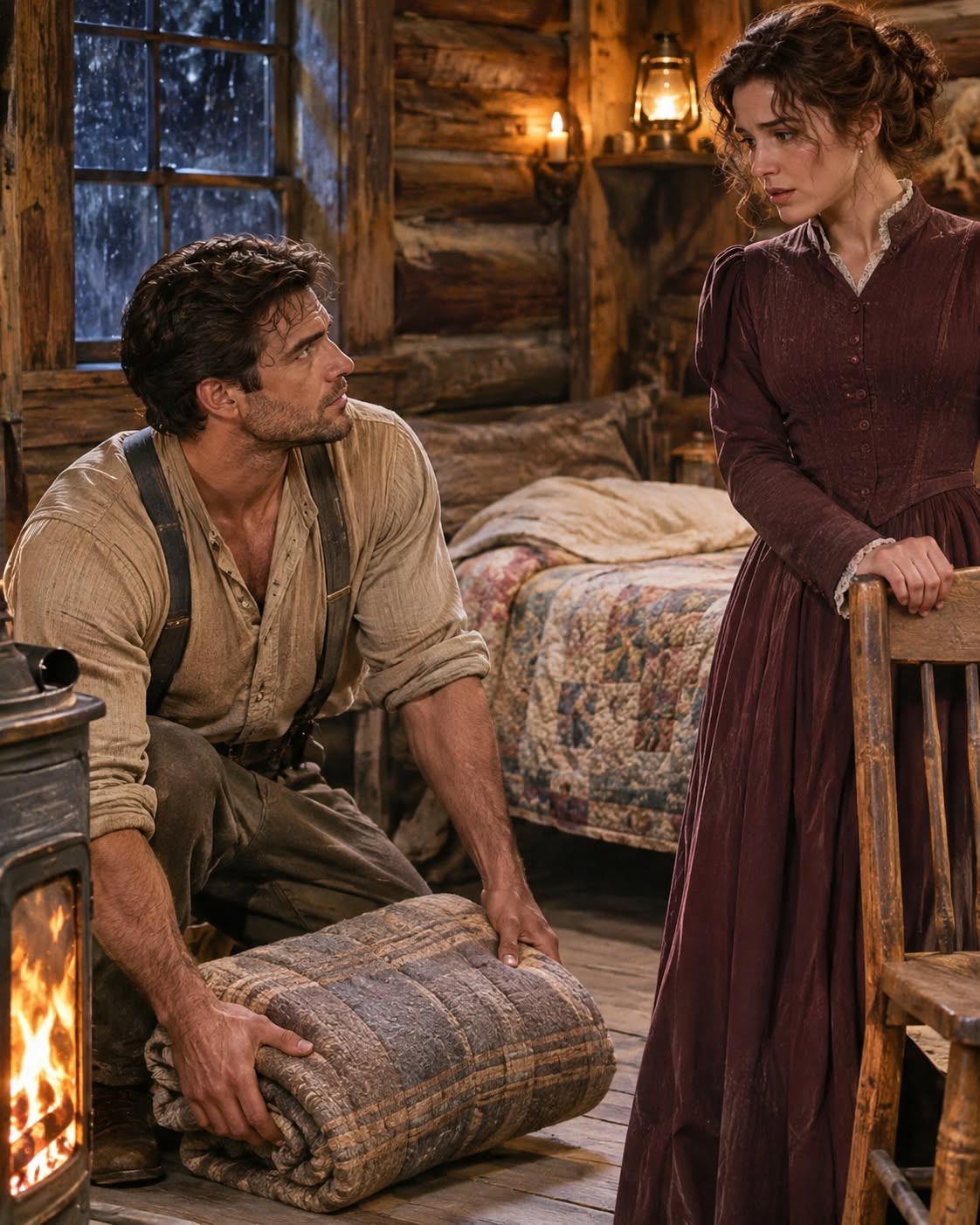
Amos did not sleep much that night.
Clara knew because every time she woke, she heard him moving around the cabin.
Once, she found him standing beside the window, looking toward the dark outline of the northern ridge.
At dawn, she placed a cup of coffee beside him.
“Will you tell me what Silas Crowe wants?”
Amos remained silent for several seconds.
Then he pulled out a chair.
“There’s a spring on the northern side of my property. Best water for miles. Runs even when the creek gets low.”
“And Silas wants it?”
“He wants the land around it. Says his company surveyed the ridge and found that the spring falls inside an old mining claim.”
“Is that true?”
“No.”
The answer came quickly.
“Then why are you worried?”
“Because Silas has money, lawyers, and friends in the county office. I have a cabin, a few horses, and a deed that was written before half the men in Bitter Creek were born.”
Clara examined the folded document.
“May I see it?”
Amos hesitated before handing it over.
She unfolded the paper carefully.
The language was complicated, but she read it slowly, following every paragraph with her finger.
Then she stopped.
“Amos?”
“What?”
“This document doesn’t claim ownership of your entire property.”
“It says the northern ridge.”
“Look here. It refers to a boundary established by a survey marker near the old pine. It doesn’t mention the spring itself.”
Amos leaned closer.
“What’s your point?”
“Your property line may not be where Silas says it is.”
He studied the document again.
Clara turned it over.
There was a faint stamp near the bottom, almost hidden beneath a fold.
“Where did you get this?”
“From the county clerk’s office.”
“Did you receive an original?”
“No. A copy.”
“Then we need to see the original.”
Amos frowned.
“You think a stamp changes anything?”
“I think details matter when someone is trying to take something from you.”
He looked at her more carefully.
“Where did you learn to read legal papers?”
“My father was a solicitor. I spent half my childhood listening to him explain contracts at the dinner table.”
Amos blinked.
“You never mentioned that.”
“You never asked.”
Again, that quiet sentence.
He lowered his eyes.
“I’m beginning to see a pattern.”
Clara almost smiled.
“Then perhaps we should break it.”
By midmorning, they were riding toward Bitter Creek.
The settlement was little more than a main street lined with wooden buildings, a blacksmith’s shop, a general store, and a small office where the county records were kept.
Amos tied his horse outside.
“Stay close,” he said.
“I can manage.”
“I know. But Silas has friends here.”
Inside the county office, a clerk named Mr. Whitcomb greeted Amos with obvious discomfort.
“Mr. Ransom. I wasn’t expecting you.”
“Then you’ll be pleased to see me.”
Clara stepped forward.
“We would like to examine the original survey for the northern ridge.”
Whitcomb looked at her.
“Who are you?”
“Clara Ransom.”
The clerk glanced at Amos.
“Your wife?”
“Yes.”
Whitcomb shuffled through several books.
“I’m afraid the old survey is missing.”
“Missing?” Clara repeated.
“Misplaced, perhaps.”
“Can you tell us when it was last examined?”
The clerk hesitated.
“Mr. Crowe requested it three weeks ago.”
Amos’s expression darkened.
“And you gave it to him?”
“I didn’t say that.”
“You just did.”
Clara gently touched Amos’s arm.
“Let me.”
She turned to the clerk.
“Mr. Whitcomb, I’m sure you understand that official records should be available to both parties in a land dispute. If the original is missing, perhaps we could examine the registry showing when it was entered, who signed it, and whether any later amendments were made.”
The clerk swallowed.
“I suppose that’s possible.”
He opened another ledger.
Clara watched his finger move down the page.
Then she noticed something.
“Stop there, please.”
Whitcomb froze.
The entry was dated seventeen years earlier. It listed Amos’s father as the original claimant and named two witnesses.
But beside the record was a later notation.
Boundary amended upon request of Silas Crowe Mining Company.
 Clara read it twice.
“Who authorized this amendment?”
Whitcomb looked uncomfortable.
“It’s signed by the county surveyor.”
“Where is the supporting document?”
The clerk turned several pages.
There was no supporting document.
Clara pointed to the empty space.
“This amendment has no attached survey, no witness signatures, and no record of notification to the original landowner.”
Amos stared at her.
“Can they do that?”
“I don’t believe they can.”
Whitcomb hurriedly closed the ledger.
“I think you’ve seen enough.”
“No,” Clara said calmly. “I don’t think we have.”
The clerk’s face reddened.
“You should speak with the county attorney.”
“We intend to.”
Outside, Amos stood beside the horses, looking at Clara as if he had just discovered an entirely new person.
“You handled that better than I would have.”
“You would have frightened him.”
“I was thinking of doing exactly that.”
“Which is why I went inside first.”
He gave a short laugh.
It was the first time she had heard him laugh without trying to hide it.
But their relief did not last.
As they approached the general store, a woman hurried toward them.
“Mr. Ransom!”
Amos recognized her.
“Mrs. Bell?”
The woman was the widow of a miner who had died the previous winter. She held a folded letter in her hand.
“I’ve been looking for you.”
“What happened?”
“Silas’s men came to my house this morning. They say the water ditch behind my property is going to be closed.”
Amos frowned.
“Why?”
“They claim it crosses land owned by the mining company.”
Clara looked at the letter.
“May I see that?”
Mrs. Bell handed it over.
It was a notice demanding that she stop using the small stream that ran behind her home.
Clara examined the wording.
“Does your family have an agreement with Amos’s father?”
Mrs. Bell nodded.
“He let us use the water when my husband helped repair the mill. We have a paper somewhere, but I don’t know where.”
Clara turned toward Amos.
“Your father made agreements with the families down the creek?”
“He did. Several.”
“Then Silas isn’t just trying to take your spring. He’s trying to change the entire water system.”
Amos looked toward the northern ridge.
His expression hardened.
“We need those agreements.”
That afternoon, they returned to the cabin and searched every old chest, drawer, and cupboard.
Clara found nothing at first.
Then, while moving a loose board beneath the kitchen shelves, she noticed a narrow space behind the wall.
Inside was a small oilcloth packet.
Amos took it from her.
The packet contained several folded papers and a letter written in his father’s hand.
He read the first lines aloud.
Amos,
If Crowe ever returns asking about the northern spring, do not trust the papers he brings. The original agreements are not in the county office. I kept them where no one would think to look.
Amos stopped.
“Where?”
Clara unfolded the second sheet.
It contained a rough drawing of the property, with a small cross marked near the old mill.
“Here,” she whispered.
“The mill hasn’t been used in fifteen years.”
“Then perhaps nobody has searched it.”
They left before sunset.
The old mill stood beside the creek, its wooden wheel broken and its roof sagging beneath years of weather.
Inside, dust covered the machinery.
Amos searched behind the stone foundation while Clara examined the floorboards.
Then she found a small iron handle beneath a loose plank.
“Amos!”
He came over and pulled the board aside.
Beneath it was a narrow wooden compartment.
Inside lay a metal box.
Amos lifted it carefully and set it on the floor.
The lock was old, but the key was tied to a ribbon around the letter.
When the lid opened, they found a stack of documents wrapped in oilcloth.
The first was a water-sharing agreement signed by Amos’s father and three neighboring landowners.
The second was a map showing the spring, the creek, and the old mill.
The third was a deed establishing the northern water source as protected land, with usage rights shared among the families named in the agreement.
Clara read the final page.
Then she looked up.
“Amos, this is important.”
“How important?”
“It means Silas cannot simply claim the spring because he wants it. Your father’s agreement protects the water rights of these families.”
Amos took the document.
For a long moment, he said nothing.
Then he looked at the old mill around them.
“My father knew this day might come.”
“Yes.”
“And he left these papers for me.”
Clara nodded.
“Because he trusted you to protect them.”
Amos looked at her.
“No. I think he trusted someone to understand them.”
The words surprised her.
Before she could answer, a sound came from outside.
A horse.
Then another.
Amos quickly gathered the documents.
A voice called from the doorway.
“Mr. Ransom?”
It was Eli, the young boy who had come asking for flour.
He looked frightened.
“Mrs. Bell sent me. Mr. Crowe is at the settlement. He says he’s bringing a surveyor tomorrow morning.”
“Why?”
Eli swallowed.
“He says he’s going to mark the new boundary. And he told everyone that if you interfere, he’ll have the sheriff remove you.”
Amos stepped toward the door.
“Did he say anything else?”
Eli nodded.
“He said the spring isn’t what he’s really after.”
Clara’s fingers тιԍнтened around the documents.
“What does he want?”
The boy looked between them.
Then he spoke in a trembling voice.
“He said there’s something buried beneath the northern ridge. Something worth more than all the water in Bitter Creek.”
Amos went completely still.
Clara unfolded the old map again.
Near the ridge, almost hidden beneath a faded mark, was a note written in her father-in-law’s hand.
Do not let them reach the old mine.
She looked at Amos.
“Your father knew.”
Amos stared at the words.
“My father never told me there was a mine.”
Clara studied the map.
A second mark appeared beneath the first, followed by three words.
Not silver. Something else.
Before they could examine it further, a distant gunsH๏τ echoed across the valley.
They rushed outside.
Far up the mountain road, a thin column of smoke was rising from the direction of Amos’s northern pasture.
Someone had set fire to the old survey shack.
And beside the creek, a rider was already heading toward the cabin.
He carried a message.
A message addressed to Clara.
End of Part 3.