PART 2 — THE WIFE HE DIDN’T EXPECT
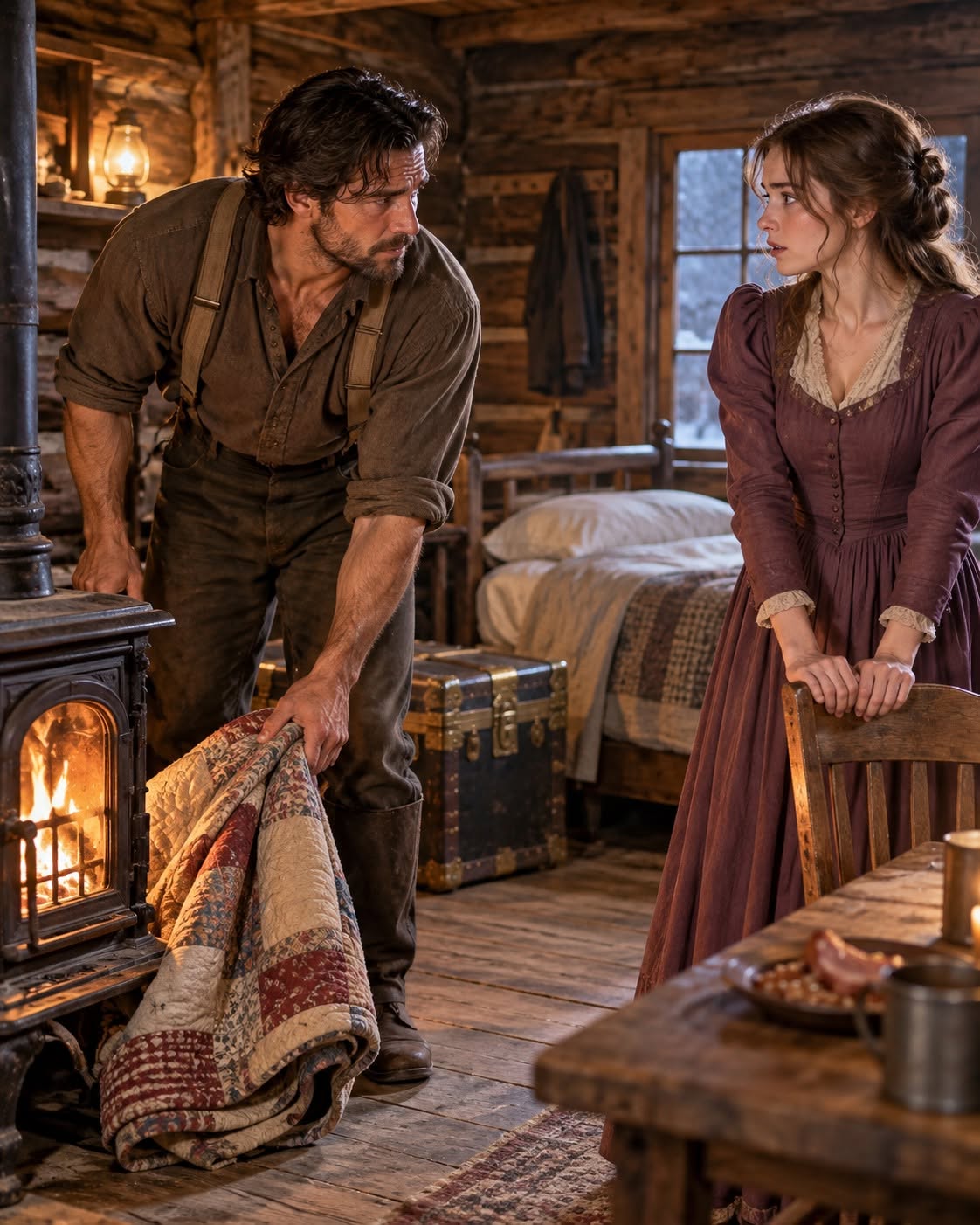
PART 2 — THE WIFE HE DIDN’T EXPECT
Clara woke before sunrise to the sound of an axe striking wood.
For several seconds, she lay beneath the heavy quilt, unsure where she was. Then the unfamiliar smell of pine smoke and the rough log walls brought everything back.
Bitter Creek.
Amos.
The mountain cabin.
And the man who had given her the only bed.
She sat up and looked toward the stove. The spare quilt lay folded neatly beside it. Amos was nowhere inside.
Clara dressed, pinned her chestnut hair beneath a ribbon, and stepped outside.
Amos was splitting logs near the woodshed. His shirt sleeves were rolled up, and his breath rose in white clouds.
“You’re awake,” he said without looking around.
“I thought I should prepare breakfast.”
“You don’t have to.”
“I know.”
He stopped swinging the axe.
Clara met his eyes.
“But I’d like to.”
Amos seemed uncertain what to say.
“There’s flour in the pantry. Bacon in the cold box.”
“Then I’ll see what I can make.”
He returned to his work.
Clara went inside, and for the next hour, the cabin filled with the smell of fresh biscuits and frying bacon.
When Amos came through the door, he stopped.
A plate waited on the table.
Beside it sat a cup of coffee.
“You made all this?”
“I did.”
“Why?”
Clara looked up from the stove.
“Because breakfast is generally better when someone cooks it.”
Amos almost smiled.
He sat down and took a bite.
 The biscuits were light, the bacon properly cooked, and the coffee stronger than anything he had tasted in weeks.
“Not bad,” he muttered.
Clara raised an eyebrow.
“Not bad?”
“Good.”
“That’s better.”
He glanced at her.
For the first time, something resembling amusement pᴀssed between them.
But it vanished when Amos noticed her looking toward the window.
“What is it?”
“Nothing.”
“Clara.”
She hesitated.
“I was wondering how far it is to the nearest church.”
“About twelve miles.”
“And the town?”
“Ten, depending on the weather.”
She nodded slowly.
Amos put down his fork.
“Planning to leave?”
Clara looked surprised.
“No. I was only asking.”
He returned to his breakfast, but the question stayed with him.
He had brought a wife to the mountains because he was tired of coming home to an empty cabin.
Yet he had never considered that she might be equally lonely.
By the end of the first week, Clara had learned the rhythm of the mountain.
The stove needed attention before dawn. Water had to be carried from the spring. The pantry required careful organization because supplies were limited, and the weather could change without warning.
Amos showed her how to recognize approaching snow by watching the clouds gather over the ridge.
Clara showed him that his pantry contained enough flour to feed a small town, provided he stopped storing it beside the damp firewood.
“You’ve been wasting half your supplies,” she told him.
“I’ve survived just fine.”
“Surviving and managing are two different things.”
Amos stared at her.
Then he laughed.
It was a rough, unfamiliar sound, as though he had forgotten how to make it.
Clara smiled.
She was beginning to understand that beneath his stern expression lived a man who had grown accustomed to being alone.
But there was something else.
Amos never spoke about his family.
He had no pH๏τographs on the walls, no letters on the mantel, and no stories about childhood.
Whenever Clara asked about his past, he found a reason to step outside.
One evening, while searching for a needle, she discovered a small wooden box beneath the bed.
Inside lay a faded pH๏τograph of a young woman holding a baby.
Clara recognized Amos immediately.
He looked younger, but the same serious eyes were unmistakable.
She heard the door open.
Amos stood in the entrance.
His gaze went straight to the pH๏τograph.
“Put that away.”
Clara quickly returned it to the box.
“I’m sorry. I wasn’t trying to pry.”
He took the box from her.
“That was my first wife.”
Clara stood still.
“I’m sorry, Amos.”
“She died eleven years ago. Fever took her in three days.”
“And the child?”
His expression тιԍнтened.
“Our boy died the following winter.”
Clara lowered her eyes.
“I didn’t know.”
“There’s nothing to know.”
He placed the box back beneath the bed.
Then he turned away.
But Clara spoke before he reached the door.
“You don’t have to pretend they never existed.”
Amos stopped.
For a long moment, he stood with his back toward her.
Then he said quietly, “I don’t know how to talk about them.”
“That’s all right. You don’t have to.”
He looked over his shoulder.
Clara offered no questions, no pity, and no advice.
She simply returned to folding the clean laundry.
That night, Amos did not sleep beside the stove.
He sat at the table until the fire burned low, looking at the pH๏τograph.
The first real storm arrived twelve days after Clara’s arrival.
Snow began falling before noon, and by evening, the path leading down the ridge had disappeared beneath a thick white blanket.
Amos checked the stable twice.
Then he noticed the kitchen window rattling.
“Stay inside,” he told Clara. “The wind’s getting dangerous.”
“I can help secure the shutters.”
“I’ll do it.”
He stepped outside.
Clara watched him struggle with the wooden shutter on the northern side of the cabin. The wind kept pulling it from his hands.
She wrapped herself in a thick coat and hurried to the door.
“Amos!”
He turned.
“Go back inside!”
“The rope is caught beneath the barrel!”
He looked down.
She was right.
Together, they secured the shutter and returned to the cabin.
But when Amos tried to close the door, it would not latch.
A gust forced it open again.
“Hold this,” he called.
Clara braced the door while he worked the broken latch into place.
Suddenly, a loud crack sounded from the woodshed.
Both turned.
The roof had partially collapsed beneath the weight of the snow.
Amos grabbed his coat.
“Stay here.”
“Your firewood—”
“I’ll get it tomorrow.”
“But you’ll need it!”
“Clara, I’m not risking you outside in this storm.”
He left the door secured and went to check the stable instead.
Clara watched from the window, worried.
Then she noticed something.
The kitchen fire was burning low.
The wood beside the stove was almost gone.
Amos would return cold and exhausted, and there would be no dry kindling ready.
She remembered the small stack of wood stored beneath the covered porch.
Carefully, she gathered her shawl and carried several pieces inside.
She had just placed them beside the stove when the door opened.
Amos stepped in, snow covering his shoulders.
His expression changed when he saw her.
“You went outside?”
“Only beneath the porch.”
“I told you to stay inside.”
“I know. But the fire was dying.”
He stared at her for a moment.
Then he looked at the wood.
“Next time, tell me before you do something like that.”
Clara nodded.
“I will.”
Amos removed his wet coat.
“Thank you.”
It was the first time he had thanked her without sounding surprised that she was capable of helping.
And Clara treasured those two words more than she wanted to admit.