PART 5 — THE LAST MESSAGE ANNA LEFT BEHIND
PART 5 — THE LAST MESSAGE ANNA LEFT BEHIND
Anders did not sleep that night.
Ingrid heard him walking through the downstairs rooms long after the lamps had been extinguished. Once, she heard the kitchen door open. Later, she heard the sound of a chair being dragged across the floor.
By morning, he looked as though he had aged several years.
The notebook remained on the kitchen table.
Einar sat beside it, holding the dark stone he had carried into the attic.
Ingrid poured three cups of coffee and placed a bowl of warm porridge in front of the boy.
Then she sat across from Anders.
“You owe your son an explanation,” she said gently.
Anders stared at the notebook.
“I know.”
“Then begin with your brother.”
He took a long breath.
“Henry and I inherited this farm from our father. We worked it together for years. But Henry wanted to sell the northern fields. There was talk of a railroad company buying land in this district.”
“Why didn’t you sell?”
“Because the land wasn’t ours alone to sell.”
He opened the notebook and turned several pages.
Their father had left the property to both brothers, but Anna had discovered an older document proving that a section of the northern fields had been promised to the families who had settled there before the town was established.
The document had never been properly recorded.
Henry wanted to claim the entire property before anyone discovered the mistake.
Anders refused.
The brothers argued. Henry left the farm and was later reported missing after a winter journey.
“I believed he had died,” Anders said. “I received a letter from a man who claimed to have found his belongings near the river.”
“Did you see a body?”
Anders shook his head.
 “No.”
Ingrid looked down at the notebook.
“And Anna discovered he was alive?”
“She found a letter in the barn. It was addressed to Henry, but the handwriting belonged to someone in town. She began asking questions.”
“Who?”
Anders hesitated.
“Mr. Bell, the land agent.”
Ingrid remembered seeing the name on a sign outside the feed store.
“What did Anna find?”
Anders turned to the final pages.
There were dates, names, and small notes about meetings. One entry mentioned a visit from Henry. Another described a disagreement between Anna and the land agent.
Then Ingrid noticed something.
A line had been underlined twice.
The original deed is not in the house. Einar knows where the stones belong.
She looked at the boy.
Einar had stopped eating.
He was watching her.
“Einar,” she said softly. “Did your mother show you something?”
The boy stood.
He walked to the doorway, paused, and looked back.
Then he held out his hand.
Ingrid followed him.
Anders came behind them.
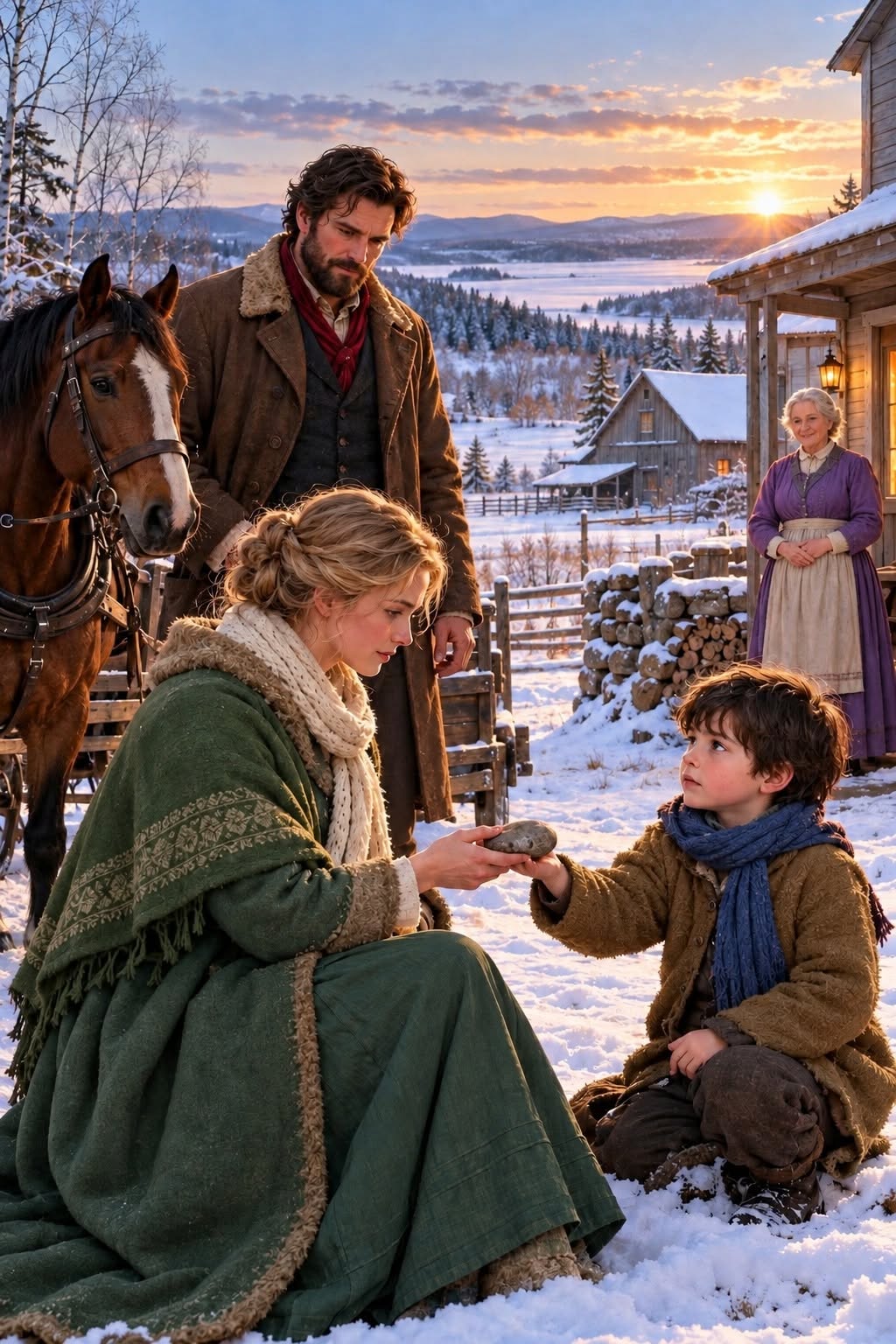
Einar led them outside, past the barn and toward a line of birch trees near the frozen creek.
He stopped beside a large flat stone.
Then he placed his dark stone on top of it.
Ingrid looked around.
There were other stones nearby, almost hidden beneath the snow.
They were arranged in a pattern.
Not randomly.
They formed a narrow path leading toward an old tree.
Anders stared.
“I’ve never seen this.”
Ingrid knelt and brushed away the snow.
Beneath the stones was a small wooden marker, its surface worn by weather.
Einar touched it.
Then he looked at his father.
“Mother.”
Anders closed his eyes.
For a long moment, he did not move.
Then he knelt beside his son.
“Did Mama bring you here?”
Einar nodded.
“She said?”
The boy struggled with the words.
“Keep.”
Anders placed a hand gently on his shoulder.
“Keep what, son?”
Einar pointed toward the tree.
Together, they cleared away the snow around its roots.
There, beneath a loose wooden cover, was a narrow compartment.
Inside lay a sealed envelope wrapped in oilcloth.
Anders recognized the handwriting immediately.
“Anna.”
He opened the envelope with great care.
The letter was short.
My dear Anders,
If you are reading this, then I was unable to tell you everything myself.
Henry came back. He did not come to make peace. He came because he discovered that the old deed could no longer be hidden.
I have placed the original document where Einar can find it. I showed him the stones because he remembers their order better than anyone. Please do not be angry with him for keeping this secret. He was helping me in the only way he knew how.
The land belongs to the families named in the deed. It must not be sold or taken from them.
Anders, I know you have carried the burden of your brother’s choices for too long. Do not let his mistakes become your son’s inheritance.
Teach Einar that he is allowed to speak, but never make him believe he must speak to be loved.
With all my heart,
Anna.
Anders lowered the letter.
For the first time since Ingrid had arrived, he wept openly.
Not loudly.
Not dramatically.
He simply sat beneath the birch tree with the letter in his hands, while the winter wind moved across the empty fields.
Ingrid stood beside Einar.
The boy looked at his father, then reached for his hand.
Anders took it.
“I’m sorry, little one,” he whispered. “I should have listened.”
Einar leaned against him.
It was a small gesture.
But Ingrid knew it meant more than a hundred spoken sentences.
The original deed was exactly where Anna had said it would be.
It named several families whose ancestors had helped establish the settlement. The northern fields could not legally be sold as private property without their consent.
When Anders brought the document to the county office, the land agent’s claims were challenged.
A few days later, Henry appeared in Kinsley Falls.
He had been living under another name in a neighboring territory, hoping to arrange the sale before anyone uncovered the original records.
But Anna’s notebook and the deed told the truth.
The county officials began an investigation, and Henry was ordered to answer questions about the documents he had attempted to conceal.
Anders did not celebrate.
He only returned home, placed the notebook in a drawer, and began repairing the fence around the northern fields.
The farm remained theirs.
More importantly, the families whose names appeared on the deed would not lose the land their ancestors had helped build.
Spring arrived slowly.
The snow retreated from the fields, revealing dark soil and the first green shoots along the fence.
Ingrid had stopped counting the days since she had crossed the ocean.
She no longer thought of the farmhouse as a place where she had been brought to perform a duty.
She had found something she had not expected.
A home where silence was no longer mistaken for emptiness.
Einar began speaking more often.
Not in long sentences, and not every day.
But he started asking questions.
He asked Ingrid how Norway looked in winter. He wanted to know whether the sea was truly as large as the pictures in her old book. He even asked whether she had collected stones as a child.
“I did,” Ingrid told him one afternoon.
“Where?”
“Beside the river near my home.”
Einar considered this.
Then he disappeared upstairs.
When he returned, he carried a small gray stone.
He placed it in her palm.
Ingrid turned it over.
There was something written on its underside in faint pencil.
Two simple words:
Stay here.
She looked at Einar.
“Did you write this?”
He nodded.
Then, after a long pause, he said, “For you.”
Ingrid felt her eyes grow warm.
She looked toward the doorway, where Anders stood watching.
He did not interrupt.
He only came forward and placed another cup of tea on the table.
That evening, after Einar had gone to bed, Anders sat beside Ingrid near the kitchen window.
“The notice I sent to Norway said I needed someone to help care for my son,” he said.
Ingrid looked at him.
“I remember.”
“I didn’t know how to explain what our lives had become. I thought a few lines would be enough.”
“They weren’t.”
“No,” he admitted. “They weren’t.”
He looked toward the stairs.
“I cannot change what you left behind to come here. And I won’t pretend this farm is an easy place to live. But I hope you know you are not here because I needed someone to fill a position.”
Ingrid was quiet for a moment.
Then she placed the little stone on the table between them.
“I came here expecting to marry a stranger,” she said. “Instead, I found a child who needed someone to listen.”
Anders lowered his eyes.
“And what did you find in me?”
She considered the question.
“A man who is still learning how to let someone stand beside him.”
He nodded slowly.
Outside, the birch trees moved in the evening breeze.
Several weeks later, Ingrid received a letter from Norway.
It was from an old acquaintance who had heard she had settled in America.
The letter contained familiar names, news from home, and a question about whether she regretted leaving.
Ingrid read it twice.
Then she sat at the kitchen table and began writing her reply.
I do miss the mountains, the harbor, and the sound of my own language spoken in the streets.
But I have learned that home is not always the place where your journey began.
Sometimes it is the place where someone finally understands the things you cannot say.
She folded the letter and placed it beside the little gray stone.
From the yard came the sound of Einar calling her.
“Mama Ingrid!”
She looked up.
The boy stood beside Anders, holding a handful of stones. He had arranged them into a crooked little circle, leaving one space open.
He was waiting for her to complete it.
Ingrid stepped outside.
Anders offered her his hand as she crossed the porch.
She took it.
And when she placed the final stone into the circle, Einar looked up at her and smiled.
It was the first completely unguarded smile she had seen on his face.
For the first time, Ingrid understood the message Anna had left behind.
The stones had never been meant to hide a secret forever.
They had been a bridge.
A way for a little boy to lead the people he loved toward the truth, one small piece at a time.
And the woman who had crossed an ocean to marry a stranger had finally discovered what she had been searching for all along:
A place where she did not have to prove she belonged.