PART 2 — THE MOUNTAIN MAN FINALLY UNDERSTOOD WHAT HE HAD DONE
PART 2 — THE MOUNTAIN MAN FINALLY UNDERSTOOD WHAT HE HAD DONE
Gideon had faced hungry wolves, violent storms, and men who would steal another man’s last handful of flour.
But nothing had prepared him for the sight inside his cabin.
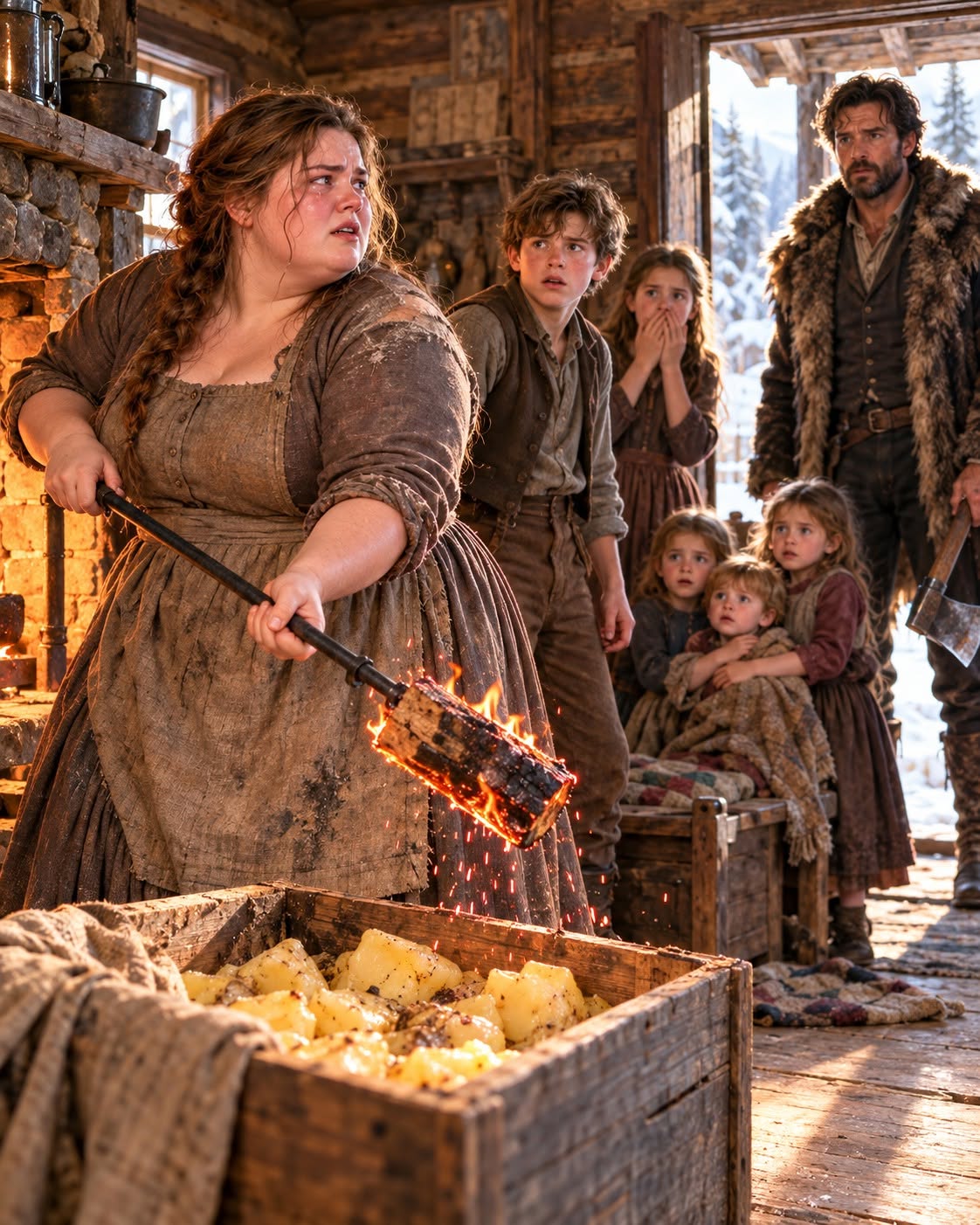
Kora stood near the hearth, one hand gripping the iron hook, the other pressed against her aching hip. Her face was pale, and her eyes were wet, but she wasn’t backing away.
Caleb stood several feet from her.
“Put that down,” Gideon ordered.
Kora looked at him.
“Will you listen if I do?”
The question struck harder than he expected.
Gideon lowered his axe and set it against the wall.
“Yes.”
“Then look at your children.”
He followed her gaze.
The youngest, Samuel, was coughing beneath a thin blanket. His cheeks were flushed, and his breathing sounded strained. Mae stood beside him, frightened and uncertain. The two younger children were pressed together near the bed.
Then Gideon noticed the crate.
“What happened?”
“That spoiled grease has been sitting beside the children’s sleeping place. I’ve asked Caleb to move it twice. He wouldn’t let me touch it.”
Caleb’s face reddened.
“She was throwing Father’s things away!”
“They’re not fit to use,” Kora replied. “And Samuel has been getting worse. I’ve been trying to tell someone all week.”
Gideon looked at the boy.
“Samuel?”
The child coughed again.
Within seconds, Gideon crossed the room and knelt beside him.
“How long has he been like this?”
Mae answered before anyone else could.
“Since yesterday. He wouldn’t eat breakfast.”
Gideon’s expression changed.
He looked back at Kora.
“Why didn’t you tell me?”
“I tried.”
Her voice cracked.
“You left before sunrise every morning. You came back after dark. When I spoke, you told me to keep the house running. I didn’t know whether you wanted to hear anything else.”
For the first time, Gideon had no answer.
He carefully took the iron hook from her hand and placed it beside the fireplace.
Then he turned toward Caleb.
“Go fetch Mrs. Bell from the lower settlement. Tell her Samuel needs help. Mae, bring his warmest blanket. And nobody touches that crate.”
Caleb hesitated.
“Now,” Gideon said.
The boy hurried outside.
Gideon returned to Kora.
“Can you stand?”
“I can.”
“Your hip?”
“It hurts.”
He glanced at the bruise beginning to show through her dress.
“Sit down. I’ll bring you a chair.”
“I don’t need—”
“Kora.”
His voice softened.
“Please.”
She finally allowed him to guide her toward the table.
It was the first time since arriving that Gideon had asked rather than ordered.
Mrs. Bell arrived less than an hour later.
She was an older widow who had helped families in the mountain settlements for decades. After examining Samuel, she advised Gideon to keep the child warm and arrange further medical attention if his breathing did not improve.
 She also examined Kora’s hip.
“Nothing suggests a serious break,” she said, “but you’ve taken a hard fall. You’ll need rest.”
Kora looked embarrᴀssed.
“I have work to finish.”
Mrs. Bell gave her a stern look.
“Then the work can wait.”
Gideon stood beside the doorway, listening.
He had spent seven days believing that Kora was managing the household because that was what he had paid for.
Now he understood how little he had actually seen.
After Mrs. Bell left, he found Kora sitting near the window.
The children were unusually quiet.
“Caleb told me what happened,” he began.
Kora didn’t look up.
“He said you struck him.”
“I didn’t.”
“He said you threatened to burn the crate.”
“I was trying to get it away from Samuel. I wasn’t going to hurt anyone.”
Gideon nodded.
“I believe you.”
She finally looked at him.
“Do you?”
“Yes.”
Silence settled between them.
Then Gideon pulled out the chair opposite hers.
“I owe you an apology.”
Kora stared at him.
“An apology?”
“I brought you here and expected you to take care of everything without asking what you needed. I saw the clean floors and the meals, but I didn’t see what it cost you.”
Her eyes lowered.
“You didn’t ask whether I wanted to come here.”
Gideon looked down at his hands.
“No. I didn’t.”
“You agreed to three sacks of wheat, and my father agreed to hand me over. Everyone seemed satisfied with the arrangement except me.”
He swallowed.
“I know.”
“Do you?”
Her voice was quiet, but the question carried seven days of hurt.
Gideon didn’t try to defend himself.
“No,” he admitted. “I don’t think I understood.”
That evening, Gideon made supper.
It was a poor attempt.
The potatoes were unevenly cut, the bread was hard, and the stew tasted mostly of salt.
But Kora ate a small bowl.
So did the children.
After supper, Gideon gathered everyone near the hearth.
“There’s something we need to settle,” he said.
Caleb crossed his arms.
“Is she leaving?”
Kora went still.
Gideon looked at his son.
“That’s her decision to make.”
Caleb frowned.
“But Father, you paid for her.”
The room became silent.
Gideon took a slow breath.
“I paid her father. That was wrong. Kora isn’t something I bought, and she isn’t here because any of us owns her.”
Caleb looked confused.
“But why did you bring her?”
“Because I was lonely, and because I thought I could solve my problems by bringing someone into this house to work for us. I didn’t stop to consider what that meant for her.”
Mae looked toward Kora.
“Are you going away?”
Kora’s expression softened.
“I don’t know yet.”
The youngest girl, little Ruth, slipped off her stool and approached her.
“Will you still make biscuits?”
Kora almost smiled.
“If I decide to stay, I suppose I could.”
Ruth nodded as if that settled something important.
Caleb remained silent.
But later, when Kora struggled to reach the water pitcher, he quietly moved it closer to her.
She noticed.
He pretended not to see her noticing.
Three days pᴀssed.
Samuel’s condition gradually improved with warmth, rest, and the care Mrs. Bell had recommended. Kora’s hip also began to feel better, though Gideon insisted she avoid heavy work.
He took over hauling water.
He repaired the loose window shutters.
He even attempted to wash the dishes.
The results were disastrous.
“You’ve used half the soap on one skillet,” Kora observed.
Gideon looked down at the bubbles covering his sleeves.
“Seems excessive.”
“It is.”
“Then you should probably show me how to do it.”
She raised an eyebrow.
“Are you asking me for help?”
“I am.”
Kora took the cloth from him.
“Well, that’s a first.”
For a moment, they exchanged a look.
Then Gideon smiled.
It was brief, but genuine.
On the fourth evening, Mae approached Kora while the others were outside.
“Can I ask you something?”
“Of course.”
“Did your father really give you away?”
Kora stopped folding a blanket.
“Yes.”
Mae looked down.
“Caleb said Father paid for you because we needed someone to cook.”
Kora carefully placed the blanket on the chair.
“Your father thought he was solving a problem. But I don’t think he understood that I had feelings about it.”
“Are you angry with him?”
Kora considered the question.
“I’m angry about what happened. And I’m still deciding what I think of your father.”
Mae nodded.
Then she whispered, “I miss my mother.”
Kora sat beside her.
“I imagine you do.”
“Father never talks about her anymore.”
“Maybe it hurts too much.”
Mae looked toward the doorway, where Gideon was helping the younger children gather firewood.
“She used to sing while she cooked.”
Kora smiled gently.
“Perhaps you could teach me one of her songs.”
Mae’s eyes widened.
“You’d want to learn?”
“Of course.”
That night, Mae sang softly while Kora prepared supper.
Gideon stopped outside the kitchen when he heard the familiar melody.
He stood there for a long time.
For the first time in years, the cabin sounded like a home.
But the peace did not last.
The following morning, a rider appeared on the mountain trail.
Gideon recognized the horse before he recognized the man.
Arthur.
Kora’s father.
She was standing near the stove when the front door opened.
Arthur entered without knocking.
His eyes moved across the room before settling on her.
“Well,” he said. “You’ve made yourself comfortable.”
Kora’s hands тιԍнтened around the dishcloth.
“What are you doing here?”
Arthur ignored the question and turned toward Gideon.
“I’ve come to discuss our arrangement.”
Gideon stepped between them.
“There is no arrangement.”
Arthur frowned.
“Don’t start playing games. You got what you paid for.”
“I got nothing that gives me the right to keep her.”
Arthur’s expression darkened.
“That’s not what we agreed.”
Kora slowly stepped away from the stove.
“Father, you sold me for three sacks of wheat.”
Arthur shrugged.
“You had a roof over your head, didn’t you?”
“I had a father.”
For the first time, Arthur seemed uncomfortable.
Then he reached into his coat and produced a folded document.
“There’s been a misunderstanding. The storekeeper says the debt wasn’t fully settled. Gideon owes me another payment.”
Gideon took the paper.
He studied the writing, then looked up.
“This isn’t my signature.”
Arthur’s face changed.
“Don’t be foolish.”
“I signed one agreement. This isn’t it.”
Kora stepped closer.
“What does it say?”
Gideon handed her the document.
She couldn’t understand every word, but she recognized the figure written near the bottom.
One hundred dollars.
And beside it was a line claiming that Gideon had agreed to pay Arthur for Kora’s continued service.
Kora looked at her father.
“You came here to sell me twice?”
Arthur’s jaw тιԍнтened.
“Watch your tongue.”
“No.”
Her voice was steadier than before.
“You don’t get to decide my life anymore.”
Gideon folded the document.
“Get off my property.”
Arthur backed toward the door, but his expression had become cold.
“You think this is over? Ask him what happens when a man refuses to honor a debt.”
He mounted his horse and rode away.
Gideon remained on the porch, watching until the rider disappeared between the pines.
When he returned, Kora was standing beside the table.
“What debt was he talking about?”
Gideon hesitated.
Then he reached into the drawer and pulled out an old envelope.
Inside was a letter bearing the name of a man in Red Creek.
“I should have told you,” he said.
Kora read the first few lines.
Her face grew pale.
The letter revealed that Arthur hadn’t simply approached Gideon with an offer.
He had been trying to arrange the transaction for months.
And there was one more detail.
The three sacks of wheat had never been intended to settle Gideon’s debt.
They were payment for something else.
At the bottom of the letter was a sentence written in Arthur’s unmistakable hand:
The girl must never learn why her mother left her that winter.
Kora slowly lowered the paper.
“My mother?”
Gideon looked toward the window.
“I think your father has been hiding something from you for a very long time.”
And suddenly, the three sacks of wheat no longer seemed like the worst thing Arthur had taken from his daughter.