PART 2: THE WOMAN WHO MADE A BANKER TREMBLE — AND TURNED A DYING RANCH INTO A FORTUNE
It was a deep, unpleasant sound that rolled across the yard and made the two armed men behind him exchange amused glances.
“Co-signer?” he repeated, looking Mattie up and down. “Mr. Tucker, is this some kind of joke? You sent all the way to Missouri for a housekeeper, and now she’s pretending to be a lawyer?”
Griffin stepped onto the porch.
“Leave her out of this, Caldwell.”
The banker ignored him.
“My business is with the man who owes me money.”
Mattie adjusted the cuffs of her traveling dress.
“Then perhaps you should conduct it with the man who can actually read your accounts.”
Caldwell’s smile disappeared for half a second.
“What did you say?”
“You heard me.”
She opened her velvet ledger.
“I have examined the original loan agreement, the cattle delivery receipts, and the payment records you sent Mr. Tucker over the past two years. There are some rather interesting discrepancies.”
Caldwell laughed again.
“Woman, you wouldn’t know a mortgage from a menu.”
Mattie looked at him calmly.
“Then you’ll have no difficulty explaining why the interest rate on this agreement changes three times without a corresponding amendment.”
She held up a sheet.
“And why you charged for seventy-four cattle when the original delivery receipt signed by your own inspector records only fifty-nine.”
Griffin stared at her.
Seventy-four?
He remembered selling cattle to Caldwell’s company, but he had never questioned the figures on the settlement papers.
Mattie continued.
“And here is my personal favorite.”
She turned another page.
“You charged Mr. Tucker for transporting cattle that never left his property.”
The deputy shifted in his saddle.
Caldwell’s face reddened.
“Those are accounting errors.”
“Three years of accounting errors?”
Mattie raised an eyebrow.
“How unfortunate for you.”
Griffin had never seen anyone speak to Harrison Caldwell that way.
The man controlled the county’s largest lending operation. He owned two warehouses, a cattle-buying company, and enough land to influence every election in the district.
Men twice Griffin’s size lowered their voices when Caldwell entered a room.
Yet Mattie stood before him as though he were an inconvenient salesman trying to sell her a broken sewing machine.
Caldwell leaned forward.
“Listen carefully, Mrs. Tucker. Your husband signed those agreements. His signature is on every page.”
Mattie nodded.
“Indeed. And that is why I am asking you to explain them rather than pretending they don’t exist.”
She reached into her ledger and removed a folded document.
“This is a copy of the original deed transfer, filed with the county clerk three years ago. The property was never legally transferred to your lending company because the final release was not properly recorded.”
Griffin’s heart began pounding.
“What?”
Mattie glanced at him.
“Not now, Griffin.”
Caldwell snatched the document.
His eyes moved over the page.
Then his expression changed.
“You forged this.”
“No,” Mattie answered. “I obtained it from the county records office yesterday.”
Caldwell crumpled the paper.
“You think a few pieces of paper will stop me?”
Mattie closed her ledger.
“No. I think the truth will.”
The banker turned toward the deputy.
“Arrest her for interfering with a lawful repossession.”
The deputy hesitated.
“Mr. Caldwell, I would need to see the court order.”
Caldwell’s expression became murderous.
“I told you to do your job!”
Mattie smiled faintly.
“And I believe he just did.”
The confrontation ended without an arrest.
Caldwell rode away after warning Griffin that the matter was far from finished.
But Griffin barely heard him.
He was staring at Mattie.
When the dust settled, she walked back into the cabin, placed her ledger on the table, and began removing her gloves.
Griffin followed.
“Where did you learn all that?”
“Learn what?”
“Don’t play games with me. You knew exactly what those documents meant.”
Mattie poured herself a glᴀss of water.
“I can read.”
“That’s not what I mean.”
She looked at him.
“Then ask the question you actually want to ask.”
Griffin hesitated.
“Who are you?”
For the first time, Mattie’s expression changed.
She sat down.
“My father owned a grain company in Missouri. He supplied flour, livestock feed, and agricultural equipment to several counties. I helped him manage the accounts from the time I was sixteen.”
She paused.
“When he died, I discovered that his business partner had been falsifying the books. He had been stealing from my father for years.”
“What happened?”
“I proved it. In court.”
Griffin stared.
“You went to court?”
“I did.”
“And you won?”
“I recovered most of the estate. But the scandal destroyed the business, and my stepbrothers decided that a woman who understood money was more troublesome than a woman who could be married off.”
Her voice became quieter.
“They told me I was too large to be loved, too outspoken to be respectable, and too stubborn to make a suitable wife.”
Griffin looked down.
He remembered every glance he had given her at the railway station.
Every silent calculation about her size.
Every ᴀssumption he had made.
Mattie closed the ledger.
“I answered your advertisement because I wanted a home. I thought perhaps a man who needed help would understand the value of someone who could actually provide it.”
Griffin swallowed.
“I didn’t know.”
“No,” she replied. “You didn’t bother to ask.”
The following morning, Mattie was awake before sunrise.
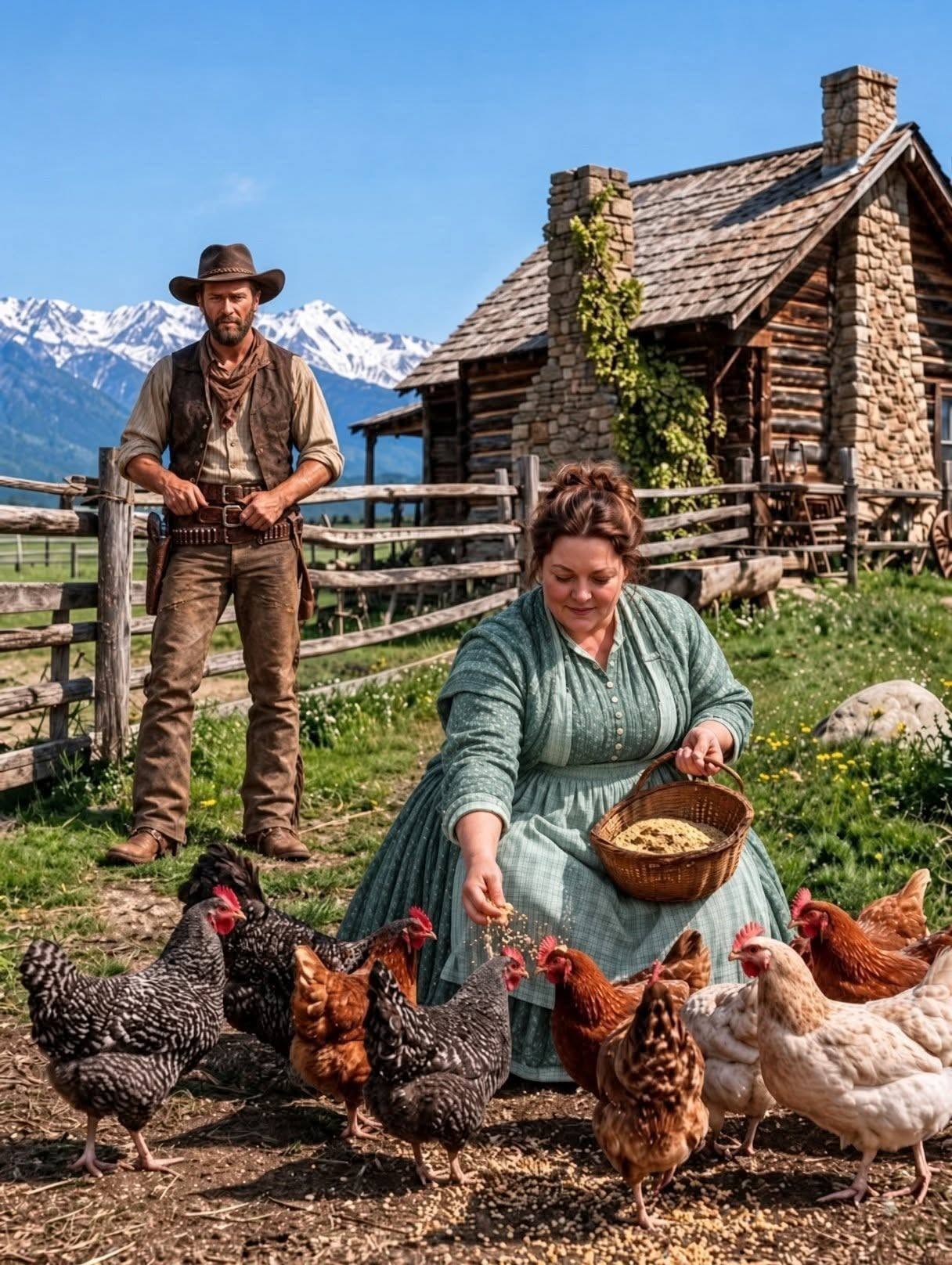
Griffin found her outside the chicken coop, examining the feed trough.
“What are you doing?”
“Saving your chickens.”
“They’re just chickens.”
“They’re your income, Griffin. Or they would be if you stopped feeding them spoiled grain.”
She showed him the feed.
The sacks were damp, and much of the grain had begun to mold.
“Where did you buy this?”
“Caldwell’s supply store.”
Mattie looked at him.
“Of course.”
She walked toward the barn.
There, she examined the cattle.
The animals were thin, their coats dull, and several had sores along their legs.
“Your cattle aren’t dying because the land is worthless,” she said.
Griffin folded his arms.
“Then why are they dying?”
“Because you’re spending money on the wrong things.”
She pointed toward the empty water troughs.
“You have a water problem. Your feed is poor. Your fences are broken, and you’ve allowed the strongest animals to be sold while keeping the weakest.”
Griffin looked away.
“I needed money.”
“And Caldwell knew it.”
She returned to the cabin and opened her ledger.
“Tell me how much money you have left.”
“Not enough.”
“How much?”
He reluctantly named the figure.
Mattie wrote it down.
Then she asked about the cattle, the equipment, the remaining grain, the property taxes, and the outstanding debt.
For nearly two hours, she worked.
Finally, she turned the ledger toward him.
“Your ranch isn’t bankrupt.”
Griffin stared at the numbers.
“What?”
“It’s poorly managed, heavily exploited, and suffering from bad water access. But it isn’t bankrupt.”
She tapped the page.
“You still have valuable land, a good location, and something Caldwell wants very badly.”
“What?”
“Your northern pasture.”
Griffin frowned.
“There’s nothing up there but rocks.”
Mattie smiled.
“Then why has Caldwell been trying to buy it for three years?”
Three days later, Mattie rode to Laramie.
Griffin objected.
“You shouldn’t go alone.”
“Why?”
“Caldwell has people watching the road.”
“Then perhaps they’ll learn something useful.”
He looked frustrated.
“Mattie, I’m serious.”
She stopped beside her horse.
“Griffin, I’ve spent most of my life being told what I cannot do. I don’t intend to begin obeying every man who thinks he knows better.”
Then she mounted.
Before leaving, she turned.
“Keep the cattle away from the eastern creek. And don’t sell anything to Caldwell until I return.”
She rode away.
Griffin watched her disappear over the ridge.
For the first time since his father’s death, he felt as though someone had taken the burden off his shoulders.
And that frightened him almost as much as Caldwell.
Mattie returned shortly before sunset.
She was carrying a leather folder and wearing the expression of someone who had just discovered a very profitable secret.
Griffin met her at the gate.
“What happened?”
She dismounted.
“I found the reason Caldwell wants your northern pasture.”
She opened the folder.
Inside were survey maps, mineral reports, and a geological ᴀssessment prepared by a mining engineer.
Griffin stared.
“Silver?”
“Not exactly.”
She pointed to a marked section near the northern ridge.
“An old geological survey identified a significant deposit of copper and ᴀssociated minerals beneath this property. Caldwell has known about it for years.”
Griffin slowly looked up.
“My father never mentioned anything.”
“Perhaps he didn’t know the full extent. But Caldwell did.”
She handed him another document.
“His company has been quietly purchasing neighboring parcels. If he acquires your northern pasture, he can connect those properties and control the entire deposit.”
Griffin stared at the map.
The land he had considered worthless was potentially worth a fortune.
“Why didn’t he simply make me an offer?”
Mattie’s expression hardened.
“Because he knew you were desperate. He wanted the property for a fraction of its value.”
Griffin sat down on the porch steps.
“My father spent forty years building this place.”
Mattie sat beside him.
“And you nearly lost it because someone convinced you it was worth nothing.”
He looked at her.
“Can we stop him?”
Mattie smiled.
“We can do considerably more than that.”
Over the next two weeks, the Broken Spur began to change.
Mattie hired two local men to repair the fencing.
She negotiated a fair contract with a feed supplier outside Caldwell’s territory.
She arranged for the well to be inspected and discovered that the water problem could be solved by repairing an old underground channel.
She also began keeping detailed records of every expense and every animal.
Griffin watched in disbelief.
The woman he had expected to spend her days cleaning the kitchen was now directing men twice her size, negotiating contracts, and studying survey maps late into the night.
But the biggest surprise came when she asked him to build a new chicken coop.
“A chicken coop?” he asked.
“Several.”
“Why?”
“Because we’re going to sell eggs.”
He laughed.
“Mattie, I have a ranch, not a poultry farm.”
“Then you should be grateful I’m improving your business.”
She showed him her calculations.
The nearby mining camps had hundreds of workers, many of whom lived on preserved food and imported supplies.
Fresh eggs were expensive.
The ranch could supply them.
Then she pointed to another page.
“Your northern pasture has the right conditions for a small dairy operation, too. If we improve the feed and water, we can sell milk and ʙuттer to the mining camps.”
Griffin stared at her.
“You’ve planned all this?”
“Of course.”
He looked at the ledger.
“How long have you been thinking about it?”
Mattie smiled.
“Since the train station.”
But Caldwell wasn’t finished.
On a cold Thursday morning, a telegram arrived.
It was addressed to Griffin.
The message was brief.
FINAL NOTICE. PROPERTY AUCTION SCHEDULED FOR MONDAY. FAILURE TO APPEAR WILL RESULT IN DEFAULT JUDGMENT.
Griffin read it twice.
Then he looked at Mattie.
“He’s going to take the ranch.”
She examined the telegram.
“No.”
“Mattie—”
“No, Griffin.”
She placed the paper on the table.
“He’s going to try.”
She opened her ledger and removed a document Griffin had never seen before.
It was a sworn statement from a former employee of Caldwell’s lending company.
The man claimed that Caldwell had instructed employees to alter cattle weights, inflate loan balances, and falsify signatures on several property agreements.
There were names.
Dates.
Amounts.
And a list of other ranchers who had suffered the same treatment.
Griffin looked at her.
“Where did you get this?”
“From a man who worked for Caldwell for eleven years. He contacted me after I placed an advertisement seeking information about fraudulent livestock settlements.”
“You advertised?”
“Of course.”
She smiled.
“People talk when they discover someone is willing to listen.”
Griffin looked at the list.
There were twenty-three ranchers.
Twenty-three families.
Twenty-three properties.
Mattie closed the ledger.
“Caldwell hasn’t just been stealing from you. He’s been stealing from this entire valley.”
Griffin stood.
“Then we go to the sheriff.”
Mattie shook her head.
“The sheriff has dinner with Caldwell every Sunday.”
“Then what do we do?”
She looked at him.
“We gather the people he’s hurt.”
On Sunday afternoon, the Broken Spur filled with horses.
Ranchers arrived from across the valley.
Some were old men who had lost their land.
Others were young couples struggling to keep their farms.
A widow named Mrs. Harlan arrived with two children and a box of documents.
Mattie welcomed every one of them.
She had arranged chairs, coffee, and a large table covered in papers.
Griffin stood near the door, watching.
He had never seen his ranch so full.
Mattie stepped forward.
“My name is Martha Tucker. Some of you know me as the woman who married Griffin Tucker. Others have probably heard that I am a troublesome housewife who spends too much time reading account books.”
A few people laughed.
She continued.
“I don’t care what anyone calls me. What I care about is the fact that twenty-three families have been cheated by the same man.”
She opened her ledger.
“And I believe we finally have enough evidence to stop him.”
One by one, the ranchers began placing their documents on the table.
Griffin watched as their fear slowly turned into anger.
Then an elderly man stood.
“Mrs. Tucker, what if Caldwell comes after us?”
Mattie looked at him.
“Then he’ll have to come after all of us.”
On Monday morning, Caldwell arrived at the Broken Spur with the deputy and his two armed men.
He expected Griffin to be waiting alone.
Instead, he found twenty-three ranchers standing across the yard.
Mattie stood on the porch.
Her velvet ledger was open.
Caldwell’s smile disappeared.
“What is this?”
Mattie stepped forward.
“Good morning, Mr. Caldwell.”
“Move aside.”
“No.”
He glanced at the gathered men.
“You’re interfering with a lawful property auction.”
Mattie held up a document.
“Not anymore.”
She handed it to the deputy.
“This is a sworn complaint supported by original financial records from twenty-three affected families. It includes evidence of fraudulent loan balances, altered livestock receipts, and forged property transfers.”
The deputy examined the papers.
Caldwell turned red.
“This is nonsense!”
Mattie opened another page.
“And this is a letter from your former bookkeeper, Mr. William Foster, confirming that you personally authorized the alterations.”
The banker stared at her.
“You little—”
“Careful,” Griffin interrupted.
It was the first time he had spoken.
He stepped beside Mattie.
“You’ve spent three years making me believe I was a failure. You made me think my father’s land was worthless and that I was too stupid to save it.”
Caldwell sneered.
“You are a failure, Tucker.”
Griffin looked at the ranchers standing behind him.
“Perhaps I was. But I wasn’t the only one you tried to destroy.”
The deputy folded the complaint.
“Mr. Caldwell, I think you’ll need to come with me.”
Caldwell looked around.
For the first time, nobody stepped forward to help him.
His two armed men slowly lowered their weapons.
Mattie closed her ledger.
“Have a pleasant afternoon.”
That evening, Griffin found Mattie sitting on the porch.
The sun was setting behind the mountains.
The repaired chicken coop stood in the distance, and the cattle were gathered near the new water trough.
He sat beside her.
“Can I ask you something?”
“Certainly.”
“Why did you marry me?”
Mattie looked at him.
“Because your advertisement said you wanted a strong woman.”
“And you believed me?”
“I believed you needed help.”
Griffin nodded slowly.
“That’s fair.”
He looked toward the ranch.
“You’ve done more in three weeks than I managed in three years.”
Mattie smiled.
“Then perhaps you should stop trying to do everything alone.”
He turned toward her.
“Mattie, I owe you an apology.”
She waited.
“I judged you before I knew you. I looked at your size and decided what you could and couldn’t do. I thought I was buying a wife who would take care of my chores.”
His voice softened.
“But you’ve given me something I didn’t know I needed.”
“What?”
“Hope.”
Mattie looked away.
For a moment, the only sound was the wind moving through the grᴀss.
Then Griffin reached for her hand.
She let him take it.
“I don’t know whether you can ever love a man like me,” he said. “But I would like the chance to become someone worthy of your trust.”
Mattie’s eyes softened.
“Griffin, I didn’t come here to be someone’s servant.”
“I know.”
“I didn’t come here to be someone’s investment, either.”
“I know.”
She looked at him.
“I came here because I wanted a home. A place where I could be useful without being treated as though my worth depended on how much space I occupied.”
Griffin gently squeezed her hand.
“Then let’s build that home together.”
For the first time, Mattie leaned her head against his shoulder.
And Griffin Tucker understood that the greatest fortune on his ranch wasn’t beneath the northern ridge.
It was sitting beside him.
But the following morning, a rider arrived from Laramie carrying a sealed letter.
It was addressed to Mattie.
She opened it at the kitchen table.
Griffin noticed her expression change.
“What is it?”
She read the letter again.
Then she slowly placed it on the table.
The letter was from a law firm in Missouri.
It informed her that her late father’s estate had finally been settled.
But the final paragraph contained something neither of them expected.
Her father had owned shares in a regional agricultural company that had recently discovered a mᴀssive natural resource deposit on land adjoining the Broken Spur.
And those shares had been placed in trust for Mattie.
The estimated value was extraordinary.
Griffin stared at the letter.
“Mattie, do you understand what this means?”
She nodded slowly.
“Yes.”
Then she looked at him.
“But there’s something else.”
She turned the page.
The agricultural company was owned by a consortium of investors.
And the largest investor was none other than Harrison Caldwell.
The same man who had spent years trying to take Griffin’s ranch.
Mattie read the final line aloud.
The company is requesting an immediate meeting with Martha Cole Tucker to discuss the acquisition of the Broken Spur and surrounding properties.
Griffin looked at his wife.
“Are they trying to buy our land?”
Mattie closed the letter.
“No, Griffin.”
Her expression became firm.
“I believe they’re trying to buy us out before we discover what lies beneath the entire valley.”
Then she opened her velvet ledger to a fresh page.
“Get your horse ready, husband.”
“Where are we going?”
Mattie smiled.
“To Laramie.”
And for the first time, Griffin Tucker wasn’t afraid of what awaited him there.
Because the woman he had ordered to tend his chickens was about to become the most formidable businesswoman in Wyoming Territory.
END OF PART 2.