PART 2: THE CHRISTMAS SECRET THAT BROKE ETHAN CALLOWAY’S HEART
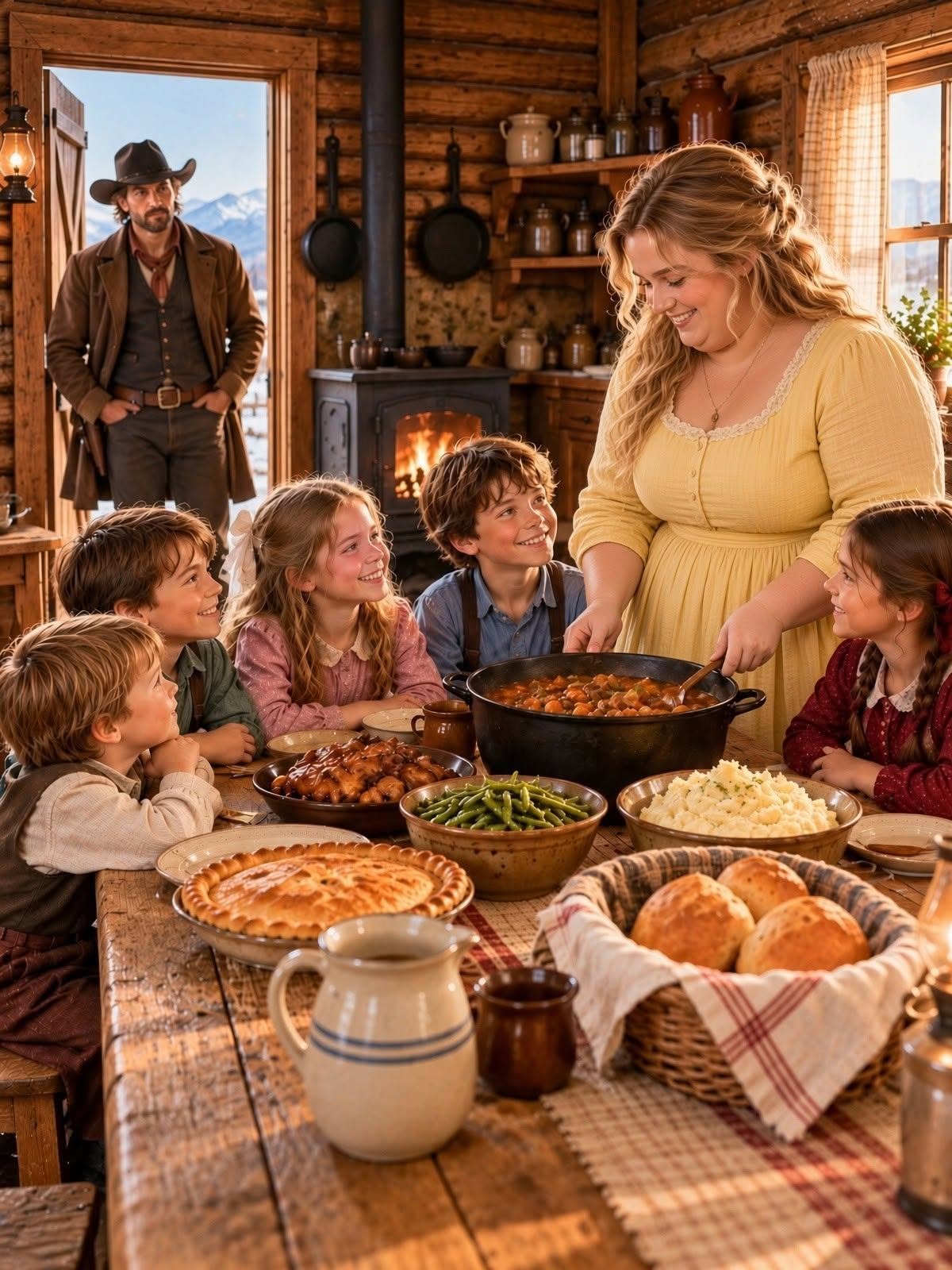
The fire had burned low by the time supper ended.
Outside, snow swept across the Wyoming plains, burying the wagon tracks and covering the ranch in a blanket of white. Inside, the five Calloway children sat around the table, reluctant to leave the first warm, peaceful meal they could remember.
Clara Bennett gathered the empty plates.
“I can wash those,” Maggie offered quickly.
Clara glanced at the twelve-year-old girl.
“You can help me dry them, if you like.”
Maggie hesitated.
“Just dry them?”
“Just dry them.”
“What about the pots?”
“I’ll take care of the pots.”
“And the floor?”
“Maggie.”
The girl fell silent.
Clara set a plate down and gently turned toward her.
“You don’t have to earn your supper by cleaning up after everyone. You ate because you were hungry. That’s reason enough.”
Maggie’s lips trembled, but she quickly looked away.
Across the table, Ethan watched them.
He had seen his daughter scrub floors, mend shirts, and prepare meals far too complicated for a twelve-year-old. He had told himself she was simply a capable girl, that keeping busy helped her cope with her mother’s death.
But now, watching her clutch a dish towel as though Clara might take it away, he began to wonder whether he had mistaken fear for responsibility.
“Girls,” he said gruffly, “go upstairs. It’s late.”
Maggie immediately gathered the younger children.
“Come on, Ben. Lucy. Samuel. Eli.”
The little boy with the wooden horse slipped his hand into hers.
Clara noticed something peculiar.
None of the children looked at Ethan before leaving.
They looked at Maggie.
Every decision seemed to pᴀss through the eldest girl first.
When the bedroom door closed upstairs, Clara turned to Ethan.
“May I ask you something?”
“If it’s about the letters, I believe we’ve covered that.”
“It’s not.”
She wiped her hands on a towel.
“When was the last time your children had a proper Christmas?”
Ethan’s expression hardened.
“Christmas is a day like any other when you’re trying to keep a ranch alive.”
“That wasn’t my question.”
He stared into the fire.
“Two years ago, when their mother was alive, we had a tree. She made gingerbread cookies. The children hung stockings above the fireplace.”
“And last year?”
“Last year, their mother had been gone six months.”
Clara waited.
Ethan rubbed his jaw.
“I tried. I bought a small tree from the man in town. But Maggie took it down before Christmas morning. Said there was no point in decorating when we couldn’t afford presents.”
“And you let her?”
“I was behind on the feed bill. Two of my best cattle had died in a blizzard. I had a fence down on the north pasture, and the bank was threatening to call in the loan.”
His voice rose.
“What would you have had me do? Spend money on ribbons when I wasn’t sure I could keep food on the table?”
“Nothing,” Clara replied quietly. “I would have had you sit with your children and tell them you were frightened, too.”
Ethan looked at her sharply.
“Men don’t have the luxury of falling apart.”
“No. But children shouldn’t have to fall apart in their father’s place.”
The words struck him harder than Clara intended.
He turned away.
“You’ve known us for less than a day. You have no idea what this family has endured.”
“That’s true,” she answered. “But I know what a child looks like when she’s afraid to ask for another biscuit.”
He said nothing.
Clara picked up the last plate.
“And I know what it looks like when a man is so busy surviving that he doesn’t notice his children have stopped asking him for anything at all.”
She left him alone by the fire.
For a long time, Ethan remained motionless.
Then he looked toward the staircase.
For the first time in two years, he wondered what his children had stopped asking for.
And what else they had learned to live without.
The following morning, Clara woke before sunrise.
She had barely slept. The mattress in the spare room was lumpy, the wind had rattled the window throughout the night, and somewhere in the house a loose shutter had banged until nearly three o’clock.
Still, she rose, pinned up her hair, and went downstairs.
She found Maggie already kneading dough.
The girl had flour on her sleeves and dark circles beneath her eyes.
“Good morning,” Clara said.
Maggie jumped.
“Oh! I’m sorry. I didn’t mean to wake you.”
“You didn’t. What are you making?”
“Bread.”
“I can see that. Who taught you?”
“Mama.”
Maggie’s hands slowed.
“She taught me before she got sick. I had to finish learning on my own.”
Clara stepped closer.
“Would you mind showing me?”
Maggie looked suspicious.
“You know how to make bread, don’t you?”
“I do. But I suspect you know something I don’t.”
“What?”
“How to make bread in a kitchen with a stove that seems determined to smoke me out of the house.”
For the first time, Maggie laughed.
It was a small, startled sound, as though she hadn’t expected laughter to come out of her own mouth.
Clara smiled.
“There. Now, show me what you’ve learned.”
They worked together, and soon the kitchen filled with the warm smell of rising dough.
When Ben came downstairs, he stopped at the doorway.
“What’s that smell?”
“Bread,” Maggie answered.
“Real bread?”
Clara looked at him.
“Is there another kind?”
He approached the counter cautiously.
“Sometimes we make flat cakes when the flour runs low.”
“Then today we’ll have bread.”
Ben grinned.
“Can I have two pieces?”
“Three, if you’re hungry.”
His smile vanished.
“Three?”
“Three.”
He looked at Maggie.
She stared at Clara as if she were trying to determine whether this was another trick.
Before either child could respond, footsteps sounded on the stairs.
Ethan entered, fastening the ʙuттons on his work shirt.
“What is all this?”
“Breakfast,” Clara replied.
“I can see that.”
“Then we’re making progress.”
Ben snorted with laughter.
Ethan sH๏τ him a look, but the boy only ducked behind a chair, still grinning.
Clara placed a plate on the table.
“Sit down, Mr. Calloway.”
“I need to check the south pasture.”
“The cattle will survive another fifteen minutes.”
“I don’t like being told what to do in my own house.”
“Neither do I,” Clara replied. “But I’ve traveled eight hundred miles, discovered that your children have been living like little adults, and spent the night listening to your roof argue with the wind. I think I’ve earned the right to insist on breakfast.”
Maggie gasped.
Ethan stared at Clara.
Then, unexpectedly, a rough laugh escaped him.
It was brief, almost rusty from disuse, but it was real.
He pulled out a chair.
“Fifteen minutes,” he muttered.
“Twenty,” Clara corrected.
“Fifteen.”
“Then you had better eat quickly.”
The children exchanged glances.
For the first time in a very long while, their father was sitting at the breakfast table instead of rushing out the door.
And for the first time, the house felt as though it might become a home again.
But the peace did not last.
That afternoon, Clara went upstairs to fetch her sewing basket and discovered Maggie’s bedroom door standing open.
Inside, the five children were gathered around a small wooden box.
Maggie held a folded sheet of paper in both hands.
Her face was pale.
“We didn’t mean for this to happen,” Lucy whispered.
Clara stopped in the doorway.
“What happened?”
All five children turned.
Maggie immediately hid the paper behind her back.
“Nothing.”
Clara looked from one frightened face to another.
“Sweetheart, I’ve never known five children to look quite so guilty over nothing.”
Ben began twisting the hem of his shirt.
Eli clutched his wooden horse.
Maggie swallowed.
“Please don’t tell Papa.”
Clara’s expression grew serious.
“That depends on what you’ve done.”
“We haven’t stolen anything,” Maggie blurted.
“I didn’t say you had.”
“We didn’t hurt anybody.”
“Then why are you so frightened?”
Maggie looked at the paper in her hands.
Then she slowly brought it forward.
It was an old advertisement, torn along one edge and stained with what looked like candle wax.
HOUSEKEEPER WANTED. FOUR GIRLS. DON’T EXPECT MUCH.
Clara recognized the words immediately.
Beneath the advertisement was a second sheet covered in Maggie’s careful handwriting.
It was the first letter she had sent to Clara.
Clara sat down on the edge of the bed.
“You wrote every letter?”
Maggie nodded.
“Most of them. Lucy helped with the last two.”
“And the things about the lonely house? The man who wanted a family but didn’t know how to ask?”
Maggie looked down.
“Those were true.”
Clara studied her.
“Did your father know you were writing to me?”
“No.”
“Did you think I would marry him?”
The girl burst into tears.
“I thought you might come.”
Her words tumbled out between sobs.
“I didn’t know if you’d want to marry Papa. I didn’t even know if you’d like him. But you wrote back, and you sounded kind, and I thought if you came here, maybe things would change.”
Clara felt her chest тιԍнтen.
“What things, Maggie?”
The girl covered her face.
“Everything.”
Lucy began crying, too.
Ben stood beside the bed, his little fists clenched.
Maggie forced herself to continue.
“Papa doesn’t talk to us anymore. Not really. He goes to the barn before we wake up, and sometimes he’s still out there when we go to bed. When Eli cries for Mama, Papa gets this look on his face like somebody has hurt him.”
She wiped her cheeks.
“And when Papa looks like that, I make Eli stop crying.”
Clara glanced at the youngest boy.
He was staring at the floor.
Maggie’s voice dropped to a whisper.
“Last month, Papa forgot Eli’s birthday.”
Clara went still.
“He didn’t mean to,” Maggie rushed to explain. “He was fixing the fence, and there was a sick cow, and the bank man came. Papa had so much to do.”
She swallowed hard.
“But Eli waited all day for him to remember.”
The little boy hugged his wooden horse тιԍнтer.
Clara moved closer.
“Eli, sweetheart, is that true?”
He nodded without looking up.
“I was four.”
Clara’s heart broke.
“And what did you do?”
“I waited.”
His voice was so small that she almost didn’t hear it.
“Then Maggie made me a cake out of the last flour. But Papa didn’t come inside until it was dark.”
Clara drew the child into her arms.
“Oh, darling.”
Eli began to cry against her shoulder.
Maggie watched them, tears streaming down her face.
“I thought if Papa had a wife, someone would make him come inside. Someone would make him eat with us. Someone would tell him when Eli was sick, or when Lucy had nightmares, or when Ben was pretending he wasn’t hungry because there wasn’t enough food.”
She looked directly at Clara.
“I didn’t mean to trick you. I just wanted somebody to take care of us.”
Clara held Eli close while her own eyes filled with tears.
For a moment, she couldn’t speak.
She had come to Wyoming believing she was answering an advertisement from a lonely rancher.
Instead, she had found five children trying desperately to save a family they were too young to understand.
And Maggie, barely twelve years old, had decided that if the adults would not change their lives, she would have to change them herself.
Clara gently wiped the girl’s tears.
“Listen to me, Maggie. What you did was wrong. You sent letters pretending to be your father, and you brought a stranger into your family’s life without his permission.”
Maggie nodded miserably.
“But I understand why you did it.”
The girl looked up.
“You do?”
“Yes. I understand that you were scared. I understand that you missed your mother. And I understand that you wanted your father to come back to you.”
Maggie began sobbing harder.
“But I’m not your mother,” Clara continued gently. “And I cannot promise to become your father’s wife.”
The girl’s face crumpled.
“I know.”
“But I can promise you something else.”
Clara took both her hands.
“I will not punish you for telling me the truth. And I will not leave this house simply because you are frightened.”
Maggie stared at her.
“Really?”
“Really.”
For the first time, the girl leaned forward and allowed herself to be held.
Clara wrapped her arms around Maggie, Lucy, and Eli.
Ben pressed against her side, and Samuel, who had been silent throughout the confession, finally stepped forward and joined them.
Five children.
One desperate lie.
And a grief that had been allowed to grow in the dark for far too long.
That evening, Ethan returned from the south pasture earlier than usual.
He found Clara standing by the fireplace with Maggie beside her.
The children were upstairs, but he could hear their voices through the ceiling.
Something about Clara’s expression made him stop.
“What happened?”
Clara didn’t answer immediately.
Maggie twisted her hands together.
“Papa, I need to tell you something.”
Ethan removed his gloves.
“What is it?”
The girl drew a shaky breath.
“I wrote the letters.”
His face went blank.
“What letters?”
“The ones to Miss Bennett.”
For a moment, Ethan seemed unable to understand.
Then he looked at Clara.
“You knew?”
“I found out this afternoon.”
He turned back to Maggie.
“You forged my name?”
Maggie’s eyes filled.
“Yes.”
“You advertised for a wife?”
“Yes.”
“You invited a woman to travel across the country, believing she was coming to marry me?”
Maggie began to cry.
“I thought—”
“You thought what?”
His voice rose so sharply that the girl flinched.
Ethan stopped.
But the anger had already escaped.
“Do you have any idea what you have done? Miss Bennett gave up her job. She gave up her home. She traveled all this way because of a lie!”
“I know!”
“No, you don’t know!”
Maggie shrank back.
Ethan ran a hand over his face.
“I have spent every day trying to keep this ranch alive. Every day! And now I find out my own daughter has brought a stranger into this house because she thinks she can arrange my life for me?”
“Ethan,” Clara said quietly.
He ignored her.
“Do you understand what could have happened? What if Miss Bennett had been someone dangerous? What if she’d taken advantage of you?”
Maggie was trembling.
“I just wanted—”
“What did you want?”
The girl looked up at him through her tears.
“I wanted you to be our papa again!”
The words struck the room like a gunsH๏τ.
Ethan stopped breathing.
Maggie pressed both hands against her chest.
“I wanted you to sit with us. I wanted you to tell us stories like you used to. I wanted you to remember our birthdays without somebody having to remind you.”
Her voice cracked.
“I wanted you to stop looking at us like we were all that was left of Mama!”
Ethan’s face drained of color.
Maggie immediately covered her mouth.
She looked terrified by her own words.
“I’m sorry, Papa. I’m sorry. I didn’t mean—”
But Ethan had already stepped backward.
For two years, he had buried his grief in work. He had convinced himself that keeping the ranch alive was the same as keeping his family alive.
He had believed his children were coping because they never complained.
He had not understood that they were silent because they were afraid of making him hurt more.
“Maggie,” he whispered.
She shook her head.
“Please don’t send Miss Bennett away. I’ll tell her it was all my fault. I’ll never write another letter. I’ll do all the chores. I’ll—”
“Stop.”
Ethan’s voice broke.
Maggie fell silent.
He approached her slowly, then knelt in front of his daughter.
“Look at me.”
She couldn’t.
“Maggie, look at me, sweetheart.”
Finally, she raised her eyes.
Ethan swallowed hard.
“You should never have had to do any of this.”
The girl stared at him.
“You’re twelve years old. You should be worrying about school, and books, and whether your brothers are stealing your ribbons. You shouldn’t be trying to find a wife for your father because you think he’s forgotten how to love you.”
Maggie’s tears fell faster.
“I thought you were lonely.”
“I am.”
The admission seemed to cost him everything.
“I am lonely, Maggie. I miss your mother every day. Sometimes I wake up and forget she’s gone, and then I remember, and it feels like losing her all over again.”
He pressed her hands between his own.
“But none of that is your fault. Do you hear me? None of it.”
Maggie began to sob.
Ethan pulled her into his arms.
“I should have been there,” he whispered. “I should have listened. I should have noticed.”
She clung to his coat.
“I didn’t know what else to do.”
“I know.”
“I just wanted our family back.”
Ethan closed his eyes.
“So did I, sweetheart.”
For the first time in two years, father and daughter cried together without either of them trying to hide it.
Clara stood by the fireplace, watching quietly.
She had come to the ranch expecting to find a husband.
Instead, she was witnessing a father finally finding his way back to his children.
And she realized that whatever happened between her and Ethan, this moment mattered more than any promise made in a letter.
Later that night, after the children had gone to bed, Ethan found Clara on the porch.
She stood beneath the overhang, wrapped in her coat, watching snow fall over the dark pasture.
He approached without his hat.
“Miss Bennett.”
She turned.
“Mr. Calloway.”
“I owe you an apology.”
“Yes,” she said. “You do.”
He gave a tired, rueful smile.
“I deserved that.”
For a moment, neither spoke.
Then Ethan looked toward the barn.
“I don’t know how to fix this.”
“You don’t have to fix everything tonight.”
“I should have known what was happening.”
“Perhaps. But grief has a way of making people blind to things they cannot bear to see.”
He looked at her.
“Is that what happened to you?”
Clara’s expression changed.
She had not intended to discuss her own life, but something in his question made her pause.
“I was engaged once,” she said. “To a man who promised me a home and a family.”
“What happened?”
“He died of pneumonia three weeks before our wedding.”
Ethan lowered his eyes.
“I’m sorry.”
“So was I. For a long time.”
She drew her coat closer.
“After he died, I kept working at the dressmaker’s shop. I made wedding gowns for women who had no idea how hard it was to sew lace while your heart was breaking.”
Ethan listened without interrupting.
“I thought if I kept busy, I’d stop missing him. But one day I realized I had become so afraid of losing someone again that I’d stopped allowing myself to want anything.”
She looked toward the house.
“When I answered your advertisement, I thought I was taking a chance on a new life.”
“And now?”
“Now I know the advertisement wasn’t yours.”
He nodded, accepting the truth.
“I can’t ask you to stay.”
“No,” Clara agreed. “You can’t.”
He looked at her, surprised by her bluntness.
“But,” she continued, “I haven’t decided to leave.”
“Why?”
She looked at the snow-covered ranch, then at the windows glowing warmly behind them.
“Because those children have already lost their mother. I won’t pretend I can replace her. But I can see that they need someone willing to sit at the table with them, listen to them, and remind them that being children is not a crime.”
Ethan’s eyes grew wet.
“And what do you need, Clara?”
The question caught her off guard.
She had spent so much of her life being useful that she had almost forgotten what it felt like to be asked what she wanted.
“I need honesty,” she said at last. “I need to know that if I stay here, I won’t be expected to become a wife simply because five children decided they wanted one.”
“You won’t.”
“I need to know that you’ll do your share. That you won’t leave me to raise your children while you disappear into the barn every time the house becomes painful.”
Ethan nodded slowly.
“I can’t promise I’ll always know what to do.”
“Neither can I.”
“But I can promise to try.”
Clara studied him.
“Then that’s where we begin.”
He held out his hand.
Not as a husband claiming a bride.
Not as a man demanding that a woman fulfill the promise of a letter.
But as a father asking for help.
Clara took it.
And for the first time since she had stepped off the train, neither of them felt like a stranger standing in the snow.
Christmas morning arrived beneath a pale blue sky.
Clara woke to the sound of whispering outside her bedroom door.
She opened it to find all five children crowded in the hallway.
Maggie stood at the front, holding a small bundle wrapped in brown paper.
“We made you something,” she said.
Clara knelt.
“For me?”
Maggie nodded and handed her the bundle.
Inside was a hand-sewn apron, made from pieces of fabric in different shades of blue. The sтιтches were uneven, and one pocket sat slightly crooked, but the apron had clearly taken hours of work.
Lucy had embroidered a tiny flower near the hem.
Ben had contributed a wooden ʙuттon.
Samuel had written a message on a small piece of paper and tucked it into the pocket.
Thank you for coming.
Clara pressed the apron against her chest.
“Oh, my goodness.”
Maggie looked anxious.
“It’s not very good.”
“It’s beautiful.”
“The pocket is crooked,” Ben said.
“Then it will be perfect for holding crooked things,” Clara replied.
The children laughed.
Eli stepped forward, holding his wooden horse.
“Can you stay until next Christmas?”
The question silenced the hallway.
Clara looked at the little boy, then at Maggie.
She knew she could not promise a marriage. She could not promise that grief would disappear or that the ranch would suddenly become prosperous.
But she could make one promise.
“I’ll stay through the winter,” she said. “And we’ll see what spring brings.”
Eli considered this.
“That’s a long time.”
“It is.”
“Long enough for more bread?”
Clara laughed.
“Long enough for plenty of bread.”
The children cheered.
Downstairs, Ethan stood near the fireplace, watching them descend the staircase together.
For the first time in two years, he had bought a Christmas tree.
It was small, slightly crooked, and missing several branches on one side. He had cut it himself from the edge of the property and decorated it with strips of fabric, dried berries, and a handful of wooden ornaments the children had found in a trunk.
Beneath it sat five small presents.
Nothing expensive.
A book for Maggie.
A new set of pencils for Lucy.
A pocketknife for Ben, to be used only under his father’s supervision.
A carved wooden train for Samuel.
And a second wooden horse for Eli, who immediately decided the two horses were brothers.
When the children opened their presents, Ethan sat on the floor beside them.
He listened to their laughter.
He answered their questions.
And when Eli crawled into his lap, Ethan held him without looking toward the door or searching for an excuse to leave.
Clara watched from the kitchen entrance.
Their eyes met.
Ethan gave her a small, grateful nod.
She returned it.
There was no declaration of love that morning. No sudden wedding, no promise that everything would be easy.
There was only a family sitting together beneath a crooked Christmas tree, learning how to live with the absence of the woman they loved.
And that was enough.
That evening, after the children had gone to bed, Ethan found Clara sitting beside the window with a book.
“May I sit?”
“Of course.”
He took the chair opposite her.
“I’ve been thinking about what you said last night.”
“Which part?”
“About needing honesty.”
She closed her book.
“All right.”
“I don’t know whether I’ll ever be ready to marry again. I loved my wife. I still do.”
“I would never ask you to stop loving her.”
“And I don’t know whether you could ever love a man who has so much grief left in him.”
Clara considered that.
“I don’t need you to be a man without grief, Ethan. I need you to be a man who doesn’t use his grief as a wall between himself and the people who love him.”
He looked down at his hands.
“That’s going to take time.”
“Then take time.”
He raised his eyes.
“Will you give me that time?”
Clara smiled faintly.
“I’ve already given you the winter.”
For a moment, he simply stared at her.
Then he laughed, a quiet, genuine sound that seemed to surprise him as much as it did her.
“Fair enough, Miss Bennett.”
“Clara,” she corrected.
He paused.
“Clara.”
It was the first time he had spoken her name without anger, shame, or the weight of a stranger’s expectations.
And somehow, it felt like the beginning of something neither of them needed to rush.
Outside, snow settled over the Wyoming ranch.
Inside, a lamp burned beside the window, and the house was filled with the soft sounds of five sleeping children.
Clara had arrived on Christmas believing she was coming to marry a stranger.
Instead, she had found a grieving father, five children who had nearly forgotten how to be children, and a home waiting for someone to help it heal.
The letters had been a lie.
But the hope that had inspired them was real.
And sometimes, Clara thought, a family did not begin with a wedding vow.
Sometimes, it began with a warm meal, an honest conversation, and a promise to stay until morning.
For the Calloways, that Christmas was not the end of their sorrow.
It was the first Christmas in two years when sorrow was no longer the only thing they shared.
And as Ethan stood in the doorway watching Clara turn down the lamp, he realized something he had not dared to believe since his wife’s death.
Perhaps the heart could make room for another kind of love without surrendering the love it had lost.
Perhaps a home could be built again.
Not because a stranger had arrived to save them.
But because, at last, they were willing to save one another.