PART TWO: THE MAN WHO WOULDN’T GIVE HIS NAME
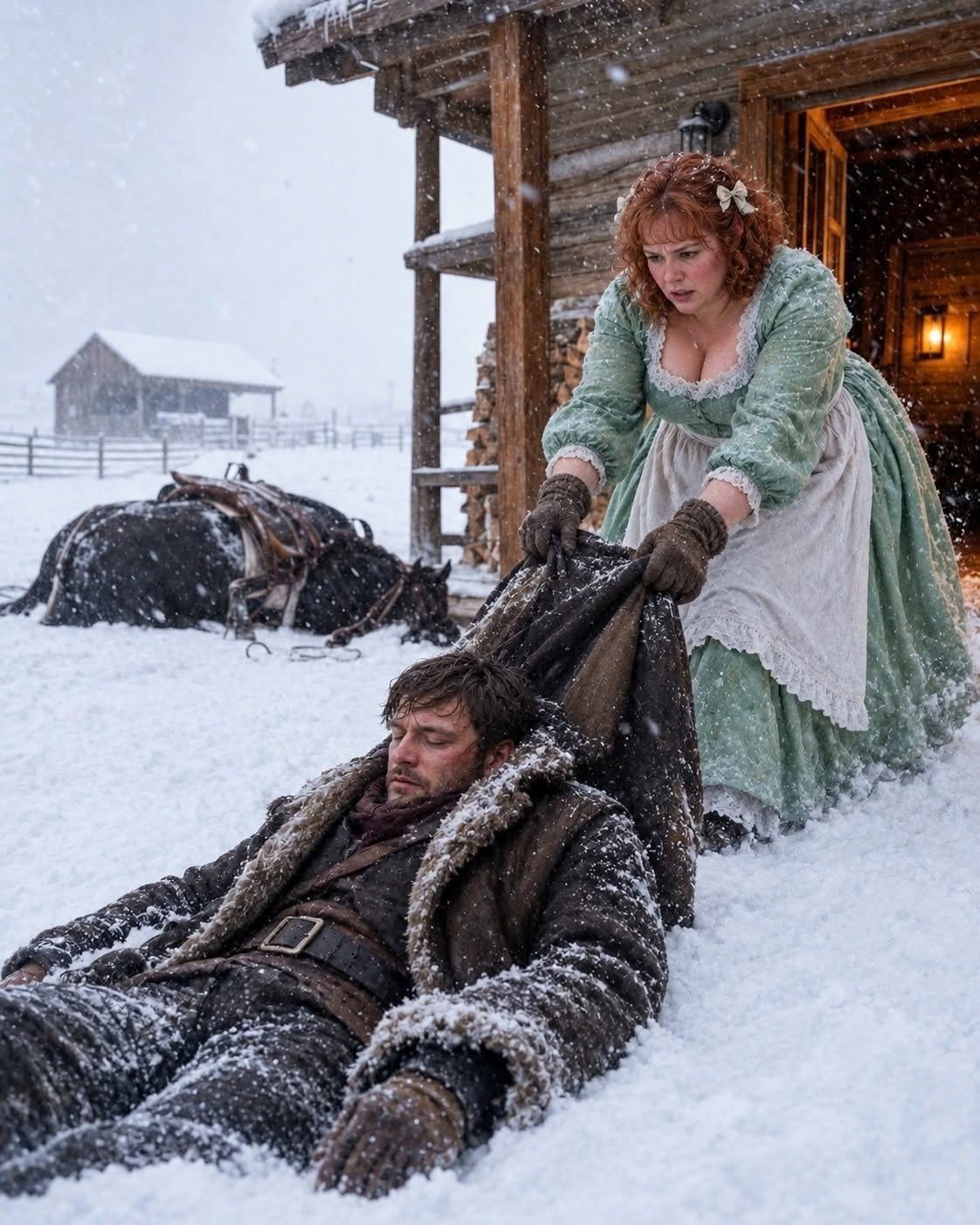
Hannah caught his wrist before he could reach the empty holster.
“Try that again,” she said, holding a needle in her other hand, “and I’ll sew your fingers to your shirt.”
The stranger blinked at her.
Then, incredibly, he smiled.
It was a small, crooked smile, the kind that seemed to belong to a man who had survived too many bad situations to be impressed by one more.
“Always this welcoming, ma’am?”
“Only for armed men who bleed on my floor.”
He glanced at the bloodstained cloth beside her knee. His smile vanished.
“Where’s my horse?”
“In the barn. Warmer than you were.”
“You took him out in this?”
“He was dying in the snow.”
The stranger looked at her for a long moment, as though he was trying to decide whether she was brave, foolish, or something far more troublesome.
“Thank you,” he said finally.
The words came out rough, almost unfamiliar.
Hannah released his wrist.
“You can thank me by telling me your name.”
“Thomas.”
“Thomas what?”
“Just Thomas.”
“Well, Just Thomas, you’re going to hold still while I clean that wound. If you faint again, I’m leaving you on the floor until I finish my coffee.”
He glanced toward the stove.
“Coffee?”
“ᴀssuming you survive long enough to deserve it.”
That earned another faint smile.
Then he tried to sit up.
The movement pulled at his injury, and his face went white. He sucked in a sharp breath and slumped against the pillows Hannah had shoved beneath his shoulders.
“Don’t be an idiot,” she snapped.
“I’ve been called worse.”
“I’m sure you earned it.”
She pressed a clean cloth against his side.
He hissed through his teeth.
“Bullet?” she asked.
“Something like that.”
“That isn’t an answer.”
“It’s the only one I have.”
Hannah studied him.
His coat was expensive but badly worn. His boots were made for riding, not walking through a blizzard. A silver watch chain showed beneath his torn waistcoat, and there was a pale scar along his jaw that looked older than the wound on his side.
He was no ordinary drifter.
And no ordinary drifter carried two pistols and a Colt revolver unless he had a reason.
“Someone chasing you?” she asked.
His gaze shifted toward the window.
For the first time, the humor disappeared completely from his face.
“Possibly.”
Hannah tied off the bandage.
“Then I hope they enjoy the weather.”
He looked at her.
“You don’t understand. The men following me aren’t the sort to turn around because of a little snow.”
“Neither am I.”
Outside, the wind struck the cabin hard enough to rattle the shutters.
For a few seconds, neither spoke.
Then Thomas asked, “You live here alone?”
“Yes.”
“No family nearby?”
“My family is buried.”
The answer came out colder than she intended.
He lowered his eyes.
“I’m sorry.”
“Don’t be. You didn’t bury them.”
She stood, carried the bloody cloth to the basin, and poured fresh water over her hands.
When she turned back, Thomas was watching the room.
His gaze pᴀssed over the rifle above the mantel, the neatly stacked firewood beside the stove, the repaired chair by the table, and the framed pH๏τograph of a broad-shouldered man standing beside Hannah in front of a newly built barn.
“Your husband?” he asked.
“Caleb.”
“How long?”
“Three years.”
Thomas nodded once.
He didn’t offer the usual words about time healing wounds or God having a plan. Hannah appreciated him for that, though she would never have admitted it.
Instead, he looked at the pH๏τograph and said, “He built a good barn.”
Hannah’s throat тιԍнтened.
“He built the first half. I built the rest.”
Thomas looked back at her.
“Then you built a good barn.”
She turned away before he could see her expression.
“Sleep, Thomas. The storm might last until morning.”
“What about you?”
“I have chores.”
“In this weather?”
“The cow doesn’t care about the weather. Neither does the stove.”
He watched her pull on her coat.
“You’re going back outside?”
“I have a barn to check.”
He tried to rise.
Hannah pointed the needle at him.
“Move one inch, and I’ll make that wound worse.”
He sank back.
“Yes, ma’am.”
“And stop calling me ma’am.”
“What should I call you?”
“Hannah.”
He repeated it quietly, as though committing the name to memory.
“Hannah.”
For reasons she couldn’t explain, hearing her name in his voice made the little cabin feel smaller.
She opened the door, stepped into the white darkness, and shut it firmly behind her.
But she didn’t notice the stranger watching through the window.
And she certainly didn’t notice the dark shapes moving along the distant ridge.
By midnight, the storm had become a living thing.
Snow piled against the barn doors. The wind howled through cracks in the timber, and the chimney groaned beneath the weight of ice.
Hannah checked the gelding twice, rubbing his legs and offering him warm water. The horse had a white star on his forehead and a temperament that suggested he was accustomed to being obeyed.
When Hannah returned to the cabin, Thomas was awake.
He had managed to sit against the wall, though his face was pale and sweat shone on his forehead.
“You’re supposed to be resting,” she said.
“I heard something.”
“Wind.”
“No.”
She stopped.
Thomas reached toward the mantel, where his weapons lay.
Hannah stepped between him and the guns.
“You’re not touching those.”
“Listen.”
She did.
At first, there was only the storm.
Then came a sound from outside.
Three faint knocks.
Not on the door.
On the barn.
Hannah’s stomach тιԍнтened.
The gelding whinnied.
Thomas’s expression hardened.
“They found me.”
“Who?”
He looked at her, and whatever he saw in her face made him stop pretending.
“My name isn’t Thomas.”
“I had gathered that much.”
“My name is Nathaniel Cole.”
The name meant nothing to Hannah.
But the fear behind it did.
“Who is Nathaniel Cole?”
Before he could answer, a man’s voice called from beyond the cabin.
“Cole! We know you’re in there!”
Hannah reached for her rifle.
Nathaniel caught her sleeve.
“Don’t go outside.”
She looked down at his hand.
“Take your hand off me.”
He did.
“There are three of them,” he said. “Maybe four. They won’t hesitate to shoot.”
Hannah lifted the rifle from the wall.
“Then they’d better be very certain they want to die in my snow.”
Nathaniel stared at her.
“You really don’t know who I am, do you?”
“No. And at the moment, I don’t care.”
Another shout came through the storm.
“Bring Cole out, woman! This doesn’t concern you!”
Hannah moved to the window and peered through a gap in the curtain.
Three riders stood near the barn, their horses tossing their heads against the wind. One man held a lantern. Another carried a rifle.
The third sat slightly apart from the others, wearing a dark coat and a broad-brimmed hat.
He was looking directly at her cabin.
Hannah felt a chill that had nothing to do with the weather.
She knew that posture.
She had seen it outside her property before.
Silas Boone.
The man who had tried to buy her homestead for three thousand dollars. Then four. Then five.
The man who had smiled at Caleb’s funeral and told Hannah that a woman alone shouldn’t be expected to survive another winter.
The man who had recently begun purchasing land along North Fork Creek, one struggling ranch at a time.
Hannah slowly lowered the curtain.
Nathaniel watched her.
“You know him?”
“Unfortunately.”
“Who is he?”
“Silas Boone.”
Nathaniel’s face changed.
“You need to listen to me very carefully,” he said. “Boone isn’t just trying to buy your land.”
A fist struck the cabin door.
“Open up!”
Hannah raised her rifle.
Nathaniel leaned forward, ignoring the pain in his side.
“Boone has been forcing ranchers off their property. He’s been changing survey markers, buying up debts, and making certain people disappear when they ask too many questions.”
Hannah’s fingers тιԍнтened around the stock.
“My husband died beneath a freight wagon.”
Nathaniel stared at her.
“When?”
“Three years ago.”
For a moment, the only sound was the wind.
Then Nathaniel said something that made the blood drain from her face.
“I know.”
Hannah turned toward him.
“What did you say?”
Nathaniel’s jaw тιԍнтened.
“I was there the night Caleb died.”
The pounding on the door stopped.
Outside, Silas Boone called through the storm.
“Hannah Mercer! You have something that belongs to me!”
Nathaniel looked at the rifle in her hands.
Then he looked into her eyes.
“And I think,” he whispered, “that Caleb’s death was the reason I was sH๏τ.”
PART THREE: THE SECRET BURIED BENEATH THE SNOW
For several seconds, Hannah couldn’t breathe.
“You were there?”
Nathaniel nodded.
“You knew my husband?”
“Not well. I met him twice. The second time, he gave me something he said could bring Boone down.”
“What?”
“A ledger.”
Hannah stared at him.
“What kind of ledger?”
“Names. Payments. Land transfers. Dates. Men who were paid to frighten ranchers into selling their properties. Men who were paid to make accidents happen.”
The room seemed to tilt.
“My husband was a rancher.”
“He was also a witness to something he shouldn’t have seen.”
Hannah stepped closer.
“Tell me what happened.”
Nathaniel glanced toward the door.
“Not with Boone standing outside.”
The door shook under another blow.
“Hannah!” Boone shouted. “I know you’re in there! Open the door, and we can settle this like neighbors!”
Hannah’s mouth twisted.
“Neighbors don’t come armed in a blizzard.”
Nathaniel reached toward the mantel again.
This time, Hannah didn’t stop him from pointing toward the window.
She did stop him from taking the revolver.
“You can barely stand.”
“I can still shoot.”
“And I can shoot better than you can stand.”
He looked at her.
Then, despite the danger outside, he laughed.
It was a short, surprised sound.
“You’re exactly like Caleb described you.”
Hannah went still.
“What did he say about me?”
“That if I ever met you, I should be careful not to mistake your quietness for weakness.”
For one painful moment, she was back in their kitchen three winters earlier, listening to Caleb talk about the coming spring.
He had promised to repair the west fence.
He had promised to plant apple trees.
He had promised they would finally take a trip to the mountains once the mortgage was paid.
Promises had become the shape of everything she had lost.
And now a wounded stranger was telling her that her husband had known his name.
“Why didn’t you come before?” she demanded.
Nathaniel looked away.
“Because I thought Boone had killed me.”
“That makes no sense.”
“I was riding to meet Caleb the night he died. I found the wagon overturned near the creek. Caleb was beneath it, and Boone’s men were already there. I saw enough to know the accident wasn’t what they claimed.”
Hannah’s grip тιԍнтened around the rifle.
“You saw my husband die?”
“No. By the time I reached him, he was gone.”
“Then what?”
“I took the ledger from a man who was trying to burn it. Boone’s men chased me. I escaped, but one of them sH๏τ me before I reached the northern trail.”
Nathaniel paused, breathing carefully.
“I should have returned to you. I should have told you what I knew. But I was afraid that if I did, Boone would come after you.”
“He came after me anyway.”
“I know.”
The shame in his voice was real.
It didn’t erase three years of unanswered questions.
But Hannah understood fear. She had lived with it long enough to recognize the way it hollowed out a person.
“What happened to the ledger?”
Nathaniel reached inside the lining of his coat and withdrew a small, oilskin-wrapped packet.
Hannah stared at it.
“You rode through that storm carrying that?”
“I carried it for three years.”
“Why?”
“Because Caleb died trying to keep it out of Boone’s hands. I wasn’t going to let his death mean nothing.”
The pounding on the door resumed.
This time, the voice outside was colder.
“Last chance, Cole.”
Nathaniel looked at Hannah.
“There’s a second way out of this cabin. Through the pantry, down into the root cellar, and out through the storage hatch. Can you reach the barn from there?”
Hannah almost smiled.
“I built the cellar.”
“Of course you did.”
She took the packet from him and tucked it inside her coat.
Then she walked to the door.
Nathaniel’s eyes widened.
“What are you doing?”
“Something you should have done when you arrived.”
She opened the door just enough to speak through the gap, keeping the rifle aimed toward the ground but ready.
Silas Boone stood on the porch, snow gathering on his hat and shoulders. Two armed men waited behind him.
“Hannah,” he said, smiling as if he had come to borrow flour. “I’m sorry about the disturbance.”
“Then leave.”
His smile thinned.
“The injured man inside has stolen property that belongs to me.”
“Funny. He says you stole it from ᴅᴇᴀᴅ men.”
Boone’s eyes hardened.
“Be careful what you repeat.”
“I’ve been careful for three years. It hasn’t brought my husband back.”
For the first time, Boone’s expression faltered.
Then he leaned toward the doorway.
“Your husband was a good man. He simply became confused about business matters he didn’t understand.”
Hannah felt the words hit like a slap.
“Get off my porch.”
“Give me Cole and the packet he’s carrying. I’ll pay you ten thousand dollars for your trouble.”
She stared at him.
Five thousand dollars had once been enough to make half the town believe she was a fool for refusing to sell.
Now Boone was offering twice that amount to silence a man who knew something about Caleb’s death.
Hannah understood.
The ledger was valuable.
And Silas Boone was frightened.
“No,” she said.
His smile vanished.
“You’ll regret that.”
“Perhaps. But not as much as you’ll regret coming onto my land with a gun.”
Boone raised one gloved hand.
The man behind him lifted his rifle.
Hannah slammed the door shut.
A sH๏τ tore through the wood.
She threw herself to the floor as splinters burst across the room.
Nathaniel grabbed her arm.
“Cellar. Now!”
They crawled through the pantry while another sH๏τ cracked against the cabin wall.
Hannah lifted the hatch and helped Nathaniel down the ladder. He nearly collapsed on the final rung, but she caught him beneath the arm.
“Don’t you dare die in my cellar,” she hissed.
“I’ll do my best.”
“You’d better.”
She lowered the hatch just as the front door splintered.
Boots thundered across the floor above them.
Hannah led Nathaniel through the narrow cellar pᴀssage toward the storage hatch. Snow blew in as she opened it, but beyond the drift lay the sheltered side of the barn.
They crawled outside.
The black gelding stood trembling in his stall.
Hannah helped Nathaniel inside, then secured the barn door behind them.
Above the wind, they could hear Boone’s men searching the cabin.
Nathaniel leaned against a support beam, pale and sweating.
“Hannah,” he whispered, “if we get out of this, I owe you more than I can ever repay.”
She checked the bandage beneath his coat.
“Then stay alive long enough to repay it.”
Outside, Silas Boone shouted an order.
And Hannah Mercer, who had spent three years refusing to surrender her land, finally understood that the fight for North Fork had never been about money.
It had been about who got to decide whose lives mattered.
She lifted her rifle.
“Now,” she whispered, “let’s teach him something about trespᴀssing.”