PART 2: THE WOMAN WHO KNEW WHAT THE DOCTORS HAD MISSED
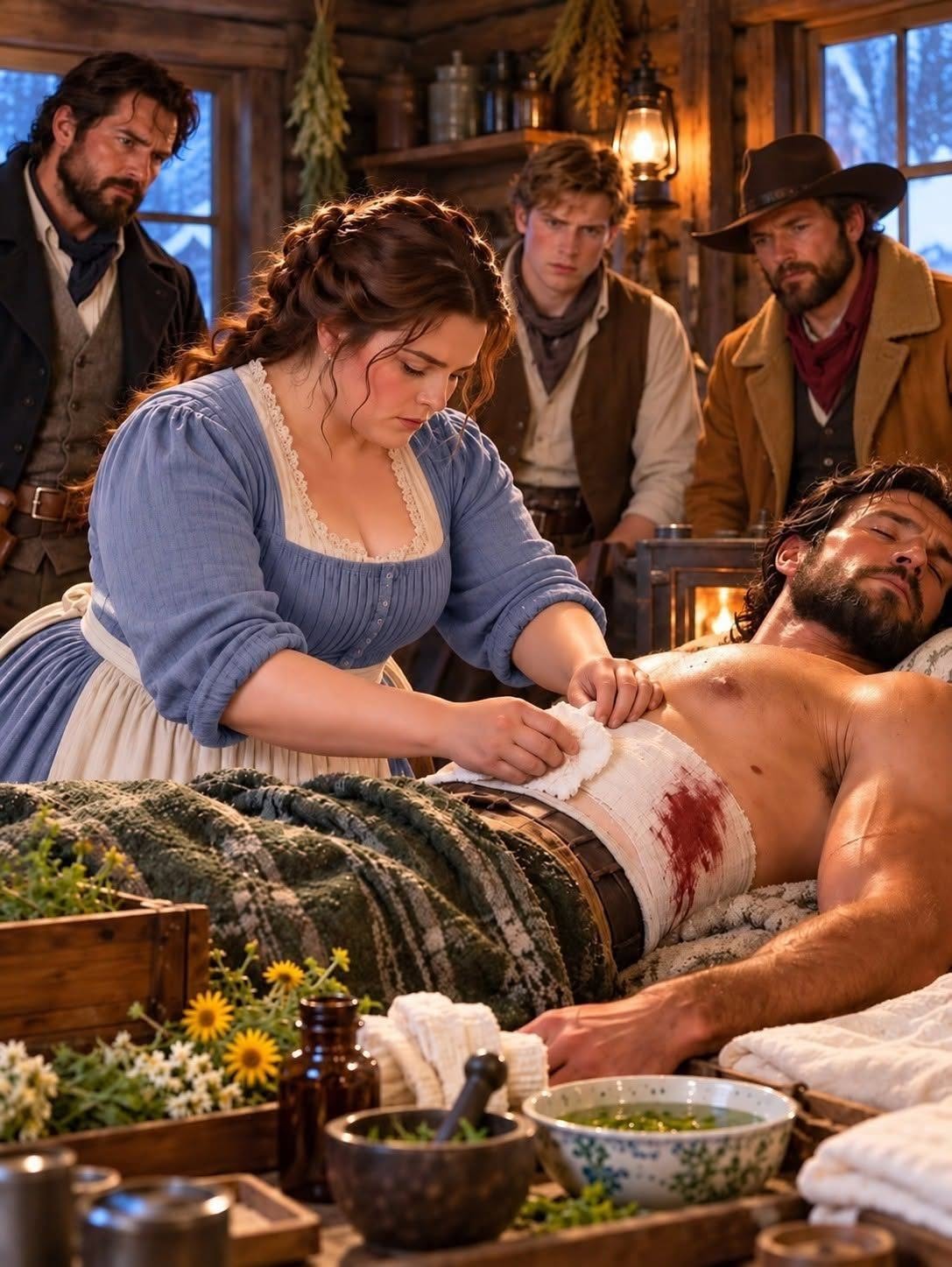
“You’re telling me you’re going to cut open a wound a trained doctor already sтιтched?”
Clara didn’t look at him.
“I’m telling you that if I leave it closed, he’ll die.”
“And if you open it?”
“He might die anyway.”
The bluntness of her answer silenced the room.
Clara reached for a clean cloth and folded it beside the basin. Her cabin smelled of woodsmoke, boiled water, and the sharp, bitter scent of herbs. Outside, the wind dragged snow against the windows as if the mountain itself were trying to force its way inside.
She had seen men die before.
She had seen them die from fever, from infected wounds, from injuries that might have been survivable if someone had acted sooner. She had also watched frightened people mistake confidence for knowledge and authority for competence.
She would not make that mistake tonight.
“Caleb,” she said, “hold the lamp steady. Jesse, bring me the small iron instrument in the brown case. The one wrapped in linen. Holt, I need you to help keep his shoulders still if he starts moving.”
Holt hesitated.
“You expect him to wake up?”
“I expect his body to fight for its life. Whether his mind wakes up or not is between him and God.”
She washed her hands again, then turned toward Ethan.
His face was frighteningly pale beneath the dark stubble covering his jaw. A sheen of sweat glistened on his forehead despite the cold air leaking through the cabin walls.
Clara touched his wrist.
His pulse was fast and weak.
“Ethan Blackwood,” she murmured, leaning close enough for him to hear if any part of him remained aware. “You’ve spent your whole life making the mountain surrender to you. Tonight, you’re going to have to let somebody else do the fighting.”
She took a breath.
Then she began.
The first cut was small, made carefully along the infected suture line. Clara worked with the precision of someone who understood that every movement mattered. She had no modern instruments, no sterile surgical room, and no trained team to call upon. She had only the supplies she had prepared herself, the knowledge she had acquired through years of study, and the terrible understanding that Ethan’s condition was deteriorating by the minute.
When the wound opened enough for her to see what lay beneath, she went still.
“Oh, Lord,” Jesse whispered.
Clara’s jaw тιԍнтened.
The tissue was badly infected. The skin around it had darkened, and a pocket of pus had formed beneath the closed wound. The original sтιтching had trapped the infection rather than allowing it to drain.
But that wasn’t all.
Near the deepest part of the wound, something pale and hard caught the lamplight.
Clara leaned closer.
“Caleb, move the lamp.”
He did.
She studied the shape, then carefully cleared enough of the surrounding tissue to identify what she was seeing.
A fragment of the bear’s claw—or possibly a splinter of bone carried into the wound during the attack—had been left embedded beneath the skin.
That foreign material had helped the infection take hold.
Clara exhaled slowly.
“There you are,” she whispered.
Holt stepped closer.
“What is it?”
“Something that should never have been left inside him.”
“Can you get it out?”
“I can try.”
“You keep saying that.”
She finally looked at him.
“Because I’m not a fool, Mr. Holt. A man’s life is not a promise I can make just because you desperately want one.”
Holt’s expression hardened, but he said nothing more.
Clara continued working, removing the visible foreign fragment and allowing the infected pocket to drain. She cleaned the wound thoroughly, discarded contaminated cloths, and used the cleanest instruments available to her.
The work was slow.
Too slow.
Ethan’s breathing grew shallower. His pulse fluttered beneath her fingers, and for one terrible moment, Clara thought she had lost him.
“Ethan?” Caleb said, stepping forward.
“Stay back.”
“He’s not breathing right!”
“I know.”
Clara checked his airway and breathing, then immediately directed Caleb to help reposition him while Jesse fetched additional warm cloths. She worked to support his breathing and keep him warm, refusing to let panic dictate the next decision.
“Come on,” she whispered. “Not tonight.”
Ethan’s chest rose.
Then fell.
Another breath came, thin but present.
Clara let out the breath she’d been holding.
“Keep talking to him,” she told Caleb. “Tell him where he is. Tell him he’s not alone.”
Caleb leaned over his friend.
“Ethan, you stubborn bastard, you hear me? You’re in Clara Whitmore’s cabin. She’s fixing what Hargrove missed, and you’re going to stay alive long enough to complain about it.”
Jesse gave a nervous, breathless laugh.
Even Holt’s mouth twitched.
Clara kept working.
By the time she finished cleaning and dressing the wound, the fire had burned low enough that Jesse had to add another log. The snow outside had grown so thick that the windows looked like pale walls.
Clara stepped back from the table.
Her shoulders ached. Her fingers trembled now that the hardest work was over.
Ethan remained unconscious.
But his breathing had become more regular, and his pulse, though still weak, was easier to find.
“Is he going to live?” Jesse asked.
Clara looked at Ethan before answering.
“I don’t know.”
Holt’s face fell.
“But the wound is open, the trapped infection has been drained, and I’ve removed what appeared to be the foreign fragment. Those were things that needed doing. Now we watch him carefully, keep him warm, maintain the dressing, and get further medical help as soon as the roads allow it.”
“You mean Doc Hargrove?” Caleb asked.
Clara’s expression changed.
“I mean a doctor who understands that closing a wound isn’t the same as healing it.”
Nobody spoke.
Then Ethan’s enormous hand moved against the blanket.
It was barely more than a twitch.
But Caleb saw it.
“His hand!”
Clara hurried back to the table and checked Ethan’s pulse again.
Still weak.
Still dangerous.
But there.
“Don’t celebrate yet,” she warned them. “The next day may decide everything.”
She pulled a chair beside the table and sat down.
For the first time that night, she allowed herself to feel the weight of what she had done.
Not pride.
Not relief.
Fear.
Because she knew the town would not judge her by the care she had taken or the knowledge she possessed.
If Ethan lived, some people would call it luck.
If he died, others would call it proof that she had no business touching him.
And if the doctors discovered how much she knew, they would ask questions she had spent years trying to avoid.
Clara stared into the fire.
She had not come to Willow Creek to become a mystery.
She had come to disappear.
But Ethan Blackwood had arrived at her door with death already closing around him.
And she had never learned how to turn away from a person who still had a chance.
PART 3: THE DOCTOR WHO RECOGNIZED HER HANDS
The first sign of dawn appeared beneath the clouds just after six.
Ethan had not awakened.
Clara had spent the remaining hours checking his breathing, monitoring his pulse, changing the dressings when necessary, and making certain the fire never died. Caleb had fallen asleep sitting upright against the wall. Jesse was curled beneath an old quilt near the stove.
Only Holt remained awake.
He watched Clara from across the room.
Finally, he spoke.
“Where did you learn to do that?”
Clara didn’t look up from the basin.
“Do what?”
“Don’t play games with me. I’ve seen men sтιтched up after gunfights. I’ve seen surgeons work in military hospitals. I’ve never seen anyone examine a wound the way you did last night.”
She wrung out a cloth.
“Then you’ve been fortunate enough to meet better doctors than the one who treated Ethan.”
“That’s not an answer.”
“No,” she agreed. “It isn’t.”
Holt leaned forward, resting his forearms on his knees.
“People in Willow Creek say you’re an herb woman. They say you sell remedies to women who can’t afford a doctor. They say you talk to plants and keep strange books in your house.”
“People in Willow Creek have a great deal of free time.”
“They also say you once turned away a man who wanted you to look at his injured horse.”
Clara finally raised her eyes.
“His horse wasn’t injured. He wanted me to tell his wife he had been thrown from it so she wouldn’t know he’d spent the night gambling.”
Holt blinked.
Then, to Clara’s surprise, he laughed.
It was a short, rough sound, but it broke the tension in the room.
“You knew that?”
“He had a playing card stuck to the back of his shirt.”
Holt laughed again, louder this time.
Caleb stirred against the wall.
“What are you laughing about?”
“Nothing,” Holt said. “Just learning that we’ve all been fools about something.”
Clara returned to her work.
She didn’t need their approval.
She had learned that lesson long before she came to Willow Creek.
But before Holt could ask another question, Ethan made a sound.
A low, rough groan escaped his throat.
Clara was on her feet instantly.
“Ethan?”
His eyelids fluttered.
His mouth moved, but no words came out.
“Don’t try to speak yet,” she told him. “You’ve been badly injured. You’re safe inside my cabin.”
His eyes opened a fraction.
They were dark gray, almost the color of the clouds hanging over the mountain.
For several seconds, he seemed unable to understand where he was. His gaze moved from the ceiling to the fire, then to Caleb.
Finally, his eyes settled on Clara.
He stared at her.
“Who…” His voice broke into a painful whisper. “Who are you?”
“Clara Whitmore.”
He swallowed.
“The woman they said couldn’t help me?”
Caleb stiffened.
Holt looked away.
Clara’s expression remained calm.
“Apparently, they were wrong about something.”
For the first time, the corner of Ethan’s mouth moved.
It wasn’t quite a smile.
Then his eyes closed again.
Clara checked him carefully and found that he had drifted back into an exhausted sleep.
Caleb let out a shaky breath.
“He’s awake.”
“Briefly,” Clara replied. “That doesn’t mean he’s out of danger.”
But the room had changed.
The man everyone had expected to die had opened his eyes.
And Clara Whitmore, the woman Willow Creek had spent years ridiculing, had been the one to bring him back from the edge.
By noon, someone would tell the town.
By nightfall, everyone would know.
And by the following morning, the first visitors would be standing outside her door.
PART 4: THE MAN WHO CAME TO TAKE HER PLACE
Doctor Samuel Hargrove arrived shortly after noon.
He came riding through the snow on a dark bay horse, his medical bag strapped behind the saddle and his expression already irritated.
Two townsmen accompanied him.
When he entered Clara’s cabin, he removed his gloves and looked directly at Ethan.
Then he saw the dressing.
“What have you done?”
Clara stood beside the table.
“Opened the infected wound, drained the collection beneath the closed incision, removed a foreign fragment, and dressed the area.”
Hargrove’s face turned red.
“You opened my sutures?”
“Yes.”
“You had no right!”
Caleb rose from his chair.
“She had every right to try to save him.”
“I’m the physician in this county!”
“And you told us he’d recover with rest,” Holt said. “You told us the wound was clean.”
Hargrove rounded on him.
“I examined the man under difficult circumstances. The wound was deep, but I had no reason to believe—”
“Then examine him now,” Clara interrupted.
The doctor glared at her.
For a moment, she thought he might refuse simply because the request came from her.
Then he approached the table.
He examined Ethan’s pulse, inspected the dressing, and carefully ᴀssessed the surrounding tissue without disturbing the wound unnecessarily.
His expression changed.
He looked again.
Then he looked at Clara.
“Where did you learn wound management?”
Clara folded her arms.
“Is that what matters right now?”
“It’s a simple question.”
“And he’s a very sick man. If you wish to help him, we can discuss my education later.”
Hargrove stared at her as if he had never heard anyone speak to him that way.
Then he turned back to Ethan.
For several minutes, he examined the cowboy and asked Clara what she had observed before treatment. She answered precisely, describing the progression of the swelling, the condition of the surrounding tissue, the patient’s weak pulse, and the signs that had concerned her.
Hargrove listened.
The more she explained, the less certain he seemed.
At last, he straightened.
“He needs continued observation,” he said. “The infection may have spread beyond the original wound. He’ll require proper medical supervision, and we need to watch closely for signs of systemic illness.”
“Agreed,” Clara said.
Hargrove looked at her sharply, perhaps expecting an argument.
She offered none.
She wanted Ethan to live, not to win a contest with a man who had failed him.
“I have supplies at my office,” the doctor continued. “I’ll send for them and arrange for someone to help monitor him.”
“Thank you.”
He picked up his bag, then paused near the door.
“Miss Whitmore.”
She looked at him.
“That was not an ordinary piece of field medicine.”
“No,” she replied. “It wasn’t.”
“Where did you learn to do it?”
Clara’s fingers тιԍнтened around the edge of the table.
“Somewhere I no longer wish to discuss.”
The doctor’s eyes narrowed.
Then he left.
Caleb waited until the sound of the horses had faded.
“Well,” he said, “that went better than I expected.”
“It went better because Ethan is still alive,” Clara replied. “Don’t confuse that with a peaceful future.”
She was right.
By sunset, the story had traveled from the general store to the church, from the blacksmith’s shop to the boardinghouse, and from there to every porch in Willow Creek.
Some people claimed Clara had used forbidden mountain magic.
Others insisted she had stolen medical supplies from a hospital.
One woman announced that the cowboy had survived because the Lord had chosen to work through an unlikely vessel.
And one particularly cruel man declared that if Clara truly possessed medical knowledge, she would have used it to improve her own life instead of hiding in a shabby cabin.
Clara heard none of those comments directly.
She was too busy watching Ethan.
But the following afternoon, a carriage pulled up outside her door.
A woman stepped down, her fur-trimmed coat immaculate despite the weather.
Mrs. Beatrice Langley was the wealthiest woman in Willow Creek and the person most responsible for turning Clara into a local joke.
She had once refused to let Clara sit at her dinner table because, as she put it, a woman who sold dried weeds had no place among respectable company.
Now she stood on Clara’s porch with a basket of food and a carefully arranged expression of concern.
“Miss Whitmore,” she said, “I have come to see the injured man.”
Clara remained in the doorway.
“He is resting.”
“I understand that. I merely wanted to offer ᴀssistance.”
“How generous.”
Mrs. Langley’s smile тιԍнтened.
She glanced past Clara, toward the table where Ethan lay beneath blankets.
“It’s remarkable, what you’ve accomplished. The entire town is talking about you.”
“Then the entire town should find something more useful to talk about.”
The older woman’s cheeks colored.
“You needn’t be so defensive. People are simply surprised.”
Clara’s voice remained quiet.
“People have spent years laughing at me. They can spend a few days wondering whether they were wrong.”
Mrs. Langley had no answer.
She set the basket down on the porch and left without another word.
Clara watched her carriage disappear into the snow.
Then she closed the door.
Behind her, Ethan’s voice emerged from the table.
“Always that charming?”
Clara spun around.
His eyes were open.
This time, he was looking directly at her.
She crossed the room and checked him before allowing herself to smile.
“Only with people who deserve it.”
Ethan studied her face.
“I believe I owe you my life.”
“You owe me the cost of a new kitchen table if you break it.”
He looked down at the heavy pine boards beneath him.
Then he laughed.
The laugh became a cough, and Clara immediately told him to stop talking.
But the sound of his laughter stayed with her long after he fell asleep again.
It was the first time since his arrival that she had allowed herself to imagine he might truly recover.
And the first time she had wondered what would happen if he did.
PART 5: THE NAME SHE HAD BURIED
Ethan’s recovery was slow.
The infection had taken a terrible toll on his body, and for days he drifted between sleep and brief periods of wakefulness. Clara followed the doctor’s guidance, maintained careful wound care, and watched for signs that his condition was worsening.
Hargrove returned regularly.
At first, he was stiff and formal.
Then he began asking questions.
By the fourth visit, he had brought a medical journal from his office.
By the sixth, he was standing beside Clara’s table with the journal open, pointing at a pᴀssage.
“You recognized the danger because of the swelling and the change in the tissue,” he said. “But you also suspected something had been left inside.”
“I felt an irregularity beneath the wound.”
“And you knew how to proceed.”
“I knew that leaving the infection trapped was dangerous. I also knew I could make things worse if I acted carelessly.”
Hargrove studied her.
“Who taught you?”
Clara looked toward the window.
Outside, the snow was finally beginning to melt from the roof.
“My father.”
“Was he a physician?”
“No.”
“Then who was he?”
She was silent for so long that Hargrove began to close the journal.
Finally, she spoke.
“Dr. Elias Whitmore. He taught surgery and anatomy at a medical college in Philadelphia for nearly thirty years.”
Hargrove’s hand stopped.
“Elias Whitmore?”
“You knew his name?”
“Every physician who trained in the East knew his work. His lectures on traumatic injuries were widely respected. He was known for his insistence that a surgeon must understand the wound, not merely close it.”
Clara’s mouth тιԍнтened.
“That sounds like him.”
“Then why are you here?”
It was a fair question.
One Clara had spent years trying not to answer.
She sat down beside the table.
“My father taught me anatomy from the time I was a child. I spent years studying his books and observing his work. Later, I trained at a private infirmary where he knew several of the physicians.”
Hargrove listened without interrupting.
“I was good at it,” Clara continued. “Better than some people expected. I learned quickly, and I could remain calm when others panicked.”
“Then why leave?”
Clara looked down at her hands.
“Because I made a mistake.”
Hargrove waited.
“During my final year of training, a young woman was brought to the infirmary after a serious accident. The physician responsible for her care had made an error. I recognized it, but I was too junior to challenge him confidently. By the time someone listened, it was too late.”
Her voice grew quieter.
“She died.”
“Was the death your fault?”
“No. But I had been afraid of offending a senior physician, and I had not spoken loudly enough or early enough. I carried that failure with me.”
Hargrove closed the journal.
“Every physician has lost patients.”
“I know that now.”
“And you believed leaving medicine would make the loss easier?”
“I believed leaving would prevent me from hurting anyone else.”
The doctor regarded her for a long moment.
“That is not how medicine works, Miss Whitmore. Knowledge does not make us infallible. It makes us responsible for recognizing our limits and doing what we can within them.”
Clara’s eyes shone, but she refused to look away.
“My father said something similar.”
“Then he was a wise man.”
“He died before I came here.”
Hargrove nodded slowly.
“I’m sorry.”
She took a steadying breath.
“When I arrived in Willow Creek, I didn’t tell anyone who I was. I wanted to be a person who could fail without carrying my father’s name into every room. I wanted a quiet life.”
“And the town gave you one?”
A faint, humorless smile crossed her face.
“Not exactly.”
Hargrove looked toward Ethan.
“No,” he said. “I suppose it didn’t.”
That evening, Clara returned to the table and found Ethan awake, watching her.
“How much did you hear?” she asked.
“Enough to know you were a doctor.”
“Not exactly.”
“You know more about medicine than most people I’ve met.”
“That doesn’t make me infallible.”
“No,” Ethan agreed. “But it makes me wonder why you’ve spent years allowing people to call you ignorant.”
Clara pulled a chair beside him.
“Because correcting every fool in town would leave me no time to live.”
He smiled faintly.
“Fair answer.”
Then his expression became serious.
“Were you afraid when you opened my wound?”
“Yes.”
“Didn’t look like it.”
“Fear doesn’t always look the way people expect.”
He studied her face.
“Why did you help me? You didn’t owe me anything.”
Clara considered the question.
“Because you were dying.”
“That simple?”
“That simple.”
He looked at the ceiling for a moment.
“Most people in this town wouldn’t have opened their doors to me if they thought it might bring trouble.”
“Most people in this town wouldn’t have opened their doors to me, either.”
“Then perhaps we’ve both been spending too much time among the wrong people.”
Clara laughed softly.
It surprised them both.
For a moment, the room felt warmer than the fire could explain.
Then Ethan reached for her hand.
His fingers were still weak, but his grip was gentle.
“Thank you, Clara.”
She looked down at their joined hands.
“You’re welcome, Ethan.”
Neither of them let go immediately.
And for the first time in years, Clara felt something other than the need to protect herself from the world.
She felt the possibility of belonging.
PART 6: WHEN THE TOWN HAD TO ANSWER FOR ITSELF
Ethan was strong enough to sit upright by the end of the second week.
By the third, he could stand with ᴀssistance.
By the fourth, he could walk a few steps across Clara’s cabin, though the effort left him pale and breathless.
The town’s atтιтude began to change.
Men who had mocked Clara at the general store now tipped their hats when they pᴀssed her.
Women who had whispered about her strange habits started asking whether she could recommend remedies for their children’s coughs.
Clara accepted neither their sudden admiration nor their excuses too readily.
She had no interest in becoming a local celebrity.
But she could not prevent the town from turning Ethan’s survival into a story.
One Sunday, Reverend Miller announced from the pulpit that the Lord had performed a miracle through Clara Whitmore.
Clara nearly walked out of the church.
She had worked too hard to understand the difference between skill and luck to let people turn Ethan’s survival into a supernatural spectacle.
After the service, she found Doctor Hargrove waiting near the steps.
“I have a proposition,” he said.
Clara raised an eyebrow.
“That sounds dangerous.”
He smiled.
“Willow Creek has no proper infirmary. I have been treating patients out of two rooms behind my office. It is inadequate, and the nearest hospital is too far away for many emergencies.”
“I’m aware.”
“I want to establish a small clinic. A proper one. Clean equipment, a dedicated treatment room, supplies, and a place where patients can be observed when they cannot safely travel.”
Clara regarded him carefully.
“And what does that have to do with me?”
“I would like you to help organize it.”
She stared at him.
“You want me to work with you?”
“I do.”
“After I contradicted you in front of your patients?”
“Especially after you contradicted me. You saw something I missed. A good physician should be grateful when someone catches an error before it becomes a tragedy.”
Clara looked down at the snow beneath her boots.
“I don’t know if I’m ready.”
“You may never feel entirely ready,” he said. “But you know your abilities, and you know your limitations. That is a better foundation than arrogance.”
Before she could answer, another voice interrupted them.
“I think she should do it.”
Ethan stood at the bottom of the steps, leaning lightly on a walking stick.
Clara hurried toward him.
“You shouldn’t be standing out here in the cold.”
“I’ve been told that several times.”
“Then perhaps you should start listening.”
He grinned.
“Perhaps.”
Then he turned toward Hargrove.
“People in this town trust you because you’re the doctor. But when I was dying, you had already decided there was nothing more to do. Clara didn’t make that decision. She looked again.”
Hargrove accepted the criticism without protest.
“She’s right to be cautious,” he said. “And I am right to ask.”
Ethan looked at Clara.
“You don’t have to prove anything to these people. Not to the town. Not to me. But if you want to help others, don’t let the people who laughed at you decide what you’re allowed to become.”
The words struck a place inside her that she had kept guarded for years.
She had come to Willow Creek believing that disappearing was the same as healing.
But perhaps she had only learned to live around her pain.
Perhaps she could do more.
Clara turned to Hargrove.
“I will help you establish the clinic. But I want the work organized properly, with appropriate equipment and clear responsibilities. And I will not pretend to know something I don’t.”
Hargrove extended his hand.
“Agreed.”
She shook it.
From the street, Mrs. Beatrice Langley had been watching the conversation.
She approached with a stiff smile.
“Miss Whitmore, I believe I owe you an apology.”
Clara waited.
“I judged you without knowing your background. I repeated things I should never have said. And when Ethan was brought to your cabin, I ᴀssumed you couldn’t help him.”
“Those ᴀssumptions nearly cost you the opportunity to learn something,” Clara replied.
Mrs. Langley’s face reddened.
“Yes. They did.”
Clara could have humiliated her.
She could have reminded her of every insult, every invitation withheld, every time she had been treated as less than human.
Instead, she said, “If you wish to help the clinic, we will need clean linens, supplies, and volunteers who are willing to work without making the patients feel ashamed of needing help.”
Mrs. Langley blinked.
“You would allow me to help?”
“I’m not asking whether you’re worthy of forgiveness. I’m asking whether you’re willing to be useful.”
The older woman lowered her eyes.
“Yes,” she said. “I am.”
It wasn’t a perfect reconciliation.
But it was more honest than anything Clara had received from her before.
And that was enough for one day.
PART 7: THE PROMISE ON THE MOUNTAIN
By early spring, Ethan could ride again.
He still tired easily, and the scar along his side pulled when he moved too quickly, but the color had returned to his face. His strength came back gradually, one day at a time.
On the morning he planned to return to his ranch, he found Clara outside her cabin, sorting medicinal plants into small bundles.
He stood beside her for a moment.
“I’m leaving tomorrow.”
Her hands paused.
“I know.”
“Caleb says the trail is clear enough.”
“Then you should be able to reach the valley before dark, provided you don’t insist on riding like a fool.”
“I make no promises.”
She gave him a stern look.
He smiled.
Then his expression changed.
“I’ve been thinking about asking you something.”
“That sounds dangerous too.”
“Would you come to the ranch with me?”
Clara looked up.
“For what purpose?”
“To see the place. Meet my men when they’re not covered in blood and snow. Sit on the porch, have supper, and perhaps let me thank you properly.”
“You’ve thanked me.”
“Not enough.”
She returned to tying the bundles.
“Ethan, I have work to do here.”
“I know.”
“The clinic is beginning to take shape.”
“I know that too.”
“And I am not going to abandon it because a mountain cowboy has decided he enjoys my company.”
He looked wounded.
“Enjoys your company? That’s all?”
Clara tried not to smile.
“Would you prefer that I say you’re tolerable when you’re not arguing?”
“I’d accept that as a promising beginning.”
She laughed.
Then she grew quiet.
For years, she had avoided attachment because she believed it would eventually become another kind of loss. She had hidden her education, her grief, and her ambitions because being unseen had seemed safer than being judged.
But Ethan had never asked her to become smaller to make him comfortable.
He had never treated her knowledge as a threat.
And when the town began praising her, he hadn’t demanded that she accept its admiration.
He had simply reminded her that her life belonged to her.
“I’ll visit,” she said at last. “When the clinic is ready to open.”
Ethan’s smile returned.
“Then I’ll make sure the ranch is ready.”
He stepped closer, careful not to crowd her.
“Clara?”
“Yes?”
“When I was lying on that table, I thought I was going to die. I heard voices around me, but I couldn’t understand them. Then I heard yours.”
She looked at him.
“I remember you telling me to stop making the mountain surrender to me.”
“You needed the advice.”
“I did.”
He hesitated.
“And when I heard you speaking, I realized something. I had spent my life believing that being strong meant never needing anyone. I was wrong.”
Clara’s eyes softened.
“So was I.”
He offered her his hand.
“Perhaps we could learn something new together.”
She looked at his hand, then placed hers in it.
“Perhaps we could.”
Their first kiss was gentle, almost uncertain. It was the kiss of two people who had spent too long protecting themselves to mistake a beginning for a guarantee.
When they parted, Ethan rested his forehead against hers.
“I’ll come back for you when the clinic opens.”
“You’ll come back because you want to see me,” Clara corrected. “Not because you think I need rescuing.”
His smile was warm.
“Understood.”
“And if you ever call me helpless, ignorant, or useless—”
“I’ll deserve whatever punishment you decide.”
She laughed, and he kissed her once more.
For the first time since arriving in Willow Creek, Clara no longer felt that she had to choose between being respected and being loved.
She could be both.
And she would never again surrender one to obtain the other.
EPILOGUE: THE WOMAN WILLOW CREEK NEVER UNDERSTOOD
By summer, the Willow Creek clinic had opened its doors.
It wasn’t grand.
The building had two treatment rooms, a small dispensary, a waiting area, and a kitchen where Clara could prepare simple meals for patients who needed to remain under observation.
Doctor Hargrove handled medical cases within his training and referred patients elsewhere when necessary. Clara organized supplies, ᴀssisted with treatment, and helped establish procedures that made the clinic safer and more reliable.
They disagreed often.
But they disagreed honestly.
And when either of them made a mistake, the other was expected to speak up.
That became the clinic’s first rule.
No one was too important to be questioned, and no patient was too poor to deserve care.
The town changed slowly.
Some people apologized.
Others simply stopped laughing.
A few continued to whisper, but their voices carried less weight once Clara’s work became impossible to dismiss.
Mrs. Langley organized a volunteer group that provided clean linens and meals for patients. She never became Clara’s closest friend, but she learned to treat her with respect.
Jesse Turner eventually began helping at the clinic on his days off. He was careful, hardworking, and eager to learn.
And Ethan Blackwood came to see Clara whenever he could.
Sometimes he brought supplies from the ranch.
Sometimes he brought flowers.
Sometimes he arrived with nothing more than a tired smile and a story about some foolish thing one of his ranch hands had done.
He never asked Clara to leave the life she had built.
Instead, he became part of it.
One evening, nearly a year after the storm, Clara stood outside the clinic watching the sun sink behind the mountains.
Ethan walked up beside her.
“Thinking about something?”
She smiled.
“I’m thinking about the night you arrived.”
“The night you cut open my side?”
“The night I saved your life.”
He chuckled.
“You make it sound as though I was an inconvenience.”
“You were an enormous inconvenience. You nearly broke my kitchen table.”
“I’ll buy you another one.”
“You’d better.”
He slipped his hand into hers.
After a moment, he asked, “Do you ever regret staying here?”
Clara looked toward the town.
She could see the church steeple, the general store, and the road leading up toward the mountain. Beyond them stood the cabin where she had once lived in near solitude, believing that the safest life was one in which nobody knew enough about her to hurt her.
“No,” she said. “I regret believing that hiding was the only way to be safe.”
Ethan squeezed her hand.
“And what do you believe now?”
She turned toward him.
“That I don’t have to let other people decide who I am. Not because they mock me. Not because they praise me. Not because they think they know my story.”
He smiled.
“Sounds like a lesson worth learning.”
“It took me long enough.”
They stood together as the last sunlight disappeared behind the mountain.
The town had once looked at Clara Whitmore and seen a woman to ridicule.
Ethan Blackwood had looked at her and seen a person willing to fight for a life everyone else had already abandoned.
But the truth was even simpler.
Clara had not saved Ethan because she wanted to prove the town wrong.
She had saved him because his life mattered.
And when the world finally discovered the woman she had been all along, she no longer needed its approval.
Sometimes the person everyone underestimates is the one who sees what everyone else has missed. And sometimes, the greatest act of courage isn’t proving the world wrong—it’s refusing to let the world decide who you are.