The Memory of a Silverback: Decoding the Reality Behind a Viral Reunion Story
The Memory of a Silverback: Decoding the Reality Behind a Viral Reunion Story
The concept of an animal harboring a profound, detailed memory of human kindness across several decades is a powerful narrative. It captures the imagination, evokes deep empathy, and frequently dominates social media feeds through emotional prose and blurry video clips.
However, within the scientific community and the rigorous documentation of wildlife conservation, separating popular internet folklore from verified biological reality is essential to truly honoring these magnificent creatures.
The Viral Tale vs. Documented History
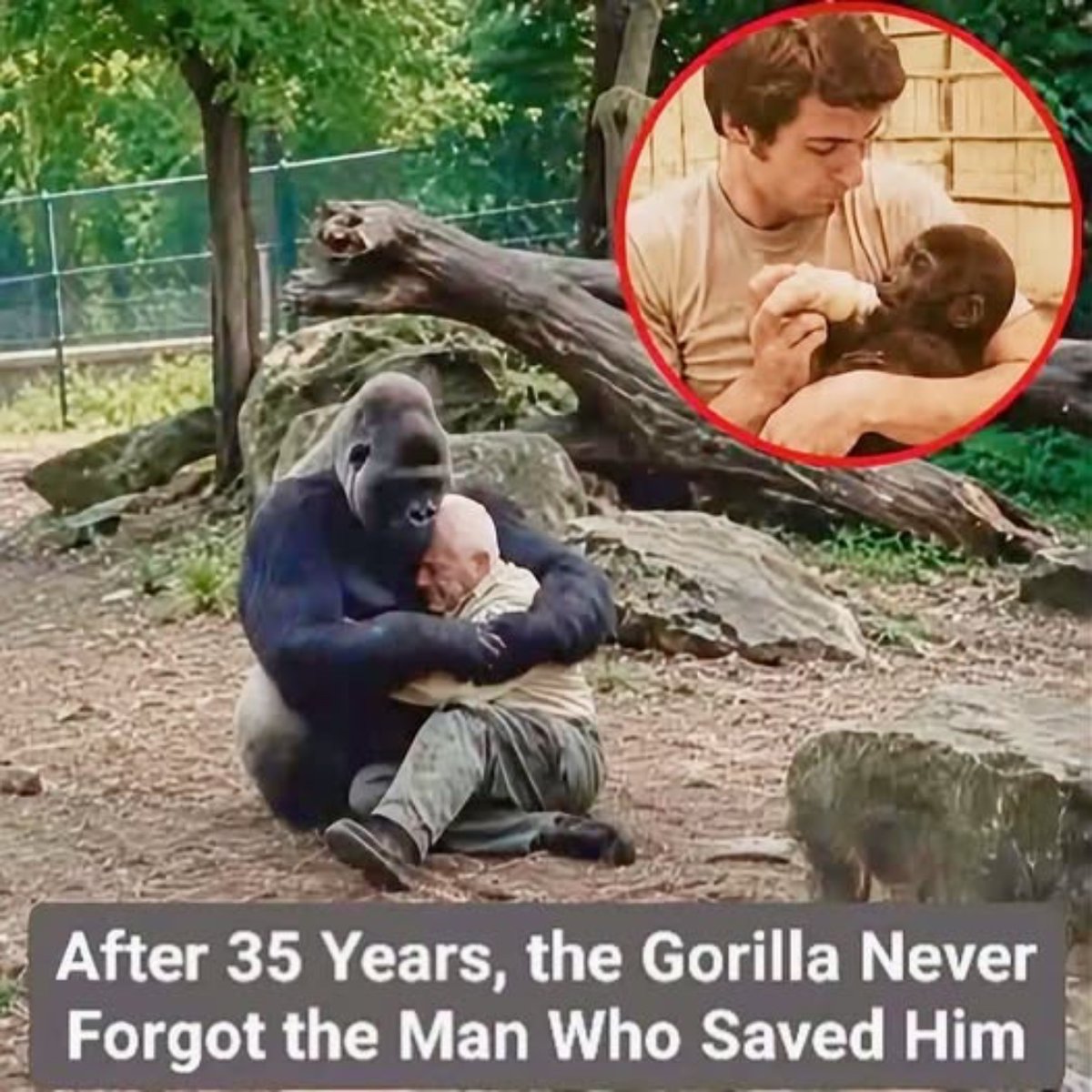
The widely circulated story of “David” and an unnamed Congolese silverback reuniting with a gentle embrace after 35 years reads like a Hollywood script. While it perfectly encapsulates our desire for emotional reciprocity from nature, conservation archives in the Democratic Republic of the Congo and global primate registries contain no official records matching this specific timeline or set of individuals.
Instead, the narrative is an amalgamated folklore, heavily inspired by a few well-documented, real-world relationships that took place under completely different circumstances.
The closest verified parallel to this phenomenon belongs to conservationist Damian Aspinall and a captive-born Western lowland gorilla named Kwibi. Aspinall raised Kwibi at a specialized park in England before releasing him into the protected forests of Gabon in 2005. Five years later, Aspinall traveled down the river to locate the gorilla. The resulting footage showed Kwibi, now a wild alpha, recognizing Aspinall’s voice, embracing him, and refusing to let him leave—a genuine testament to primate memory, but over a span of five years, not thirty-five.
“Gorillas possess exceptional long-term memory and complex social intelligence, but projecting human-like sentimentality onto wild silverbacks can be incredibly dangerous.”
The Cognitive Capacity of the Silverback
While the 35-year sanctuary hug borders on myth, the underlying science of gorilla cognition is undeniably extraordinary. Primatologists have long established that gorillas possess highly sophisticated neurological architectures capable of long-term memory storage.
-
Facial and Vocal Recognition: Studies indicate that great apes can recognize familiar human faces and vocal frequencies years after separation, particularly if those humans were ᴀssociated with intense emotional states, such as maternal care or trauma recovery.
-
Episodic-like Memory: Gorillas demonstrate the capacity to recall specific past events, including the locations of preferred food sources, complex social dynamics within their troop, and individuals who have treated them with either hostility or gentleness.
However, in a true sanctuary or wild environment, an adult silverback weighing upwards of 400 pounds is an apex protector. Their primary biological drive is the defense of their territory and troop. Field biologists warn that expecting a wild or semi-wild silverback to respond to a historic caretaker with submissive affection rather than defensive aggression is a dangerous gamble that ignores the animal’s true nature.
The True Value of Wildlife Protection
The real value of an orphaned gorilla’s journey does not lie in its ability to deliver an emotional payoff or a viral video to a human savior decades later. The true victory of wildlife conservation is entirely silent, measured by an animal’s successful reintegration into its natural environment.
When anti-poaching teams rescue an infant gorilla from the illegal bushmeat or pet trade, the objective is never to forge a lifelong bond with humans. The goal is to act as a temporary bridge—providing medical stabilization, nutrition, and safety—before stepping back entirely.
The footprint left by a wildlife rescuer isn’t meant to be a permanent path the animal follows back to humanity. It is meant to be a launching pad that allows a magnificent silverback to live freely, reproduce, and anchor the survival of an endangered species deep within the safety of the rainforest canopy, entirely independent of the human world.