The Child Born With Unusually Thick Hair Across the Body: Understanding Congenital Generalized Hypertrichosis
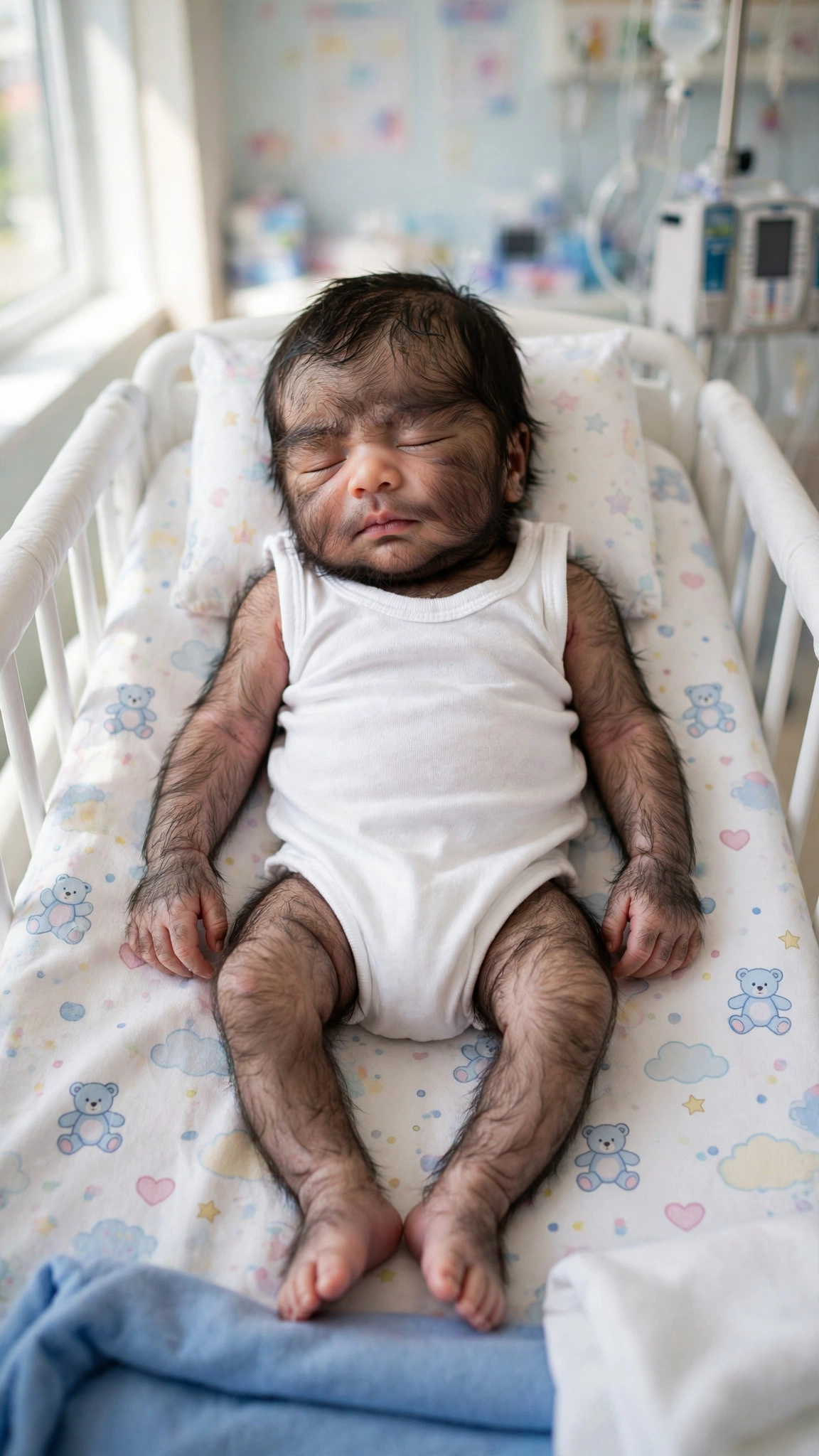
When little Leo was born, his parents immediately noticed that his body had considerably more hair than they expected in a newborn baby.
Unlike most infants, whose bodies may have only a small amount of fine hair, Leo had noticeable hair covering several areas of his body. His shoulders, back, arms, and legs appeared unusually hairy, while parts of his face also showed excessive hair growth.
At first, his parents wondered whether the condition was temporary and whether the hair would gradually disappear as he grew older.
However, as Leo developed, the excessive hair growth remained. The hair became more noticeable in certain areas, creating a physical appearance that differed considerably from that of other children.
Following examinations by medical specialists, doctors identified his condition as congenital generalized hypertrichosis, a rare disorder characterized by excessive hair growth across multiple areas of the body.
What Is Congenital Generalized Hypertrichosis?
Hypertrichosis is a medical term describing excessive hair growth that occurs in areas of the body beyond the normal pattern expected for a person’s age, Sєx, and ethnic background.
The condition can affect both males and females and may appear in localized areas or across much larger portions of the body.
When excessive hair growth is present from birth and affects multiple body regions, it may be classified as congenital generalized hypertrichosis.
Unlike hirsutism, which is typically ᴀssociated with androgen-dependent hair growth in women, hypertrichosis is not necessarily related to increased androgen levels.
The condition is rare, and its clinical presentation varies considerably depending on the underlying cause.
Some individuals develop excessive fine, soft hair, while others experience thicker and more pigmented hair that covers extensive areas of the face and body.
Why Does Congenital Hypertrichosis Develop?
Normal hair growth is regulated by a complex combination of genetic signals, hormones, and the biological activity of hair follicles.
In congenital hypertrichosis, certain developmental or genetic mechanisms may influence the normal regulation of hair growth, resulting in excessive hair production.
Some forms are ᴀssociated with inherited genetic changes, while others occur as part of specific genetic syndromes.
One recognized form is congenital generalized hypertrichosis terminalis, which can involve extensive growth of thick, pigmented hair.
Another form involves excessive growth of fine, soft hair resembling lanugo, the delicate hair normally present during fetal development.
The exact cause depends on the specific subtype. Genetic testing may help identify an underlying genetic change when a hereditary condition is suspected.
Physical Characteristics and Distribution of Hair
The most noticeable feature of congenital generalized hypertrichosis is excessive hair growth across multiple areas of the body.
Depending on the subtype, hair may appear on the face, forehead, shoulders, back, arms, legs, and other areas where hair growth would normally be limited.
In some individuals, the hair is fine, soft, and relatively light in color. In others, it may become longer, thicker, and darker.
The distribution can be relatively uniform or more pronounced in certain regions.
Some forms of congenital hypertrichosis may also be ᴀssociated with additional physical findings. For this reason, doctors need to ᴀssess the entire clinical picture rather than evaluating hair growth alone.
Medical Diagnosis and Specialist Evaluation
For Leo, identifying the underlying cause was an important step in determining the appropriate medical care.
Doctors first examined the distribution, thickness, color, and texture of his hair. They also reviewed his medical history and asked whether other family members had experienced similar characteristics.
A detailed physical examination helped specialists determine whether the excessive hair growth appeared to be an isolated condition or part of a broader genetic disorder.
Depending on the findings, doctors may recommend genetic testing, dermatological evaluation, or additional investigations to identify ᴀssociated medical conditions.
This ᴀssessment is important because different forms of hypertrichosis may require different approaches to monitoring and treatment.
Treatment and Long-Term Management
There is currently no universal treatment that permanently eliminates the underlying cause of congenital hypertrichosis.
Management focuses on the individual child’s symptoms, medical needs, and personal preferences.
Temporary hair removal methods may include shaving, trimming, waxing, or depilatory products. However, some methods can irritate sensitive skin, particularly in young children, so medical guidance is important.
Laser hair removal and other longer-lasting procedures may be considered in selected cases when the child is older and the treatment is appropriate for their skin and hair characteristics.
The effectiveness of these procedures varies, and multiple treatment sessions may be necessary.
Doctors may also recommend regular monitoring if hypertrichosis is ᴀssociated with an underlying genetic syndrome or additional medical findings.
The decision to pursue hair removal should be individualized and should take into account the child’s comfort, safety, and preferences.
The Emotional Impact of Growing Up With a Rare Condition
For Leo’s family, understanding the medical condition was only part of the experience.
As he grew older, his visible physical differences could attract attention and questions from people around him.
Children with noticeable physical differences may sometimes experience unwanted attention, misunderstanding, or social difficulties.
This makes emotional support particularly important.
Leo’s parents wanted him to grow up understanding that his appearance did not determine his value or limit his opportunities.
They hoped he would feel comfortable participating in everyday activities, developing friendships, attending school, and discovering his interests without feeling defined by his condition.
A Future Beyond Physical Appearance
Congenital generalized hypertrichosis can create a distinctive physical appearance and may require ongoing dermatological or genetic evaluation.
However, excessive hair growth alone does not determine a child’s intelligence, personality, or ability to develop meaningful relationships.
Every child with this condition has individual medical and personal needs.
With appropriate specialist guidance, supportive family relationships, and an environment that encourages acceptance, children like Leo can grow up with confidence and the opportunity to enjoy childhood.
His story is a reminder that physical differences should never determine how a child is valued or treated.
Medical Disclaimer: This article is intended for educational purposes only. Congenital hypertrichosis includes several different forms, and diagnosis and treatment should be guided by qualified dermatologists and genetic specialists.