THE CATTLEMAN’S GAMBIT: THE FLAME IN IRONWOOD VALLEY
THE CATTLEMAN’S GAMBIT: THE FLAME IN IRONWOOD VALLEY
(Part 2)
The smell of sweet applewood smoke had soured into the stink of ash and trampled tallow.
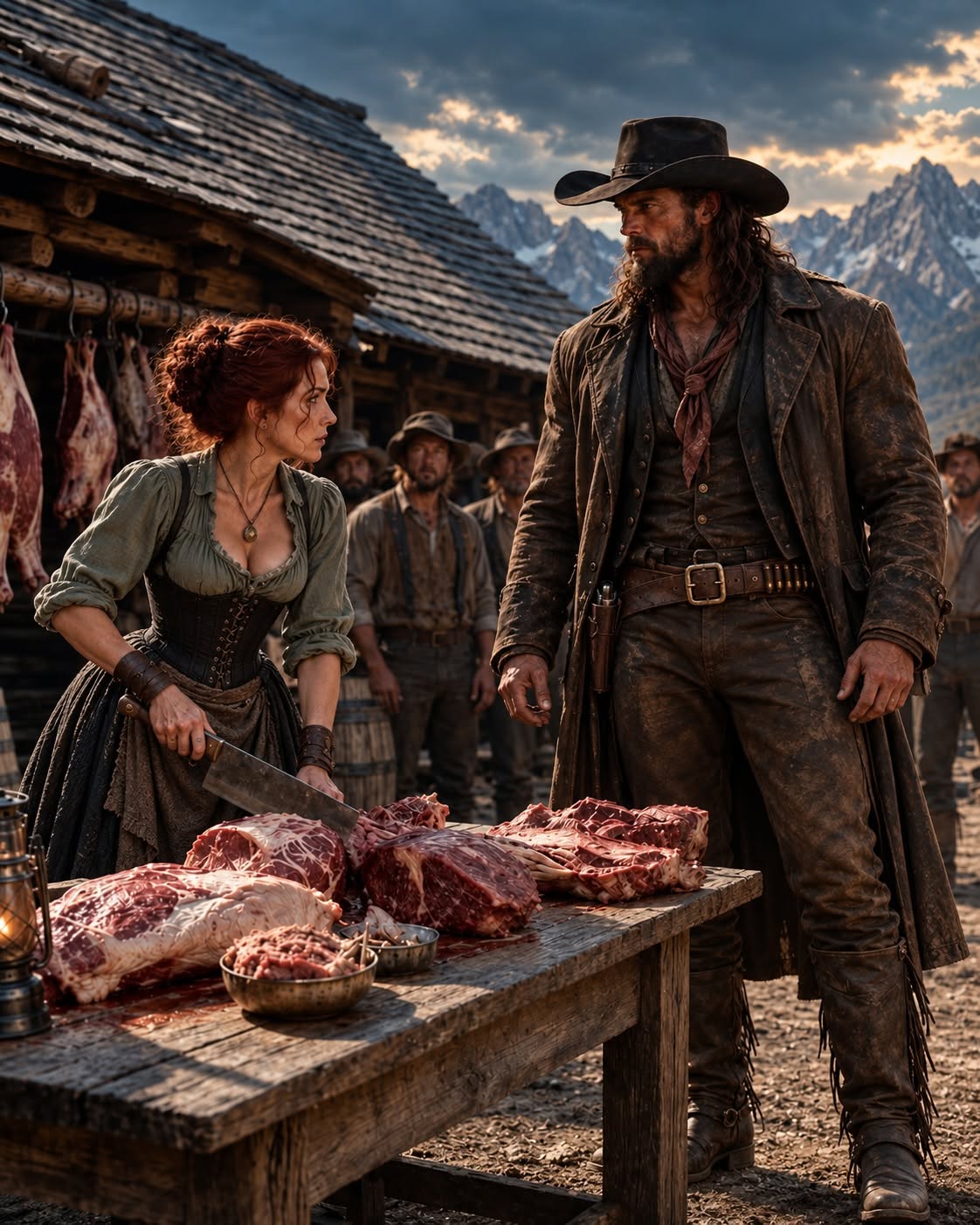
Florence stood motionless in the wreckage of the smokehouse. Beneath her boots lay three hundred pounds of prime flank, salted with her father’s private spice blend, now ground into the dirt and soaked with kerosene.
Daniel’s jaw was set like an iron vise. He bent down, picked up a charred pine stave, and hurled it against the stone foundation. “Twenty head of cattle,” he choked out, his voice thick with fury and despair. “Gone. Ruined. If Fenwick thinks he can ride onto my range, contaminate our provisions, and starve us off—”
“Fenwick didn’t hold the kerosene can, Daniel,” Florence said, her voice cutting through the smoke like a cold blade.
She held up her open hand. Resting on her palm was the silver cufflink, engraved with the ornate script initials C.F.
“He dropped this on purpose,” Florence said, turning the silver piece in the dim light. “Or he handed it to someone as a deposit.”
Daniel frowned, looking out the open doorway toward the yard. “What are you talking about?”
“Charles Fenwick never left the bunkhouse yard during his visit,” Florence explained, her gaze narrowing as she looked past Daniel toward the group of twenty-two cowboys gathered near the water trough. “His boots were spotless when he climbed into that black carriage. The mud around this threshold is two inches deep, mixed with fresh red creek clay from the northern gulch.”
She pointed to the distinct boot impressions stamped into the sawdust floor.
“The man who did this wears double-heeled riding boots with a missing spur rowel on his left foot.”
Daniel went completely rigid.
He didn’t have to look at twenty-two men to know whose spur had broken during the spring roundup. His head snapped toward the far side of the corral, where a lean, sandy-haired drover stood with his thumbs hooked nervously into his gun belt, staring intently at the dirt.
“Jesse,” Daniel muttered under his breath.
“Don’t shout,” Florence warned, laying a firm hand on his forearm. “If you confront him now, he runs to Fenwick, and Fenwick files an immediate sheriff’s injunction claiming we threatened his informants. We need proof of why the bank wants this valley so badly that they’d resort to arson.”
Daniel looked down at her, the bewilderment in his eyes giving way to an intense, searching focus. “You think this isn’t about an unpaid mortgage?”
“A mortgage pays six percent interest, Mr. Whitaker,” Florence replied coolly. “A banker doesn’t travel forty miles on a rough stagecoach and hire men to burn curing meat for six percent.”
She walked back to her heavy trunk in the cookhouse, unbuckled the brᴀss straps, and lifted the false wooden tray at the bottom. Beneath her father’s butcher knives lay a rolled linen surveyor’s map of the Sweetwater rail corridor, stamped by the Department of the Interior.
She spread it flat on the pine table.
“Before I answered your advertisement,” Florence said, “I visited the regional railway freight office in Omaha. The Union Pacific is laying a secondary northern branch to service the copper strikes in the Wind River Range. That line requires an uninterrupted water-level right-of-way.”
Her finger traced a thick red line across the paper. It cut straight through the southern bluffs, following the natural cut of the river.
“It runs through your valley, Daniel,” she said, looking up into his eyes. “Right across your bottom pasture. If you hold the deed when the rail syndicate arrives in September, the statutory easement payout is twenty dollars an acre—over sixty thousand dollars.”
Daniel took a slow, stunned breath. “Sixty thousand…”
“And if the bank forecloses before Thursday week,” Florence finished, “Fenwick and his investment partners purchase the entire three thousand acres at public auction for pennies on the dollar, collecting the railroad’s treasury drafts for themselves.”
The silence in the cookhouse was absolute, broken only by the steady crackle of the stove.
Walter Briggs stepped into the doorway, taking off his battered hat, his weathered face dark with grim resolve. “Mrs. Whitaker… the boys are outside. They saw the smokehouse. If you give the word, we’ll drag Jesse into the horse barn and find out how much Fenwick paid him.”
“No,” Florence said, rolling up the map and slipping it into her leather portfolio. “We don’t need a rope, Walter. We need oak wood, curing salt, and every wagon on this ranch hitched before sunset.”
Daniel stepped closer. “The shipment for the rail camps is due at the freight depot in seventy-two hours. We just lost three hundred pounds of cured beef. How do we fulfill a commercial contract with an empty smokehouse?”
Florence picked up her sharpest boning knife and smiled—a fierce, radiant, unbreakable smile.
“We don’t use the smokehouse, Daniel. We use the canyon.”
By midnight, Ironwood Valley was transformed into an industrial camp under the stars.
Two miles north of the homestead, where the limestone cliffs narrowed into a natural stone flume, Florence directed the operations. The cavernous overhang trapped the warm air rising from the thermal springs beneath the ridge, creating a dry, constant draft that mimicked the conditions of an enormous natural dehydrator.
Teams of cowboys worked in four-hour shifts under lantern light. Walter supervised the felling of aged green hickory and sweet chokecherry branches, keeping smoldering trenches burning along the base of the stone bluffs. Daniel and his most experienced hands dressed fifteen steers, working with rhythmic, ᴀssembly-line speed that Florence orchestrated down to the second.
Using wooden racks constructed from clean pine poles, thousands of strips of beef were brined in her father’s cider-vinegar and spiced salt solution, then hung high along the stone flume where the warm, fragrant smoke cured the meat at three times the speed of a standard wooden shed.
Nobody slept.
Florence moved from rack to rack, testing the texture, adjusting the airflow, and serving thick mugs of strong black coffee and H๏τ skillet bread to keep the men on their feet.
By Wednesday morning, forty wooden crates stood stacked in the bed of three heavy freight wagons, each stencil-branded with a neat black insignia:
WHITAKER RANCH — SWEETWATER CURED BEEF.
Four thousand pounds of preserved provisions, cured, inspected, and packed.
As the teamsters тιԍнтened the canvas covers over the loads, a solitary figure slipped away from the corrals, mounting a bay gelding and galloping hard toward the southern pᴀss.
Jesse.
Walter reached for his rifle, but Daniel caught his shoulder. “Let him ride, Walter. He’s carrying the news to town. And that’s exactly where we want Fenwick waiting.”
The Sweetwater rail siding was a bustling hive of teamsters, track layers, and armed depot guards when the three Whitaker wagons rolled into the yard on Thursday morning.
Standing on the wooden pᴀssenger platform, flanked by four armed county deputies and a county magistrate, was Charles Fenwick. His leather briefcase was open on a baggage cart, a stamped writ of execution resting beside his gold pocket watch.
“Right on time, Mr. Whitaker!” Fenwick called out with a smug, oily grin as Daniel pulled the lead team to a halt. “Though I’m afraid you’ve wasted your horses’ wind. The clock on the depot tower just struck ten. Your thirty-day grace period expired forty-eight hours ago under the accelerated clause.”
Fenwick waved the legal document in the morning sun.
“The sheriff has already signed the warrant. As of this moment, all ᴀssets, livestock, and real property of the Whitaker estate are remanded to the Northern Plains Banking Company.”
From the seat of the lead wagon, Florence climbed down. Her calico dress was dusted with wood ash, her hands were calloused from seventy-two hours of unyielding labor, but she walked across the platform planks with the bearing of an empress.
“You should check the territorial banking statutes before you recite legal poetry, Mr. Fenwick,” Florence said, stepping between the banker and the magistrate.
“Madam,” Fenwick sneered, “an uneducated woman’s opinion holds no weight in a court of—”
“Under Section 14 of the Wyoming Territorial Commercial Code,” a booming voice interrupted from the doorway of the station master’s telegraph office.
A tall, broad-shouldered man with iron-gray hair and an official gold seal pinned to his lapel strode onto the platform, followed by two armed United States marshals.
It was Marcus Vance, Chief Purchasing Agent for the Union Pacific Railroad.
Fenwick’s face went completely bloodless. “Mr. Vance… what is the meaning of this?”
“The meaning, Fenwick,” Vance said, slapping a heavy ledger down on the baggage cart, “is that the Union Pacific entered into a binding supply covenant with Mrs. Florence Whitaker three weeks ago. Under federal rail transit priority statutes, any commercial lien on an agricultural producer fulfilling an active federal logistics contract is suspended until the delivery drafts are cleared.”
Vance turned toward the three freight wagons, waving his clipboard. “Unload the crates!”
The cowboys hauled down the first box, prying the lid open with a crowbar. Inside lay rows of dark, fragrant, perfectly cured smoked beef, wrapped in wax-sealed brown parchment.
Vance took a slice, chewed it slowly, and looked at Florence with an admiring grin. “Finest smoke in the territory, Mrs. Whitaker. Exactly as your father used to cure it back in Council Bluffs.”
He turned back to the ledger and signed his name with a heavy flourish. He pulled a brᴀss-clipped stack of United States Treasury vouchers from his leather portfolio and handed them directly to the magistrate.
“Eighteen hundred dollars in federal gold drafts,” Vance announced, his voice echoing across the crowded depot platform. “Payable to the Whitaker Ranch account. That covers your principal loan balance in full, Fenwick, with three hundred dollars left over for interest and recording fees.”
The magistrate reviewed the vouchers, stamped the court ledger with a heavy brᴀss seal, and handed the canceled mortgage deed directly to Daniel.
“Your debt is discharged, Mr. Whitaker,” the magistrate declared. “The ranch is free and clear.”
Fenwick stepped backward, his mouth opening and closing in soundless panic. “This… this is an irregular transaction! The board will dispute—”
“The board won’t be disputing anything,” Marshal Hayes said, stepping forward and clamping a set of heavy steel irons around Fenwick’s wrists with a sharp, sickening click.
“Charles Fenwick, you are under arrest for federal mail fraud, interstate railway extortion, and conspiracy to commit arson.”
Fenwick gasped, thrashing in the irons. “Arson? You have no evidence!”
Florence stepped forward, reached into her reticule, and produced two items: the engraved silver cufflink and a signed, handwritten confession on bank stationery.
“Your hired man, Jesse, was intercepted at the river ford an hour ago by the Marshal’s scouts,” Florence said softly. “He traded your signed payout voucher and your bank receipts for immunity from the territorial gallows. You should have paid him in gold instead of paper, Mr. Fenwick.”
As the marshals dragged the pale, stammering banker down the depot steps, the twenty-two Whitaker cowboys let out a deafening cheer that shook the timber siding of the freight warehouse.
The late afternoon sun was dipping behind the Wind River peaks, painting the Wyoming sky in brilliant ribbons of gold, violet, and crimson as Daniel and Florence rode their buckboard back into Ironwood Valley.
The air was clean, smelling of sweet sagebrush, pine needles, and the rich, lingering smoke from the bluffs.
Daniel pulled the horses to a stop on the rise overlooking the homestead. Below them, the three thousand cattle grazed peacefully in the lush green bottomland—land that now belonged to them, unencumbered and untouchable.
He turned on the wooden bench, looking at the woman beside him.
The smudge of soot was still on her cheek, but to Daniel, she was the most magnificent sight on God’s green earth.
“Florence,” Daniel said, his voice dropping into a rough, tender rasp.
She turned to him, raising an eyebrow. “Yes, Mr. Whitaker?”
“When you stepped off that stagecoach on Monday morning,” he said, reaching out to cover her small, work-hardened hand with his own, “you told me I didn’t need a wife. You said I needed a miracle.”
A soft, knowing smile touched her lips. “I remember.”
Daniel leaned closer, his hazel eyes clear and steady, his fingers gently тιԍнтening around hers.
“I was wrong about the smokehouse, Florence. And I was wrong about what this ranch could be.”
He looked toward the white ranch house, where the smoke was rising peacefully from the kitchen chimney, and back to her face.
“I don’t need a cook,” Daniel whispered, his heart open and completely unguarded. “And I don’t need a business partner. I want a wife, Florence. If you’ll have a stubborn cowboy who’s finally learned how to listen.”
Florence looked at the vast, beautiful land stretching out before them, then met his gaze with an affection that had grown deeper than thirty days of hardship.
She smiled through a sudden shimmer of tears and laid her other hand gently against his cheek.
“Well, Mr. Whitaker,” she whispered, “it’s about time you asked.”