Reconstructed Homo erectus Face From Ethiopia Challenges Linear Human Evolution
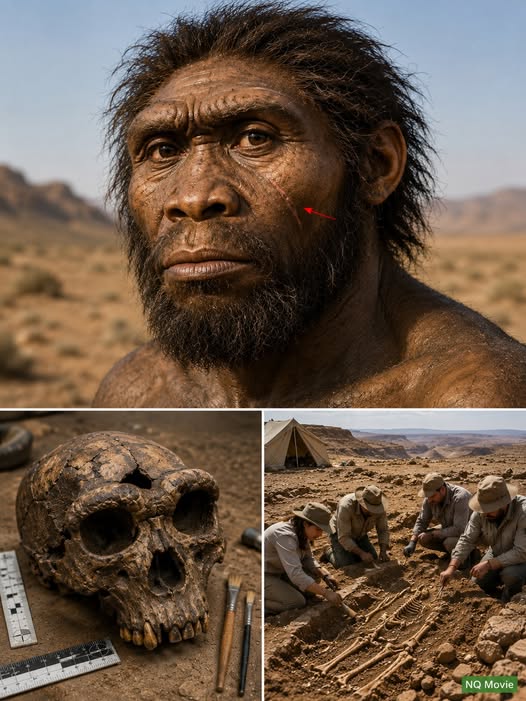
A newly reconstructed facial model of a 1.5–1.6 million-year-old Homo erectus specimen from Ethiopia is offering researchers a refreshed perspective on the appearance and variability of one of humanity’s earliest widespread ancestors.
The reconstruction reveals a combination of traits often described as both primitive and more modern in appearance, including robust cranial features alongside facial characteristics that appear closer to later human forms. This mosaic of traits is contributing to ongoing discussions about how early human evolution unfolded across different populations and regions.
Traditionally, Homo erectus has been viewed as a key transitional species in human evolution, representing an important stage between earlier hominins and later members of the genus Homo. However, new fossil reconstructions and comparative studies increasingly suggest that evolutionary changes did not occur uniformly or in a single linear progression.
Instead, researchers argue that different populations of early humans may have developed distinct combinations of anatomical features at different times. This pattern, often described as “mosaic evolution,” implies that traits such as skull shape, facial structure, and brain size did not evolve simultaneously or in a predictable sequence.
The Ethiopian reconstruction contributes to this perspective by highlighting the variability within Homo erectus populations. Rather than representing a single uniform species appearance, the evidence suggests that there may have been regional diversity influenced by environmental pressures, migration, and genetic exchange between groups.
Paleoanthropologists emphasize that facial reconstructions are based on a combination of fossil fragments, comparative anatomy, and statistical modeling. While they provide valuable visual insights, they also involve a degree of interpretation and are subject to revision as new fossils are discovered.
The broader implication of such findings is not that human evolution is being overturned, but rather that it is becoming more complex and nuanced than earlier simplified models suggested. Modern research increasingly supports a branching evolutionary history involving multiple overlapping populations rather than a straight line from primitive to modern humans.
As additional fossils from Ethiopia and other parts of Africa continue to be analyzed, scientists expect further refinements to the understanding of Homo erectus and its place in human evolution.