PART 6 — THE BLACKSMITH’S PROMISE THAT SAVED DUST HOLLOW
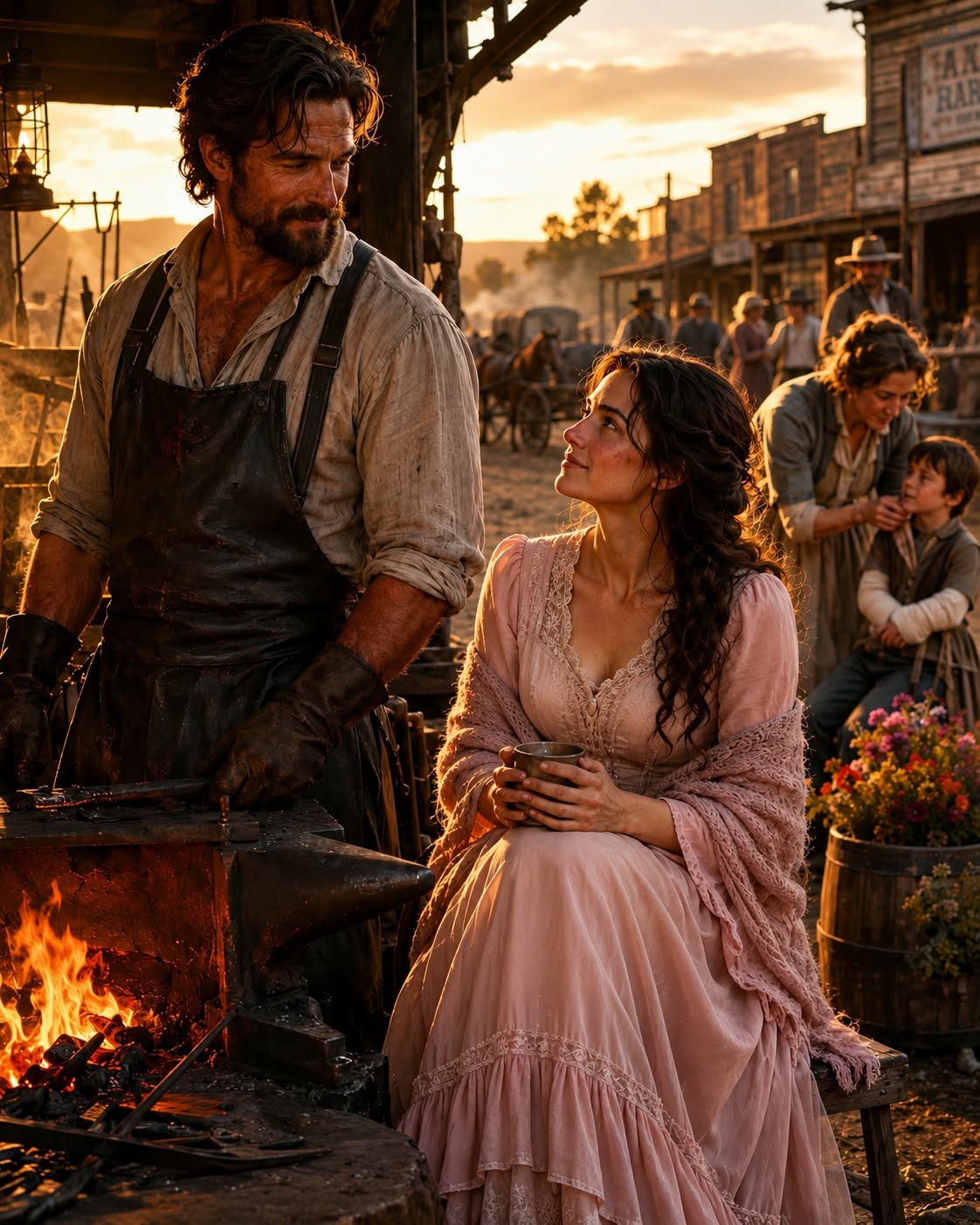
PART 6 — THE BLACKSMITH’S PROMISE THAT SAVED DUST HOLLOW
The telegram lay open in Mayor Pike’s hands.
For several seconds, he seemed unable to read the words.
Then he lowered it.
“It’s confirmed,” he whispered.
Nora stepped forward.
“What is?”
“The northern water source is contaminated.”
The mayor looked toward his daughter.
Clara stood halfway down the staircase, holding the railing.
“Father?”
Pike closed his eyes.
“The report says the mining company has been dumping waste near the underground water source for years.”
Nora remained silent.
She had suspected something was wrong, but seeing the official findings made the situation painfully real.
“Clara needs a medical ᴀssessment,” she said. “And everyone who may have been exposed should receive proper medical advice. We must make sure they have access to safe drinking water.”
Pike looked at her.
“Can you help her?”
“I can help arrange the care she needs. But she must be examined by Dr. Carter.”
The mayor nodded.
For the first time since Nora had arrived in Dust Hollow, he did not argue.
Within an hour, Dr. Carter was at the Pike residence.
He examined Clara and arranged for further testing.
Meanwhile, Callum and several townspeople organized the delivery of safe water to every household.
The church became a temporary distribution center.
Abigail prepared food for families who had been unable to leave their homes.
Silas gathered the original council records.
And Nora worked alongside Dr. Carter to make sure residents received appropriate medical attention.
The news spread quickly.
By sunset, nearly everyone in Dust Hollow knew the northern water source was unsafe.
Some were angry.
Others were frightened.
But many were simply relieved that someone had finally listened.
Then the mayor made an announcement.
He called an emergency council meeting for the following morning.
“I intend to tell the town everything,” he told Nora.
She looked at him carefully.
“Everything?”
Pike nodded.
“I knew about the company’s payments. I knew Eliza had discovered the problem. And I knew the water was dangerous.”
Callum stood beside the forge entrance.
“Then why did you let people keep drinking it?”
Pike looked down.
“Because I was afraid of losing the mining company’s money. The payments kept the town council operating. They funded the road repairs and several public buildings.”
“And the families?” Callum asked.
Pike had no answer.
“You sacrificed their health to protect your position.”
The mayor closed his eyes.
“Yes.”
For a long moment, nobody spoke.
Then Nora asked:
“What happened to Eliza?”
Pike looked toward the old wooden plaque hanging above the forge.
“She came to me with the evidence. She begged me to close the well and report the company.”
“And you refused.”
“I told her she was spreading rumors. I accused her of stealing the medical fund.”
Callum’s face тιԍнтened.
“Why?”
“Because I knew if people believed her, the company would withdraw its money. I thought I could keep the problem hidden until the mining operation ended.”
“And Eliza?”
Pike’s voice cracked.
“She died before I could make it right.”
 Callum turned away.
For six years, he had carried the shame of a false accusation against the woman he loved.
Now the man responsible stood before him admitting everything.
But the mayor’s confession did not erase the past.
It did not return the years Callum had spent grieving.
And it did not undo the harm suffered by the families.
“An apology won’t bring her back,” Callum said.
“I know.”
“But the truth will.”
The next morning, the town hall was packed.
Families filled every bench.
The mining representatives arrived with lawyers.
Dr. Carter brought the independent report.
Silas carried the original account book.
And Nora stood beside Callum.
Mayor Pike entered last.
He looked older than he had the day before.
When he reached the front of the room, he placed both hands on the wooden table.
“I have called you here because I owe every person in Dust Hollow the truth.”
The room became silent.
He admitted that the mining company had paid him to keep the northern water source available despite serious concerns about its safety.
He admitted that Eliza Wyatt had warned him years earlier.
He admitted that he had accused her of stealing money to destroy her credibility.
And he admitted that he had helped conceal the original report written by Thomas Bell.
A woman near the front began to cry.
“My grandson has been sick for months,” she said.
Pike lowered his head.
“I am sorry.”
Another man stood.
“My family lost our farm because you told us the water was safe.”
The mayor did not defend himself.
He could not.
Then Dr. Carter presented the independent findings.
He explained that the contamination required urgent attention and that the town needed a properly supervised cleanup and a reliable safe-water supply.
The mining company attempted to deny responsibility.
But Silas produced the original account book.
Whitmore provided his signed statement.
And Nora placed Eliza’s notebooks on the table.
Together, the records showed a pattern of payments, concealed reports, and ignored warnings.
The territorial authorities ordered a full investigation.
The mining company was required to suspend operations while the source of contamination was addressed.
Mayor Pike was removed from his council duties pending further proceedings.
And the families affected by the scandal were promised ᴀssistance and a formal review of their claims.
But the most emotional moment came when Abigail Turner stepped forward.
She held Ruth’s hand.
“This little girl lost her father because he tried to protect this town,” she said. “And Eliza Wyatt spent her final months protecting her when nobody else would.”
Ruth looked around the room.
Then she approached the table.
She placed a small white flower beside Eliza’s notebook.
“Miss Eliza said I should always remember that people deserve help even when nobody believes them.”
Nobody spoke.
Callum looked at the flower.
His eyes filled.
For the first time, he understood the final meaning of his wife’s sacrifice.
She had not spent her last days trying to prove herself right.
She had been trying to make sure a little girl had a future.
And Nora had helped finish what Eliza started.
The weeks that followed changed Dust Hollow.
The northern well remained closed while the necessary work was carried out.
A safe-water system was organized.
Families received medical ᴀssessments.
The town established a public health fund with transparent accounts and independent oversight.
Dr. Carter agreed to visit regularly.
And Nora was offered a permanent position as the town’s nurse.
But she hesitated.
One evening, she stood inside the forge, watching Callum repair a wagon wheel.
“What’s troubling you?” he asked.
Nora looked around the room.
The same room where she had arrived months earlier, soaked by rain and uncertain where she would sleep.
“I’m wondering whether I should stay.”
Callum stopped working.
“Why wouldn’t you?”
“I’ve spent years moving from one town to another. Sometimes I think staying somewhere means eventually giving someone the chance to disappoint you.”
He placed the hammer on the workbench.
“And leaving means nobody gets the chance to know you.”
She looked at him.
He continued.
“I offered you a room because I knew what it felt like to be alone. I never expected you to become the heart of this town.”
Nora smiled faintly.
“I’m not the heart of anything.”
“Perhaps not. But you’ve reminded people that they can look after one another.”
She looked toward the old plaque.
ELIZA WYATT — MIDWIFE OF DUST HOLLOW.
“Your wife would have been proud of what happened.”
Callum nodded.
“I think she would have liked you.”
Nora lowered her eyes.
“I wish I could have met her.”
“Sometimes I think I have.”
He reached into a drawer and removed a small wooden box.
Inside lay a silver pendant.
It had belonged to Eliza.
“She wanted this given to someone who would continue helping people when she no longer could.”
Nora stared at it.
“I couldn’t take that.”
“You wouldn’t be taking it from her. You’d be carrying what she believed in.”
Nora gently accepted the pendant.
For several moments, neither spoke.
Then Callum looked at her.
“Nora, I need to ask you something.”
She waited.
“I don’t want you to stay because you owe me anything. You don’t owe me for the room, the food, or the work you’ve done.”
“I know.”
“And I don’t want you to feel that you have to become someone else to belong here.”
Nora looked into his eyes.
“What are you asking?”
He took a breath.
“Would you consider making this house your home? Not just for a few nights. For as long as you want.”
Nora looked toward the window.
Beyond it, the town was beginning to recover.
Children were playing near the church.
The water wagons were returning from the spring.
And the little girl named Ruth was walking beside Abigail, carrying a basket of flowers.
Nora thought about all the places she had traveled.
All the doors that had been closed.
All the nights she had wondered whether she would ever find somewhere she was wanted.
Then she looked back at Callum.
“Yes,” she said quietly.
His expression softened.
“But I have one condition,” she added.
“What’s that?”
“I want to help build a proper medical room. Somewhere families can come without feeling ashamed or frightened.”
Callum smiled.
“Then I’ll build it.”
“And I want the old plaque to stay above the forge.”
“It will.”
“And I want Eliza’s name remembered.”
Callum looked toward the plaque.
“Every year.”
The following spring, Dust Hollow celebrated the opening of a small community medical room beside the blacksmith’s workshop.
It was simple but bright.
There were clean beds, shelves for medical supplies, a writing desk, and a large window overlooking the street.
Above the entrance hung a wooden sign.
THE ELIZA WYATT COMMUNITY CARE ROOM
Beneath it, in smaller letters, were the words:
No one turned away because they are poor, alone, or afraid.
Nora stood beside the doorway as the first families arrived.
Callum watched from the forge.
Ruth approached him carrying a small bunch of wildflowers.
“Mr. Wyatt?”
He looked down.
“Yes, sweetheart?”
“Miss Nora says you helped save the town.”
Callum shook his head.
“She helped save it.”
“But you gave her a place to stay.”
He glanced toward Nora.
“Sometimes that’s where saving something begins.”
Ruth thought about that.
Then she handed him the flowers.
“Can you put these beside Eliza’s plaque?”
Callum accepted them.
“I’d be honored.”
That evening, after the last patient had gone home, Nora found Callum standing beside the fireplace.
The house was warm.
The rain had returned, tapping softly against the windows.
It was the same kind of evening when she had first arrived in Dust Hollow.
Only now, there was no trunk sitting beneath an abandoned roof.
No cold street waiting outside.
And no fear of being turned away.
Callum looked at her.
“Do you remember what I said that first night?”
Nora smiled.
“You offered me a dry floor and a fire.”
He nodded.
“And I told you to sleep in the room while I stayed by the forge.”
“You also said there was only one bed.”
For the first time, Callum laughed openly.
“I remember.”
Nora touched the silver pendant at her neck.
“You gave me shelter for one night, Callum.”
He looked at her.
“And you gave this town a reason to hope again.”
She stepped closer.
“Perhaps we both found something we weren’t looking for.”
Outside, the rain continued falling.
But this time, the sound did not feel lonely.
It sounded like the beginning of another spring.
And in the small town of Dust Hollow, people would remember two names for generations.
Eliza Wyatt, the woman who tried to save them when nobody believed her.
And Nora Reed, the stranger who arrived with a black medical bag and refused to leave when the town needed her most.
As for Callum Wyatt, the lonely blacksmith who had once asked a weary woman to stay beside his fire, he finally understood something his wife had tried to teach him years earlier.
A home wasn’t built only with timber, stone, and iron.
It was built when someone opened a door.
When someone listened.
And when someone decided that another person’s suffering mattered.
THE END.
He offered her shelter for one stormy night. She helped an entire town find its way back to the light.