PART 5 — WHEN THE BLIZZARD CAME, EVERYONE KNOCKED ON THE WIDOW’S DOOR
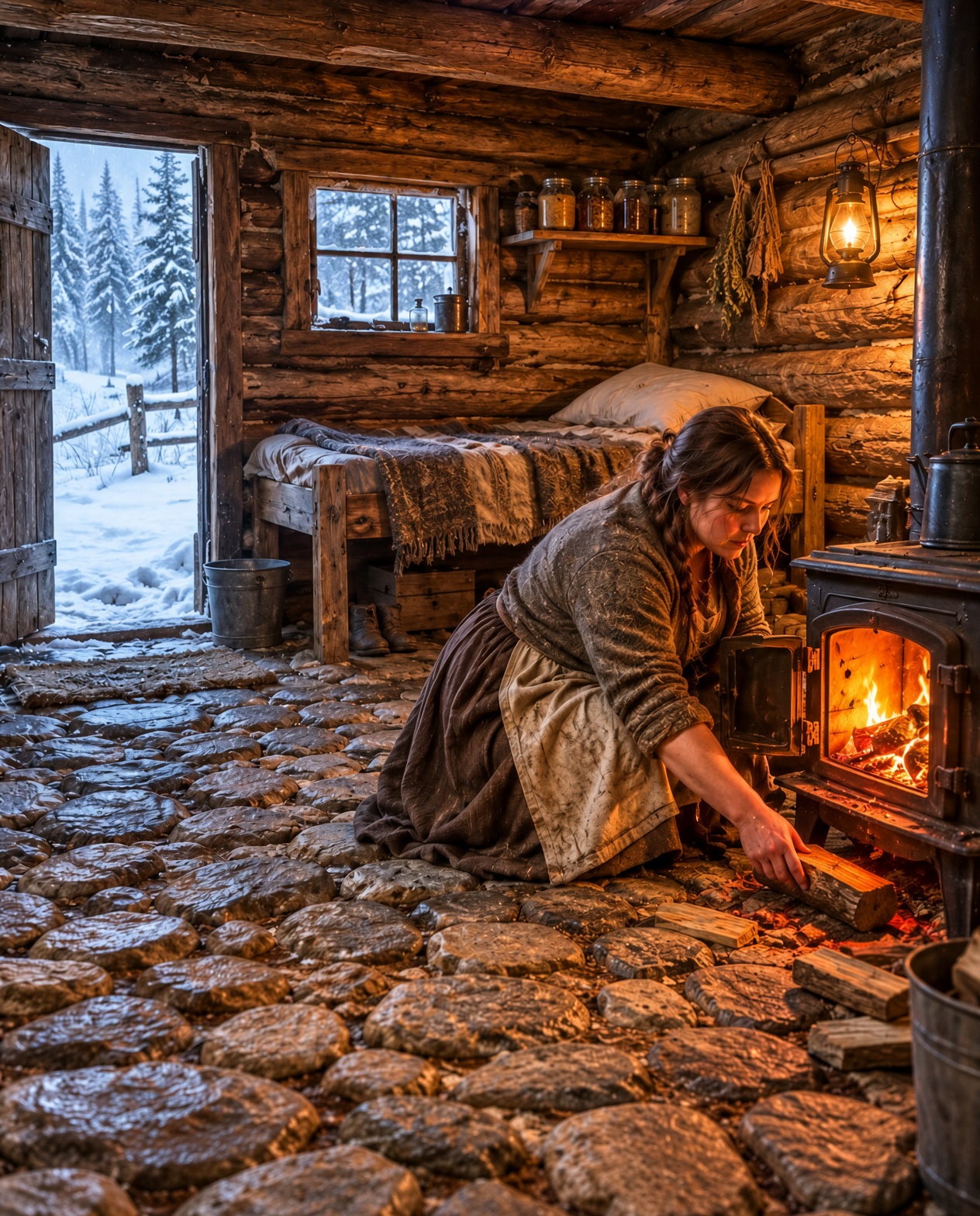
PART 5 — WHEN THE BLIZZARD CAME, EVERYONE KNOCKED ON THE WIDOW’S DOOR
Three days after Jedediah Croft’s visit, the weather changed.
At first, it was only a strange stillness.
The birds disappeared from the trees. The cattle gathered close together. Even the river seemed quieter beneath its crust of ice.
Then the northern wind arrived.
It came down from the mountains with such force that shutters rattled, fences disappeared, and snow covered the valley road within hours.
By evening, Reverend Abernathy had issued a warning.
The worst storm in twenty years was approaching.
Families hurried to gather firewood.
Farmers brought their livestock into barns.
Children were pulled away from windows as the wind began shaking the houses.
Jedediah Croft worked through the afternoon preparing his own cabin.
He had already started adapting his floor using Elspeth’s principles, but the work was incomplete.
He had managed to prepare the foundation and bring in the stones.
The rest would have to wait.
His wife, Margaret, watched him stack the remaining firewood.
“Do you think we’ll be warm enough?”
Jedediah looked toward the western window.
“I hope so.”
It was the first time in forty years that Margaret had heard uncertainty in her husband’s voice about a house he had built.
Meanwhile, Elspeth was preparing for the storm differently.
She checked the drainage channels beneath her floor.
She inspected the stove.
She covered the growing supplies and moved Sarah’s cradle away from the entrance.
Then she placed several additional logs beside the stove.
She had learned that storing warmth required preparation.
The stones could release heat slowly, but they could not create warmth from nothing.
The cabin still needed insulation, a properly managed fire, and protection from the bitter wind.
That evening, she heated the stone mᴀss carefully.
Then she closed the stove’s air controls as recommended for safe overnight operation and settled beside Sarah.
Outside, the storm swallowed Sweetwater Valley.
At midnight, the temperature fell to twenty-eight degrees below zero.
By two in the morning, it had reached thirty-four below.
Snow piled against doors.
The wind found every weakness in the buildings.
At the Colby ranch, a section of the roof began leaking cold air.
At Reverend Abernathy’s home, the family gathered in one room beneath every blanket they owned.
And at Jedediah’s cabin, the carpenter discovered that his unfinished improvements were not enough.
The floor was still drawing warmth away from the room.
His wife wrapped a shawl around her shoulders.
“Jedediah?”
He looked at the thermometer.
Forty-two degrees.
He fed another log into the stove.
But the firewood was disappearing faster than he could afford.
He thought of Elspeth.
Then he remembered his promise to return with measurements.
He had intended to visit her after completing his own floor.
Now he realized he should have listened sooner.
At sunrise, the storm became worse.
The road disappeared entirely.
Several families had exhausted their ordinary supplies, and the trading post was inaccessible.
By late morning, Martha Croft arrived at Elspeth’s cabin.
She was carrying a basket covered in a wool cloth.
When Elspeth opened the door, Martha nearly collapsed with relief.
“You’re warm.”
Elspeth stepped aside.
“Come inside.”
Martha entered and stared at the stone floor.
“I didn’t believe Jedediah when he told me.”
Elspeth helped her remove her wet shawl.
“How is your family?”
“Cold. Very cold.”
Martha hesitated.
“Could you tell us how you did it?”
Elspeth looked at her.
For months, Martha had been one of the people who questioned her ability to care for Sarah.
She had even warned that the child might be better off elsewhere.
Yet now she stood at the door asking for help.
Elspeth could have reminded her of every cruel word.
Instead, she asked:
“Have you eaten?”
Martha lowered her eyes.
“Not since yesterday.”
Elspeth placed a bowl of vegetable soup on the table and cut a piece of bread.
Martha began crying.
“I’m sorry.”
Elspeth sat opposite her.
“For what?”
“For believing people who said you weren’t capable of raising your daughter. For thinking your grief made you foolish. For not standing beside you when you needed someone.”
Elspeth looked toward Sarah, who was sleeping peacefully.
“I was frightened too, Martha.”
“I know.”
“But I couldn’t let fear make every decision for me.”
Martha wiped her eyes.
“Will you help us?”
Elspeth nodded.
“Yes. But first, we’ll make sure everyone is safe.”
By afternoon, the first visitors began arriving.
Jedediah came with Margaret.
Then Reverend Abernathy arrived with his wife and two children.
A young rancher named Daniel Colby followed, bringing his elderly mother.
Some came because their houses were unbearably cold.
Others came because they had heard that Elspeth’s cabin remained warm even when its stove was no longer burning.
The little house soon became a gathering place.
Elspeth made soup.
Margaret helped prepare bread.
Martha organized blankets.
The children sat near the growing beds, fascinated by the green plants thriving beneath the winter sky that existed only in their imagination.
One little boy pointed at a row of lettuce.
“How can that grow when everything outside is frozen?”
Maeve, the daughter of a neighboring farmer, answered from the doorway.
“Because someone remembered that spring doesn’t have to begin outside.”
The adults fell silent.
For the first time, they began seeing the cabin as more than an unusual experiment.
It was a lesson.
A lesson about preparation.
About patience.
And about the value of knowledge that might come from someone they had underestimated.
That evening, Jedediah gathered the adults around the table.
“I’ve spent forty years building houses,” he announced. “And I owe this young woman an apology.”
Elspeth looked uncomfortable.
“Mr. Croft…”
“No. Let me finish.”
He turned toward the others.
“I told you her floor would ruin the cabin. I said the stones would trap dampness and destroy the timber. I spoke without understanding what she had actually built.”
He placed his notebook on the table.
“I have examined her construction. The drainage, the insulation, the arrangement of the stone mᴀss. It is careful work. It deserves to be studied.”
Silas Black, who had arrived with the last group, scoffed.
“Are we all supposed to become stone collectors now?”
Jedediah looked at him.
“No. We’re supposed to stop confusing our own ignorance with somebody else’s foolishness.”
Nobody laughed.
Silas looked around the room.
Then he noticed something that made him uncomfortable.
Elspeth had placed an extra blanket over his chair.
She had prepared food for him too.
Even after everything he had said about her, she had made certain he would not go hungry.
He sat down without another word.
But the storm had not finished testing the valley.
Near midnight, a tremendous gust struck the western side of Elspeth’s cabin.
A section of the outer porch covering shifted.
The wind began forcing snow through a narrow gap near the entrance.
Jedediah immediately stood.
“That needs attention.”
Elspeth took a lantern.
Together, they inspected the damaged area.
The stone floor remained warm, but the cabin’s entrance needed additional protection.
Jedediah suggested a temporary wooden windbreak.
Elspeth agreed.
The men worked carefully, using spare boards and heavy canvas to reduce the drafts.
By dawn, the entrance was secure again.
Inside, the thermometer still showed sixty-two degrees.
Jedediah looked at the reading.
Then he looked at the stove.
It had been several hours since anyone had added wood.
He slowly removed his hat.
“I’ve built houses all my life,” he said quietly. “But I’ve never seen a floor do what yours does.”
Elspeth looked down at the stones.
“My father taught me something simple. The world gives us materials. What matters is learning how to use them.”
Jedediah nodded.
“Your father must have been a wise man.”
“He was.”
The storm lasted four days.
During those four days, Elspeth’s cabin became the safest gathering place in the valley.
The stone floor helped maintain a more stable temperature, and the cabin’s careful insulation reduced the amount of firewood needed.
But the most remarkable part was not the temperature.
It was what happened between the people inside.
Silas Black finally admitted that his own chimney had become unsafe.
Reverend Abernathy apologized for questioning Elspeth’s judgment.
Martha volunteered to help care for Sarah whenever Elspeth needed to work.
And Jedediah began drawing plans for several improved cabins using lessons from her design.
On the fourth morning, the wind finally weakened.
People stepped outside and looked across the transformed valley.
Everything was white.
Fences had vanished.
Trees bent beneath enormous snowbanks.
But the families who had gathered in Elspeth’s cabin had made it through.
As they prepared to leave, Margaret Croft took Elspeth’s hands.
“You saved us.”
Elspeth shook her head.
“We helped each other.”
Margaret smiled.
“Perhaps that’s what a home is supposed to do.”
But as the last visitors departed, Jedediah noticed something near the northern wall.
A small patch of moisture had appeared where the stone floor met the wooden baseboard.
He crouched.
His expression changed.
“Elspeth?”
She hurried over.
“What is it?”
He pointed toward the damp patch.
“This wasn’t here yesterday.”
Elspeth knelt beside him.
The drainage channel was still clear.
But the moisture appeared to be coming from somewhere beyond the foundation.
Jedediah touched the wall.
Then he looked at her with sudden concern.
“Your floor is working beautifully, girl. But I think the mountain itself is trying to tell us something.”
And when Elspeth followed the dampness to its source, she discovered a thin line of water running beneath the northern stones.
It was not ordinary condensation.
It was coming from a place nobody had examined.
A place that might explain why her cabin had stayed so unusually warm.
And it would lead to the discovery that changed the future of Sweetwater Valley.