PART 4 — THE SECRET HIS DAUGHTERS HAD BEEN HIDING
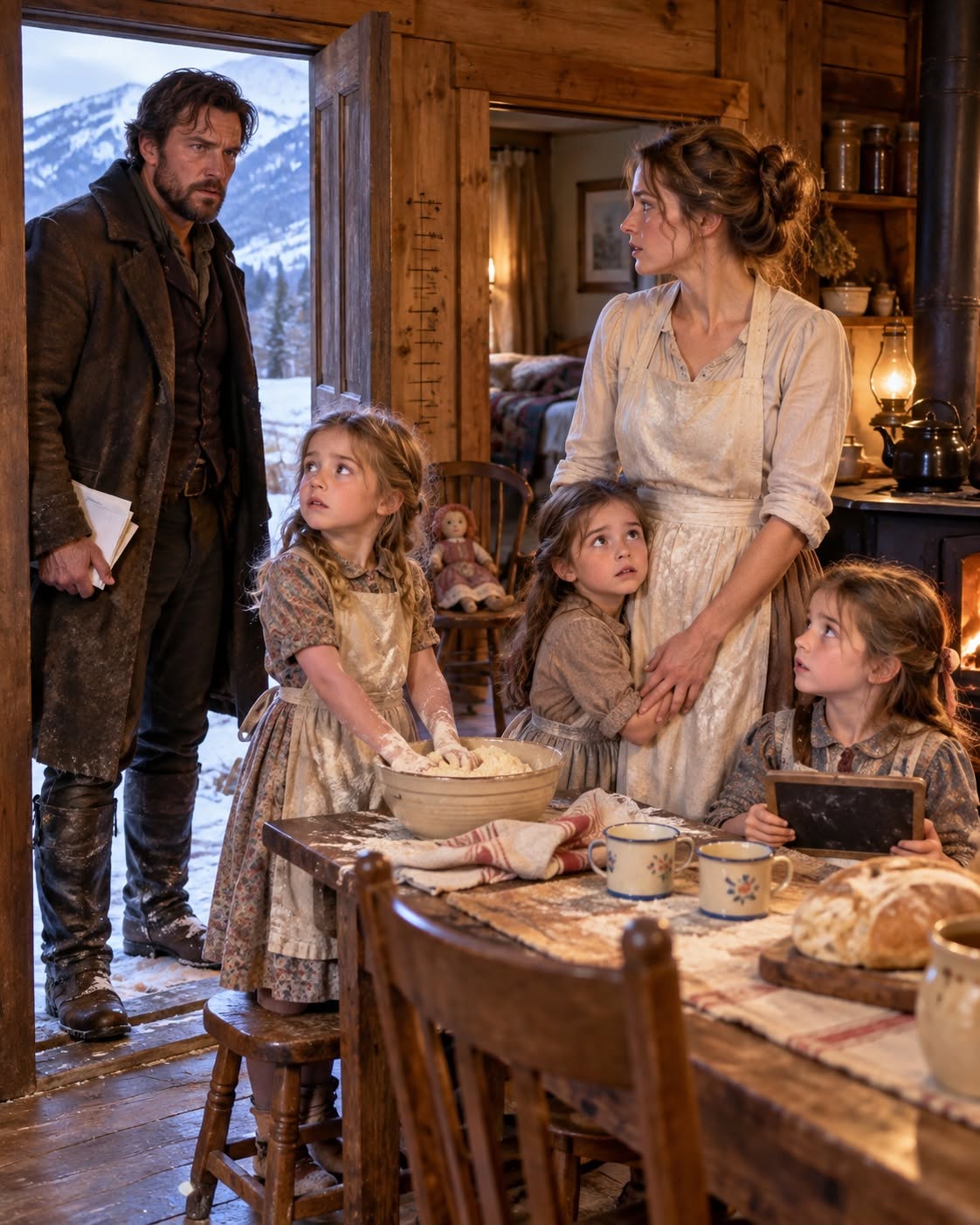
PART 4 — THE SECRET HIS DAUGHTERS HAD BEEN HIDING
Wade Blackwood had faced blizzards, stampeding cattle, and men who would rather reach for a gun than settle an argument.
But nothing had prepared him for the silence that followed his question.
“What did you tell them about me?”
Clara Bennett stood beside the kitchen table, her hands resting lightly against the back of June’s chair.
“I told them you were their father,” she answered.
Wade frowned.
“That isn’t what I asked.”
“I know.”
“Then tell me what you said.”
Clara glanced toward the three girls.
“I told them their father worked hard. I told them he loved them. And I told them that sometimes people who love each other don’t know how to show it.”
Wade removed his coat and hung it beside the door.
“You make it sound as though I’ve done something terrible.”
“No, Wade. I let your daughters decide what they wanted to tell you.”
Daisy lowered her eyes.
Nora suddenly became fascinated with the last piece of bread.
June held Clara’s skirt.
Wade noticed all three reactions.
“What aren’t they telling me?”
Clara pulled out a chair.
“Perhaps you should sit down.”
“I’ve been riding since dawn. I don’t need to sit.”
“Then perhaps you should listen.”
Something in her voice made him stop.
For six months, Clara had rarely challenged him. She had accepted his instructions, managed the household, and cared for his daughters without demanding praise.
But tonight she looked different.
Not angry.
Not frightened.
Simply unwilling to pretend everything was fine.
Wade finally sat.
Clara turned toward the girls.
“Would you like to tell Papa?”
Nobody answered.
Then Nora slowly climbed down from her chair and approached her father.
“Papa, are you going away again?”
Wade blinked.
“What?”
“Are you going away tomorrow?”
He glanced at Clara.
“Why would you think that?”
Nora looked at the floor.
“Because you came home with papers.”
Wade’s hand instinctively moved toward his coat.
The divorce papers.
 He had forgotten how visible they were.
“Those are grown-up matters,” he said.
Nora nodded, but her eyes filled.
“Does that mean Clara has to leave?”
Wade looked at the little girl.
“I haven’t decided anything.”
June immediately pressed closer to Clara.
“Please don’t send Mama away.”
The word came again.
Mama.
This time nobody corrected her.
Wade leaned forward.
“June, Clara isn’t your mother.”
The little girl’s face crumpled.
Clara immediately knelt beside her.
“It’s all right, sweetheart.”
But June shook her head.
“She is when you’re gone.”
The words struck Wade harder than he expected.
“What does that mean?”
June wiped her cheek.
“When the thunder comes, Mama sits with me. When I have bad dreams, Mama stays until I sleep. When I don’t want breakfast, she doesn’t get angry. She waits.”
Daisy finally spoke.
“And when Nora couldn’t read, Clara helped her every morning.”
Nora nodded.
“She says mistakes are how letters learn to become words.”
Wade looked from one daughter to another.
For the first time, he realized he had never asked what happened inside his cabin while he was away.
He had asked whether the floors were clean, whether the meals were prepared, and whether the girls followed instructions.
He had never asked whether they were happy.
“Why didn’t you tell me?” he whispered.
Daisy looked at him.
“Because you were always tired.”
Wade swallowed.
“I’m not too tired to listen now.”
Clara watched him carefully.
“Are you certain?”
He nodded.
And then Daisy told him something that made the room feel suddenly smaller.
“Papa, we used to hide our bread.”
Wade frowned.
“Why?”
“Because sometimes we didn’t finish supper.”
“That was because you wouldn’t eat.”
“No,” Daisy whispered. “We were afraid there wouldn’t be breakfast.”
Wade stared at her.
He remembered the winter when their mother had died. Money had been тιԍнт. The ranch had suffered through a terrible season, and he had insisted the girls finish every portion because wasting food seemed like an insult to everything they had endured.
He had never realized what his daughters had understood.
That food was something they could lose.
That every raised voice meant another punishment might follow.
He looked toward Clara.
“How long?”
“Since before I arrived.”
“Why didn’t you tell me?”
“Because I tried once.”
Wade’s expression changed.
Clara continued.
“Three months ago, Daisy spilled a bowl of milk. You told her she was too old to behave like a baby. She cried in her room for an hour. When I mentioned it that evening, you told me not to interfere with how you raised your children.”
Wade remembered.
He had considered it a minor disagreement.
Clara had remembered it as the moment she understood how much the girls feared disappointing him.
“I didn’t know,” he said.
“No,” Clara replied. “You didn’t ask.”
Later that evening, after the girls had gone to bed, Wade found Clara washing the last dishes.
He stood in the doorway for a long moment.
“I owe you an apology.”
She continued drying a plate.
“For what?”
“For the way I’ve treated you.”
Clara finally looked at him.
“That’s a beginning.”
He glanced at the folded papers on the table.
“I brought those because I thought this arrangement wasn’t working.”
“And now?”
“Now I don’t know what to think.”
Clara placed the plate on the shelf.
“Wade, I didn’t come here expecting you to love me. I answered your advertisement because I wanted a place to belong and because I believed your daughters needed someone.”
“You’ve given them more than I did.”
“I haven’t replaced you.”
He looked down.
“I know.”
“No, I need you to understand something. They don’t need a father who buys them toys or promises them a perfect life. They need the father who comes home, sits at the table, and lets them make mistakes without fearing they’ll lose his affection.”
Wade rubbed a hand over his face.
“What if I don’t know how?”
“Then learn.”
Her answer was simple.
But it left him with nowhere to hide.
He looked toward the hallway.
“Are you planning to leave?”
Clara was quiet for several seconds.
“I’ve been considering it.”
His head lifted.
“Why?”
“Because I came here to build a home, Wade. Not to spend the rest of my life waiting for you to decide whether I deserve to stay.”
Before he could answer, a small voice came from the bedroom.
“Mama?”
Clara immediately turned.
June was standing in the doorway, holding her blanket.
“What’s wrong, sweetheart?”
“Can I sleep near you tonight?”
“Of course.”
Wade watched Clara lift the little girl into her arms.
June rested her head against Clara’s shoulder.
Then she looked over Clara’s shoulder at her father.
“Papa?”
“Yes?”
“Are you angry because I called her Mama?”
Wade felt something inside him break.
He crossed the room and knelt in front of his daughter.
“No, June.”
“Then why did you look sad?”
He searched for an answer.
“Because I realized I missed too many things.”
June studied him.
“You can still come tomorrow.”
Wade nodded.
“I can.”
She reached out and touched his cheek.
“Then don’t forget.”
That night, Wade did something he had not done since his first wife died.
He pulled a chair beside his daughters’ bedroom door and stayed there until morning.
But when dawn came, Clara found the divorce papers on the kitchen table.
They were still there.
Only now, across the top page, Wade had written three words:
NOT SIGNING THEM. YET.
Clara stared at the message.
And before she could ask what it meant, a wagon stopped outside the cabin.
A woman stepped down.
She wore a dark traveling coat and carried a leather case.
Clara recognized her immediately.
It was Margaret Ellison, the county guardian appointed to oversee the girls’ welfare.
And she had not come alone.
A tall man stepped down behind her.
He carried an official envelope.
“Mr. Blackwood,” Margaret called. “We need to discuss the future of your daughters.”
Wade appeared in the doorway.
“What is this about?”
Margaret looked past him toward Clara.
“I’m afraid someone has filed a peтιтion claiming that the girls are not being raised in a suitable household.”
Then she opened the envelope.
“And the person who signed it is someone you both know.”