PART 4: THE KNIFE WAS NEVER MEANT FOR HER
PART 4: THE KNIFE WAS NEVER MEANT FOR HER
Wilder flinched.
The blade stopped immediately.
For a moment, neither of them moved.
Then Goss spoke.
“That was a poor choice of words.”
His voice sounded different now. Not angry. Not impatient.
Careful.
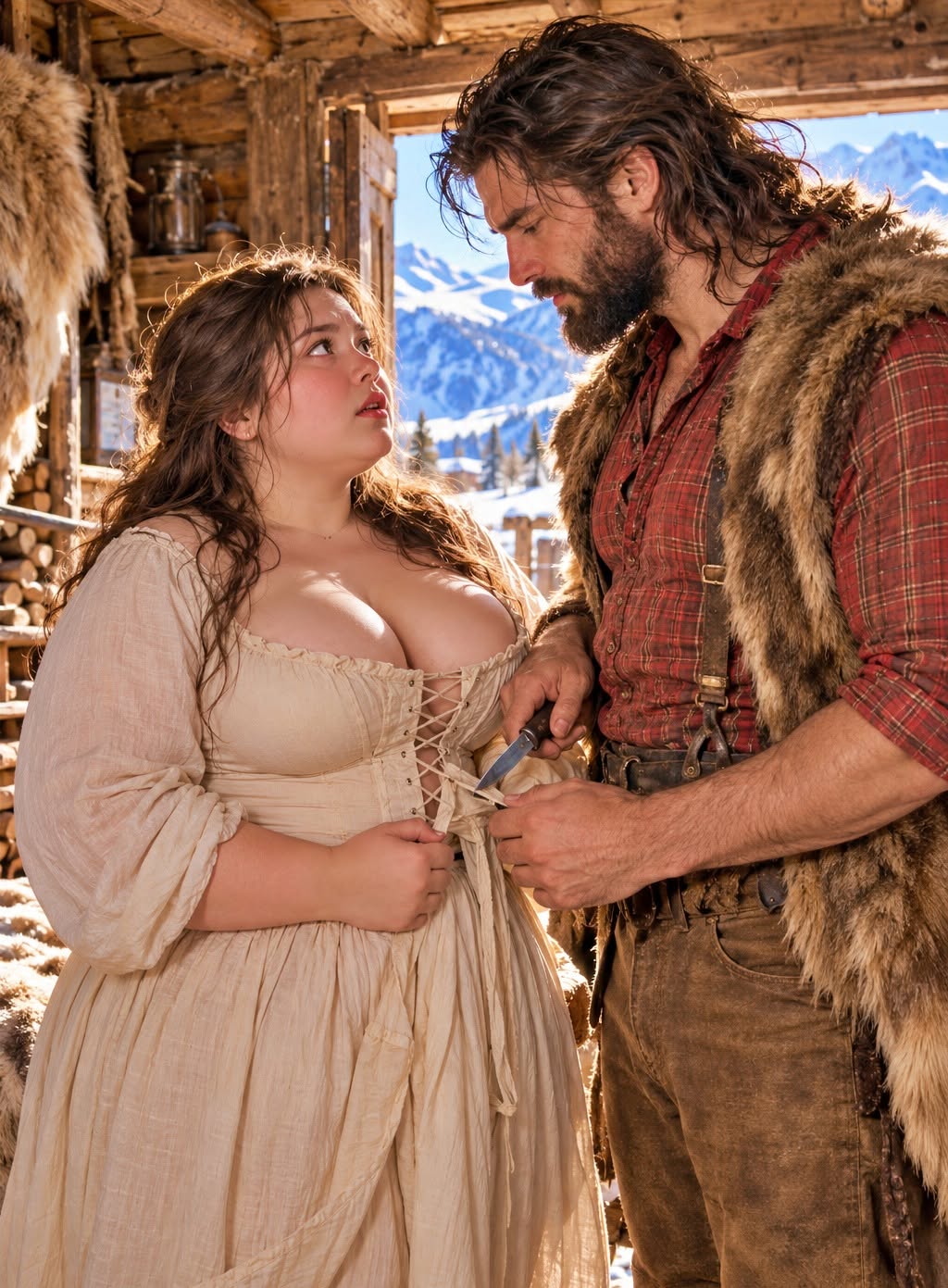
“I’m cutting the cord, not you.”
Wilder’s fingers remained pressed against her chest.
“I know.”
But she didn’t know. Not really.
She had spent twenty-six years learning that a man’s kindness could disappear the moment a woman disappointed him. She had learned that promises were often made by people who never intended to keep them.
Goss waited.
“May I?”
Wilder swallowed.
“Yes.”
He moved slowly, keeping the knife pointed away from her. With one careful motion, he severed the tangled cord.
The stays loosened.
Wilder drew a breath so deep that it hurt.
“Good Lord,” she whispered.
Goss stepped back immediately.
“There’s a clean wool dress in the chest by the bed. It belonged to my sister. She left it here last autumn.”
 Wilder turned toward him.
“Your sister?”
“She visits when the weather allows.”
He crossed to the fireplace and lifted a kettle.
“There’s H๏τ tea. I’ll put it on the table. You can dress when you’re ready.”
Then he walked outside.
The door closed.
Wilder stood alone in the cabin, staring at the severed cord in her hands.
She had expected a demand.
Instead, he had given her room to breathe.
She dressed in the wool garment. It was plain, brown, and several inches too long, but it was warm.
When she emerged from behind the hanging blanket Goss had placed across the corner, he was sitting at the table with two cups of tea.
He glanced at her.
“Better?”
“Yes.”
“Good.”
He returned to his tea.
Wilder sat opposite him.
The silence stretched.
Finally, she asked, “Did you really order a wife the way you order supplies?”
Goss looked at her.
“That’s what the service called it.”
“And you didn’t ask what she looked like?”
“No.”
“Didn’t ask whether she was young or old? Pretty or plain?”
“No.”
“Why?”
He considered the question.
“Because I wanted someone who could tell me when I was being an idiot.”
Wilder blinked.
Then, unexpectedly, she laughed.
It was a small sound, rusty from years of disuse.
Goss looked almost startled.
“What?”
“Nothing.”
“You laughed.”
“I did.”
“Was something funny?”
“Your answer.”
He nodded as though that settled the matter.
Wilder studied him.
“You could have asked for anything.”
“I asked for a woman who could work hard.”
“And what do you expect from me?”
Goss set down his cup.
“Honesty. That’s all.”
She looked toward the window.
Outside, the mountains were turning blue beneath the evening sky.
“Then I should tell you something,” she said.
“What?”
“I don’t know how to be a wife.”
Goss’s expression remained steady.
“Neither do I.”
For the first time since leaving Pincher Creek, Wilder felt that perhaps the arrangement might not be a sentence.
Perhaps it could become something else.
But the next morning, she discovered a folded letter beneath her trunk.
The handwriting was her father’s.
She recognized it instantly.
And she wished she hadn’t.
The letter was dated three weeks before her departure.
Wilder,
You must forgive me for what I have done.
The man you are going to is not the man I was told he was.
I have made a terrible mistake.
If you can find a way to leave, you must do so before the first snowfall.
Your father.
Wilder read it twice.
Then a third time.
Her father had known something.
Something about Goss.
Something he had never told her.
When Goss entered the cabin, he found her standing beside the table with the letter in her hand.
He stopped.
“Where did you get that?”
Wilder looked up.
“Did you know my father?”
Goss’s face changed.
Not much.
But enough.
“Yes.”
“How?”
He glanced at the letter.
Then he pulled out the chair opposite her and sat down.
“Because your father and I made a promise.”
Wilder’s heart began to pound.
“What promise?”
Goss looked directly at her.
“That if I ever found you, I would tell you the truth.”
He paused.
“And that truth is going to make you hate me.”