PART 4 — THE FACE BENEATH THE BURLAP
PART 4 — THE FACE BENEATH THE BURLAP
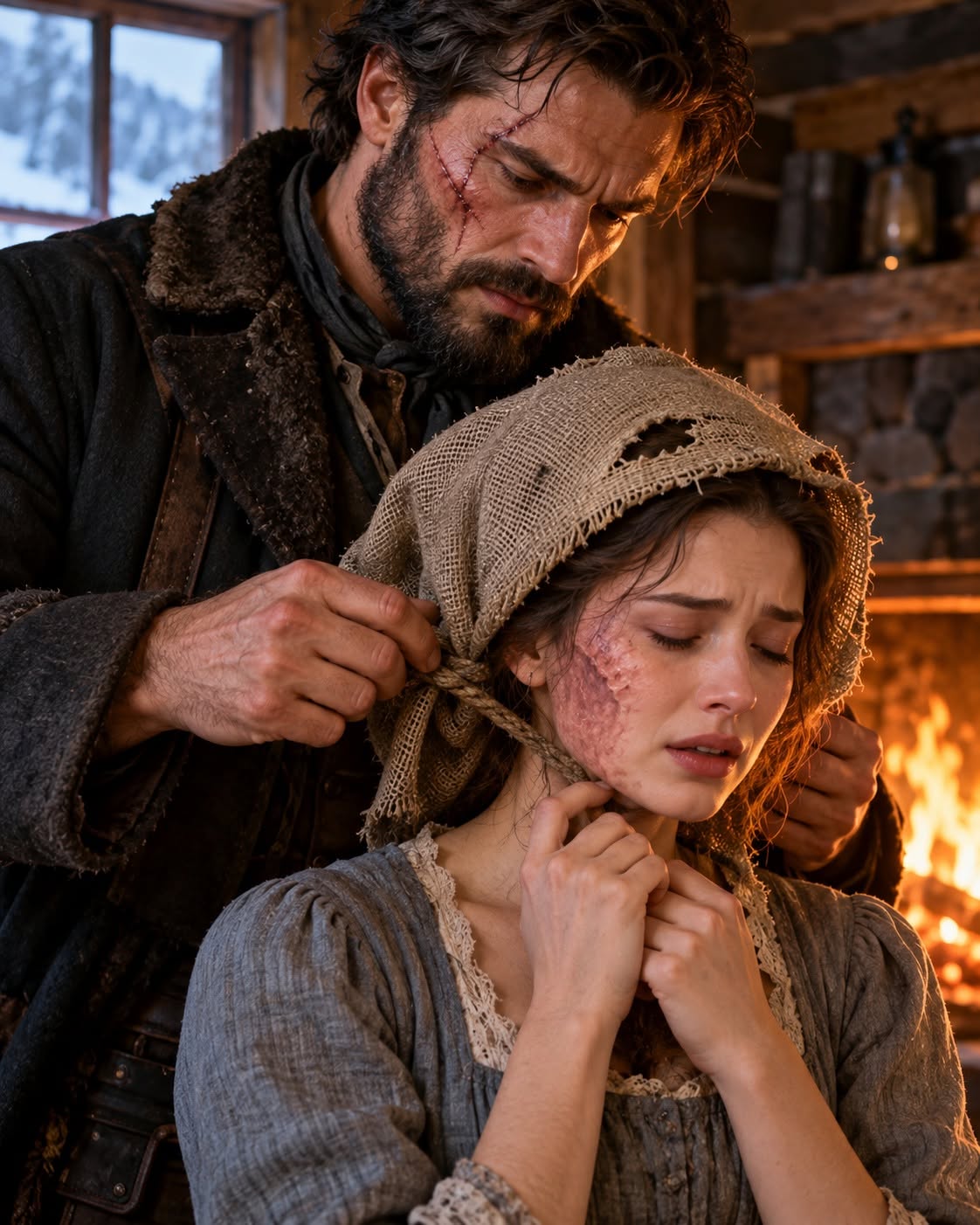
The knot finally slipped free.
The burlap sack fell into Cyrus Creed’s hands.
For one terrible moment, Josephine remained perfectly still, her eyes squeezed shut, her fingers gripping the edge of the table.
Cyrus had seen men with broken bones, women with frightened eyes, and children who ran screaming from his scarred face.
But nothing had prepared him for the expression on Josephine’s face.
A long, pale scar stretched from her left temple to the corner of her mouth. Another crossed her cheek, disappearing beneath her collar. Her left eyebrow was partially missing, and the skin around her eye bore the unmistakable marks of an old fire.
But it was not the scars that made Cyrus stop breathing.
It was the terror in her eyes.
“Please,” she whispered. “Don’t send me back.”
Cyrus set the burlap sack on the table.
He pulled a chair away from the fire and sat down, giving her room to breathe.
“Josephine,” he said quietly, “look at me.”
She slowly opened her eyes.
Cyrus pointed toward the jagged scar running down his own face.
“You see this?”
She nodded.
“A cougar gave it to me. Took a good piece of my face and nearly took my life. People have been calling me ugly ever since.”
Josephine looked at him through her tears.
“But yours is different,” she whispered.
“How?”
“Yours came from an animal.”
Cyrus studied her.
“And yours?”
 She lowered her head.
“People.”
The word settled between them like a stone.
Cyrus did not ask another question.
He rose, poured a bowl of warm stew, and placed it before her.
“Eat first. We can talk when you’re ready.”
Josephine stared at the bowl.
Then she began to cry.
Not loudly.
Not dramatically.
She simply covered her face with both hands, and for the first time in years, she allowed herself to cry without apologizing.
Cyrus returned to his chair.
He remained there until the fire burned low.
And when Josephine finally spoke, the story she told him changed everything.
Three years earlier, Josephine had lived in a small farmhouse outside Lewiston.
Her father had been a blacksmith. Her mother had taught her to read, sew, and keep accounts.
They had not been wealthy, but they had been happy.
Then a fire destroyed their home.
Josephine had been trapped inside when a burning beam collapsed across the doorway. Her father dragged her from the flames, but the fire had already left its mark.
Her father died from his injuries several weeks later.
Josephine survived.
But the woman who emerged from that burning house was no longer treated like the daughter of a respected blacksmith.
People stared.
Children whispered.
Men who had once asked for her hand in marriage suddenly found reasons to look elsewhere.
Then Thaddeus Cooper appeared.
He was a freight agent with a friendly smile and a reputation for helping families find work in distant territories.
He offered Josephine a position as a housekeeper.
She accepted.
For six months, she worked in his home, keeping accounts and preparing meals.
Then Cooper began telling her that she owed him money.
The cost of her room.
The cost of her food.
The cost of the clothes he claimed to have purchased for her.
The debt grew until he insisted she could never repay it.
When Josephine refused to marry a man Cooper had selected, he became cruel.
He threatened to send her away.
He told her that nobody would ever want a woman with her face.
And when she finally escaped, he found her again.
“He told me I was worth ten dollars,” she whispered.
Cyrus’s jaw тιԍнтened.
“He said the sack would make it easier for someone to take me.”
Cyrus looked at the burlap lying on the table.
For a moment, he could not speak.
Then he asked, “Did Cooper burn your house?”
Josephine looked up.
“I don’t know.”
She reached into the pocket of her dress and pulled out a small, folded piece of paper.
It was a letter.
The edges were yellowed, and the handwriting was faded.
“My father gave me this before he died. He told me never to let Cooper see it.”
Cyrus unfolded the paper.
The letter contained a list of names, payments, and land transactions.
At the bottom was a signature.
Thaddeus Cooper.
Cyrus read it twice.
Then he looked at Josephine.
“Your father was investigating him.”
She nodded.
“He told me Cooper was stealing from the freight company. He said he had proof.”
Cyrus turned the letter over.
There was another line written in a different hand.
If anything happens to me, the original records are hidden beneath the old blacksmith’s forge.
Cyrus stood.
“Where is that forge?”
Josephine’s eyes widened.
“Outside Lewiston.”
He folded the letter carefully.
“Then that’s where we’re going.”
She looked terrified.
“But Cooper will find us.”
Cyrus walked to the door and checked the weather.
Snow was falling again.
“Not if we find him first.”
The following morning, Cyrus saddled his horse.
Josephine stood beside the cabin, wrapped in a thick wool coat.
She had asked him twice whether he intended to leave her behind.
Both times, he had answered the same way.
“You’re coming if you want to.”
Now she looked toward the trail.
“I want to.”
Cyrus nodded.
He helped her mount, then swung into the saddle behind her.
They rode toward Lewiston.
But before they reached the valley, they encountered a man standing beside the trail.
Thaddeus Cooper.
He was accompanied by two riders.
And in his hand was a folded document.
Cyrus stopped his horse.
Cooper smiled.
“Creed. I was hoping we’d meet again.”
Josephine went rigid.
Cyrus felt her trembling.
He spoke without turning.
“You’re safe, Josie.”
Cooper lifted the document.
“I have a warrant for your arrest.”
Cyrus looked at the paper.
Then at Cooper.
And when the freight agent revealed the name written at the bottom, Cyrus realized the truth was even worse than he had imagined.
The warrant had been signed by the territorial judge.
A man who had been ᴅᴇᴀᴅ for six months.