PART 3: WHAT HAPPENED WHEN THE CHURCH DOORS OPENED
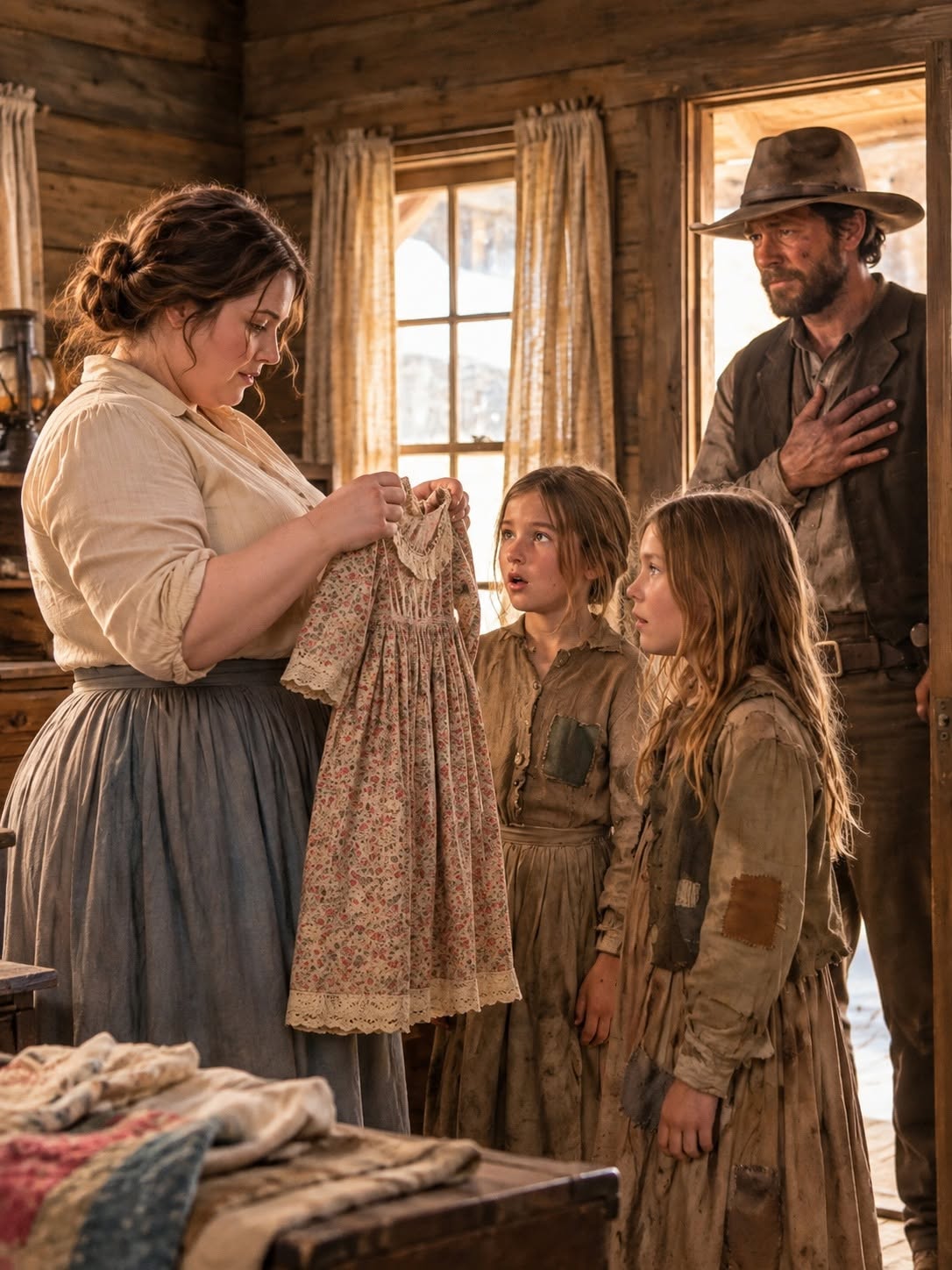
HIS DAUGHTERS WERE TOO EMBARRᴀssED TO WEAR THEIR TORN CLOTHES TO CHURCH—THEN THE HOUSEKEEPER TURNED OLD CURTAINS INTO BEAUTIFUL DRESSES
PART 3: WHAT HAPPENED WHEN THE CHURCH DOORS OPENED
Miss Tilden touched the embroidered leaves again.
“Where did you say your mother got this cloth?”
Nell looked puzzled.
“She received it as payment for a gown she made for a banker’s wife in Zanesville. Why?”
Miss Tilden’s eyes filled.
“Because my mother used to speak of a seamstress in Ohio who made the most beautiful things she’d ever seen. Her name was Margaret Marsh.”
Nell went completely still.
“That’s my mother.”
Miss Tilden covered her mouth.
“Your mother made my wedding dress.”
For a moment, nobody spoke.
Then Miss Tilden began to cry.
“She refused to accept money from us. My father had lost his position, and we couldn’t afford the dress. Your mother told me that every bride deserved to feel beautiful, regardless of what her family could pay.”
Nell lowered her eyes.
“That sounds like her.”
Miss Tilden gently touched Ruth’s sleeve.
“And these leaves. She always embroidered them into her finest work. She called them the leaves of endurance. She said they were a reminder that even after the hardest winter, something beautiful could grow again.”
Ruth looked down at her dress.
For the first time, she understood that she wasn’t wearing old curtains.
She was wearing something that carried a history of kindness.
Miss Tilden turned toward the church.
“Come inside, girls. I believe we have something worth celebrating today.”
But before they could enter, Lucinda Whitcomb stepped forward.
“I still don’t see why everyone is making such a fuss.”
Her voice was sharp enough to cut through the quiet.
“They’re just dresses.”
Nate turned toward her.
“Yes,” he said. “They are.”
He looked at his nieces.
“But they’re dresses made with love, patience, and more kindness than some people manage in a lifetime.”
Lucinda’s cheeks reddened.
Her mother, who had been standing near the church entrance, finally stepped forward.
“Lucinda. Apologize.”
“But Mama—”
“Now.”
The girl looked toward Ruth.
Her expression changed.
“I shouldn’t have called your clothes names,” she muttered.
Ruth studied her.
“No. You shouldn’t have.”
Lucinda looked down.
“I didn’t know they would look like this.”
Ruth’s answer was quiet.
“They didn’t have to look like anything for you to be kind.”
That silenced everyone.
Nell placed a hand on Ruth’s shoulder.
“Come along. We didn’t come here to spend Sunday arguing.”
The girls walked through the church doors.
And something remarkable happened.
People stopped talking.
Three girls in matching green dresses entered the sanctuary, their skirts catching the morning light through the stained-glᴀss windows.
Ruth held her head high.
Josie smiled shyly.
Pearl reached into her pocket and touched her mother’s silver thimble.
Then Reverend Collins stood behind the pulpit.
He looked at the girls, then at Nell.
“Before we begin today’s service, I would like to say something.”
The congregation settled.
“For many years, this church has spoken about generosity. We have collected food for struggling families, raised money for widows, and prayed for those who have less than we do.”
He paused.
“But perhaps we have forgotten that kindness is not something we offer only when it is convenient.”
His eyes moved toward the front pew.
“Sometimes kindness means accepting help. Sometimes it means offering it without making another person feel small. And sometimes it means remembering that a child’s dignity is worth more than any piece of cloth.”
Nate lowered his head.
He knew those words were meant for him as much as anyone.
Reverend Collins continued.
“I understand that Mrs. Marsh has spent the past several days turning old curtains into beautiful dresses for these three young ladies.”
A few people smiled.
“But I have also heard that she did something more important. She gave these girls a reason to walk through these doors again.”
The congregation began applauding.
Pearl looked frightened by the noise.
Josie squeezed her hand.
Ruth glanced at Nell.
Nell simply smiled.
Then something happened that none of them expected.
Miss Tilden stood.
“I would like to tell everyone about Margaret Marsh.”
She spoke of Nell’s mother, the seamstress who had quietly made dresses for brides who couldn’t afford them, repaired coats for children who had none, and taught young girls to sew without ever charging a penny.
“She used to say that a needle could mend more than fabric,” Miss Tilden said. “It could mend a little piece of someone’s confidence.”
Nell pressed her hand against her mouth.
She hadn’t heard anyone speak about her mother that way in years.
When the service ended, people gathered around the girls.
Mrs. Whitcomb complimented Ruth’s dress.
The church organist asked Nell how she had made the collars.
And three little girls approached Pearl, asking whether they could see her pockets.
Pearl proudly demonstrated.
“There’s room for a handkerchief, two ʙuттons, and my mother’s thimble.”
Everyone laughed.
For the first time in months, she laughed with them.
But the greatest surprise came after church.
As Nate helped the girls into the wagon, a thin elderly woman approached him.
She was wearing a faded brown shawl and carrying a small wooden sewing box.
“Mr. Garrett?”
“Yes, ma’am?”
“My name is Abigail Turner. I live near the old mill.”
She glanced at Nell.
“I’m sorry to trouble you, but I heard what you’ve done for these children.”
Nell smiled.
“There’s no trouble.”
Abigail opened her sewing box.
Inside were several pieces of fine blue fabric.
“My granddaughter is getting married next month. Her mother died when she was little, and I cannot afford to buy her a proper wedding dress.”
She hesitated.
“I wondered if you might be willing to help.”
Nell looked at the fabric.
Then at Abigail’s trembling hands.
“I would be honored.”
Abigail began to cry.
“I don’t have much to pay you.”
Nell gently closed the sewing box.
“Then we’ll find another arrangement.”
Nate watched the exchange.
 He understood something then.
Nell hadn’t simply rescued his nieces from embarrᴀssment.
She had brought something back into the town that people had forgotten they needed.
The ability to help one another without keeping score.
That evening, the Garrett house felt different.
Ruth was humming while she put away the dishes.
Josie had spread a sewing pattern across the kitchen table.
Pearl was showing her thimble to a wooden doll.
Nate stood near the fireplace, watching them.
“I owe you an apology,” he said.
The girls looked up.
“For what?” Josie asked.
“For letting you believe you had to stay home because your clothes weren’t good enough.”
Ruth stopped humming.
Nate continued.
“I thought I was protecting your pride by refusing help from people. I didn’t realize I was making you carry my pride instead.”
Ruth looked at him for a long moment.
“Papa wouldn’t have wanted us to stay home.”
“No,” Nate said softly. “He wouldn’t.”
“I miss him.”
“So do I, sweetheart.”
He knelt and pulled her into his arms.
“I can’t replace your father. But I can promise to listen better than I have.”
Josie joined them.
Then Pearl climbed into Nate’s lap.
For a moment, the four of them remained together beside the fire.
Nell quietly gathered the dishes.
But Nate noticed her.
“Mrs. Marsh?”
She turned.
“Would you sit with us?”
She hesitated.
“I have supper to finish.”
“It can wait.”
He pulled out a chair.
“Please.”
Nell sat.
And for the first time since arriving at the Garrett ranch, she wasn’t sitting at the edge of the family.
She was part of it.
Two weeks later, Nate made an announcement at breakfast.
“I’ve been thinking about the house.”
Ruth looked up.
“What about it?”
“The upstairs room beside yours is empty. I thought we could turn it into a proper sewing room.”
Josie’s eyes widened.
“For Nell?”
“For all of you.”
He placed a small wooden box on the table.
Inside were new needles, scissors, measuring tapes, and several bolts of inexpensive but beautiful fabric.
Pearl gasped.
“Can we make more dresses?”
“If Mrs. Marsh agrees to teach you.”
Nell looked at him.
“Mr. Garrett, I was hired to keep your house.”
“And you’ve done that.”
He smiled.
“But you’ve also reminded us what makes it a home.”
He paused.
“I’d like to increase your wages. And if you wish, you can take sewing orders from the women in town. We’ll provide the materials until you have enough customers to support the work yourself.”
Nell stared at the box.
For years, she had been treated as a woman whose usefulness depended on how quietly she could work.
Now someone was offering her the chance to build something of her own.
“Why?” she whispered.
Nate looked at the girls.
“Because you saw what they needed before I did.”
His voice softened.
“And because I believe my brother would have liked having you in this house.”
Nell’s eyes filled.
“Thank you.”
Ruth reached across the table.
“You don’t have to thank him. You’re staying, aren’t you?”
Nell laughed through her tears.
“I believe I am.”
Harvest Sunday became a tradition.
Every year, the girls wore something Nell had helped them make.
They eventually learned to sew their own clothes, and the little upstairs room became known throughout the valley as the Green Room.
Women brought fabric.
Girls came to learn.
Widows found work.
And children who had once been too ashamed to enter the church came to understand that their worth had never depended on the clothes they wore.
Lucinda Whitcomb became one of Nell’s students.
It took her a long time to earn Ruth’s friendship, but she did.
One afternoon, she arrived at the Green Room carrying a basket of fabric.
“I want to make dresses for the children at the orphanage,” she said.
Ruth looked at her.
“Why?”
Lucinda lowered her eyes.
“Because I remember what I said to you.”
She placed the basket on the table.
“And because I don’t want anyone else to feel the way you felt.”
Ruth studied her for a moment.
Then she handed Lucinda a pair of scissors.
“Start by learning how to cut a straight line.”
They both smiled.
Years later, Pearl would still keep her mother’s silver thimble.
It would sit in a small wooden box beside the first green dress Nell had made for her.
The fabric had faded.
The seams had been repaired more than once.
But Pearl refused to throw it away.
Whenever someone asked why, she told them the story of the Sunday she had been too ashamed to enter church.
And how a woman who had lost nearly everything had given three little girls something no money could buy.
The courage to stand tall.
Nate never forgot that morning either.
He eventually understood that providing for his family meant more than filling their plates, repairing their roof, or keeping strangers from thinking they needed help.
It meant making sure the people he loved never felt ashamed to ask for what they needed.
And Nell?
She never again had to wonder whether she belonged somewhere.
One evening, as the girls worked on a new dress beside the kitchen window, Nate placed a cup of tea beside her.
“You know,” he said, “those curtains were the most expensive things you ever brought into this house.”
Nell laughed.
“They were old curtains.”
“Not to me.”
He looked toward Ruth, Josie, and Pearl.
“They gave us our family back.”
Nell glanced at the girls.
“No, Mr. Garrett. They simply reminded us we already had one.”
Outside, the last golden leaves drifted across the yard.
Inside, three sisters laughed over a crooked seam, a housekeeper threaded another needle, and a man who had once believed he could raise children with nothing but hard work finally understood the value of a gentle heart.
The old curtains were gone.
But what they had made would last far longer than the cloth itself.
BECAUSE THE MOST BEAUTIFUL THING A CHILD CAN WEAR IS NOT A PERFECT DRESS. IT IS THE KNOWLEDGE THAT THEY ARE LOVED, JUST AS THEY ARE.