PART 3: THE SECRET SILAS WHITCOMB COULDN’T BURY
PART 3: THE SECRET SILAS WHITCOMB COULDN’T BURY
Ara stood frozen beside the cradle.
The words Silas had shouted through the door seemed to echo inside her head.
What you did to our first child.
He knew exactly which memory to use.
Three years earlier, their first daughter, little Rose, had been born healthy. But within weeks, she developed a fever.
Ara had begged Silas to send for a doctor.
He refused.
He said the child was weak and that the family should not waste money on a physician.
By the time a doctor finally arrived, Rose was already beyond help.
She died in Ara’s arms.
Silas had blamed her ever since.
He told the town she had neglected the baby. He said her grief had made her unreliable. He even suggested that she had failed to care for Rose properly.
Now he was using that tragedy to threaten her again.
A knock shook the cabin door.
“Ara!” Silas shouted. “You know what happened. Don’t make me explain it to everyone.”
She held Grace and Hope closer.
Then another voice came from outside.
“Step away from the door, Whitcomb.”
Elias.
He had returned with Dorothy and a young lawyer named Samuel Reed.
Silas turned.
“Vance. This is between me and my wife.”
“Then you shouldn’t have brought three men to threaten her.”
Silas laughed.
“I have a legal complaint. My wife stole my children.”
Samuel stepped forward.
“Then you can present your complaint before the judge. You have no authority to enter this property.”
Silas looked at the lawyer’s papers.
“You think a piece of paper will stop me?”
“It might,” Samuel replied, “especially when it documents that you have been ordered to stay away from your wife until the court can hear the matter.”
Silas’s expression hardened.
He looked toward the cabin window.
“Ara, come outside. I won’t ask again.”
For several seconds, nothing happened.
Then the door opened.
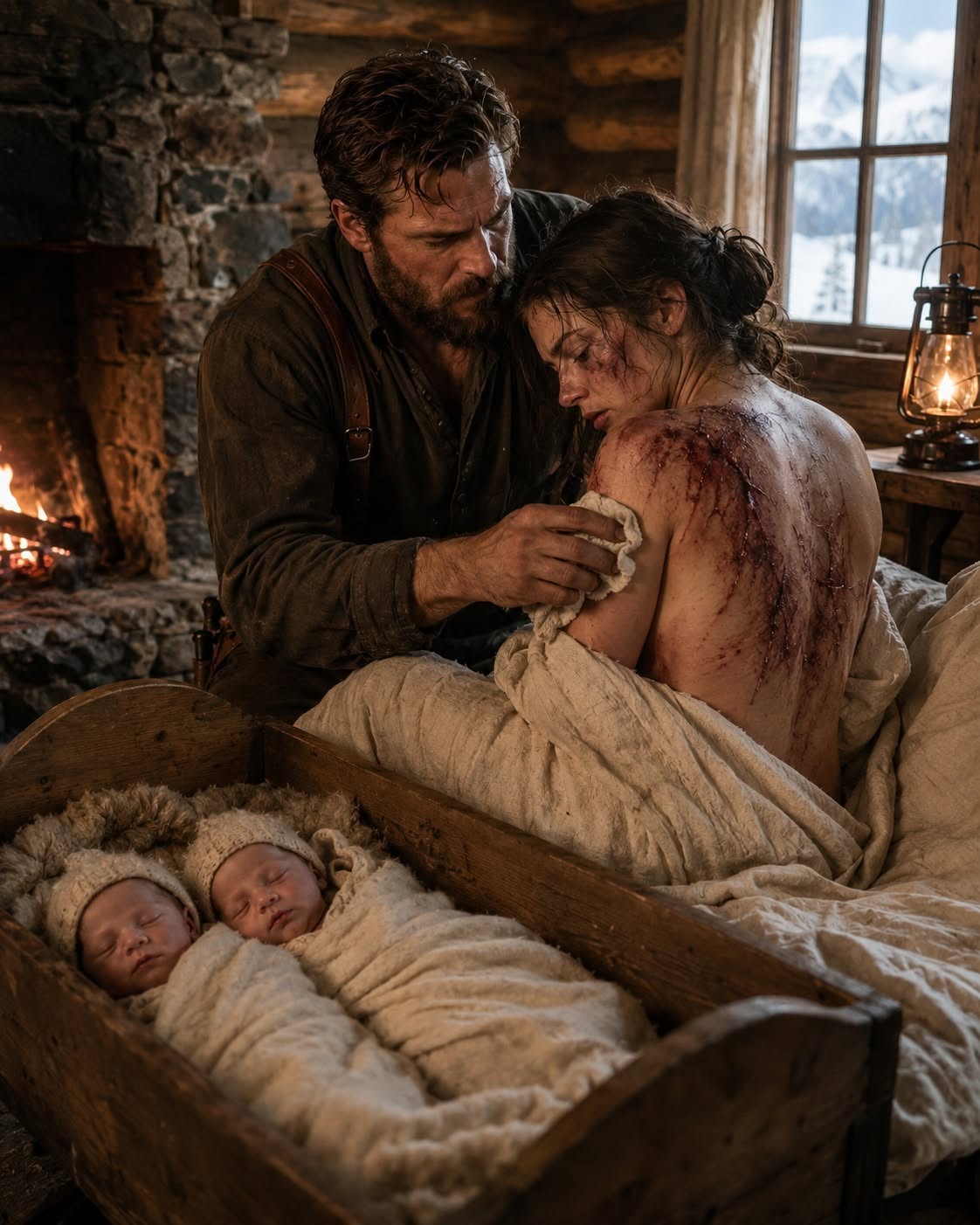
Ara stood on the threshold, wrapped in a blanket, holding both babies.
Her face was pale, but her eyes were steady.
“I won’t go with you.”
Silas stared.
“You don’t have a home.”
“I have one now.”
“You have nothing.”
Ara looked down at her daughters.
“I have them.”
Silas stepped forward.
Elias moved between them.
“That’s far enough.”
For a moment, the two men stood face to face.
Silas was accustomed to people lowering their eyes.
Elias didn’t.
Finally, Silas turned toward his companions.
“Let’s go.”
He climbed onto his horse, but before riding away, he pointed at Ara.
“You’ll regret humiliating me.”
Ara didn’t answer.
She simply closed the door.
When the sound of the horses disappeared, her knees weakened.
Elias caught her before she fell.
“It’s over for tonight,” he said.
But Ara shook her head.
“No. He won’t stop.”
Elias looked at Samuel.
“Then we make sure the court hears everything.”
The following morning, Samuel began gathering evidence.
Dorothy provided a statement confirming the twins’ condition when Elias brought them to her.
She also described the injuries she had observed on Ara’s back.
The ranch hands who had seen Silas arrive agreed to testify about his threats.
But the most important witness came unexpectedly.
Her name was Mrs. Abigail Mercer.
She was an elderly widow who lived near the Whitcomb property and had once helped Ara during her first pregnancy.
Abigail arrived at Elias’s cabin carrying a small cloth bundle.
“I should have spoken sooner,” she said.
Ara invited her inside.
Abigail sat beside the fire and placed the bundle on the table.
Inside was a letter.
It was written by Silas.
Ara recognized his handwriting immediately.
“What is this?”
Abigail took a slow breath.
“Three months before the twins were born, Silas came to my house. He asked me whether I knew anyone who would take a baby girl.”
Ara’s face went white.
“He wanted to give away our child?”
“He said he needed an heir and could not afford to raise another daughter.”
Abigail continued.
“I told him that children weren’t livestock to be traded. He became angry and left.”
She touched the letter.
“Later, I found this near my doorstep. I believe he dropped it.”
Ara unfolded the paper.
It contained instructions to a man named Henry Pike, asking him to arrange a private adoption if the second child was another girl.
At the bottom was a sentence that made Ara’s hands tremble.
My wife must not be allowed to interfere.
Elias read the letter.
His expression darkened.
“This proves he planned to take the children before they were born.”
Samuel nodded.
“And it supports the claim that he intended to separate Ara from them.”
 But the letter contained another name.
Henry Pike.
Samuel recognized it.
“He works for the county registrar.”
“Would he testify?” Elias asked.
“I don’t know. But we need to find him.”
That afternoon, Samuel rode into town.
He returned after sunset with troubling news.
Henry Pike had disappeared.
His office had been emptied, and his rented room was locked.
But the registrar’s ᴀssistant had given Samuel something important: a copy of a document Pike had filed shortly before leaving.
It was an application to register the twins under Silas’s name alone.
Ara stared at the paper.
“He was going to take their names away from me.”
Samuel nodded.
“He was preparing to claim full control before you could challenge him.”
For the first time, Ara understood how carefully Silas had planned everything.
The public humiliation.
The threats.
The locked door.
The attempt to make her appear unstable.
He hadn’t simply wanted her gone.
He wanted the girls without her.
That night, Elias sat outside the cabin beneath the stars.
Ara joined him after the twins had fallen asleep.
“Why did you never marry again?” she asked.
Elias looked toward the dark ridge.
“I did marry once.”
“Your wife?”
“Margaret. She died seven years ago.”
Ara lowered her eyes.
“I’m sorry.”
“So am I.”
He rubbed his hands together.
“I spent a long time believing that if I cared about anyone again, I’d only have something else to lose.”
Ara was quiet.
“Do you still believe that?”
Elias looked toward the window, where the soft glow of the fire illuminated the two tiny cradles.
“No.”
Ara followed his gaze.
“Neither do I.”
For a moment, their hands rested close together on the wooden bench.
Neither moved away.
Then Elias spoke.
“When this is over, you don’t have to stay here because you have nowhere else to go.”
Ara looked at him.
“What do you mean?”
“You can stay because you want to. You can leave if you choose. But I want you to know that this cabin has room for all three of you.”
Ara’s eyes filled.
“Even after the trouble Silas brings?”
Elias nodded.
“Especially then.”
Three days later, the hearing began.
The small courtroom in Silver Creek was packed.
Silas arrived wearing his finest suit, accompanied by two men who had known him for years.
He looked confident.
Ara entered with Samuel.
Elias walked behind her, carrying one of the babies while Dorothy held the other.
Whispers moved through the room.
Silas stood immediately.
“Those are my daughters!”
The judge raised his hand.
“You will speak when called upon, Mr. Whitcomb.”
The hearing began with Dorothy’s testimony.
She described Ara’s injuries and the condition of the newborn twins.
Then Abigail presented Silas’s letter.
The judge examined it carefully.
Silas’s attorney objected, claiming the document could not be authenticated.
But Abigail testified that she had personally received it.
Then came Ara’s turn.
She stood slowly.
Her hands trembled, but she looked directly at the judge.
She described the locked well, the long walks through the snow, the threats, and the night she had been beaten and abandoned.
She also spoke about Rose.
“I asked my husband to help our first daughter when she became sick,” she said. “He refused to send for a doctor until it was too late. After she died, he told everyone it was my fault.”
Silas stood abruptly.
“That’s a lie!”
The judge struck the desk.
“Sit down, Mr. Whitcomb!”
Ara continued.
“When my twins were born, he called them worthless because they were girls. He tried to take them from me. I ran because I believed he would separate us forever.”
The courtroom fell silent.
Then Samuel presented the property deed showing that the well belonged to Ara, along with the forged loan application.
The judge studied the documents for a long time.
Finally, he turned toward Silas.
“Mr. Whitcomb, do you deny signing this application?”
Silas swallowed.
“I was protecting my family’s property.”
“By signing your wife’s name without permission?”
“I had a right—”
“You had no such right.”
The judge ordered a further investigation into the alleged forgery and granted Ara temporary custody of the twins. He also issued a strict order preventing Silas from approaching her or the children.
Silas looked toward Ara.
For once, she did not lower her eyes.
The hearing was not the end of the legal proceedings, but it was the beginning of something she had almost stopped believing was possible.
Freedom.
Outside the courthouse, Elias waited beside the wagon.
Ara stepped toward him.
“It’s done,” she whispered.
“Not everything,” Samuel reminded her gently. “But you’ve taken the first important step.”
Elias helped her into the wagon.
As they began the journey back to the mountains, Ara looked down at Grace and Hope.
“Your father will never decide your worth again,” she whispered.
That evening, the cabin was filled with warmth.
Dorothy prepared supper.
Elias repaired a loose board near the cradle.
Lily—no, there was no older child in this story; the twins were still tiny, and Ara held both close as the fire burned.
For the first time, she slept without fear of footsteps outside the door.
But at dawn, a stranger arrived.
He was a thin man with a gray beard and a weathered leather satchel.
He asked for Elias.
When Elias stepped outside, the stranger handed him a folded letter.
“I was told to deliver this to you if Silas Whitcomb ever lost his position.”
Elias opened it.
The handwriting belonged to Margaret, his late wife.
His face went pale.
Ara appeared in the doorway.
“Elias? What’s wrong?”
He looked at the letter again.
Then at the stranger.
“Who gave you this?”
The man removed his hat.
“Your wife’s brother. He says there’s something you were never told about the night Margaret died.”
Elias gripped the paper.
For seven years, he had believed he knew the truth about his past.
Now, as the stranger pointed toward the distant valley, he realized that the secret he had buried with his wife might be connected to the very man who had tried to destroy Ara and her daughters.
And the letter began with five words:
Elias, Margaret did not die alone…