PART 3 — THE MAN WHO KNEW TOO MUCH ABOUT THE NINE CHILDREN
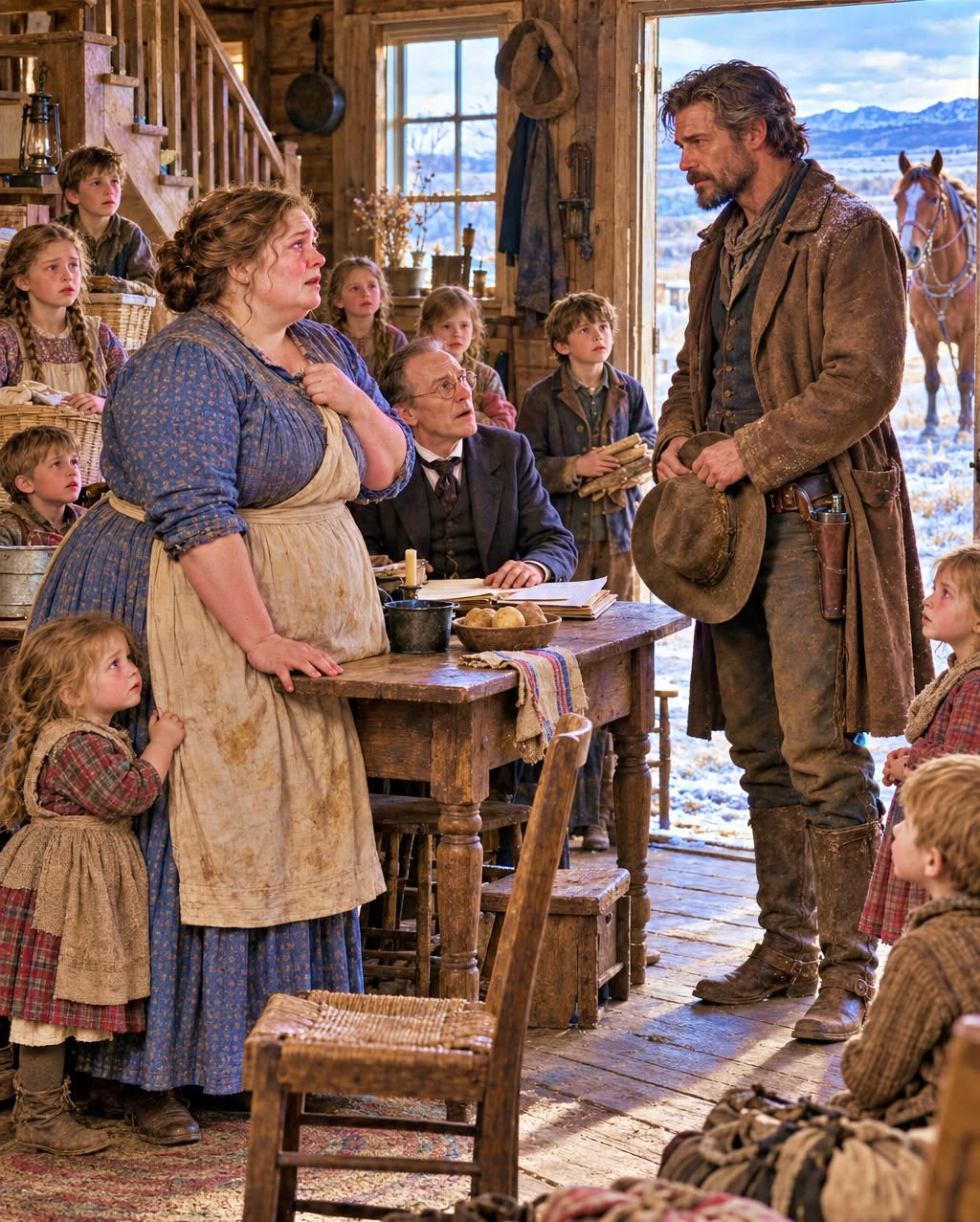
PART 3 — THE MAN WHO KNEW TOO MUCH ABOUT THE NINE CHILDREN
For several seconds, nobody spoke.
Eli held the inspection report in one hand.
Della stood beside him, struggling to understand what she had just heard.
The judge had personally instructed the committee to reject their household.
Why?
Mrs. Hargrove took the document back.
“I cannot discuss the judge’s private instructions.”
Eli stared at her.
“Then explain why an official report uses my ᴅᴇᴀᴅ brother’s name to discredit me.”
“I’ll have to investigate.”
“By noon?”
She lowered her eyes.
“I cannot promise anything.”
Della felt the room beginning to close around her.
“Please,” she whispered. “These children have nowhere else to go.”
Mrs. Hargrove looked at the nine children.
For a moment, her stern expression softened.
But then she closed her folder.
“I am sorry, Mrs. Brennan.”
The officials left.
Thomas was the first to speak.
“Are they really taking us?”
Della opened her arms.
All nine children crowded around her.
“I won’t let you go without fighting for you.”
Eli stood near the window, staring toward the road.
He looked angrier than Della had ever seen him.
“Eli?”
He turned.
“I’m going into town.”
“Why?”
“To speak with the judge.”
“Will he listen?”
Eli picked up his coat.
“He’ll have to.”
Della caught his arm.
“Don’t do anything foolish.”
He looked down at her hand.
Then he gently covered it with his own.
“I’ve spent a long time avoiding trouble, Della. But I’m beginning to think trouble has found us anyway.”
He kissed her forehead.
It was a simple gesture, unexpected and gentle.
Then he rode away.
The journey to town took nearly two hours.
Eli went directly to the courthouse.
The judge, Silas Whitcomb, was sitting behind his desk when Eli entered.
 He looked up.
“Mr. Brennan.”
“Your Honor.”
“I understand you’ve married Mrs. Whitfield.”
“Brennan now.”
The judge ignored the correction.
“An interesting decision.”
“Why did you order my household rejected?”
Whitcomb closed his book.
“The committee determines suitability.”
“You wrote the instruction.”
“I have concerns about your background.”
“You mean my brother’s background.”
The judge’s expression тιԍнтened.
“Your brother was a difficult man.”
“He was also ᴅᴇᴀᴅ before that report was filed.”
Whitcomb stood.
“Watch your tone.”
Eli placed both hands on the desk.
“Why are you trying to take those children?”
“Because the law requires proper guardianship.”
“Then apply the law fairly.”
The judge stared at him.
“You have no idea what you’re involving yourself in.”
“Then explain it.”
Whitcomb walked toward the window.
“Those children have relatives. Some have families willing to take them.”
“Separately?”
“Depending on the circumstances.”
“They’ve lived together for seven years.”
“That is unfortunate.”
Eli’s jaw тιԍнтened.
“Unfortunate?”
The judge turned.
“Some children require separation for their own benefit.”
“Who decides that?”
“The court.”
“And who benefits?”
The judge went silent.
Eli understood then.
This wasn’t simply about regulations.
Someone wanted those children removed from Della’s home.
And the judge was determined to make it happen.
Before Eli could ask another question, the courthouse door opened.
A well-dressed man entered.
He was carrying a leather briefcase.
Judge Whitcomb immediately straightened.
“Mr. Caldwell.”
The stranger nodded.
“Your Honor.”
Eli recognized the name.
James Caldwell.
A wealthy ranch owner who had recently purchased several properties around the county.
Caldwell glanced at Eli.
“Ah. The new husband.”
Eli didn’t move.
Caldwell smiled.
“I hope married life is treating you well.”
“What do you want?”
The man’s smile widened.
“To offer ᴀssistance. Those nine children represent a considerable responsibility. Mrs. Brennan might be happier if she didn’t have to carry it.”
Eli stared at him.
“She’s not carrying it alone.”
“Of course. But you have only recently arrived. You may discover that raising nine children is considerably more difficult than you imagine.”
“What exactly are you offering?”
Caldwell opened his briefcase.
Inside were nine separate documents.
Nine placements.
Nine different destinations.
Each child had been ᴀssigned to a different household.
Eli felt something cold move through his chest.
“You arranged this?”
“I helped identify suitable families.”
“You haven’t even met them.”
Caldwell smiled.
“Children adapt.”
Eli picked up the documents.
Then he noticed something.
Every placement carried the same financial authorization number.
The money wasn’t coming from the families.
It was coming from a private charitable foundation.
A foundation owned by James Caldwell.
“What is this?”
“Administrative support.”
Eli examined the final page.
There were payment amounts beside each child’s name.
He looked up.
“Why are you paying people to take these children?”
Caldwell’s smile disappeared.
“They require support.”
“Then why are the amounts different?”
Silence.
Eli placed the papers on the desk.
“I want to know what you’re doing.”
Caldwell closed his briefcase.
“Be careful, Mr. Brennan. You’re a newcomer. You don’t understand how things work here.”
Eli stepped closer.
“Then perhaps somebody ought to explain.”
When Eli returned home, Della was waiting on the porch.
She saw his expression.
“What happened?”
He handed her the papers.
She read the names.
Thomas.
Sarah.
Caleb.
Annie.
Ruth.
Samuel.
Jacob.
Mary.
Elsie.
Beside every name was a different destination.
Della’s hands began shaking.
“They’ve already decided.”
“Not yet.”
She looked at him.
“Eli, what are we going to do?”
He glanced toward the children playing in the yard.
“I found something strange in town.”
He explained the financial arrangements.
Della read the documents again.
Then she noticed something.
A small notation beside the payment for Thomas.
Agricultural apprenticeship.
Sarah’s document mentioned domestic employment.
Caleb’s listed work at a remote cattle station.
Della looked horrified.
“They aren’t placing them in families.”
Eli shook his head.
“Not all of them.”
“They’re sending my children to work.”
He put a hand on her shoulder.
“We need to find out why.”
That evening, Della made a discovery of her own.
She was searching through the old wooden chest where she kept the children’s birth papers when she found a letter she had never seen before.
It was addressed to her by her late friend, Margaret Ellison.
Margaret had once worked in the county orphan office.
She had died two years earlier.
Della unfolded the paper.
My dear Della,
If the county ever tries to take the children from you, look beneath the loose floorboard in the old schoolhouse.
There is something you must understand about the first nine children.
Della stopped reading.
The first nine children?
She looked toward the staircase.
The children had come to her at different times over seven years.
Some had lost parents.
Others had been abandoned.
One had been found sleeping behind a general store.
They had different surnames.
Different histories.
What could possibly connect them?
She continued reading.
They were not brought to you by chance.
Someone chose your house because your husband once helped protect their parents.
Della felt her heart pounding.
Her husband?
She had never been married.
At least, not legally.
She and Thomas Whitfield had lived together for only a few months before he disappeared during a cattle drive.
The county had declared him missing.
But his name had never been removed from her old property papers.
Could Margaret have been referring to him?
Della folded the letter and put it in her apron pocket.
Then she looked toward Eli.
He was outside repairing the stable.
She needed to tell him.
But before she could reach the door, a small voice came from behind her.
“Mama Della?”
It was Elsie.
The little girl held a wooden toy horse.
“Why is that man taking our names?”
Della knelt.
“Who, sweetheart?”
“The man from the wagon.”
Della’s stomach тιԍнтened.
“What man?”
Elsie pointed toward the road.
“The one who came yesterday. He talked to Sarah.”
Della looked toward the yard.
Sarah was carrying water from the well.
Della hurried outside.
“Sarah!”
The girl turned.
“Yes, Mama?”
“Did someone speak to you yesterday?”
Sarah hesitated.
Then she nodded.
“A man asked me questions.”
“What questions?”
“He asked whether I remembered my real father.”
Della felt cold.
“What did you say?”
“I said I didn’t know him.”
Sarah lowered her voice.
“But he said my father was still alive.”
Della froze.
“Who told you that?”
Sarah reached into her pocket.
She pulled out a folded pH๏τograph.
It showed a man standing beside a little girl.
On the back was a name.
Thomas Whitfield.
Della nearly dropped it.
Her missing husband.
The father she had believed had disappeared forever.
And beneath his name was a short message.
Tell Della the truth before Caldwell finds the property deed.
Eli came running when he heard Della crying out.
He found her on the porch, holding the pH๏τograph.
He looked at it.
Then at her.
“Who is that?”
“My husband.”
Eli studied the image.
“Thomas?”
She nodded.
“He’s alive.”
Eli looked toward the children.
“What does Caldwell want with him?”
Della handed him Margaret’s letter.
Eli read it slowly.
Then he looked toward the distant hills.
“The children weren’t sent to you by chance.”
“What does that mean?”
He folded the letter.
“It means somebody knew their families were connected.”
Della stared at him.
“Connected how?”
Eli lowered his voice.
“I think they’re all heirs to the same piece of land.”
Della looked at the nine names on the county paperwork.
And suddenly, she understood why Caldwell was so desperate to separate them.
If the children stayed together, they could inherit the property collectively.
But if they were divided and sent away, their claims could be challenged individually.
Della looked toward the stable.
“Then we have to find Thomas.”
Eli nodded.
But before either could move, a wagon appeared at the end of the road.
Two men climbed down.
One carried a badge.
The other carried a document.
The sheriff approached the porch.
“Mrs. Brennan?”
Della stood.
“What is it?”
“I have an order signed by Judge Whitcomb.”
Eli stepped forward.
“What order?”
The sheriff unfolded the paper.
It was an emergency removal order.
But the sheriff wasn’t looking at Della.
He was looking at Sarah.
“I’m here to take the oldest child into custody immediately.”
Della moved in front of her daughter.
“No.”
The sheriff hesitated.
“Ma’am, don’t make this difficult.”
Eli moved beside her.
“You’re not taking anyone.”
The sheriff lifted his hand.
“Mr. Brennan, step aside.”
Then a voice came from behind the wagon.
“Let them stay.”
Everyone turned.
An old man stood beside the road.
His coat was torn.
His beard was gray.
He leaned heavily on a wooden walking stick.
Della stared at him.
The face was older, thinner, and marked by years of hardship.
But she knew those eyes.
The man took one trembling step forward.
“Della.”
She covered her mouth.
“Thomas?”
He nodded.
Then he looked at the nine children.
“My children,” he whispered.
Thomas Whitfield had finally come home.
But he hadn’t returned alone.
In his other hand, he carried a leather folder.
And inside that folder was the original deed to the land beneath all nine children’s names.
END OF PART 3