PART 3 — THE LETTER THAT REVEALED WHY HE HAD CHOSEN HER
PART 3 — THE LETTER THAT REVEALED WHY HE HAD CHOSEN HER
Eleanor hardly slept that night.
The sheriff had left with a promise to investigate the land claim, but Caleb remained awake long after the fire had burned low.
He sat at the table, studying the disputed document.
Every so often, he would turn it over, examine the signature, and set it down again.
At last, Eleanor came downstairs.
“You’re still awake.”
Caleb looked up.
“I didn’t mean to disturb you.”
“You didn’t. The silence did.”
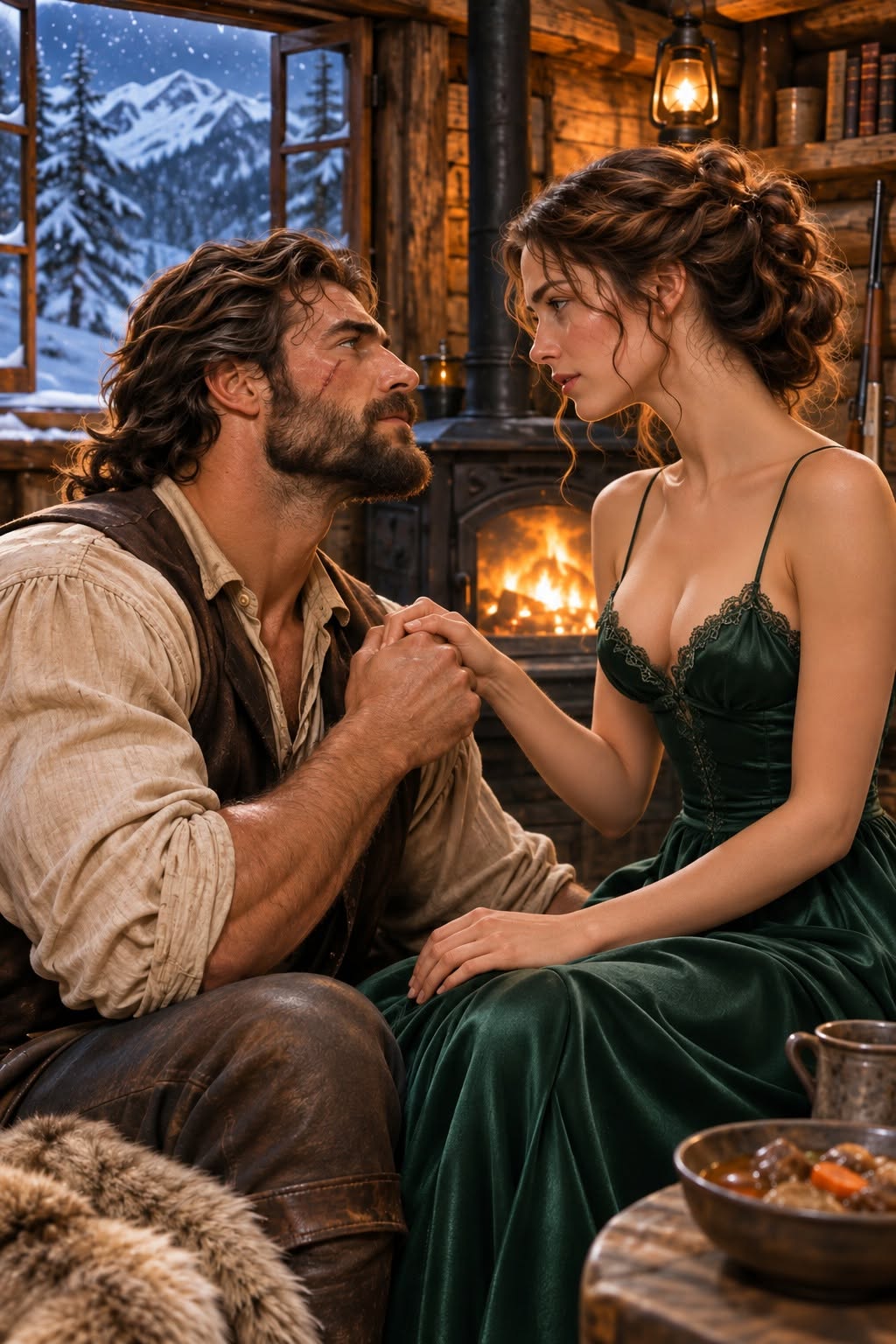
He moved the chair beside him.
She sat.
“Tell me about your father.”
Caleb stared at the document.
“He was a miner before he became a trapper. He spent years working in the northern mountains. One winter, he discovered an old survey marker that didn’t match the county records.”
“Was that how he found this land?”
“Yes. He believed the original mining claim included the cabin, the pasture, and a stretch of forest beyond the ridge.”
“Why didn’t he settle the matter?”
“He tried. But the man who had recorded the claim disappeared before the papers could be filed.”
Eleanor leaned closer.
“And Graves knows this?”
“He knows enough.”
Caleb placed the document on the table.
“My father kept a copy of the original survey. He said it was hidden somewhere on the property. Before he died, he told me never to let anyone take the northern pasture.”
“Did you find it?”
“No.”
“Then why did you marry me?”
He looked at her.
“Because I didn’t want to spend the rest of my life alone.”
The answer was so simple that Eleanor felt foolish for expecting something more complicated.
Caleb continued.
“I know that sounds selfish.”
“It sounds honest.”
“I thought if I had a wife, perhaps I would finally learn how to be part of the world again.”
Eleanor studied his face.
“Caleb, you cannot expect me to become your entire world.”
“I don’t.”
“Good. Because I intend to have friends, interests, and opinions. Some of them may even disagree with yours.”
A faint smile crossed his face.
“I was hoping they would.”
She reached for his hand.
“Then perhaps we can learn together.”
For a moment, Caleb simply looked at their joined hands.
Then he turned his palm upward, allowing her to hold it more comfortably.
It was a small gesture.
But Eleanor understood that, for him, even small gestures required courage.
The next morning, Eleanor began exploring the cabin.
She wanted to know the place she had agreed to call home.
There were shelves of books, carefully repaired furniture, jars of preserved fruit, and a small room Caleb used for storing tools.
In a corner of the bedroom stood an old writing desk.
Inside it, she found a bundle of papers wrapped in oilcloth.
The first was a letter from Caleb’s father.
The second was a rough drawing of the mountain.
The third was a list of names.
Eleanor recognized one immediately.
Nathaniel Graves.
But there were others.
A county clerk.
A former mining superintendent.
And a man named Arthur Whitmore.
Her breath caught.
Arthur Whitmore was her late husband’s father.
She read the list again.
Why would her father-in-law’s name appear among the people connected to Caleb’s father’s mining claim?
A note was attached.
The Baltimore connection must be verified before the claim can be restored.
Eleanor carried the papers downstairs.
“Caleb, what does this mean?”
He looked at the list.
For several seconds, he did not speak.
Then he pulled out a chair.
“Your father-in-law was involved in the original mining company.”
Eleanor sat opposite him.
“My husband’s father?”
“Yes. He helped finance the operation before the mine closed.”
“But why would that matter now?”
“Because the original claim was never properly transferred. Your husband’s family may have inherited part of the rights.”
Eleanor stared at him.
“My husband never mentioned a mine.”
“Perhaps he didn’t know.”
She thought of the creditors, the foreclosure, and the papers she had signed without fully understanding them.
“Could Graves have known?”
“That’s what I’m afraid of.”
Caleb unfolded the old drawing.
At the bottom was a symbol: a mountain peak with three small circles beneath it.
Eleanor recognized the symbol.
She had seen it before.
On the back of her mother’s wedding clock.
Her heart began to pound.
“Caleb, I think I know where another copy of these papers might be.”
He looked up.
“Where?”
“My mother’s belongings.”
Eleanor had lost almost everything when the creditors came.
But not everything had been sold.
Before the auction, she had hidden a small box of family keepsakes with a trusted former servant. The box contained letters, pH๏τographs, and a few items from her parents’ home.
She had not thought about it in months.
Now she wondered whether it contained the missing piece of the mystery.
The problem was that the box remained in Baltimore.
Caleb listened as she explained.
“We can’t travel there in this weather,” he said.
“I know.”
“But we can write to the woman who kept it.”
 Eleanor nodded.
“Her name is Mrs. Porter. She served my mother for twenty years. She would never have thrown anything away.”
Caleb fetched paper and ink.
Eleanor wrote a careful letter asking Mrs. Porter to examine the box and look for anything bearing the mountain symbol.
When she finished, Caleb offered to send it with the next available mail rider.
He folded the letter and placed it beside the door.
Then he looked at her.
“You’ve become very quiet.”
“I’m thinking.”
“About Baltimore?”
“About how strange it is that my old life and this mountain seem connected.”
Caleb nodded.
“Perhaps they always were.”
She studied him.
“Did you know who my father-in-law was when you sent the first letter?”
“No.”
“Did you know my husband’s family had connections to your father’s claim?”
“No. I discovered that after Graves contacted me.”
Eleanor believed him.
But she also realized that the man she had married was connected to a story that had begun long before either of them had met.
And that story was not finished.
Two days later, the sheriff returned.
He brought a visitor.
A thin, nervous man wearing a black coat and carrying a leather folder.
“Mrs. Mercer, Mr. Caleb,” Sheriff Reed said. “This is Mr. Edwin Price. He used to work in the county land office.”
Price removed his hat.
“I believe I can explain the disputed claim.”
Caleb gestured toward the table.
“Then explain it.”
Price opened his folder.
He produced a copy of an old mining record.
“The northern pasture was never legally sold. The original company dissolved, but its ownership was transferred into a family trust.”
“Whose family?” Eleanor asked.
Price looked at her.
“The Whitmore family.”
Eleanor felt her heart skip.
“Mine?”
“Your late husband’s family, yes.”
Caleb leaned forward.
“And my father’s claim?”
“Your father was named caretaker of the property after the mine closed. He was responsible for maintaining the land until the trust could be properly settled.”
Eleanor looked at Caleb.
He seemed stunned.
Price continued.
“Unfortunately, the original trust papers disappeared. Without them, the county could not establish the proper ownership.”
“Who benefited from that?” Eleanor asked.
Price hesitated.
“Several people acquired leases and rights to the surrounding property. Mr. Graves was among them.”
Caleb’s voice turned cold.
“So he knew the land wasn’t his.”
“Yes.”
“Then why did he file the claim?”
“Because he believes the original documents are gone forever.”
Eleanor looked at the papers.
“And what happens if we find them?”
Price closed the folder.
“Then the property may be restored to the trust, and every fraudulent transfer could be challenged.”
Caleb stood.
“Where were the original papers kept?”
Price looked toward the window.
“Your father hid them somewhere on this mountain.”
Caleb’s face changed.
“My father never told me where.”
“Perhaps he couldn’t.”
Price reached into his folder and removed a small pH๏τograph.
It showed Caleb’s father standing beside a large pine tree.
Behind him was a wooden building that no longer existed.
On the back, someone had written:
Where the first winter ended.
Caleb stared at the picture.
“I know this place.”
Eleanor looked at him.
“Where?”
“The old mining cabin. It’s on the northern ridge.”
Sheriff Reed frowned.
“That building collapsed years ago.”
“Not entirely,” Caleb replied. “There’s a stone foundation beneath it.”
Price nodded.
“Then that’s where we should look.”
They waited until the weather improved.
On the morning of their journey, Caleb prepared two horses and packed food, blankets, and lanterns.
Eleanor put on her warmest coat.
Caleb examined her boots.
“Those won’t do.”
“They’re the warmest pair I own.”
“The trail is rough. You’ll need mine.”
He brought out a sturdy pair of leather boots from the storage room.
“They belonged to my mother,” he explained. “She was smaller than I am, but I think they’ll fit.”
Eleanor slipped them on.
They were a little large, but comfortable.
“Thank you.”
Caleb nodded.
Then, as she mounted the horse, he offered his hand.
She accepted it.
Their journey took them through pine forests and across a frozen stream. The mountains rose around them, quiet and enormous.
At last, they reached the remains of the old mining cabin.
Most of the wooden structure had collapsed, but the stone foundation remained.
Caleb dismounted.
“My father brought me here when I was thirteen.”
Eleanor looked around.
“Did he tell you about the papers?”
“No. He told me to remember the place.”
They searched the foundation carefully.
Behind a loose stone, Eleanor discovered a narrow metal container.
It was sealed with wax.
Caleb knelt beside her.
For a moment, he simply stared at it.
Then he opened the container.
Inside were several folded documents, a small notebook, and a letter.
The first document bore the seal of the original mining company.
The second named the Whitmore family trust.
The third contained the signatures of Caleb’s father and Eleanor’s father-in-law.
Eleanor felt tears sting her eyes.
Her family had been connected to this mountain all along.
She opened the letter.
To the rightful heirs,
The land must remain protected until the family trust can be restored. No single person should be permitted to sell or divide it without the agreement of all named beneficiaries.
The spring and northern pasture are to remain open for the benefit of the surrounding families.
If this agreement is broken, the original documents must be presented to the county court.
At the bottom were two signatures.
One belonged to Caleb’s father.
The other belonged to Arthur Whitmore.
Eleanor looked at her husband.
“Caleb, this means the land was never supposed to belong to Graves.”
He nodded slowly.
“It means he has been trying to steal something that was never his.”
But then Eleanor noticed something strange.
The document listed three beneficiaries.
The Whitmore family.
The Mercer family.
And a third name.
Nathaniel Graves.
She read it again.
“Caleb, why is Graves named as a beneficiary?”
He took the paper from her.
His expression darkened.
“Because he was part of the original trust.”
Eleanor looked at him.
“Then how did he become the enemy?”
Caleb unfolded the final page.
It contained a handwritten note from his father.
Graves was entrusted with the records after the mine closed. He was supposed to protect the land until the heirs could be identified.
Instead, he changed the agreements and claimed the property for himself.
Eleanor stared at the page.
The man who had taken her home had once been entrusted with protecting it.
And now he wanted to destroy the very people the trust had been created to help.
Caleb carefully placed the papers back into the container.
“We have to get these to the sheriff.”
Eleanor nodded.
But before they could leave, a horse whinnied somewhere beyond the trees.
Caleb turned sharply.
A rider emerged from the forest.
Nathaniel Graves.
He stopped several yards away and looked at the metal container in Caleb’s hands.
Then he smiled.
“I wondered how long it would take you to find that.”
Caleb stepped in front of Eleanor.
“Stay where you are, Graves.”
The older man laughed softly.
“You’ve never understood how this works, Mercer. Your father didn’t leave you a fortune. He left you a problem.”
Eleanor held the documents тιԍнтly.
“These papers belong to the trust.”
Graves looked at her.
“Mrs. Whitmore. Or should I say Mrs. Mercer? You’ve had a remarkable talent for marrying into trouble.”
Eleanor lifted her chin.
“And you’ve had a remarkable talent for taking things that don’t belong to you.”
His smile disappeared.
“You have no idea what those documents will cost you.”
Caleb’s voice was quiet.
“She’s not afraid of you.”
Graves glanced at him.
“No. But she should be.”
He turned his horse and rode away.
Caleb watched until the man disappeared behind the trees.
Then he looked at Eleanor.
“We need to go. Now.”
She held the documents against her chest.
“Caleb?”
“Yes?”
“I think your father knew this day would come.”
He nodded.
“And I think he knew we’d have to face it together.”
Eleanor reached for his hand.
“Then let’s finish what he started.”
But when they returned to the cabin, a letter was waiting beneath the door.
It had come from Baltimore.
The handwriting belonged to Mrs. Porter.
Eleanor opened it with trembling fingers.
Dear Mrs. Mercer,
I found the box you asked about. There is a document inside bearing your mother’s name. I believe it explains why your father-in-law wanted the mountain trust restored.
But there is something else.
Your first husband knew about the trust before he died.
And he left a letter addressed to you.
Eleanor stopped reading.
She looked at Caleb.
“My first husband knew?”
Caleb took the letter and examined the final lines.
Then his expression changed.
Because Mrs. Porter’s message ended with a warning:
Do not let Nathaniel Graves reach Baltimore before you do. He knows what the letter contains.
TO BE CONTINUED…