PART 3 – THE LAST PROMISE: WHEN HE FINALLY UNDERSTOOD THAT LOVE WAS NOT ENOUGH
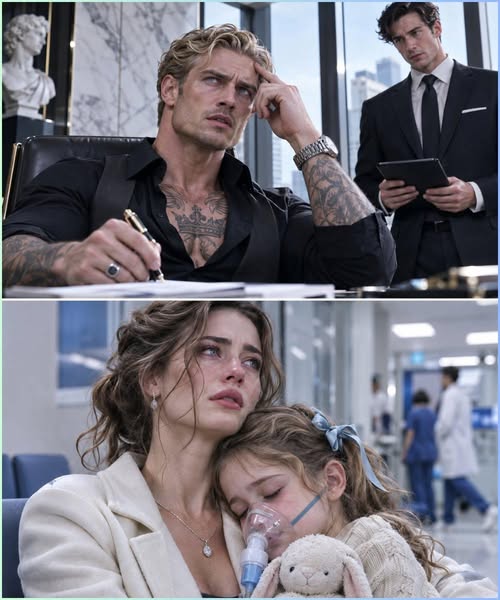
One year after I left Greenwich, Russell Whitcomb appeared at the entrance of the Pasadena library carrying a small wooden box.
I was standing near the children’s reading section, helping Poppy arrange picture books on a low shelf.
When she saw him, she dropped the book in her hands.
“Daddy!”
Russell smiled.
“Hello, princess.”
She ran toward him.
He knelt and caught her in his arms.
I watched them from a distance.
He looked different.
His expensive suit had been replaced by a simple navy sweater and dark trousers. There was no ᴀssistant following him, no phone pressed against his ear, and no impatient expression suggesting that he had somewhere more important to be.
He had come alone.
And he was early.
That was something I never thought I would notice about my own husband.
But I did.
“Mommy,” Poppy called, “Daddy brought something!”
Russell approached me.
“I hope you don’t mind.”
“What is it?”
He opened the wooden box.
Inside was a small silver frame.
It contained my father’s original bridge sketch, carefully restored from the damaged drawing.
I stared at it.
For several seconds, I couldn’t speak.
“Where did you get this?”
“Your father made two versions of that sketch. I found the smaller one in an archive box at the Greenwich house. It was damaged at one corner, so I had a conservator restore it.”
I touched the frame.
“You remembered this?”
“I remembered how much it meant to you.”
He paused.
“I’m sorry it took me so long.”
I closed the box carefully.
“Thank you.”
It was the first time in months that I had accepted something from him without feeling that I owed him anything in return.
We sat outside the library while Poppy played in the courtyard.
Russell watched her carefully.
“She looks happy.”
“She is.”
“She’s grown so much.”
“She has.”
He smiled faintly.
“I missed her first swimming lesson.”
“You did.”
“And her school performance.”
“Yes.”
He lowered his head.
“I can’t get those days back.”
“No, you can’t.”
He looked at me.
“I’m not asking you to pretend they didn’t happen.”
“Then why are you here, Russell?”
He took a deep breath.
“Because I want to tell you something before you hear it from someone else.”
I waited.
“The board has removed me as chief executive of Whitcomb Development.”
I wasn’t surprised.
“What happened?”
“The Harborstone investigation concluded. The independent review found that the approval process had been seriously mishandled. The company also confirmed that your original architectural concept had been improperly attributed.”
He looked toward the courtyard.
“Tessa’s employment was terminated after the internal investigation. The company corrected the project records and issued a formal acknowledgment of your original work.”
I nodded.
“That should have happened a long time ago.”
“I know.”
He hesitated.
“I also sold my shares.”
I turned toward him.
“Why?”
“Because I realized I had spent my entire life building a company and almost nothing building a family.”
I studied his expression.
“Selling your shares doesn’t make you a better husband.”
“I know that too.”
“Losing your position doesn’t give you the right to start over with me.”
He nodded.
“I understand.”
For a moment, we listened to Poppy laughing.
Then Russell spoke again.
“I’ve started working with a small development firm. Nothing like Whitcomb. We’re focusing on community housing and public spaces.”
I looked at him.
“Why?”
He smiled sadly.
“Your father once told me that a building should make people’s lives better. I used to think he was talking about architecture. I think he was talking about everything.”
I didn’t answer.
Because I remembered my father saying those exact words.
And I wondered whether Russell had finally understood something that I had been trying to explain for years.
Two weeks later, something unexpected happened.
I received a call from the hospital where Poppy had been treated during that frightening night in Greenwich.
They were organizing a fundraising initiative to expand pediatric emergency services.
Daniel had recommended my work.
Evelyn encouraged me to submit a proposal.
I agreed.
The project would redesign the children’s waiting area, making it brighter, calmer, and more accessible to families experiencing emergencies.
I spent three weeks developing the concept.
When I presented it to the hospital committee, I included a small section dedicated to parents who needed somewhere comfortable to sit beside their children during long nights.
A committee member asked why that detail mattered so much to me.
I smiled.
“Because sometimes the most important thing a child needs isn’t another machine or another monitor. It’s a parent who can stay beside them.”
After the presentation, the committee unanimously approved my proposal.
My first major independent public project was officially underway.
And this time, every drawing, every calculation, and every presentation carried my name.
Russell continued visiting Poppy.
At first, he came every other weekend.
Then he began arranging video calls during the week.
He learned her favorite breakfast, her preschool teacher’s name, and which stuffed animal she refused to sleep without.
He even learned how to braid her hair.
Badly.
Very badly.
One Saturday, Poppy came running into the kitchen with two uneven braids.
“Mommy! Daddy did my hair!”
I looked at Russell.
He stood behind her, holding a hairbrush like someone who had survived a difficult battle.
“I think I did pretty well.”
I raised an eyebrow.
“Did you?”
Poppy giggled.
“Daddy said the second one is better because he practiced on the first one.”
For the first time in years, I laughed with him.
Not because I had forgotten what happened.
But because I could finally enjoy a moment without pretending that everything between us was perfect.
Still, I maintained clear boundaries.
Russell and I were no longer a couple.
We were two parents learning how to give our daughter the stability she deserved.
He respected that.
And that mattered more than any romantic declaration he could have made.
Then came the day that changed everything for Russell.
It was Poppy’s fifth birthday.
We organized a small celebration in the garden of our apartment building.
There were balloons, cupcakes, strawberry cake, and a table covered in children’s drawings.
Russell arrived early.
He carried a large box.
Poppy opened it and gasped.
Inside was a miniature architectural drawing set.
Colored pencils, rulers, a sketchbook, and a small wooden model house.
“Daddy! Is this mine?”
“Every bit of it.”
“Can I build a house?”
“You can build anything you imagine.”
She threw her arms around him.
Then she ran to show me.
“Mommy, look! I’m going to be an architect like Grandpa!”
I smiled.
“Then you’ll need to practice drawing.”
Russell watched us.
There was something in his expression that I recognized.
Regret.
But this time, he didn’t interrupt our moment to ask for forgiveness.
He simply stood there, smiling at his daughter.
Later, when the guests had left, Poppy fell asleep on the couch.
Russell helped me gather the decorations.
As he picked up the paper plates, he noticed a small envelope beneath the table.
It was addressed to me.
Inside was a pH๏τograph.
Our wedding day.
I had almost forgotten that particular picture.
Russell stood beside me, holding my hand, while my father stood behind us with an enormous smile.
On the back, my father had written:
May you always build a home where both of you feel loved.
Russell read it twice.
Then he handed it to me.
“I failed that promise,” he whispered.
I looked at the pH๏τograph.
“Yes, you did.”
“I wish I had understood sooner.”
“So do I.”
He looked at me.
“Do you ever think about what would have happened if I had come home that night?”
I considered the question.
“Sometimes.”
“Would we still be together?”
I shook my head slowly.
“I don’t know. But I know I wouldn’t have kept living the way we were living.”
He nodded.
Then he asked the question I had expected for months.
“Is there any chance we could ever be a family again?”
I looked at him for a long moment.
“Russell, we already are a family. Poppy is our family. But being her parents doesn’t mean we have to be husband and wife.”
His eyes became wet.
“I still love you.”
I believed him.
But love had never been the only thing missing from our marriage.
Trust was missing.
Respect was missing.
Partnership was missing.
And those things couldn’t be restored simply because one person had finally realized their importance.
“I hope you find happiness,” I told him. “But I can’t promise you that it will be with me.”
He looked down.
Then he nodded.
“I understand.”
And for once, he didn’t ask me to change my answer.
Six months later, the children’s emergency waiting area officially opened.
The hospital held a small ceremony.
My design included soft natural light, comfortable family seating, quiet spaces for children, and a wall of colorful illustrations created by local schoolchildren.
Above the entrance was a small plaque:
THE DOUGLAS FLETCHER FAMILY CARE SPACE
I had named it after my father.
Evelyn stood beside me during the ceremony.
Daniel attended with his wife.
Poppy wore a beautiful yellow dress and held a bouquet of white roses.
Russell was there too.
He stood at the back of the room.
When the hospital director invited me to speak, I stepped forward.
I looked at the people gathered before me.
Then I looked at my daughter.
“Years ago, my father taught me that architecture isn’t about creating beautiful buildings. It’s about creating places where people feel safe, valued, and cared for.”
I paused.
“He believed that the smallest details often matter most. A door that opens easily. A chair beside a hospital bed. A window that allows a frightened child to see the sunlight.”
My voice trembled slightly.
“This project is dedicated to him. But it’s also dedicated to every parent who has ever sat beside a hospital bed, hoping that someone they love will be okay.”
When I finished, the room filled with applause.
Poppy ran toward me.
“Mommy! Grandpa would love it!”
I knelt and hugged her.
“I think he would, sweetheart.”
Across the room, Russell was wiping his eyes.
He didn’t come forward.
He didn’t try to make the moment about himself.
He simply applauded.
And I appreciated that.
A year later, I received the final divorce decree.
The paperwork arrived on a quiet Tuesday morning.
I signed the last document at my attorney’s office.
There was no dramatic confrontation.
No shouting.
No desperate promises.
Just two people acknowledging that the marriage they had once believed would last forever had reached its end.
Russell signed his documents that afternoon.
He sent me a short message.
I hope your life becomes everything you once dreamed it could be. Thank you for giving me the chance to become a better father.
I read it.
Then I put my phone down.
Outside, Poppy was waiting beside the car with her little backpack.
“Mommy, are we going home?”
I smiled.
“Yes, baby.”
She climbed into her seat.
As I fastened her belt, she asked:
“Will Daddy come for dinner on Sunday?”
“If he wants to.”
“Can we make his favorite pasta?”
I laughed softly.
“Of course.”
She seemed satisfied.
Then she added something that made my heart ache in the sweetest possible way.
“Mommy, I think Daddy is happier now.”
I looked at her.
“Why do you think that?”
“Because he doesn’t look at his phone when he’s with me anymore.”
I kissed her forehead.
“That’s a very good thing, sweetheart.”
And it was.
Russell had finally learned to be present.
But I had learned that I didn’t have to return to a broken marriage simply because the person who hurt me had started becoming better.
That evening, I opened the wooden box containing my father’s restored bridge sketch.
I placed it on my desk beside my professional portfolio.
Underneath it was the wedding pH๏τograph.
For a moment, I considered putting the pH๏τograph away.
Then I changed my mind.
I left it where it was.
Not because I wanted to return to that marriage.
But because I no longer needed to hate the past to appreciate the life I had built afterward.
My father had once told me that buildings were promises to the people who lived inside them.
I finally understood that a home wasn’t defined by its walls, its address, or the name on its mailbox.
A home was where your voice mattered.
Where your dreams weren’t treated as inconveniences.
Where your child never had to wonder whether someone would show up.
And where love didn’t require you to disappear.
I had spent years trying to save my marriage.
Then I spent one terrible birthday learning that I couldn’t save something alone when the other person refused to see it was breaking.
But leaving hadn’t destroyed my family.
It had given my daughter a happier mother, given me back my career, and given Russell the opportunity to become the father he should have been from the beginning.
Sometimes, the ending of a marriage isn’t the ending of a family.
Sometimes, it’s the beginning of three people finally learning how to live honestly.
I looked at the restored drawing one last time.
Then I turned off the light.
From the bedroom, Poppy called:
“Mommy! Can you read me a story?”
“Coming, sweetheart!”
I walked toward her voice.
And this time, I wasn’t walking away from someone.
I was walking toward the life I had finally chosen.
THE END.