PART 3 – THE FINAL BETRAYAL: THE SECRET THAT CHANGED EVERYTHING
She sat beside the H๏τel window with her father’s old pH๏τograph in her hands, staring at a face she hadn’t seen in fourteen years.
Her father, Thomas Bennett, had been a quiet man.
He wasn’t wealthy in the traditional sense. He didn’t own a mansion, drive expensive cars, or attend charity galas.
But he understood business.
He understood people.
And, apparently, he had understood the Voss family far better than Lydia ever had.
At 8:15 the following morning, Margaret Ellis arrived carrying a sealed envelope.
“Before you open this,” Margaret said, “I need you to understand that your father’s estate was never as simple as you were told.”
Lydia looked at her.
“What does that mean?”
Margaret placed the envelope on the table.
“Your father established a private investment trust shortly before his death. It was funded through several businesses, including a shipping partnership that eventually became connected to Voss Enterprises.”
Lydia stared at the envelope.
“How much?”
Margaret hesitated.
“The current estimated value is approximately eighty-six million dollars.”
Lydia laughed once.
It wasn’t amusement.
It was disbelief.
“Eighty-six million?”
“Yes.”
“Why didn’t anyone tell me?”
“Your father left specific instructions. The trust was to remain dormant until someone attempted to use your idenтιтy or financial interests without your permission.”
Lydia looked at the envelope.
“And Alexander Voss?”
“Your father appointed him as an independent trustee because Alexander was the only member of the Voss family he believed could be trusted to protect the arrangement.”
Lydia frowned.
“But Alexander is trying to take Fletcher’s company.”
Margaret nodded.
“That’s what we need to understand.”
She handed Lydia a second document.
It was a letter in her father’s handwriting.
Lydia recognized the uneven letters immediately.
Her fingers trembled.
She began reading.
My dearest Lydia,
If you are reading this, something has happened that I spent many years hoping you would never have to face.
I knew Richard Voss. I knew his ambitions, his weaknesses, and the dangerous expectations he placed upon his sons.
I also knew that one day, someone might attempt to use your name to obtain something that did not belong to them.
I established this trust not to make you wealthy, but to ensure that no person could ever make you financially dependent on their kindness.
Never confuse being loved with being protected.
And never remain in a room where someone needs you to be smaller so they can feel powerful.
You have always been stronger than you know.
Love,
Dad.
Lydia lowered the letter.
For several moments, she couldn’t speak.
She had spent six years believing she was fortunate to have married Fletcher Voss.
She had believed his wealth, his connections, and his protection were things she needed to preserve.
Her father had spent his final years making sure she would never need any of them.
Margaret gently touched her shoulder.
“Your father wanted you to have choices.”
Lydia wiped her eyes.
“Then I think it’s time I made one.”
Meanwhile, Fletcher was discovering that his brother’s plans were considerably more complicated than he had imagined.
The emergency board meeting began at nine.
Alexander arrived with three attorneys and a financial adviser.
Fletcher sat at the head of the table, but the atmosphere had changed.
He no longer commanded the room.
He was defending his position.
Alexander opened his presentation.
“Voss Enterprises has accumulated significant liabilities. The company has also been exposed to unauthorized financial transactions, questionable vendor agreements, and executive misconduct.”
Fletcher interrupted.
“You’ve been involved in these transactions.”
Alexander didn’t blink.
“Prove it.”
“I have Celia’s records.”
“Then provide them to the investigators.”
Fletcher leaned forward.
“You’re not taking this company.”
Alexander folded his hands.
“That depends on the shareholders.”
The board chairman cleared his throat.
“Before we proceed, there’s an additional matter.”
He turned toward the entrance.
“Lydia Bennett has requested permission to address the board.”
Fletcher immediately stood.
“What?”
The doors opened.
Lydia walked into the room.
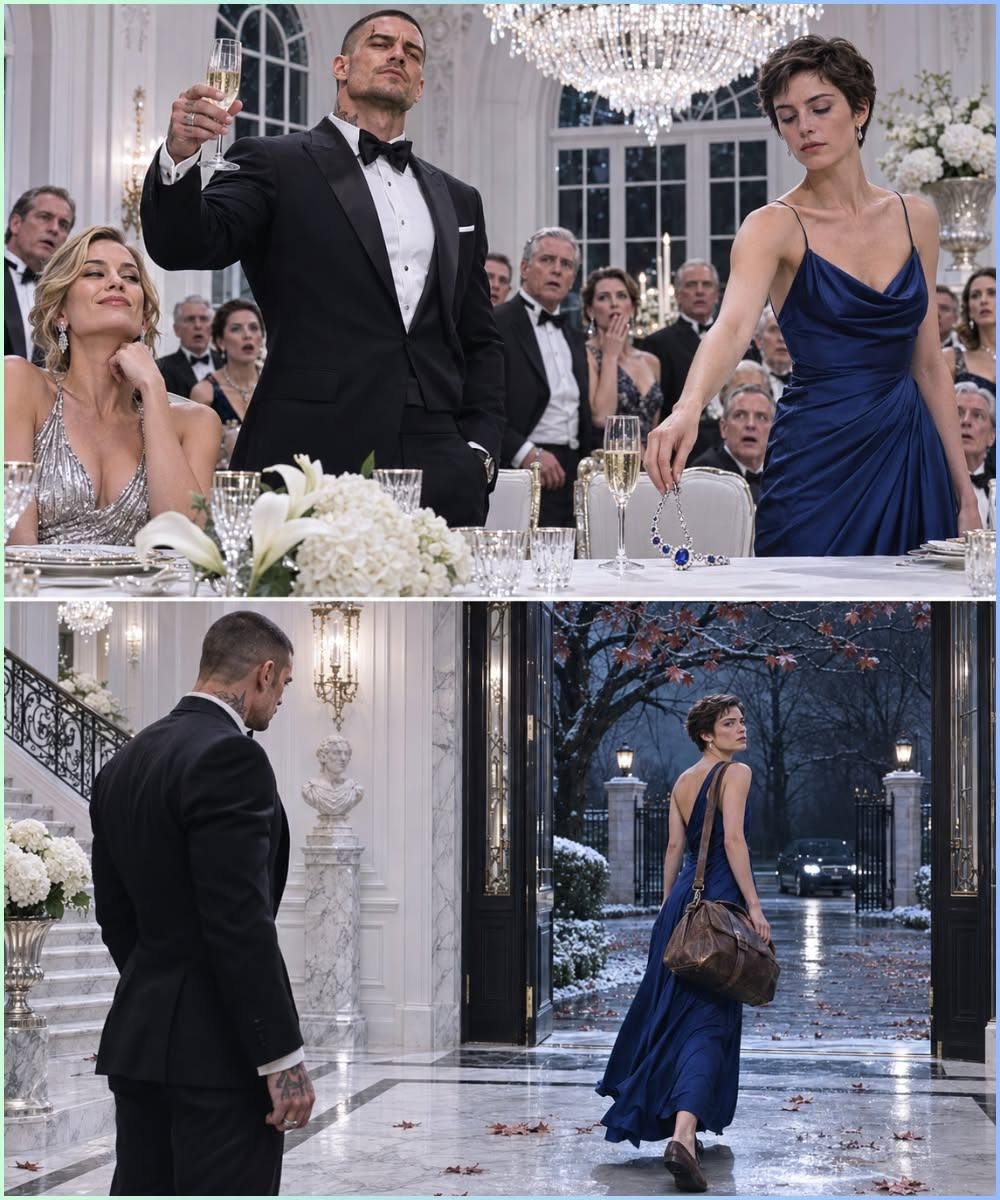
She wore a simple black suit, carried a leather folder, and looked nothing like the woman who had left the gala with an old brown traveling bag.
Fletcher stared.
“Lydia?”
She nodded politely.
“Good morning.”
Alexander rose.
“Lydia.”
She looked at him.
“Mr. Voss.”
Fletcher glanced between them.
“You two know each other?”
Alexander answered before she could.
“Our families have known each other for a long time.”
Fletcher’s expression hardened.
“What does that mean?”
Lydia took her seat.
“It means you weren’t the only person in this room who had a relationship with my family before our marriage.”
The chairman invited her to speak.
Lydia opened her folder.
“I am here to clarify three matters. First, I did not authorize the Northbridge transactions. Second, my idenтιтy was used without my permission. Third, I have documents establishing the actual ownership structure of several ᴀssets currently being claimed as part of Voss Enterprises.”
Fletcher stared at her.
“What ᴀssets?”
She placed a document on the table.
“The Baltimore shipping terminal.”
The board members exchanged glances.
Fletcher frowned.
“That terminal belongs to Voss Enterprises.”
“No. It doesn’t.”
She turned another page.
“It was acquired through a separate partnership funded by my father’s trust. Voss Enterprises has operated it under a long-term commercial agreement.”
Fletcher looked at Alexander.
Alexander remained silent.
Lydia continued.
“The agreement was negotiated four years ago. I secured the renewal terms personally. The company has benefited from the arrangement, but the underlying ownership was never transferred.”
The chairman examined the document.
“Are you saying Mrs. Bennett’s family trust owns the terminal?”
“Yes.”
“And what is the estimated value?”
“Approximately twenty-eight million dollars.”
Fletcher leaned back.
For the first time, he looked genuinely stunned.
“You’re telling me you own one of our most important shipping terminals?”
Lydia looked at him.
“I am telling you that my family owns it. You simply never bothered to understand the contracts you were signing.”
The meeting continued for nearly three hours.
Lydia provided the trust documents, the original acquisition agreements, and the records showing how Northbridge had attempted to use her idenтιтy.
The board ordered an independent forensic audit.
Alexander’s financial interests were also placed under review.
But the most important revelation came when Margaret Ellis entered with an additional document.
It was a letter signed by Thomas Bennett and witnessed by two independent attorneys.
The letter explained why Alexander had been appointed trustee.
Fourteen years earlier, Richard Voss had attempted to force Thomas Bennett into a financial arrangement that would have transferred control of several shipping ᴀssets to the Voss family.
Thomas refused.
Alexander, then a young executive, had secretly helped him protect those ᴀssets.
Richard discovered the arrangement and removed Alexander from several family business responsibilities.
Alexander eventually left the company.
But Thomas never forgot what he had done.
He established the trust and appointed Alexander as an independent trustee.
Fletcher listened in disbelief.
“Why didn’t anyone tell me?”
Alexander finally spoke.
“Because your father never trusted you with the truth.”
Fletcher’s face darkened.
“You’re my brother.”
“Yes.”
“You could have told me.”
“I tried.”
Alexander leaned forward.
“Do you remember the meeting where I questioned Celia’s appointment?”
Fletcher said nothing.
“You told me I was jealous because I wasn’t running the company. You told security to escort me out.”
Fletcher looked away.
“I was protecting my business.”
“No, Fletcher. You were protecting your ego.”
Alexander closed the folder.
“I didn’t come here to destroy you. I came because Celia and several other people were stealing from a company that belonged to employees, investors, and families who trusted us.”
He paused.
“And because I knew you would never listen to me.”
The board voted to remove Fletcher from executive leadership pending the investigation.
Alexander was appointed interim chairman.
The company remained operational under independent oversight.
And Lydia’s trust retained ownership of the Baltimore terminal.
For Fletcher, it was the beginning of a very different life.
Celia Brandt was arrested three weeks later.
The investigation uncovered a network of fraudulent consulting agreements, forged authorizations, and transfers totaling nearly twelve million dollars.
The evidence also revealed that Celia had been working with Alexander’s former financial adviser, who had secretly provided her with confidential company information.
Alexander had not authorized the theft.
In fact, he had been gathering evidence against the group for months.
Owen cooperated with investigators and provided internal communications that helped establish how the fraudulent transactions had been approved.
Fletcher was questioned extensively about his executive oversight and the signatures attached to the disputed documents.
Although the investigation found no evidence that he had personally received the stolen funds, his failure to supervise the transactions and his repeated disregard of internal warnings cost him his position.
He had spent years believing he was untouchable.
Now he had to answer questions from people who didn’t care about his last name.
And Celia, the woman he had chosen over his wife, eventually admitted that she had deliberately used his trust to gain access to the company.
When Fletcher learned that she had been planning to leave the country with the money, he finally understood how little their relationship had meant to her.
He had mistaken attention for loyalty.
Just as he had mistaken Lydia’s patience for weakness.
Six months later, the divorce was finalized.
Lydia retained her separate investments, the ᴀssets protected by her family trust, and the compensation she had independently earned.
She didn’t pursue Fletcher’s personal fortune.
She didn’t want his mansion.
She didn’t want his cars.
She didn’t want the expensive jewelry he had once used to apologize for being absent.
She wanted a clean separation.
And she got one.
The first thing she did was purchase a modest waterfront property outside Boston.
It had three bedrooms, a small garden, and enormous windows overlooking the harbor.
There was nothing particularly impressive about it.
But every morning, Lydia woke up to sunlight instead of the sound of Fletcher’s phone.
She hired a small team to manage the Baltimore terminal and established an independent logistics company using her father’s trust.
She named it Bennett Harbor Group.
Not Voss.
Not Fletcher.
Bennett.
For the first time, she built something that carried her own name.
And she made one promise to herself.
No employee would ever be treated as disposable simply because someone powerful wanted a more convenient arrangement.
One afternoon, nearly eight months after the gala, Lydia received an unexpected call.
It was Owen.
“How are you?”
“Better than I was.”
He laughed softly.
“I suppose that’s fair.”
There was a pause.
“Fletcher asked me to give you something.”
Lydia’s expression changed.
“What?”
“A letter.”
“I don’t think that’s necessary.”
“I understand. But he asked me to make sure you received it.”
She considered refusing.
Then she said, “You can send it to Margaret.”
Owen agreed.
The letter arrived two days later.
It was handwritten.
Lydia,
I have spent months trying to understand how we reached this point.
At first, I blamed Celia. Then Alexander. Then the board. Then the circumstances surrounding the company.
Eventually, I had to consider the possibility that the person responsible for the destruction of our marriage was me.
I remember the Baltimore contract. I remember the necklace.
I remember asking what I would do without you.
I never imagined I would have to find out.
I also remember the hospital. I know there are things I can never repair.
I don’t expect you to forgive me.
But I want you to know that I finally understand what I lost.
Fletcher.
Lydia read it twice.
Then she folded the letter and placed it in a drawer.
She didn’t hate him.
That surprised her.
For a long time, she had imagined that freedom would feel like anger.
Instead, it felt like indifference.
She no longer needed him to understand her pain.
She no longer needed an apology to validate her decision.
She had already moved forward.
A year after the night of the gala, the Baltimore terminal opened a new operations center.
Lydia stood at the podium in a navy dress, looking out at the employees, business partners, and local officials gathered before her.
Behind her, a large sign displayed the company’s new name.
BENNETT HARBOR GROUP.
She had chosen to retain nearly all existing employees during the restructuring.
Several people had worked at the terminal for more than twenty years.
One of them, an older supervisor named Martin, approached her after the ceremony.
“Mrs. Bennett, can I tell you something?”
“Of course.”
“We were worried when the Voss situation started. We thought we’d all lose our jobs.”
Lydia smiled.
“I understand.”
He shook his head.
“Your father would have been proud.”
Her smile softened.
“Thank you, Martin.”
After the ceremony, she walked alone along the harbor.
The November wind moved through her hair.
She remembered the first night she had arrived at the train station with her old brown bag.
She had been frightened.
She had been exhausted.
She had wondered whether she had made a terrible mistake.
Now, standing beside the water, she understood something she hadn’t understood then.
Leaving Fletcher hadn’t been an act of revenge.
It had been an act of survival.
Two weeks later, Fletcher appeared outside her office.
His security detail was gone.
He wore a simple charcoal coat and looked older than Lydia remembered.
She was surprised to see him.
“Fletcher.”
“Lydia.”
He looked around the office.
“Impressive.”
“Thank you.”
He glanced toward the harbor visible through the windows.
“You built all this?”
“With a good team.”
He nodded.
Then he looked at her.
“I wanted to see you.”
“Why?”
He seemed to struggle with the answer.
“I suppose I wanted to know whether you were happy.”
Lydia studied him.
“I am.”
He lowered his eyes.
“Good.”
For a moment, they stood in silence.
Then Fletcher said:
“I’ve been thinking about that night. The gala.”
“So have I.”
“I should never have done that to you.”
“No, you shouldn’t.”
“I thought you would come back.”
“I know.”
He looked at her.
“Why didn’t you?”
Lydia almost smiled.
“Because you never understood why I stayed.”
He frowned.
She continued.
“I didn’t stay because I couldn’t survive without you. I stayed because I believed we were building something together. I believed the difficult years were temporary. I believed there was still a man beneath all the ambition who remembered how to love me.”
Fletcher looked down.
“And when I finally understood that you no longer wanted to build anything with me, I left.”
He swallowed.
“Do you think we could ever…”
“No.”
The answer was gentle.
But final.
Fletcher nodded slowly.
“I understand.”
She hoped he did.
Then he looked at her one last time.
“Goodbye, Lydia.”
“Goodbye, Fletcher.”
He walked toward the elevator.
Lydia watched the doors close.
And when they did, she felt no desire to follow.
That evening, she returned home.
The little house was warm.
A pot of soup was simmering on the stove, and music played softly from the living room.
On the kitchen table sat the old brown traveling bag.
She had kept it all these years.
Inside were the pH๏τographs, her pᴀssport, the old documents, and the letter from her father.
She took out the letter and read the final paragraph again.
Never confuse being loved with being protected.
For years, she had believed that love meant sacrifice without limits.
She had believed that being a good wife meant understanding every absence, forgiving every disappointment, and asking for less whenever her husband gave less.
She had believed that walking away meant failure.
Her father had understood something she had taken far too long to learn.
A woman could love someone deeply and still choose herself.
She could forgive without returning.
She could lose a marriage without losing her future.
And she could build an empire without needing a powerful man to give her permission.
Lydia placed the letter back inside the bag.
Then she walked toward the window.
The harbor lights shimmered in the distance.
Her phone vibrated.
A message from Martin.
The team has completed the first phase of the new shipping expansion. Everything is on schedule. Congratulations, boss.
Lydia smiled and replied.
Congratulations to the entire team. We built this together.
She put the phone down.
Outside, a ship moved slowly across the dark water.
She watched it until its lights disappeared beyond the harbor.
Once, she had been the woman standing behind Fletcher Voss, quietly keeping his empire from collapsing.
He had believed she was fortunate to stand beside him.
He had believed that without his name, his money, and his protection, she would have nowhere to go.
He had publicly ended their marriage expecting her to beg for a place in his world.
Instead, she had walked away carrying nothing but an old bag and the documents he had never bothered to understand.
And in the end, she had discovered that the life he thought he was giving her had been hers all along.
The sapphire necklace remained in the mansion.
The empire remained in the hands of the people who knew how to protect it.
And Lydia Bennett finally belonged to herself.