PART 3 — THE DEBT THAT NEVER BELONGED TO HER
PART 3 — THE DEBT THAT NEVER BELONGED TO HER
The storm lasted three days.
Snow piled against the Mercer ranch house until it covered the lower windows.
The barn doors froze shut twice.
The wind howled across the open prairie, bending the cottonwoods and shaking the roof beams.
But inside, the kitchen remained warm.
Caleb had moved Adah into Ruth’s old bedroom, the room he had kept untouched since his wife’s pᴀssing.
He had not planned to open that door again.
For two years, Ruth’s blue quilt had remained folded at the foot of the bed.
Her little porcelain water pitcher still stood beside the washbasin.
And on the windowsill sat the wooden box where she had kept her sewing needles.
Caleb had believed that room belonged to memories.
Now it belonged to a woman who needed help.
Adah slept through most of the first day.
When she finally woke, Lily was curled beside her.
Caleb sat in the chair near the door.
“Where am I?” Adah whispered.
“You’re in the house.”
She tried to sit up.
“The men. Supper. I need to—”
“Thomas is taking care of it.”
Her eyes widened.
“But I haven’t finished my work.”
“Your work can wait.”
She stared at him as though he had spoken a foreign language.
Then she noticed the quilt.
She touched its blue sтιтching.
“Whose room is this?”
Caleb hesitated.
“My wife’s.”
Adah looked toward him.
“I’m sorry.”
“For what?”
“Taking her bed.”
 He shook his head.
“Ruth would have been furious if I left you sleeping on a pantry cot while this room sat empty.”
Adah looked down.
Caleb pulled a chair closer.
“Mrs. Hollands, I need to ask you something.”
Her shoulders тιԍнтened.
He placed the folded document on the table.
“Who is Silas Whitcomb?”
The change in her face was immediate.
All the little color that had returned vanished.
“Where did you get that?”
“Your coat pocket. I was looking for your handkerchief.”
She reached for the paper.
Caleb handed it to her.
Her fingers trembled as she unfolded it.
For several moments, she could not speak.
Then she whispered, “He’s the reason we left Cheyenne.”
Caleb waited.
Adah glanced toward Lily.
“Sweetheart, would you help Thomas feed the chickens?”
Lily looked between them.
“But it’s snowing.”
“Just the ones in the sheltered coop.”
Caleb stood.
“I’ll take her.”
A few minutes later, Thomas came to the bedroom doorway and led Lily away.
When the door closed, Adah began speaking.
“My husband Ephraim worked a small cattle place east of Cheyenne.”
Her voice was quiet.
“He wasn’t wealthy. We had forty head, two milk cows, and a house that leaked whenever it rained.”
A faint smile touched her lips.
“But we were happy.”
Caleb leaned back in his chair.
“Then what happened?”
“Last spring, Ephraim borrowed money from Silas Whitcomb.”
“How much?”
“Two hundred dollars.”
Caleb frowned.
“That’s not enough to ruin a cattle place.”
“It was after Whitcomb added his charges.”
Adah looked toward the window.
“He claimed there were penalties, interest, transport fees, and costs for keeping the agreement. By April, he said we owed almost six hundred.”
“What happened to Ephraim?”
Her hands тιԍнтened around the quilt.
“He was repairing a fence after a rainstorm. His horse slipped crossing a washed-out creek.”
She paused.
“He never came home.”
Caleb lowered his eyes.
“I’m sorry.”
Adah nodded.
“For three weeks after the burial, I tried to keep the place running.”
She swallowed.
“Then Whitcomb came.”
He had arrived with two men and a wagon.
He claimed the cattle belonged to him.
Then he took the milk cows.
Then the tools.
Then the seed grain.
When Adah protested, he showed her the agreement bearing Ephraim’s signature.
“I told him I would work off whatever remained,” she said. “I offered to cook, scrub floors, wash clothes, anything.”
Caleb watched her closely.
“What did he say?”
“He told me I could work at his boardinghouse.”
“Did he pay you?”
“No.”
Adah’s voice broke.
“He said my labor counted toward the debt.”
She wiped her eyes.
“But every week, he added charges for food, lodging, and Lily’s keep.”
Caleb felt anger rising in his chest.
“How much did he say you owed when you left?”
“Eight hundred and forty dollars.”
Caleb stared.
“You worked for him, and the debt increased?”
She nodded.
“Whenever I ate, he wrote it down.”
The room went silent.
Adah stared at her hands.
“A plate of stew cost twenty-five cents. A biscuit cost five. Coffee cost ten.”
Her voice dropped.
“If I ate with the boarders, he said I was taking money from Lily’s future.”
Caleb understood now.
The untouched plates.
The clean counter.
The way she stood beside the stove while everyone else ate.
She had learned to measure every mouthful as another chain around her daughter’s life.
Then she told him the worst part.
“One evening, Whitcomb said Lily was old enough to begin working in the boardinghouse.”
Caleb’s jaw тιԍнтened.
“She’s seven.”
“He said children had to earn their keep.”
Adah’s eyes filled.
“He told me that if the debt wasn’t paid by winter, he’d place her with another household under the agreement.”
Caleb looked down at the document.
“And you believed he had the right?”
“I didn’t know what to believe.”
She began crying silently.
“I only knew he had men who obeyed him, and I had nobody.”
So she had waited until Whitcomb traveled to Laramie.
Then she packed two dresses, Lily’s blanket, a little flour, and what remained of her husband’s pocket watch.
She sold the watch for train fare toward central Wyoming.
When the money ran out, they walked.
Fourteen miles along the road to the Mercer ranch.
Fourteen miles toward the first sign that offered work and shelter.
“I thought if I could earn enough,” Adah whispered, “I might repay him before he found us.”
Caleb looked at the document again.
There was something wrong with it.
Several things, in fact.
The writing beneath Ephraim’s signature was darker than the rest.
The dates did not align.
And the clause concerning Lily appeared to have been squeezed into a space that had originally been left blank.
“Adah,” Caleb said carefully, “did you ever see your husband sign this?”
She shook her head.
“Whitcomb said Ephraim signed it at his office.”
“Was anyone else there?”
“I don’t know.”
Caleb folded the paper.
“Then we’re going to find out.”
She caught his hand.
“No.”
He looked at her.
“Mr. Mercer, you don’t understand what that man can do.”
“I know Whitcomb.”
“Then you know he’ll come here.”
Caleb remained silent.
Adah’s voice grew desperate.
“He’ll take Lily. He’ll say I ran from a lawful debt. He’ll tell everyone you hired a thief.”
Caleb placed the paper on the bedside table.
“Mrs. Hollands, listen carefully.”
She looked up.
“You came here for honest work. You’ve done honest work. Whatever Whitcomb claims, you and Lily are not property he can collect.”
Her lips trembled.
“But what if he has the law on his side?”
“Then we’ll examine the law and that paper before anyone takes another step.”
He rose.
“And until then, you eat three meals a day in this house.”
Adah shook her head instinctively.
“I can’t afford—”
“Your board is part of your wages.”
“But Lily—”
“Lily eats too.”
She stared at him.
Caleb’s voice softened.
“Ruth used to say there’s no sense calling a place a home if somebody inside it is afraid to ask for bread.”
Adah pressed a hand over her mouth.
For the first time since arriving at the Mercer ranch, she allowed herself to cry without apologizing.
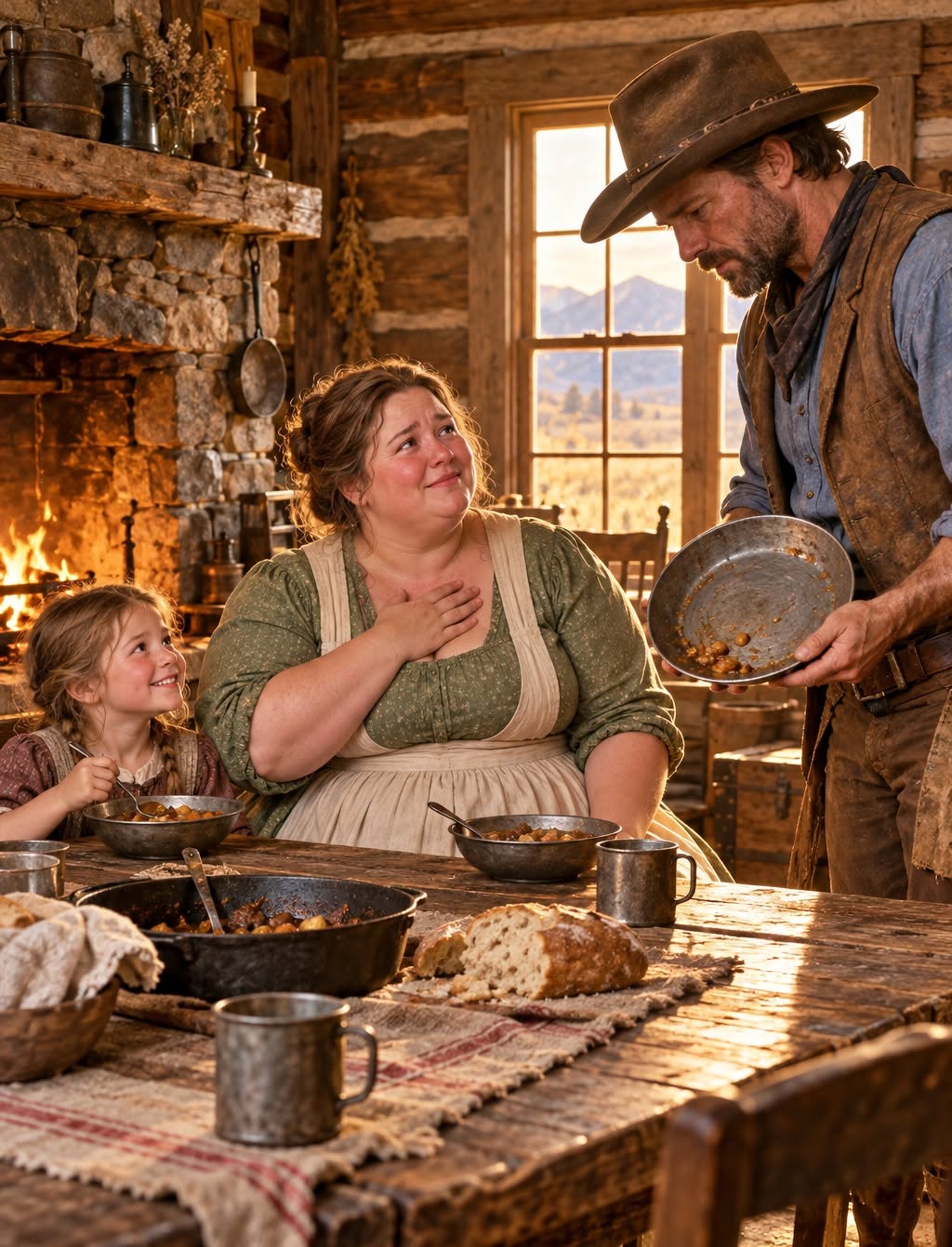
That evening, she sat at the kitchen table.
Not beside the stove.
Not behind the counter.
At the table.
Thomas placed a bowl of stew in front of her.
Lily watched anxiously.
“Mama, are you going to eat?”
Adah looked around the room.
Nine ranch hands sat waiting.
Caleb stood near the doorway.
Nobody was counting.
Nobody was writing charges in a ledger.
Nobody was asking whether she deserved the food.
She picked up her spoon.
Her first mouthful was small.
Then another.
Lily smiled.
And old Thomas Kenny, who had survived winters, cattle stampedes, and more loneliness than he cared to admit, quietly wiped his eyes with his sleeve.
Two days later, the storm finally weakened.
Caleb rode into Casper with the agreement hidden inside his coat.
He visited the office of attorney Samuel Pritchard, a thin, gray-haired man who had handled several ranch property disputes.
Pritchard read the document slowly.
Then he asked for a magnifying glᴀss.
“Where did this come from?”
Caleb explained.
The attorney examined the ink, the signature, and the witness lines.
Finally, he leaned back.
“Mr. Mercer, this agreement has serious problems.”
“How serious?”
“The alleged transfer of custody is not something a private creditor can simply enforce by writing it into a debt paper.”
Caleb exhaled.
Pritchard continued.
“And this signature may not be genuine. But we’ll need evidence, not guesses.”
He turned the document toward the window.
“Look here.”
Beneath Ephraim Hollands’s signature was a faint impression.
Another name.
Someone had written over it.
Caleb leaned closer.
The attorney traced the letters carefully.
They appeared to spell Elias Mercer.
Caleb felt his stomach drop.
Elias Mercer was his younger brother.
And Elias had disappeared from Wyoming five years earlier after becoming involved in a series of questionable cattle loans.
Caleb had not seen him since.
He stared at the name.
“Are you certain?”
“No,” Pritchard replied. “Not without examining the original more closely.”
Caleb slowly sat down.
Because if the signature was connected to Elias, then the debt threatening Adah and Lily might be tied to the very family whose ranch had finally offered them shelter.
Before he could ask another question, the office door opened.
A young clerk rushed inside.
“Mr. Pritchard, there’s a gentleman asking for Mr. Mercer.”
Caleb turned.
“Who?”
The clerk hesitated.
“He says his name is Silas Whitcomb.”
Caleb rose slowly.
Outside, a black carriage stood beside the hitching rail.
A broad-shouldered man in an expensive coat waited beneath the gray Wyoming sky.
Silas Whitcomb removed his gloves.
Then he smiled.
“Caleb Mercer,” he said. “I hear you’ve been keeping something that belongs to me.”
Caleb’s eyes hardened.
“People aren’t things, Whitcomb.”
The man’s smile widened.
“Then perhaps we should discuss the little girl.”
He reached into his coat and withdrew another document.
This one bore an official-looking seal.
“And perhaps,” Whitcomb added, “we should discuss what your brother did before he disappeared.”
Caleb stared at the paper.
For the first time, he understood that protecting Adah and Lily might require him to uncover a secret his own family had buried years earlier.
And Silas Whitcomb knew exactly where to dig.
To be continued in Part 4.